

P0700 on 2013-2020 Ford Fusion Hybrid: Transmission Control System Fault Causes and Fixes
P0700 is a general transmission fault alert. On the Fusion Hybrid, this can indicate a range of issues, but a known problem is internal transmission bearing failure, often preceded by a grinding or thumping noise. This failure is documented in TSB 22-2396 and owner forums report it commonly occurs around 105,000-107,000 miles. A proper diagnosis requires scanning the Transmission Control Module (TCM) for more specific codes.
- P0700 is a general alert; the real trouble codes are stored in the Transmission Control Module (TCM).
- A scan tool that can read TCM codes is mandatory for an accurate diagnosis.
- Pay close attention to any grinding or thumping noises, as this is a key symptom of a known, serious mechanical issue with the HF35 transmission in these cars (TSB 22-2396).
- Do not ignore this code. What starts as a noise or minor shifting issue can lead to a complete transmission failure requiring costly replacement.
- Due to the complexity of the hybrid eCVT, this code almost always requires professional diagnosis and repair.
What's Unique About the 2013-2020 Ford Fusion Hybrid
The 2013-2020 Ford Fusion Hybrid uses an HF35 electronically controlled continuously variable transmission (eCVT). While P0700 can be triggered by common issues like low fluid, this specific platform is subject to a Technical Service Bulletin (TSB 22-2396) for internal transmission problems. This TSB addresses a thumping, rubbing, or grinding noise caused by failing differential side bearings or transfer shaft issues, which can lead to a P0700 code being set. This makes mechanical noise a critical diagnostic clue on these vehicles, with owner experiences suggesting failures often occur just outside the 100k mile hybrid warranty period.
Symptoms You May Notice
- Check Engine Light is on
- Thumping, rubbing, or grinding noise from the transmission area, especially while the vehicle is moving, which persists even in neutral but disappears when the vehicle is stationary.
- Harsh or erratic shifting.
- Vehicle enters 'limp mode' or 'fail-safe' mode
- Delayed engagement when shifting into gear.
- Decreased fuel efficiency.
- Vehicle may stall or jerk.
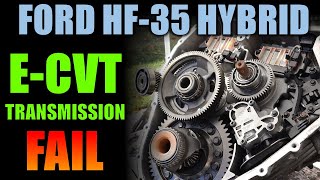
- A whining noise that sounds like a failing power steering pump, 🎬 Watch: Hear what a failing HF35 transmission sounds like which can be caused by fluid cavitation due to a leak or low level or a failing stator bearing.
- Replacing a wheel bearing. The grinding noise from a failing transmission bearing can be mistaken for a bad wheel bearing, leading to unnecessary repairs.
- Replacing the ECM/PCM. The P0700 code is stored in the ECM, but the ECM is almost never the cause; it is only reporting the fault from the TCM.
- Clearing the code without further diagnosis. Simply clearing the P0700 from the ECM will not fix the underlying issue in the transmission, and the light will almost certainly return.
Most Likely Causes
- Internal Transmission Bearing/Transfer Shaft Failure 🔴 High Probability → Shop Transmission Assembly A known issue documented in Ford TSB 22-2396 affects the HF35 transmission, where differential side bearings or the transfer shaft can fail. Owners and independent shops report this failure is common, often occurring between 100,000 and 115,000 miles.
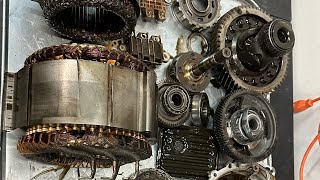
How to confirm: Listen for a thumping, rubbing, or grinding noise while the vehicle is in motion (the noise will not be present when stationary). A professional diagnosis involves internal transmission inspection as outlined in the TSB. This failure often results in significant metal shavings in the transmission fluid, visible during a fluid change. 🎬 See the internal damage caused by this common bearing failure
Typical fix: Depending on severity, the fix involves either installing a revised transfer shaft kit or replacing the entire remanufactured transmission assembly. This is a major repair quoted to owners for $6,800-$7,000 at dealerships.
Est. part cost: $500-$4000 - Low or Degraded Transmission Fluid 🟡 Medium Probability → Shop Transmission Assembly The HF35 transmission can seep fluid over time from axle seals or case halves. Low or burnt fluid is a primary contributor to the bearing failure noted above, as it leads to overheating and poor lubrication. The fluid check procedure is also complex, requiring the engine to be running to get an accurate level, which can lead to unintentional under-filling.
How to confirm: Check the transmission fluid level and condition. The fluid should be at the correct level and bright red. Dark, burnt-smelling fluid or fluid with metal particles indicates a serious problem. This transmission does not have a dipstick; the level must be checked via a fill plug on the side of the transmission case while the vehicle is level and running.
Typical fix: If the fluid is low, top it off with the correct type (Motorcraft MERCON LV) and inspect for leaks. If the fluid is old or dirty, perform a fluid drain and fill. Many owners recommend proactive fluid changes every 30k-60k miles to prevent failure. 🎬 Watch: How to perform a transmission fluid drain and fill
Est. part cost: $50-$150 - Faulty Transmission Control Module (TCM) ⚪ Low Probability → Shop Transmission Assembly
How to confirm: This is typically a diagnosis of exclusion. If a P0700 code appears with no other accompanying transmission codes, and all wiring and mechanical components test good, the TCM itself may have an internal fault. This is not a common failure point for this specific vehicle compared to the mechanical issues.
Typical fix: Replace the Transmission Control Module. This often requires programming the new module to the vehicle.
Est. part cost: $300-$800
Rare But Worth Checking
- Wiring Harness Issues: Corroded connectors or damaged wires between the TCM and transmission sensors or solenoids can cause erratic signals and trigger a fault. This is more common in areas with harsh weather or high road salt usage.
- Failed Transmission Range Sensor: → Shop Transmission Assembly A faulty range sensor can send incorrect gear position data to the TCM. This was the subject of a recall (13C09) on early 2013-2014 MKZ Hybrids, a platform mate, for causing a potential rollaway condition.
Diagnosis Steps
- Use an advanced OBD-II scanner capable of reading manufacturer-specific codes from the Transmission Control Module (TCM). Do not rely on a basic code reader that only checks the ECM.
- Record all codes stored in the TCM. These codes (e.g., P07A3, P07A4) are essential for diagnosing the root cause.
- Listen for any abnormal noises from the transmission. Specifically, a grinding, thumping, or whining noise that is present while the vehicle is moving (in any gear, including neutral) but stops when the vehicle is stationary.
- Check the transmission fluid level and condition. This requires raising the vehicle level, removing a fill plug, and adding fluid while the engine is running. Look for signs of low fluid or fluid that is dark, burnt, or contains metallic debris.
- Inspect the transmission wiring harness and connectors for any visible damage, corrosion, or loose connections.
- Based on the specific TCM codes, test the corresponding sensors, solenoids, or circuits.
- If a mechanical failure is suspected per TSB 22-2396, a professional tear-down and inspection is required.
Parts You'll Likely Need
- Remanufactured HF35 Transmission Assembly
(OEM #HG9Z-7000-BRM (2015-2016), DG9Z-7000-E / EG9Z-7000-ARM (2013-2015))— In cases of severe internal mechanical failure, such as the bearing failure described in TSB 22-2396, a complete replacement is often the recommended and most cost-effective long-term repair.
Trusted brands: Motorcraft
OEM price range: $3500-$5000
Aftermarket price range: $2500-$4000 - Motorcraft MERCON LV Automatic Transmission Fluid
(OEM #XT-10-QLVC)— This is the required fluid for servicing the HF35 transmission. Low or degraded fluid is a primary cause of transmission problems and bearing failure. A drain and fill requires approximately 4.5-5 quarts.
Trusted brands: Motorcraft
OEM price range: $8-$12 per quart
Aftermarket price range: $7-$10 per quart
Related Codes That Often Appear With This One
- P07xx — P0700 is a general alert. It will almost always be accompanied by more specific codes in the P07xx range (e.g., P07A3 for Transmission Friction Element 'A' Stuck On) that are stored in the TCM and identify the actual fault.
- P0C2F — This code can indicate an internal transmission failure where motor speeds do not match expected values, which could be related to the mechanical bearing failures seen in these transmissions.
Technical Service Bulletins (TSBs) & Recalls
- TSB 22-2396: Published Oct 25, 2022, this is the most current TSB for this issue, superseding TSB 20-2219 and 19-2391. It addresses a thumping/rubbing or grinding noise from the HF35 transmission due to differential side bearing or transfer shaft issues. It covers 2013-2020 Fusion/MKZ and 2013-2018 C-Max models.
Platform-Specific Known Issues
- A significant number of 2013-2020 Fusion Hybrids are affected by a potential for premature differential bearing failure within the HF35 transmission, as documented in Ford TSB 22-2396.
- Owner forums and repair shop data indicate this failure is not rare, with many instances occurring between 105,000 and 115,000 miles, often just outside the 8-year/100,000-mile hybrid component warranty.
- The failure presents as a distinct grinding or thumping noise that is dependent on vehicle speed, not engine RPM, and is a key indicator that differentiates it from other issues.
Hidden / Shadow Codes Worth Checking
- N/A - No specific shadow codes found: While Ford's IDS (Integrated Diagnostic System) provides more detailed data than standard scanners, searches did not reveal specific, non-standard 'shadow' or 'hidden' codes for this P0700 fault. Diagnosis relies on the standard P07xx codes stored in the TCM. (see via Ford IDS or equivalent high-level scan tool like FORScan.)
Scan Tool Commands That Help
- Ford IDS / FORScan: TCM Adaptive Tables Reset / Clear Transmission Adaptive Tables — This function should be used after any transmission repair, including fluid changes or component replacement, to clear the learned shift adaptations. It can also be used as a diagnostic step if experiencing erratic shifting without other codes present, though it will not fix an underlying mechanical or electrical fault.
- Ford IDS: Transmission Characterization/Solenoid IDN — When installing a remanufactured HF35 transmission, the scan tool will prompt for an 11-digit transmission identification code from the new unit's tag. This procedure is necessary to program the TCM with the correct parameters for the replacement transmission.
Wiring & Ground Locations
- G100, G101, G102, G111, G112 — Located on the left front of the engine compartment.. These are primary ground points for the engine compartment. A corroded or loose ground at these locations can cause a variety of issues, including erratic sensor readings and communication problems with the TCM, potentially triggering a P0700.
- TCM (Transmission Control Module) — Located on top of the transmission assembly itself.. Knowing the physical location is critical for inspecting the module and its connectors for damage, corrosion, or loose connections, which are potential causes of a P0700 code.
- C175T — This is a main connector at the Powertrain Control Module (PCM).. This connector carries signals for multiple transmission-related components, including the Transmission Range Sensor (pins 17, 26, 27, 30), Turbine/Transmission Shaft Speed Sensor (pin 16), and Transmission Fluid Temperature Sensor (pin 19). Testing for voltage and continuity at these pins is a key step in diagnosing sensor-related transmission codes that accompany a P0700.
Real Owner Repair Stories
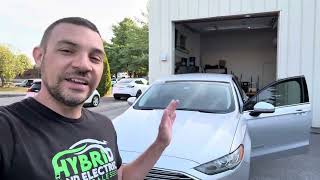
- YouTube channel 'Hybrid and Electric Car Sales' (Ford Fusion Hybrid, year not specified, came into the shop with no transmission fluid and was not drivable.) — Car would not drive, no fluid in transmission. Upon disassembly, the transfer gear had completely failed and broken through the transmission case.
❌ Tried (didn't work) The vehicle was brought in non-operational, so no prior failed attempts were documented. The initial state was already a catastrophic failure.
✅ What actually fixed it A complete transmission rebuild was performed. This involved disassembling the entire unit, cleaning all components, and replacing the failed transfer gear, all bearings, and the broken section of the case with a new case cover. The transmission was reassembled with a new OEM rebuild kit and fresh fluid, which restored the vehicle to running and driving condition. - Reddit user BobertFrost6 on r/fordfusion (2017 Ford Fusion Hybrid with 107,000 miles.) — A loud running noise, which was diagnosed as a transmission bearing failure.
❌ Tried (didn't work) The owner called the Ford customer service number to ask for financial assistance since the failure occurred just 7,000 miles after the 100,000-mile hybrid component warranty expired. Ford declined to provide any assistance.
✅ What actually fixed it The final resolution was not posted by the original author, but the confirmed diagnosis was a failed transmission requiring a full replacement at a quoted cost of $6,800 from a Ford dealership. An independent transmission shop reportedly confirmed to the owner that this failure is common around 105,000 miles.
OEM Part Supersession History
DG9Z-7000-E→EG9Z-7000-ARM— Part number update for remanufactured assembly. This part fits 2013-2015 Fusion and MKZ Hybrid models.TSB 19-2391 / 20-2219→TSB 22-2396— The Technical Service Bulletin for the transmission grinding noise has been updated multiple times. TSB 22-2396 is the latest version, expanding the model years covered to 2020 and updating the service procedure and part lists.
Heads up: Always use the latest TSB for the most current repair procedures and part numbers, as older versions may be incomplete or have outdated information.
Model Year Variations Within This Range
- 2013-2016: Early TSBs for the bearing failure (like 19-2391 and 20-2219) specifically covered models built on or before August 15, 2015. While the latest TSB (22-2396) extends coverage to 2020, some forum discussions suggest that the bearing issue was potentially addressed or improved in transmissions manufactured for the 2017 model year and newer, though failures are still reported on these later years.
- 2019-2020: A specialty hybrid repair shop notes that they use remanufactured transmissions from 2019-2020 models as upgraded replacements for earlier years. While Ford may state they are not directly compatible, this shop has a process to make them work in any model year from 2013-2020, suggesting the later units are a better design.
Diagnostic Flowchart
Other Known Issues on This Vehicle
Issues unrelated to this code that are worth knowing about as an owner of this generation:
- Shift Cable Bushing Failure 🔴 High — Very common. Affects millions of Ford vehicles, including 2013-2016 Fusions. The bushing can degrade at any mileage due to heat and contaminants. (Ref: Recall 22S43 / NHTSA 22V413.)
- Steering Gear Motor Bolt Corrosion 🔴 High — Common in salt-belt regions. Affects 2013-2016 models. Corrosion causes bolts to fracture, leading to a loss of power steering assist. (Ref: Recall 19S26.)
- Electronic Throttle Body (ETB) Failure 🟠 Medium — A widespread issue across many Ford models of this era. Can cause the vehicle to suddenly enter 'limp mode' with reduced power, which is a significant safety risk. (Ref: Ford Customer Satisfaction Program 13N03 (extended warranty coverage).)
- Battery Energy Control Module (BECM) Failure 🔴 High → Shop Vehicle Battery — Affects 2019-2020 Fusion PHEV (Energi) models. Can cause a loss of drive power or fire. (Ref: Recall 23V440000.)
Used vs. New Parts: Buying Guide for This Vehicle
When a used part is the smart pick: Given the extremely high rate of a known, inherent bearing defect in the HF35 transmission, purchasing a used unit from a junkyard is a very high-risk option. It only makes sense if the donor vehicle has very low mileage (well under 50,000 miles) and if the cost of the used unit plus labor is significantly less than a third of the cost of a remanufactured unit, to account for the high probability of premature failure.
Donor-vehicle mileage cap: roughly under 50000 miles for the part to have meaningful remaining life.
What to inspect on the donor part:
- Verify the donor vehicle's mileage. Do not trust a seller's claim without proof.
- If possible, get the service history of the donor vehicle to see if transmission fluid changes were performed.
- Inspect the fluid from the donor transmission. If it is dark, burnt, or contains any metallic particles, reject the part immediately.
- Check for leaks around the axle seals and case halves.
OEM-only on this vehicle (don't cheap out):
- Complete Transmission Assembly: Due to the bearing defect, a Ford-certified remanufactured unit is the most reliable option.
- Transmission Fluid: Use only Motorcraft MERCON LV. Using other fluids can cause performance issues and damage.
Aftermarket brands forum-validated for this vehicle:
- Specialty Rebuild Kits: Some independent hybrid shops, like 'Hybrid and Electric Car Sales' in Tennessee, have developed their own comprehensive rebuild kits with upgraded components that are well-regarded in online communities.
Brands owners have reported issues with on this vehicle:
- Generic, unverified used transmissions from online marketplaces or general junkyards without a robust warranty and verified low mileage are extremely risky.
Real Owner Stories
Aggregated from forums and TSBs cited above. Mileages and costs reflect what owners reported in those sources.
2017 Ford Fusion Hybrid 2.0L I4 — ~105000 miles
Symptoms: Transmission seems to have gone out; occurred 5,000 miles over the warranty limit.
What fixed it: Replacement of the transmission assembly.
Cost: $6,800-$7,000
Source hint: Reddit - r/fordfusion: '2017 Hybrid transmission seems to have gone out. 5k miles over the warranty.'
2013-2020 Ford Fusion Hybrid 2.0L I4 — ~110000 miles
Symptoms: Thumping, rubbing, or grinding noise from the transmission area while moving; noise persists in neutral but disappears when stationary.
What fixed it: Installing a revised transfer shaft kit or replacing the entire remanufactured transmission assembly per TSB 22-2396.
Source hint: TSB 22-2396
Related OBD-II Codes
Frequently Asked Questions
My 2017 Fusion Hybrid is making a grinding noise that stops when I'm parked. Does TSB 22-2396 apply to me?
Is there a recall for the transmission bearing failure in the HF35 eCVT?
How can I check the transmission fluid level on my 2015 Fusion Hybrid to prevent P0700?
I'm at 105,000 miles and hearing a whine like a power steering pump. Is this related to P0700?
Will the hybrid component warranty cover my transmission repair at 110,000 miles?
Can a faulty Electronic Throttle Body cause transmission-related symptoms?
Helpful Videos
We Have This Part in Stock


The information in this article is provided for general reference and educational purposes only. Vehicle specifications, procedures, and part compatibility can vary by production date, trim level, and region. Always consult your vehicle's factory service manual and verify part numbers before purchasing or performing repairs. Safety-critical components such as airbags, seat belts, and braking systems should be installed by a qualified professional.
- Ford Fusion Hybrid:
- 🧭 Diagnostic Flowchart
- 🎬 Helpful Videos
- 🛍️ Shop This Part
- What's Unique About the 2013-2020 Ford Fusion Hybrid
- Symptoms You May Notice
- Most Likely Causes
- Rare But Worth Checking
- Diagnosis Steps
- Parts You'll Likely Need
- Related Codes That Often Appear With This One
- Technical Service Bulletins (TSBs) & Recalls
- Platform-Specific Known Issues
- Hidden / Shadow Codes Worth Checking
- Scan Tool Commands That Help
- Wiring & Ground Locations
- Real Owner Repair Stories
- OEM Part Supersession History
- Model Year Variations Within This Range
- Other Known Issues on This Vehicle
- Used vs. New Parts: Buying Guide for This Vehicle
- Real Owner Stories
- 2017 Ford Fusion Hybrid 2.0L I4 — ~105000 miles
- 2013-2020 Ford Fusion Hybrid 2.0L I4 — ~110000 miles
- Related OBD-II Codes
- Frequently Asked Questions
- 🎟️ Get 5% Off