

P0701 on 2001-2005 GMC Sierra: Transmission Control System Fault Guide
P0701 on a 2001-2005 GMC Sierra means the transmission control module (TCM) has detected a fault and asked the main computer to turn on the check engine light. You must scan for other, more specific transmission codes to find the real problem, which could range from low fluid to internal transmission failure. This code is a general request for the MIL, not the root cause.
- P0701 is a general warning, not a specific diagnosis. The real problem is indicated by other codes stored in the Transmission Control Module (TCM).
- You MUST use a scanner that can read TCM codes to properly diagnose the issue.
- Always check the transmission fluid level and condition first; it's a simple and common cause of transmission problems.
- On this generation of Sierra, P0701 is often a precursor to issues with shift solenoids or other internal transmission components.
- Do not replace parts randomly. The diagnostic path is determined by the secondary codes found in the TCM.
What's Unique About the 2001-2005 Gmc SIERRA
The 2001-2005 GMC Sierra (GMT800 platform) typically uses the 4L60E or 4L80E automatic transmission. While robust, these transmissions are known to develop issues with solenoids, clutch packs (specifically the 3-4 clutch pack), and valve bodies over time, especially with high mileage or heavy use. The P0701 code often serves as the first warning of these underlying component failures, which are documented in manufacturer service bulletins for this generation of truck. A less common but notable issue on this platform is a faulty ignition switch, which can cause intermittent power loss to the TCM and trigger a P0701 along with other seemingly unrelated electrical codes.
Diagnostic Flowchart
Tap your situation to follow the diagnostic path that matches what you're seeing on this vehicle.
Symptoms You May Notice
- Check Engine Light is on
- Harsh, jerky, or delayed shifting.
- Transmission slipping between gears.
- Vehicle enters "limp mode" (stuck in one gear, often 2nd or 3rd).
- Failure to engage Drive or Reverse, sometimes with a "Range Shift Inhibited" message.
- Whining or clunking noises from the transmission.
- Decreased fuel efficiency.
- PRNDL (shift indicator) on the dash may flash or disappear.
- Replacing only the Transmission Range Sensor (Neutral Safety Switch) without checking for other codes. While it can be a cause, it's often not the primary fault.
- Clearing the code without diagnosis. The P0701 code will almost certainly return until the underlying transmission fault is addressed.
- Performing a transmission fluid 'flush' on a high-mileage, poorly maintained unit. This can dislodge debris and worsen the problem. A pan drop, filter change, and fluid top-off is often safer.
Most Likely Causes
- Other Transmission Codes Stored 🔴 High Probability → Shop Transmission Assembly P0701 is an informational code by design, triggered by more specific faults detected by the TCM.
How to confirm: Use an OBD-II scanner capable of reading manufacturer-specific transmission codes (TCM codes). A basic engine code reader is insufficient.
Typical fix: Diagnose and repair the cause of the other stored codes (e.g., P0751 for a shift solenoid, P0731 for an incorrect gear ratio).
Est. part cost: $50-$1000+ - Low or Burnt Transmission Fluid 🟡 Medium Probability → Shop Transmission Assembly Leaks from seals, gaskets, or the transmission pan are common on older trucks. Fluid breaks down over time, especially under heavy use, leading to poor hydraulic pressure and overheating.
How to confirm: Check the transmission fluid dipstick for level and condition with the engine running and transmission warm. The fluid should be reddish and not smell burnt.
Typical fix: Top off the fluid if low and repair any leaks. If the fluid is dark, burnt, or contains debris, a fluid and filter change is necessary. Use the correct fluid type (DEXRON-VI for most GM applications).
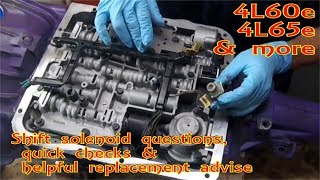
Est. part cost: $20-$150 - Faulty Shift Solenoid or Pressure Control Solenoid 🟡 Medium Probability → Shop Transmission Valve Body Solenoids inside the 4L60E/4L80E are a very common failure point. It is highly recommended to replace both the 'A' (1-2) and 'B' (2-3) solenoids at the same time.
How to confirm: Confirm with a specific solenoid-related DTC (e.g., P0751, P0756). A mechanic can test the solenoid's resistance (should be 20-40 ohms) and function.
Typical fix: Replace the faulty solenoid(s). This requires removing the transmission oil pan. 🎬 See this walkthrough on replacing 4L60-E shift solenoids. Often sold as a master kit.
Est. part cost: $40-$200 - Wiring Harness or Connector Issues ⚪ Low Probability The main transmission harness connector can become contaminated with fluid, and wires can become brittle, chafed, or damaged from heat and age, especially near the exhaust or bellhousing.
How to confirm: Visually inspect the wiring harness leading to the transmission for damage, corrosion, or loose pins. Check for continuity on specific pins with a multimeter.
Typical fix: Repair the damaged section of the harness or clean/replace the connector. Repair harnesses are available.
Est. part cost: $10-$300
Rare But Worth Checking
- Faulty Transmission Control Module (TCM): → Shop Transmission Assembly While less common, the TCM itself can fail, causing erratic behavior and setting a P0701 code, sometimes with no other codes present. This should be considered after all other possibilities are ruled out. A replacement often requires programming.
- Internal Mechanical Failure: As indicated by TSB PIP4379K, issues like a worn valve body, failing clutch packs (especially the 3-4 clutch), a broken sun shell, or a bad torque converter can trigger this code along with others. This is a worst-case scenario requiring a transmission rebuild or replacement.
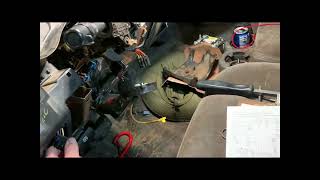
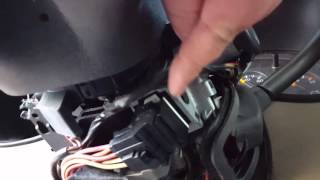
- Faulty Ignition Switch: → Shop Ignition Switch A failing ignition switch is a known issue on GMT800 trucks that can cause intermittent power loss to the TCM and instrument cluster. This can trigger P0701 and a host of other electrical codes, often accompanied by a non-start condition or gauges acting erratically. Tapping the fuse box or wiggling the key may temporarily resolve the issue.
Diagnosis Steps
- Use an advanced OBD-II scanner to read codes from the Transmission Control Module (TCM). Do not rely on a basic code reader that only checks the engine computer.
- Document all stored transmission codes. These are the key to your diagnosis.
- Check the transmission fluid level and condition. The engine should be running and the transmission warm, in Park.
- Inspect the main transmission wiring harness and connector for any visible damage, corrosion, or fluid contamination. Pay close attention to where the harness may rub against the frame or engine components.
- Check fuses related to the TCM/Transmission. On these trucks, this can include the "IGN 0" fuse in the interior fuse panel, which can cause limp mode if blown.
- If an ignition switch issue is suspected, check for voltage drops at the TCM power supply fuses while wiggling the key in the ignition. 🎬 Watch: How to replace a faulty GMT800 ignition switch. A drop from battery voltage to a much lower voltage (e.g., 3-4 volts) when starting the engine points to a faulty switch.
- Follow the specific diagnostic procedures for any other codes found. For example, if a P0751 (Shift Solenoid 'A' Performance) is present, test the solenoid circuit resistance (20-40 ohms) at the transmission connector.
- If no other codes are found, investigate potential issues with the TCM power and ground circuits directly at the module.
- If all wiring and sensors check out, the problem may be an internal mechanical failure or a faulty TCM.
Parts You'll Likely Need
- Transmission Shift Solenoid Kit
(OEM #24236934)— Shift solenoids are a frequent failure point in 4L60E/4L80E transmissions and will trigger specific codes that lead to a P0701. This ACDelco kit often includes multiple solenoids and a filter plate.
Trusted brands: ACDelco, Bosch, Rostra
OEM price range: $150-$250
Aftermarket price range: $70-$150 - Transmission Fluid and Filter Kit — Low or degraded fluid is a common cause of transmission problems and should be the first service performed.
Trusted brands: ACDelco
OEM price range: $80-$120
Aftermarket price range: $40-$70 - Ignition Switch
(OEM #D1462G)— A known weak point on this platform that can cause intermittent power to the TCM, triggering P0701 and other codes. A cheap part that can solve complex-seeming electrical issues. It is recommended to use a genuine GM or ACDelco part.
Trusted brands: ACDelco, Delphi
OEM price range: $40-$80
Aftermarket price range: $20-$50 - Transmission Control Module (TCM)
(OEM #24256861)— In rare cases where no other cause is found, the TCM itself may be faulty. It often requires programming to the vehicle's VIN.
Trusted brands: ACDelco
OEM price range: $300-$500
Aftermarket price range: $200-$400
Related Codes That Often Appear With This One
- P0700 — P0700 is a nearly identical code, also indicating a generic transmission system malfunction request to the PCM.
- P0731-P0736 — These codes indicate incorrect gear ratios, often due to internal slipping or solenoid issues, as noted in TSB PIP4379K.
- P0751, P0756, etc. — These codes point to specific electrical faults with shift solenoids, a common cause on these transmissions.
- P0740, P0785, P2761 — This combination of codes (TCC, 3-2 Solenoid, PC Solenoid) can point towards an electrical issue like a faulty ignition switch or fuse box problem that affects power to the entire transmission control system.
Technical Service Bulletins (TSBs) & Recalls
- PIP4379K: Addresses conditions like no engagement into drive, delayed engagement, no reverse, and range inhibit, which may be accompanied by code P0701 among many others.
- 01-07-30-042H: Informs technicians that a clunk noise on the 2-3 upshift or 3-2 downshift on 4L60-E transmissions is a normal characteristic and no repairs should be attempted for the noise alone.
Platform-Specific Known Issues
- The NHTSA Technical Service Bulletin #PIP4379K specifically mentions P0701 in conjunction with a host of other transmission codes related to delayed or no engagement in drive or reverse, pointing towards potential internal hydraulic or mechanical issues.
- A faulty ignition switch is a well-documented cause of P0701 and other transmission codes on GMT800 trucks, due to intermittent power loss to the TCM.
- On 4L60E transmissions, a 2-3 upshift or 3-2 downshift clunk is considered a normal characteristic and should not be mistaken for a fault unless accompanied by codes or slipping.
Mechanic-Grade Diagnostic Values
- 1-2 & 2-3 Shift Solenoid Resistance (4L60E/4L80E) — expected: 20-40 Ohms at 68°F.. Failure: A reading outside this range, or an open/short circuit, indicates a failed solenoid.
- Pressure Control (PC) Solenoid Resistance (4L60E/4L80E) — expected: 3.5-8.0 Ohms at 68°F.. Failure: Resistance outside this range suggests the PC solenoid is faulty.
- Torque Converter Clutch (TCC) PWM Solenoid Resistance (4L60E/4L80E) — expected: 10-15 Ohms at 68°F.. Failure: An open circuit or a reading outside the specification points to a bad TCC PWM solenoid.
- Voltage at 'IGN 0' fuse (in-dash fuse panel) — expected: Battery voltage with key in 'Run' position.. Failure: A significant voltage drop (e.g., to 3-4 volts) when the key is turned to 'Start' and back to 'Run' points to a failing ignition switch.
- Voltage at Transmission Connector Pin E (Pink Wire) — expected: Battery voltage with key on, engine off.. Failure: Low or no voltage indicates an open or short in the power feed circuit from the fuse box, possibly due to a bad ignition switch or corroded fuse block.
Scan Tool Commands That Help
- Tech 2 / GDS2: Transmission Output Controls — After retrieving DTCs, a technician can use this function to individually command each shift solenoid, TCC solenoid, and pressure control solenoid on and off. This helps verify if the solenoid is mechanically functioning (an audible click should be heard) and if the wiring to it is intact, without having to remove the transmission pan.
- Tech 2 / GDS2: Reset Transmission Adapts — After replacing transmission components like solenoids or the valve body, the learned shift pressure and timing values must be reset. This forces the TCM to relearn the characteristics of the new parts, ensuring smooth shifting. Failing to do this can result in continued harsh or erratic shifting even after the repair.
Wiring & Ground Locations
- G103 & G104 — On the engine block, typically on the front driver's side or on the cylinder heads. G104 is often on the rear of the passenger side cylinder head.. These are primary engine and PCM/TCM ground points. Corrosion or a loose connection at these locations can cause erratic sensor readings, incorrect solenoid operation, and communication errors between modules, leading to a P0701 and other electrical codes.
- Transmission Case Connector (20-pin round) — On the passenger side of the transmission case.. This is the main electrical interface for the transmission. Pin E (Pink wire) is the 12V+ ignition feed for the solenoids. Testing for battery voltage at this pin is a critical step to rule out power supply issues from the ignition switch or fuse block. Other pins can be used to test individual solenoid resistance without dropping the pan.
- Underhood Fuse Block — On the driver's side of the engine bay.. This block supplies power to the transmission via several fuses (e.g., 'TRANS', 'IGN 0'). Corrosion can build up on the internal busses or on the underside where the harnesses connect, causing intermittent voltage loss to the TCM and triggering a host of transmission codes, including P0701.
Real Owner Repair Stories
- Reddit user in r/ChevyTrucks (2004 Sierra with 4L60E) — Check engine light with codes for all transmission solenoids setting immediately at startup. Transmission in limp mode.
❌ Tried (didn't work) Checked resistance of all solenoids; all were within spec., Replaced the 3-2 solenoid based on slightly confusing specs, but the new part measured the same., Checked for continuity on the ignition feed wire from the fuse box to the PCM and transmission; all checked out with 0.5 ohms., Checked for voltage at the transmission connector (Pin E) with key-on, which showed correct battery voltage.
✅ What actually fixed it The ignition switch was faulty. It provided correct voltage in the 'Run' position but would drop to ~3.4 volts after cranking the engine and returning to 'Run'. Replacing the $30 ignition switch resolved all codes and restored normal transmission function. - GMTNation forum user (2005 Silverado 1500 5.3L with 4L60E) — Cluster of transmission codes including P0740, P0753, P0758, P0785, and P2761.
❌ Tried (didn't work) Initial diagnosis pointed towards major internal transmission failure or a bad TCM.
✅ What actually fixed it Replacing the ignition switch fixed the problem completely. The user reported a $33 part from Napa resolved all the codes. - GMTNation forum user (2005 GMC Sierra) — Multiple transmission codes (P0740, P0785, P2761), ABS light, 4x4 light, and intermittent no-start condition.
❌ Tried (didn't work) Checking all known ground points.
✅ What actually fixed it The issue was traced to the underhood fuse box. Tapping on the fuse box would allow the truck to start. This points to internal corrosion or a bad connection within the fuse block itself, a known issue on GMT800 trucks.
When the Usual Fixes Don't Work
- A common diagnostic path for a P0701 accompanied by multiple solenoid electrical fault codes (e.g., P0753, P0758, P1860) would be to suspect a major internal transmission wiring or component failure. However, numerous documented cases on 2001-2005 Sierras show that this exact combination of codes is frequently caused by a faulty ignition switch. The switch fails to provide stable voltage to the transmission's power supply circuit (often via the 'IGN 0' fuse), causing the solenoids to lose power simultaneously and trigger a cascade of electrical fault codes. A technician who focuses only on the transmission may perform costly and unnecessary internal repairs, while the root cause is a relatively inexpensive and simple-to-replace ignition switch.
OEM Part Supersession History
Varies→ACDelco D1462G— Standard replacement part for the electrical portion of the ignition switch.
Heads up: While many aftermarket versions exist, owner and forum reports strongly recommend using a genuine ACDelco or Delphi switch to avoid premature failure and repeat issues.
Model Year Variations Within This Range
- 2005 only: Some 4L60E transmissions produced from February 2005 onward were equipped with an Input Speed Sensor (ISS). Swapping a non-ISS transmission from an earlier model (2001-2004) into a 2005 truck that expects an ISS will cause shifting problems and set codes, as the TCM will not receive the expected signal.
- 2003-2005: The 2003 model year marked a significant refresh for the GMT800 platform, including changes to the electrical architecture and the introduction of drive-by-wire for V8 engines. While the core causes of P0701 are similar, diagnostic procedures for wiring may differ slightly from 2001-2002 models due to PCM and wiring harness changes.
Helpful Videos
We Have This Part in Stock


The information in this article is provided for general reference and educational purposes only. Vehicle specifications, procedures, and part compatibility can vary by production date, trim level, and region. Always consult your vehicle's factory service manual and verify part numbers before purchasing or performing repairs. Safety-critical components such as airbags, seat belts, and braking systems should be installed by a qualified professional.
- Gmc SIERRA:
- 🧭 Diagnostic Flowchart
- 🎬 Helpful Videos
- 🛍️ Shop This Part
- What's Unique About the 2001-2005 Gmc SIERRA
- Symptoms You May Notice
- Most Likely Causes
- Rare But Worth Checking
- Diagnosis Steps
- Parts You'll Likely Need
- Related Codes That Often Appear With This One
- Technical Service Bulletins (TSBs) & Recalls
- Platform-Specific Known Issues
- Mechanic-Grade Diagnostic Values
- Scan Tool Commands That Help
- Wiring & Ground Locations
- Real Owner Repair Stories
- When the Usual Fixes Don't Work
- OEM Part Supersession History
- Model Year Variations Within This Range
- 🎟️ Get 5% Off