

P0705 on 2014-2020 Chevrolet Impala: Transmission Range Sensor Failure Causes and Fixes
On a 2014-2020 Impala, code P0705 almost always means the internal Transmission Range Sensor has failed. The part itself is affordable (~$60-$150), but it's located inside the transmission, making replacement a complex, labor-intensive job for a professional. Expect a total repair cost of $400-$800, with most of that being labor.
- P0705 on a 2014-2020 Impala points to a problem with the Transmission Range Sensor, which is located inside the transmission.
- Symptoms are serious and can prevent the car from starting or cause dangerous driving conditions. Do not drive the vehicle.
- This is not a DIY-friendly repair. The high cost is due to the 3-5 hours of professional labor required to access the sensor, not the price of the part itself.
- The most likely cause is the failure of the sensor itself, often due to internal plastic components breaking down.
- Before approving an expensive repair, ensure the shop has confirmed the sensor is faulty using a scan tool, and has ruled out simpler wiring issues.
What's Unique About the 2014-2020 Chevrolet Impala
For the 2014-2020 Chevrolet Impala, which uses a GM 6T70 or similar 6-speed automatic transmission, the Transmission Range Sensor is not a simple external part. It is an 'Internal Mode Switch' (IMS) located inside the transmission and attached to the valve body. This transmission was co-developed with Ford (who calls it the 6F50) and is used across a wide range of GM vehicles. The internal location makes replacement significantly more difficult and expensive. A well-documented failure mode involves the plastic dowel pins that hold the switch assembly together breaking down from wear, which disrupts its ability to send a correct signal.
Symptoms You May Notice
- Check Engine Light is illuminated.
- Vehicle will not crank or start, or only starts in Neutral but not Park.
- Gear indicator on the dashboard (PRNDL) is blank, incorrect, or erratic.
- Transmission is stuck in a single gear ('limp mode').
- Harsh, delayed, or erratic shifting between gears.
- Reverse lights do not work when in Reverse.
- Inability to shift out of Park.
- Replacing the Transmission Control Module (TCM) before verifying the sensor and wiring are good.
- Condemning the entire transmission when only the relatively inexpensive internal mode switch has failed.
Most Likely Causes
- Failed Internal Transmission Range Sensor (Internal Mode Switch) 🔴 High Probability → Shop Transmission Assembly The sensor is an internal component subject to heat and constant mechanical movement. A specific, common failure point is the plastic dowel pins within the switch assembly breaking or wearing out, causing the internal contacts to misalign and send incorrect signals.
How to confirm: A technician will use a scan tool to monitor the gear position data from the sensor in real-time. If the data is erratic, does not match the physical gear selection, or shows multiple gears selected at once, the sensor is faulty.
Typical fix: The transmission pan and valve body must be removed to access and replace the internal mode switch. This is a labor-intensive process. 🎬 Watch: Step-by-step 6T70 internal mode switch repair guide
Est. part cost: $60-$150 - Wiring or Connector Damage 🟡 Medium Probability The main wiring harness leading to the transmission case connector can be damaged by road debris, heat from the exhaust, or corrosion at the connector pins. In related Chevrolet models, manufacturer service bulletin #PIP5101 notes that technicians should specifically inspect the Park Neutral Position connector and switch for spread terminals, bent pins, or missing/damaged weather seals.
How to confirm: Visually inspect the wiring harness going to the transmission case connector. Check for frayed wires, corrosion in the pins, or loose connections. A multimeter can be used to test for continuity and proper voltage at the connector pins according to the vehicle's wiring diagram.
Typical fix: Repair the damaged section of the wiring harness or clean/replace the corroded connector.
Est. part cost: $10-$100 - Low or Contaminated Transmission Fluid ⚪ Low Probability → Shop Transmission Assembly
How to confirm: Check the transmission fluid level and condition. If the fluid is very low, dark, or has a burnt smell, it can indicate internal transmission problems that may affect sensor operation or point to larger issues.
Typical fix: Perform a transmission fluid drain and fill. If the fluid is severely contaminated, a more thorough flush or further diagnosis of the transmission's health is needed.
Est. part cost: $100-$250
Rare But Worth Checking
- Faulty Transmission Control Module (TCM): → Shop Transmission Assembly This is an uncommon cause. The TCM should only be suspected after the sensor and its entire circuit have been thoroughly tested and confirmed to be working correctly. A faulty TCM will often be accompanied by other transmission-related trouble codes, such as P0700.
Diagnosis Steps
- Read the fault codes with an OBD-II scanner. Confirm P0705 is present and note 🎬 See: How to diagnose a P0705 transmission range sensor code any other codes, especially P0700.
- Check the transmission fluid level and condition. Ensure it is at the correct level and not burnt or contaminated.
- Using a professional scan tool, access the live data stream for the Transmission Range Sensor (TRS/IMS).
- Slowly move the gear shifter through all positions (P, R, N, D, L). Verify that the position displayed on the scan tool perfectly matches the shifter position. If the reading is erratic, jumps, is incorrect, or shows impossible states (e.g., in Park and Drive simultaneously), the sensor is the likely culprit.
- If the scan tool shows no data, perform a visual inspection of the main transmission wiring harness and the large round connector for any visible damage, corrosion, or loose pins.
- If the wiring appears intact, use a multimeter and a service manual wiring diagram to test for voltage, ground, and signal integrity at the transmission connector. This rules out a circuit issue between the TCM and the sensor.
- If the external circuit tests good and the sensor data is confirmed to be faulty, the internal mode switch needs to be replaced.
Parts You'll Likely Need
- Transmission Range Sensor / Internal Mode Switch
(OEM #24042166)— This is the component that fails internally, sending incorrect gear position data to the car's computer. On this vehicle, it is located inside the transmission. Note: This part may also be cross-referenced or superseded by part number 24259852, though 24259852 is more commonly listed as a speed sensor, so verification with VIN is critical.
Trusted brands: ACDelco, GM Genuine, Dorman, WVE
OEM price range: $100-$150
Aftermarket price range: $55-$90
Related Codes That Often Appear With This One
- P0700 (Transmission Control System Malfunction)
Technical Service Bulletins (TSBs) & Recalls
- GM TSB 14047: Addresses a common, unrelated issue of water leaking into the trunk due to faulty taillight gaskets, which is a frequent owner complaint for this platform.
- Bulletin #PIP5101: A manufacturer service bulletin for related Chevrolet models notes that P0705 may be accompanied by a blank PRNDL display, a lack of power, and an inability to shift, requiring inspection of the Park Neutral Position connector for damaged pins or weather seals.
Platform-Specific Known Issues
- The Transmission Range Sensor is located inside the 6T70/6T75 transmission and is serviced as an 'Internal Mode Switch'. Its replacement requires significant labor, including the removal of the transmission valve body.
- A known internal failure point is the breakage of plastic dowel pins that hold the switch assembly together, leading to misalignment of the electrical contacts.
Mechanic-Grade Diagnostic Values
- IMS Signal Circuit Resistance to Ground — expected: Infinite resistance (OL). Failure: Any reading less than infinite resistance indicates a short to ground in the signal circuit.
- IMS Signal Circuit End-to-End Resistance — expected: Less than 2 ohms. Failure: A reading of 2 ohms or greater indicates high resistance or an open in the circuit.
- General Digital TRS Output Voltage — expected: Varies by gear, e.g., Park: ~0.8-1.2V, Reverse: ~1.8-2.2V, Neutral: ~2.8-3.2V, Drive: ~3.5-4.2V.. Failure: Voltage that is erratic, does not change with gear selection, or is outside the expected range for a given gear indicates a faulty sensor.
Hidden / Shadow Codes Worth Checking
- P182E: Internal Mode Switch Indicates Invalid Range. This code sets when the TCM receives a combination of signals from the IMS that does not correspond to any valid gear position. (see via Professional GM-capable scan tools like the GDS2.)
- P1915: Internal Mode Switch Does Not Indicate Park/Neutral During Start. This code specifically points to a failure of the IMS to send the correct Park or Neutral signal to the TCM/ECM during a start attempt. (see via Professional GM-capable scan tools like the GDS2.)
- P0851 / P0852: Park/Neutral Position (PNP) Switch Circuit Low/High Voltage. These codes indicate an electrical fault (short to ground or power) specifically on the Park/Neutral signal circuit that runs from the IMS to the ECM. (see via Most professional scan tools, including GDS2.)
Scan Tool Commands That Help
- GDS2 (GM Global Diagnostic System 2): Monitor 'Internal Mode Switch' Data (Signal A, Signal B, Signal C, Signal P) — This is the primary diagnostic step. While an assistant moves the gear selector through P-R-N-D, the technician watches these parameters. The scan tool will show the expected state (High/Low) for each signal in each gear. Any deviation, flicker, or incorrect state points directly to a faulty IMS or its wiring.
- GDS2 (GM Global Diagnostic System 2): Reset Transmission Adapts — This function should be performed after replacing the Internal Mode Switch or performing any major transmission repair. It clears the learned shift adaptations from the TCM, allowing it to relearn shift points with the new components.
Wiring & Ground Locations
- G111 — On the engine block, typically on the lower left (driver's side) rear of the engine, sometimes specified as below the starter.. This is a primary engine and transmission ground point. A loose or corroded G111 can cause a floating ground, leading to erratic voltage signals from various sensors, including the Internal Mode Switch, which can trigger a P0705.
- Transmission 20-Way Connector — The main round electrical connector on the outside of the transmission case where the vehicle body harness connects to the internal transmission components.. This connector is the gateway for all signals from the IMS and TCM to the rest of the vehicle. Technicians disconnect it to isolate the internal transmission wiring from the external harness to determine if a fault (like a short or open) is inside or outside the transmission.
Real Owner Repair Stories
- ATSG (Automatic Transmission Service Group) Mechanic Video (GM 6T70 Transmission (as used in 2014-2020 Impala and others)) — Incorrect range information from the switch, leading to codes like P0705.
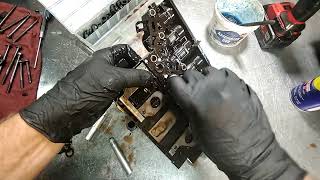
✅ What actually fixed it The video demonstrates the exact internal failure: the small plastic dowel pins that align the switch components shear off from wear. This allows the switch contacts to separate and send incorrect signals. The video shows a professional repair by disassembling the switch, filing the broken pins smooth, and rebuilding the 'mushroom' heads with a UV-cured plastic welding compound ('Bondic'). While this specific repair is shown, the standard procedure is to replace the entire switch assembly. - Owner Complaint NHTSA ODI #10583357 — An owner reported that their vehicle would not shift out of 1st gear when accelerating onto a freeway due to a defective transmission range sensor and code P0705.
OEM Part Supersession History
24282293→24042166— Likely an updated design or change in manufacturing for the Internal Mode Switch assembly.
Heads up: When searching for this part, ensure the supplier lists 24042166 as the current part number, which replaces the older 24282293.
Model Year Variations Within This Range
- 2014-2020: The 2014-2020 Impala uses the second generation (Gen 2) of the 6T70 transmission. The first generation was used in earlier GM vehicles. While the P0705 code can occur on both, the internal components, particularly the integrated TCM/valve body (TEHCM), are not interchangeable between generations. It is critical to source parts specifically for the Gen 2 transmission.
Diagnostic Flowchart
Other Known Issues on This Vehicle
Issues unrelated to this code that are worth knowing about as an owner of this generation:
- Water Leak Into Trunk 🟠 Medium — Very common. Water pools in the spare tire well, often caused by failed taillight housing gaskets. (Ref: GM has a technical service bulletin (14047) for this issue, providing thicker replacement gaskets (parts 23211647 & 23211648).)
- MyLink Infotainment System Glitches 🟡 Low — Frequently reported. Symptoms include a black or frozen screen, Bluetooth connectivity problems, and random reboots. (Ref: Software updates can resolve some issues, but hardware replacement is sometimes necessary. A system reset (holding Home and Fast Forward) can provide a temporary fix.)
- Electrical System Problems 🟠 Medium — Commonly reported, especially in 2014-2015 models. Can manifest as random warning lights, parasitic battery drain, or malfunctioning door locks.
- Rough Shifting or Transmission Shudder 🔴 High → Shop Transmission Assembly — A known issue with the 6-speed automatic, sometimes related to torque converter wear or old fluid.
- Cracked Front Catalytic Converter Pipe 🟠 Medium — Some 2014-2017 models with the 3.6L V6 may develop cracks around the mounting flange weld, causing an exhaust leak.
Used vs. New Parts: Buying Guide for This Vehicle
When a used part is the smart pick: For this specific repair, using a used part is almost never a smart choice. The primary failure mode is mechanical wear of plastic components inside the sensor. A used part has an unknown amount of wear and has been subjected to the same heat and stress as the part that failed.
What to inspect on the donor part:
- Not applicable as a used part is not recommended.
OEM-only on this vehicle (don't cheap out):
- Internal Mode Switch (IMS): The cost of labor to access this part is very high. The risk of a used part failing prematurely far outweighs the small cost savings on the part itself. Always install a new, high-quality part.
- Transmission Control Module (TCM): As this is also an internal component that requires significant labor to access and may require programming, a new, correctly programmed unit is the only reliable option.
Aftermarket brands forum-validated for this vehicle:
- ACDelco (GM Genuine)
- Dorman (Often provides redesigned or improved components)
- WVE (NTK)
Brands owners have reported issues with on this vehicle:
- No-name, unbranded parts from online marketplaces should be avoided due to the high labor cost of a potential repeat failure.
Real Owner Stories
Aggregated from forums and TSBs cited above. Mileages and costs reflect what owners reported in those sources.
2014-2020 Chevrolet Impala (6T70 Transmission)
Symptoms: The internal failure mode involves the breakage of plastic dowel pins that hold the switch assembly together, leading to misalignment of the electrical contacts.
What fixed it: Replacement of the internal mode switch (IMS) after removing the transmission pan and valve body.
Source hint: ATSG (Automatic Transmission Service Group) - A video from this professional group demonstrates the internal failure mode of the switch on a 6T70 transmission, involving the breakage of plastic dowel pins.
10th Gen Chevrolet Impala
Symptoms: Water pools in the spare tire well, often caused by failed taillight housing gaskets.
What fixed it: A successful DIY fix using butyl tape as an alternative to the official GM gaskets.
Source hint: Reddit r/10thGenImpala - A user details a successful DIY fix for the common trunk water leak using butyl tape as an alternative to the official GM gaskets, showing owner resourcefulness for platform issues.
Related OBD-II Codes
Frequently Asked Questions
Does GM TSB 14047 regarding water leaks apply to my 2014-2020 Impala's transmission issues?
Why is my Impala gear indicator blank or showing the wrong gear on the dash?
Can I just replace the sensor on the outside of the transmission?
My Impala won't start in Park but starts in Neutral; is this related to P0705?
Should I buy a used Internal Mode Switch to save on repair costs?
Is the P0705 code common on other GM vehicles besides the Impala?
Helpful Videos

We Have This Part in Stock


The information in this article is provided for general reference and educational purposes only. Vehicle specifications, procedures, and part compatibility can vary by production date, trim level, and region. Always consult your vehicle's factory service manual and verify part numbers before purchasing or performing repairs. Safety-critical components such as airbags, seat belts, and braking systems should be installed by a qualified professional.
- Chevrolet Impala:
- 🧭 Diagnostic Flowchart
- 🎬 Helpful Videos
- 🛍️ Shop This Part
- What's Unique About the 2014-2020 Chevrolet Impala
- Symptoms You May Notice
- Most Likely Causes
- Rare But Worth Checking
- Diagnosis Steps
- Parts You'll Likely Need
- Related Codes That Often Appear With This One
- Technical Service Bulletins (TSBs) & Recalls
- Platform-Specific Known Issues
- Mechanic-Grade Diagnostic Values
- Hidden / Shadow Codes Worth Checking
- Scan Tool Commands That Help
- Wiring & Ground Locations
- Real Owner Repair Stories
- OEM Part Supersession History
- Model Year Variations Within This Range
- Other Known Issues on This Vehicle
- Used vs. New Parts: Buying Guide for This Vehicle
- Real Owner Stories
- 2014-2020 Chevrolet Impala (6T70 Transmission)
- 10th Gen Chevrolet Impala
- Related OBD-II Codes
- Frequently Asked Questions
- 🎟️ Get 5% Off