

P0705 on 2008-2012 Honda Accord: Transmission Range Sensor Failure Causes and Fixes
On a 2008-2012 Honda Accord, code P0705 is almost always caused by a faulty Transmission Range Sensor (also called a Neutral Safety Switch). Symptoms include a flashing 'D' light, no-start conditions, and erratic shifting. Replacing the external sensor is a common DIY fix, with the part costing between $50 and $170.
- P0705 on an 8th-gen Accord is almost always a bad Transmission Range Sensor.
- Key symptoms are a flashing 'D' light and the car not starting in Park but starting in Neutral.
- This is a very DIY-friendly repair because the sensor is located on the outside of the transmission.
- When replacing the sensor, you MUST ensure the new part is correctly aligned with the transmission in the Neutral position.
- Always inspect the wiring and connector for damage before buying a new sensor.
What's Unique About the 2008-2012 Honda Accord
For the eighth-generation Honda Accord, this is a very common and well-documented issue. The Transmission Range Sensor is mounted externally on the transmission case, making it highly susceptible to corrosion and water damage from road spray. However, this external placement also makes it significantly easier to access and replace compared to vehicles with internal sensors, turning a potentially major transmission repair into a manageable DIY task for many owners.
Symptoms You May Notice
- Check Engine Light is on
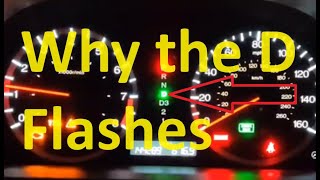
- Flashing 'D' (Drive) indicator light on the instrument cluster
- Vehicle will not start, or only starts in Neutral instead of Park
- Incorrect gear position shown on the dashboard
- Harsh, erratic, or delayed transmission shifting
- Transmission is stuck in one gear (limp mode)
- Reverse lights do not turn on when in Reverse
- Shifting problems are noticeably worse in hot weather or after the car has been driven for a while
- Replacing the battery when a no-start condition occurs. A classic symptom of a bad range sensor is the ability to start in Neutral but not Park. Some owners also find that jiggling the shifter while in Park will allow the car to start, which points directly to a worn sensor.
- Assuming an internal transmission failure. The harsh shifting and flashing 'D' light can be mistaken for a major transmission problem, but P0705 almost always points to this much simpler external sensor circuit issue.
Most Likely Causes
- Faulty Transmission Range Sensor (Neutral Safety Switch) 🔴 High Probability → Shop Transmission Assembly The sensor is mounted externally on the transmission, exposing it to road salt, water, and debris, which leads to internal corrosion and electrical failure over time. The plastic housing can also develop cracks, allowing moisture intrusion.
How to confirm: After confirming no wiring damage, test the sensor's output signals with a multimeter while shifting through the gears. The voltage should change consistently for each position. If the readings are erratic or absent, the sensor is bad. A classic real-world test is to see if the car starts in Neutral but not Park; this strongly points to a worn internal contact for the 'Park' position.
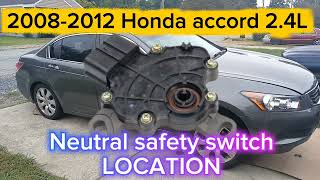
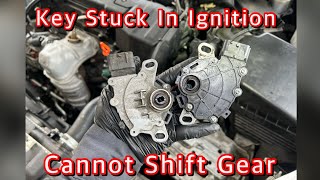
Typical fix: Replace the transmission range sensor. This involves removing the driver's side front wheel for access, unplugging the connector, removing two bolts, and installing the new sensor. 🎬 See this step-by-step replacement walkthrough The new sensor must be properly aligned by lining up the neutral marks on the sensor body and the transmission shaft before tightening the bolts.
Est. part cost: $50-$170 - Damaged Wiring or Corroded Connector 🟡 Medium Probability The wiring harness to the sensor is in a vulnerable location near the front wheel, where it can be damaged by road debris or suffer from corrosion in the connector pins from water intrusion.
How to confirm: Visually inspect the wiring harness leading to the sensor for any breaks, chafing, or signs of green corrosion on the connector pins. Perform a continuity test on the wires if no visible damage is found.
Typical fix: Repair the damaged section of wire or clean the connector terminals with electrical contact cleaner. If the connector itself is damaged or heavily corroded, it may need to be replaced with a new pigtail.
Est. part cost: $5-$50 - Misadjusted Transmission Range Sensor ⚪ Low Probability → Shop Transmission Assembly This typically only occurs after a recent replacement if not installed correctly. The sensor's mounting holes are slotted to allow for precise alignment.
How to confirm: Place the transmission in Neutral. Check the alignment marks on the sensor and the transmission body; they should line up perfectly. An improperly adjusted sensor can cause the PCM to read two gear positions at once.
Typical fix: Loosen the sensor's mounting bolts and rotate it until the alignment marks are correctly positioned, then retighten the bolts.
Est. part cost: $0
Rare But Worth Checking
- Faulty Powertrain Control Module (PCM): This is extremely rare. Before suspecting the PCM, all other causes (sensor, wiring, adjustment) must be ruled out. A faulty PCM will typically set other, unrelated trouble codes as well.
- Misadjusted Shift Linkage Cable: If the cable connecting the gear shifter to the transmission is stretched or loose, the sensor may not correctly report the gear position. This is uncommon but possible on high-mileage vehicles.
Diagnosis Steps
- Read the code with an OBD-II scanner and confirm P0705 is present. Note any other codes.
- Check for the most common symptoms: flashing 'D' light, no-start in Park (but starts in Neutral), and incorrect gear display.
- Put the transmission in Neutral and engage the parking brake.
- Safely lift and support the front of the vehicle. Remove the driver's-side front wheel.
- Locate the Transmission Range Sensor on the side of the transmission case. It will have a wiring connector and be attached to the shift linkage.
- Inspect the electrical connector and wiring harness for any signs of corrosion, damage, or loose connections.
- If the wiring looks good, check the sensor's alignment. With the transmission still in Neutral, the alignment marks on the sensor body and the lever should line up.
- If alignment is correct, test the sensor's electrical output. Using a multimeter, back-probe the connector to measure voltage signals as a helper shifts the car through each gear (with the key on, engine off). Refer to a service manual for specific wire colors and expected voltage values. A failure to produce the correct voltage for each gear indicates a faulty sensor.
- If the sensor and wiring test good, the issue may be a misadjusted shift cable or, in very rare cases, the PCM.
Parts You'll Likely Need
- Transmission Range Sensor (Neutral Safety Switch)
(OEM #V6 Models: 28900-RYF-023 (supersedes 28900-RYF-013) | 4-Cylinder Models: 28900-R9L-003)— This is the electronic sensor that fails most often, causing the P0705 code. It is the primary component responsible for communicating gear position to the car's computer. There are different parts for the V6 and 4-cylinder engines.
Trusted brands: Honda (Genuine), Beck/Arnley, Rostra, Dorman, Standard Motor Products (Intermotor)
OEM price range: $150-$190
Aftermarket price range: $50-$120
Related Codes That Often Appear With This One
- P1705 — On some older Honda models, P1705 was used for a short in the transmission range switch circuit. Some generic scan tools may misinterpret or display P0705 when the underlying Honda-specific code is P1705. Forum discussions confirm they point to the same physical part and failure.
- P0706 — This code indicates a performance or range issue with the same sensor, often caused by a misadjustment or intermittent electrical fault in the same circuit that triggers P0705.
Technical Service Bulletins (TSBs) & Recalls
- Honda TSB #11-033: Addresses an issue where the VCM (Variable Cylinder Management) on V6 models repeatedly switches on and off during light throttle, causing a jerking or hesitation feeling. A PCM software update was released to improve the VCM timing. While not directly related to P0705, the drivability symptom could be misdiagnosed.
Platform-Specific Known Issues
- Intermittent Failure and Temperature Sensitivity: A user on a Honda Accord forum detailed their experience with P0705 on a V6 model where the symptoms were highly dependent on temperature. The hard shifting, slipping, and lurching were minor when ambient temperatures were below 60°F but became severe and almost immediate when temperatures were above 70°F. After replacing the sensor, the car drove perfectly for one evening in cool weather, but the severe symptoms returned the next day, indicating the new sensor may have also been faulty or there was an underlying wiring issue exacerbated by heat. This highlights that the failure can be intermittent and temperature-sensitive, which can complicate diagnosis.
Mechanic-Grade Diagnostic Values
- Continuity test of the sensor in Reverse — expected: With the sensor connector unplugged and the shifter in Reverse, there should be continuity between terminals #3 and #9 of the 10-pin sensor connector.. Failure: If there is no continuity (open circuit), the sensor's internal contacts for the reverse circuit are faulty, and the sensor must be replaced.
- Continuity test for shorts between gear positions — expected: With the shifter in Reverse, there should ONLY be continuity between terminals #3 and #9. There should be NO continuity between terminal #3 and any other pin in the connector.. Failure: If continuity is found between terminal #3 and any pin other than #9, it indicates an internal short within the sensor, which would cause the PCM to see multiple gear positions at once.
- Live Data Scan Tool Check (Honda HDS) — expected: When viewing live data on a Honda Diagnostic System (HDS) or equivalent scan tool, only one gear position (e.g., 'ATP P') should show as 'ON' at a time. All others should be 'OFF'.. Failure: If two positions show as 'ON' simultaneously (e.g., both 'ATP P' and 'ATP R' are ON when in Reverse), it confirms a fault in the sensor or its wiring, triggering P0705.
Scan Tool Commands That Help
- Honda Diagnostic System (HDS) or equivalent: A/T Data List — This is the primary function used to diagnose P0705. It allows a technician to view the 'ON'/'OFF' status of each individual gear position input (ATP P, ATP R, ATP N, etc.) as seen by the PCM in real-time. This is the fastest way to confirm if the PCM is receiving conflicting signals (e.g., seeing Park and Reverse simultaneously), which is the direct cause of the code.
Wiring & Ground Locations
- G101 — On the driver's side of the engine/transmission assembly, typically on the transmission housing near the starter motor or on the engine block near the intake manifold.. G101 is a primary ground point for the engine and transmission control systems. A loose or corroded G101 ground can cause a floating ground reference, leading to erratic sensor readings, including those from the transmission range sensor, and can trigger various transmission-related fault codes like P0705.
- Transmission Range Sensor Connector — On the front or side of the transmission case, accessible after removing the driver's side front wheel and a plastic splash shield. It is a 10-pin rectangular connector.. This is the main connector for all signals from the range sensor to the PCM. It is highly susceptible to corrosion from road spray. A visual inspection of the pins for green or white corrosion is a critical first step. Testing for continuity and shorts is performed at this connector.
- PCM Connector B (49-Pin) — The Powertrain Control Module (PCM) is located in the engine compartment. Connector B is one of the main connectors plugging into it.. The individual signal wires from the transmission range sensor terminate at specific pins on this connector. For example, on a 2.4L model, the signal wires for the range switch can be traced to pins on this connector to test for continuity or shorts between the sensor and the PCM, ruling out a wiring harness issue.
Real Owner Repair Stories
- YouTube - Carsntoys (Acura (Honda platform-mate)) — No-start condition. Owner might replace the battery unnecessarily.
❌ Tried (didn't work) Replacing the battery.
✅ What actually fixed it The owner found that jiggling the gear shifter while in Park would allow the car to start. This pointed directly to a worn-out transmission range sensor. Replacing the sensor and correctly aligning it during installation resolved the no-start issue. - Go-Parts search result summary (Honda Accord (generation not specified, but principle applies)) — Persistent P0705 code and shifting issues.
❌ Tried (didn't work) Replacing the transmission range sensor with a new part., Replacing the sensor a second time with another new part.
✅ What actually fixed it The actual cause was found to be the wiring harness. Several wires had melted together due to engine heat, causing a short circuit between the signal wires that the PCM interpreted as a P0705 fault. Repairing the melted wiring harness finally fixed the problem. - NHTSA ODI #11174984 (Honda Pilot cross-reference) — An owner reported that within a week of driving, the check engine light came on with codes P0700, P0705, and P0740 present, all in relation to the automatic transmission.
- NHTSA ODI #10544028 — An owner reported that the transmission was failing due to codes P0705 and P0706, with a dealership estimate of $4800 to replace the transmission.
OEM Part Supersession History
28900-RYF-013→28900-RYF-023— Standard part revision by the manufacturer, likely for improved durability or material changes to combat moisture intrusion.
Heads up: The new part number (28900-RYF-023) is a direct replacement for the old one and is fully compatible with all V6 models in the 2008-2012 range.
Model Year Variations Within This Range
- 2008-2012: The transmission range sensor is different for vehicles equipped with the 4-cylinder engine versus the V6 engine. The V6 models use part number 28900-RYF-023, while the 4-cylinder models use 28900-R9L-003. The parts are not interchangeable.
Diagnostic Flowchart
Other Known Issues on This Vehicle
Issues unrelated to this code that are worth knowing about as an owner of this generation:
- Excessive Oil Consumption (V6 VCM Models) 🔴 High — Widespread issue affecting J35Z2/J35Z3 V6 engines. Variable Cylinder Management (VCM) can cause piston rings to become fouled with carbon, leading to oil burning. Often noticeable after 60,000 miles. (Ref: A class-action lawsuit was settled, and Honda issued warranty extensions and software updates (e.g., TSB 11-033) to alter VCM engagement, but the underlying mechanical issue can persist.)
- Excessive Oil Consumption (4-Cylinder K24 Models) 🔴 High — Common on 2008-2011 models with the K24Z engine. Caused by sticking piston oil control rings, leading to oil consumption of up to a quart every 1,000 miles. (Ref: Honda addressed this with TSB 12-087, extending the warranty to 8 years/125,000 miles for piston and ring replacement on affected vehicles.)
- Torque Converter Shudder 🟠 Medium — Common on V6 models, felt as a vibration or 'washboard' feeling under light acceleration between 20-60 mph. Caused by deteriorated automatic transmission fluid and torque converter clutch lock-up issues. (Ref: Honda issued TSBs (e.g., 17-018 for later models, but the issue is known on 8th gen) recommending a transmission fluid flush (sometimes multiple times) with updated fluid and a PCM software update.)
- Premature Rear Brake Wear 🟡 Low — Very common across the generation. The rear brake pads tend to wear out much faster than the front pads, sometimes in as little as 25,000-40,000 miles. This is often attributed to the rear brake proportioning and pad material.
- VTC Actuator Rattle on Cold Start (4-Cylinder) 🟠 Medium — Affects the K24Z engines. A brief, loud rattling or grinding noise for a couple of seconds upon a cold start. Caused by a faulty pin in the Variable Timing Control (VTC) actuator. (Ref: Honda TSB #09-010 was issued to address this problem by replacing the VTC actuator.)
Used vs. New Parts: Buying Guide for This Vehicle
When a used part is the smart pick: A used sensor is a high-risk, low-reward choice. Given that the primary failure mode is internal wear and corrosion from exposure, a used part from a junkyard has an unknown history and may fail soon after installation. It only makes sense as a very temporary, low-cost diagnostic tool to see if the sensor is the issue, or if the budget for repair is extremely limited.
Donor-vehicle mileage cap: roughly under 60000 miles for the part to have meaningful remaining life.
What to inspect on the donor part:
- Inspect the plastic housing for any cracks, especially around the mounting points and the main body seam.
- Check the electrical connector pins to ensure they are straight, clean, and free of any green or white corrosion.
- Ensure the alignment marks are clearly visible and not worn off.
- If possible, ask for a part from a lower-mileage, accident-totaled vehicle rather than one from a high-mileage cash-for-clunkers vehicle.
OEM-only on this vehicle (don't cheap out):
- Powertrain Control Module (PCM) - In the extremely rare event the PCM is the cause, a new or professionally remanufactured, VIN-programmed unit is essential. A used PCM can create immobilizer and communication issues.
Aftermarket brands forum-validated for this vehicle:
- Standard Motor Products (Intermotor)
- Beck/Arnley
- Dorman (often includes updated designs to prevent common failures)
Brands owners have reported issues with on this vehicle:
- Unnamed, 'white-box' parts from online marketplaces should be avoided. They often have high failure rates and may not be properly calibrated, causing the code to return immediately.
Real Owner Stories
Aggregated from forums and TSBs cited above. Mileages and costs reflect what owners reported in those sources.
2008-2012 Honda Accord V6
Symptoms: Hard shifting, slipping, and lurching that were minor when ambient temperatures were below 60°F but became severe and almost immediate when temperatures were above 70°F.
What fixed it: The owner replaced the sensor, though they noted symptoms returned, suggesting either a faulty replacement part or heat-exacerbated wiring issues.
Source hint: Vehicle-specific issues section regarding Intermittent Failure and Temperature Sensitivity
2010 Acura TSX
Symptoms: P0705 code, flashing 'D' light, and disabled paddle shifters.
What fixed it: Replacing the range sensor.
Source hint: AcuraZine - 'Error code PO705' (2015)
2008-2012 Honda Accord
Symptoms: Flashing D light and shifting issues.
What fixed it: Repairing a wiring short that was discovered after the sensor had already been replaced.
Source hint: 2CarPros.com example cited in forum_citations
1999 Accord EX V6 (AT)
Symptoms: Code P0705; owner noted that installing a new Neutral Safety Switch did not resolve the issue.
What fixed it: The source details the failure of a new switch to fix the problem, suggesting further diagnostic steps are needed for this specific case.
Source hint: Honda-Tech - '99 Accord EX V6 (AT) Code P0705 - New Neutral Safety Switch didn't help' (2016)
NHTSA Reported Incident
Symptoms: Check engine light with codes P0700, P0705, and P0740 in relation to the automatic transmission.
What fixed it: A transmission shop confirmed the relation to the automatic transmission after the codes appeared within a week of driving.
Source hint: NHTSA ODI #11174984
Related OBD-II Codes
Frequently Asked Questions
Why does my Honda Accord only start when I shift it into Neutral?
Does Honda TSB #11-033 explain why my transmission is shifting harshly?
Where is the Transmission Range Sensor located on the 2008-2012 Accord?
Can I just clean the sensor, or do I need to buy part 28900-RYF-023?
Why do my shifting problems get worse when it's hot outside?
Is it true that an Acura TSX part will fit my Accord?
Can P0705 lead to a total transmission replacement recommendation?
Helpful Videos

We Have This Part in Stock

The information in this article is provided for general reference and educational purposes only. Vehicle specifications, procedures, and part compatibility can vary by production date, trim level, and region. Always consult your vehicle's factory service manual and verify part numbers before purchasing or performing repairs. Safety-critical components such as airbags, seat belts, and braking systems should be installed by a qualified professional.
- Honda Accord:
- 🧭 Diagnostic Flowchart
- 🎬 Helpful Videos
- 🛍️ Shop This Part
- What's Unique About the 2008-2012 Honda Accord
- Symptoms You May Notice
- Most Likely Causes
- Rare But Worth Checking
- Diagnosis Steps
- Parts You'll Likely Need
- Related Codes That Often Appear With This One
- Technical Service Bulletins (TSBs) & Recalls
- Platform-Specific Known Issues
- Mechanic-Grade Diagnostic Values
- Scan Tool Commands That Help
- Wiring & Ground Locations
- Real Owner Repair Stories
- OEM Part Supersession History
- Model Year Variations Within This Range
- Other Known Issues on This Vehicle
- Used vs. New Parts: Buying Guide for This Vehicle
- Real Owner Stories
- 2008-2012 Honda Accord V6
- 2010 Acura TSX
- 2008-2012 Honda Accord
- 1999 Accord EX V6 (AT)
- NHTSA Reported Incident
- Related OBD-II Codes
- Frequently Asked Questions
- 🎟️ Get 5% Off