

P0705 on 2012-2016 Honda CR-V: Transmission Range Sensor Failure Causes and Fixes
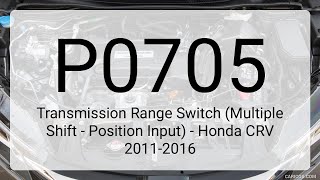
This code means the Transmission Range Sensor has failed or its circuit is compromised. The most likely fix is replacing the sensor, which is located on the outside of the transmission. Expect to pay around $40-$80 for an aftermarket sensor and $160-$240 for a genuine OEM part.
- P0705 on a 2012-2016 CR-V almost always points to a problem with the Transmission Range Sensor or its wiring.
- Key symptoms include a flashing 'D' light, no-start conditions, no reverse lights, and erratic shifting.
- The most common fix is replacing the sensor (OEM Part #28900-RPC-013), which is located on the outside of the transmission.
- Proper alignment of the new sensor is critical for it to function correctly; this must be done with the transmission in Neutral, often using a 2.0mm blade to set the position.
- Before replacing the sensor, always inspect the wiring and connector for corrosion or damage. If the code returns after replacement, re-check all connections, including at the PCM.
What's Unique About the 2012-2016 Honda CR-V
The 2012-2016 Honda CR-V (fourth generation) uses an externally mounted transmission range sensor, which is both good and bad news. The good news is that it's relatively easy to access and replace without opening up the transmission itself. The bad news is that its location on the transmission housing makes it vulnerable to road salt, moisture, and debris kicked up from the road. This can lead to water intrusion, internal corrosion, and premature failure of the sensor or its electrical connector, a common complaint in owner forums.
Symptoms You May Notice
- Check Engine Light is on
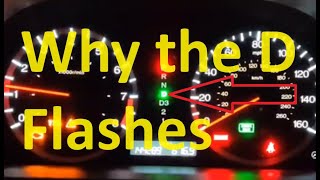
- Flashing 'D' (Drive) indicator on the dashboard
- Vehicle will not start, or only starts in Neutral but not Park (or vice-versa)
- Needing to jiggle the shifter to get the vehicle to start
- Inability to shift out of Park
- Harsh, delayed, or erratic shifting
- Reverse lights do not work
- Transmission enters 'limp mode,' limiting vehicle speed
- Gear indicator on dash is incorrect or shows multiple gears at once (e.g., 'R' and 'N' both lit)
- Replacing the battery when the vehicle won't start. A faulty range sensor can prevent the starting signal if it doesn't detect that the transmission is in Park or Neutral.
- Assuming an internal transmission failure. The harsh shifting and gear selection issues are often symptoms of the bad sensor input, not a mechanical problem inside the transmission.
- Replacing the sensor without checking the wiring. An Acura owner on AcuraZine replaced the sensor twice before realizing the wiring harness pigtail was the actual problem.
Most Likely Causes
- Faulty Transmission Range Sensor 🔴 High Probability → Shop Transmission Assembly The sensor is exposed to the elements on the exterior of the transmission. Water and road salt can penetrate the sensor's housing over time, causing internal corrosion and short circuits. This is the most common point of failure.
How to confirm: After checking the wiring, test the sensor's continuity for each gear position. Using a multimeter, check for continuity between specific terminals on the disconnected sensor connector as the shifter is moved to each position; compare results to the service manual's chart. 🎬 See this walkthrough on how to test and replace the switch. A simpler method is a voltage test at the PCM; if the sensor's output signals are incorrect or absent, the sensor is faulty.
Typical fix: Replace the transmission range sensor. It is crucial to align the new sensor correctly. Service manuals specify setting the transmission to Neutral and using a 2.0mm feeler gauge or blade to hold the new switch in the neutral position 🎬 Watch: Step-by-step guide for Honda and Acura range switch replacement. during installation.
Est. part cost: $40 - $240 - Damaged Wiring or Corroded Connector 🟡 Medium Probability The wiring harness and connector for the sensor are located under the vehicle, where they are susceptible to moisture, road salt, and physical damage from road debris. The connector pins can corrode, and wires can become frayed or broken.
How to confirm: Visually inspect the wiring harness leading to the sensor for any breaks, frays, or signs of heat damage. Unplug the connector and check for green/white corrosion, bent, or pushed-out pins. A user on Honda-Tech with a recurring P0705 found the final fix was cleaning and reseating the PCM connectors.
Typical fix: Repair the damaged section of wiring or clean the connector terminals with electrical contact cleaner. If corrosion is severe, the connector pigtail may need to be replaced.
Est. part cost: $10 - $50 - Misadjusted Transmission Range Sensor ⚪ Low Probability → Shop Transmission Assembly This typically only occurs after the sensor or transmission has been replaced and was not aligned correctly during reassembly. It can also happen if the shift cable linkage is loose or damaged.
How to confirm: Ensure the vehicle is in Neutral. Check the alignment marks on the sensor and the transmission case; they should line up perfectly as specified in the service manual.
Typical fix: Loosen the sensor's mounting bolts and adjust its position until the alignment marks are correct, then retighten the bolts.
Est. part cost: $0
Rare But Worth Checking
- Faulty Powertrain Control Module (PCM): This is extremely rare and should only be considered after all other possibilities, including the sensor, wiring, and adjustment, have been thoroughly ruled out. A recurring code after replacing the sensor and checking wiring may point to a PCM issue, as one forum user discovered after reseating the PCM connectors resolved the problem.
- Damaged or Contaminated Shift Linkage: Rarely, the mechanical linkage from the shifter to the transmission can be bent, obstructed, or contaminated with debris, preventing the sensor from accurately rotating to the correct position for the selected gear.
Diagnosis Steps
- Check the transmission fluid level and condition. While not a direct cause of P0705, low or dirty fluid can cause other transmission issues that may present with similar symptoms.
- Connect an OBD-II scanner to confirm the P0705 code and check for any other related codes.
- Visually inspect the transmission range sensor, its connector, and the wiring harness for any obvious signs of damage, corrosion, or loose connections. Pay close attention to the connector pins.
- Place the vehicle in Neutral. Check the alignment marks on the sensor to ensure it is adjusted correctly.
- Using a multimeter and the vehicle's service manual, back-probe the sensor's connector to test the voltage signals for each gear position (P, R, N, D). Verify the correct signals are being sent.
- If the wiring and adjustment are good but the sensor's output signals are incorrect or absent, the transmission range sensor is faulty and needs to be replaced.
- If the sensor is replaced and the code returns, re-check the wiring for an intermittent short or open circuit. A user on AcuraZine had the code return after two days, which ended up being a wiring issue.
- If the sensor and wiring are confirmed to be good, the issue may lie with the Powertrain Control Module (PCM), which requires advanced diagnostics. Check the PCM connections for corrosion before considering replacement.
Parts You'll Likely Need
- Transmission Range Sensor (Neutral Safety Switch)
(OEM #28900-RPC-013)— This is the component that fails most frequently, causing the P0705 code. It is exposed to the elements and fails due to internal corrosion. This part number is for the 2012-2014 5-speed automatic transmission and supersedes older versions like 28900-PPV-013 and 28900-RCR-013.
Trusted brands: Honda (Genuine), Rostra, Dorman
OEM price range: $160-$240
Aftermarket price range: $40-$80
Related Codes That Often Appear With This One
- P0706 — P0706 indicates a range/performance issue with the same sensor, often pointing to a sensor that is failing intermittently or is out of adjustment, but has not completely shorted or opened its circuit yet.
Technical Service Bulletins (TSBs) & Recalls
- While no specific TSB number for P0705 on this CR-V is widely published, Honda's service manuals contain a detailed, multi-step diagnostic procedure for this exact code. The procedure involves checking for specific voltage at PCM pins and using a Honda Diagnostic System (HDS) to monitor switch signals, ultimately leading to either a wiring repair or sensor replacement.
Platform-Specific Known Issues
- Real-World Repair Story: A user on the Honda-Tech forums with a P0705 code and flashing 'D' light replaced the range switch, but the problem persisted, especially in cold weather. Following the service manual, they performed electrical checks which pointed towards the PCM. The final fix was simply reseating all the PCM connectors behind the glovebox and thoroughly cleaning the range switch connector again. This highlights that even after replacing the part, the issue can be a poor connection elsewhere.
Mechanic-Grade Diagnostic Values
- Voltage at PCM Connector C, Pin C10 (Reverse Signal) — expected: Approx. 10V when NOT in Reverse, drops to ~0V when in Reverse.. Failure: Voltage does not change when shifting into/out of Reverse, or is always 0V (short to ground).
- Voltage at PCM Connector C, Pin C12 (Park/Neutral Signal) — expected: Approx. 5V when NOT in Park or Neutral.. Failure: Voltage is present when in Park or Neutral, or is always 0V.
- Voltage at PCM Connector C, Pin C20 (Drive Signal) — expected: Approx. 5V when NOT in Drive.. Failure: Voltage is present when in Drive, or is always 0V.
- Transmission Range Sensor Continuity Test — expected: Continuity should exist between specific pairs of pins on the sensor connector for each gear position (P, R, N, D, etc.) as defined in the service manual chart.. Failure: No continuity where there should be, or continuity where there shouldn't be, indicates a failed internal switch.
Scan Tool Commands That Help
- Honda Diagnostic System (HDS): Live Data Monitoring (A/T Gear Position) — To observe the exact signals (e.g., ATP, ATR, ATN, ATD) the PCM is receiving from the range switch in real-time while shifting through gears. This quickly confirms if the PCM's input matches the physical gear selected, isolating the problem to the sensor/wiring if they don't match.
- Honda i-HDS (for 2015-2016 CVT models): PCM/TCM Reset — Required after replacing the transmission or valve body on CVT models to clear learned values. While not a direct fix for P0705, it's a necessary step if major transmission work is performed alongside the sensor replacement.
Wiring & Ground Locations
- G101 — On the left side of the engine compartment.. This is a primary engine and transmission component ground. A corroded or loose connection here can cause a floating ground, leading to erratic voltage signals from sensors like the transmission range switch.
- Transmission Case Ground — A ground wire runs from the negative battery terminal harness directly to a bolt on the transmission case, often near the starter or under the airbox.. This is the most direct ground for the transmission and its externally mounted sensors. Forum users report this ground point is highly susceptible to corrosion ('crusty green'), which can directly cause intermittent P0705 codes by creating a poor ground path for the sensor.
- PCM Connectors (A, C) — Located behind the glove box.. The range switch signals are sent to specific pins on these connectors (e.g., C10, C12, C20). A poor connection at the PCM itself, due to moisture or vibration, can mimic a sensor or wiring failure, as documented in real-world repair stories.
OEM Part Supersession History
28900-PPV-013, 28900-RCR-013, 28900-RPC-003, and others→28900-RPC-013— Part consolidation and potential design improvements.
Heads up: These part numbers apply to the 2012-2014 CR-V with the 5-speed automatic transmission. They are not compatible with the 2015-2016 CVT models.28900-R9R-003→28900-RJ2-003— Part revision for CVT application.
Heads up: These part numbers are for the 2015-2016 CR-V with the CVT. They will not work on the earlier 5-speed automatic models.
Model Year Variations Within This Range
- 2012-2014: These models use a conventional 5-speed automatic transmission. The P0705 code is a well-documented issue. The correct replacement sensor is OEM part number 28900-RPC-013.
- 2015-2016: These models received a facelift which included a new engine and a Continuously Variable Transmission (CVT). While a P0705 is still possible, the range sensor is a different part (typically 28900-RJ2-003). CVT issues on these models are also commonly related to software and other codes like P1890 (belt slip), so diagnosis should consider the entire CVT system.
Diagnostic Flowchart
Used vs. New Parts: Buying Guide for This Vehicle
When a used part is the smart pick: A used transmission range sensor from a junkyard or online seller is a reasonable choice for this repair. It is an external, relatively simple electro-mechanical switch, not a complex electronic module. A forum user reported success with a $16 junkyard part, offering significant savings over a new OEM part.
Donor-vehicle mileage cap: roughly under 80000 miles for the part to have meaningful remaining life.
What to inspect on the donor part:
- Check the connector for any signs of corrosion (green or white powder) or bent pins.
- Inspect the plastic housing for cracks or signs of physical damage.
- If possible, ask for the donor vehicle's mileage; lower is always better.
- Ensure the part comes from a vehicle in the correct year range (2012-2014 for 5-speed auto, 2015-2016 for CVT) as they are not interchangeable.
OEM-only on this vehicle (don't cheap out):
- Powertrain Control Module (PCM)
Aftermarket brands forum-validated for this vehicle:
- Dorman
- Rostra
- Standard Motor Products (SMP)
Real Owner Stories
Aggregated from forums and TSBs cited above. Mileages and costs reflect what owners reported in those sources.
Honda Civic (related platform)
Symptoms: P0705 code and a flashing 'D' light that persisted after replacing the range switch, especially in cold weather.
What fixed it: The final fix was not the sensor itself, but reseating all the PCM connectors behind the glovebox and thoroughly cleaning the range switch connector again.
Source hint: Honda-Tech - P0705/blinking d light despite changing transmission range switch
Acura TL (related vehicle)
Symptoms: A recurring P0705 code that would return even after parts were replaced.
What fixed it: After replacing the sensor twice and the wiring harness, the problem was ultimately traced to a persistent wiring issue, highlighting the need for thorough circuit testing.
Source hint: AcuraZine - P0705 code don't know what to do anymore!
Documented NHTSA Reports
Honda Pilot (Cross-Manufacturer Reference)
Symptoms: An owner reported that within a week of driving, the check engine light came on with codes P0700, P0705, and P0740 present, all relating to the automatic transmission.
What fixed it: A transmission shop confirmed the relationship between these codes and the transmission system.
Source hint: NHTSA ODI #11174984
Honda Accord (Cross-Manufacturer Reference)
Symptoms: A report describes a transmission failing due to codes P0705 and P0706.
What fixed it: In this instance, a dealership suggested a full transmission replacement at a cost of $4800, though this is often a misdiagnosis for a range sensor issue.
Source hint: NHTSA ODI #10544028
Related OBD-II Codes
Frequently Asked Questions
My CR-V's 'D' light is flashing and it won't start. Is this related to the P0705 code?
I replaced the transmission range sensor on my 2014 CR-V, but the P0705 code came back. What should I check next?
Why does the transmission range sensor fail so often on the 2012-2016 CR-V?
Is there a special trick to installing a new transmission range sensor on my CR-V?
My reverse lights don't work and the transmission is shifting hard. Could this be caused by the P0705 code?
Can a simple adjustment fix the P0705 code, or do I have to replace the part?
Are there any official Honda recalls or TSBs for the P0705 code on this CR-V?
Helpful Videos


We Have This Part in Stock

The information in this article is provided for general reference and educational purposes only. Vehicle specifications, procedures, and part compatibility can vary by production date, trim level, and region. Always consult your vehicle's factory service manual and verify part numbers before purchasing or performing repairs. Safety-critical components such as airbags, seat belts, and braking systems should be installed by a qualified professional.
- Honda CR-V:
- 🧭 Diagnostic Flowchart
- 🎬 Helpful Videos
- 🛍️ Shop This Part
- What's Unique About the 2012-2016 Honda CR-V
- Symptoms You May Notice
- Most Likely Causes
- Rare But Worth Checking
- Diagnosis Steps
- Parts You'll Likely Need
- Related Codes That Often Appear With This One
- Technical Service Bulletins (TSBs) & Recalls
- Platform-Specific Known Issues
- Mechanic-Grade Diagnostic Values
- Scan Tool Commands That Help
- Wiring & Ground Locations
- OEM Part Supersession History
- Model Year Variations Within This Range
- Used vs. New Parts: Buying Guide for This Vehicle
- Real Owner Stories
- Honda Civic (related platform)
- Acura TL (related vehicle)
- Documented NHTSA Reports
- Honda Pilot (Cross-Manufacturer Reference)
- Honda Accord (Cross-Manufacturer Reference)
- Related OBD-II Codes
- Frequently Asked Questions
- 🎟️ Get 5% Off