

P0705 on 2003-2008 Honda Pilot: Transmission Range Sensor Causes and Fixes
On a 2003-2008 Honda Pilot, code P0705 is almost always caused by a faulty Transmission Range Sensor (also called a Neutral Safety Switch). This can cause a no-start condition, a flashing 'D' light, and prevent reverse lights from working. Replacing the sensor is the typical fix, with the part costing around $170 for an OEM replacement. Proper alignment during installation is critical.
- P0705 on a 2003-2008 Pilot almost always means the Transmission Range Sensor has failed.
- Key symptoms are a flashing 'D' light, a Check Engine Light, and potentially a no-start condition.
- The fix is replacing the externally mounted sensor, which requires careful alignment in the Neutral position.
- Before replacing the sensor, always inspect the wiring and connector for corrosion or damage, as this can cause the same symptoms.
- This is a common, well-documented problem for this vehicle and its platform mates like the Acura MDX and Honda Odyssey.
What's Unique About the 2003-2008 Honda Pilot
For the first-generation Honda Pilot, the P0705 code is a very common and well-documented issue. The primary culprit is almost always the external Transmission Range Sensor itself, which is exposed to the elements on the side of the transmission and is prone to failure from moisture and corrosion over time. Unlike some vehicles where this code can point to complex internal transmission problems or require dropping the transmission to access an internal switch, on the Pilot it's typically a straightforward, albeit somewhat inconvenient, 🎬 Watch this walkthrough for replacing the range switch. external component replacement that can be done by a DIYer.
Symptoms You May Notice
- Flashing 'D' (Drive) indicator light on the instrument cluster.
- Check Engine Light is on.
- Engine will not crank or start.
- Engine only starts in Neutral (N) but not in Park (P), or vice-versa.
- Incorrect gear position displayed on the dash (e.g., 'R' and 'N' lit up at the same time).
- No reverse lights when in Reverse.
- Harsh or delayed transmission shifting.
- Vehicle gets stuck in 2nd gear (limp mode).
- Replacing the PCM before thoroughly testing the sensor and its circuit. This is an expensive and unnecessary repair in most P0705 cases.
- Replacing internal transmission components. The P0705 code points to an issue with the external range sensor circuit, not an internal mechanical failure of the transmission.
- Replacing the starter motor or battery for a no-start symptom without checking for the P0705 code first. If wiggling the gear shifter allows the car to start, the issue is almost certainly the range sensor.
Most Likely Causes
- Faulty Transmission Range Sensor (Neutral Safety Switch) 🔴 High Probability → Shop Transmission Assembly The sensor is mounted externally on the transmission, making it vulnerable to road grime, moisture, and corrosion, which can cause internal short circuits or wear of the internal contacts.
How to confirm: Test the sensor's output signals for each gear position using a multimeter and compare them to the specifications in the factory service manual. 🎬 See how to test and replace the sensor yourself. A simpler, though less definitive, test is to see if wiggling the shifter or the sensor connector changes the symptoms. If the car starts in N but not P, the sensor or its alignment is highly suspect.
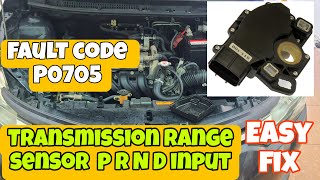
Typical fix: Replace the transmission range sensor. This requires removing the battery and battery tray for access. 🎬 Watch this guide on fixing the P0705 input error. The new sensor must be carefully aligned in the NEUTRAL position before tightening the bolts. Failure to align it correctly will result in the same symptoms returning.
Est. part cost: $150-$260 - Damaged Wiring or Corroded Connector 🟡 Medium Probability The wiring harness and connector for the sensor are located underneath the vehicle and are susceptible to damage from road debris, moisture, and heat from the exhaust.
How to confirm: Visually inspect the wiring harness leading to the transmission range sensor for any signs of fraying, melting, or breaks. Unplug the connector and check for green or white corrosion, bent pins, or moisture inside. Perform a continuity test on the wires between the sensor and the PCM.
Typical fix: Repair the damaged section of wire or clean the connector terminals with electrical contact cleaner. In some cases, the connector pigtail may need to be replaced.
Est. part cost: $10-$50 - Misadjusted Transmission Range Sensor ⚪ Low Probability → Shop Transmission Assembly The sensor is held in place by bolts and can be knocked out of alignment, although this is uncommon unless it was recently replaced incorrectly.
How to confirm: Verify the sensor's alignment marks are correctly positioned when the transmission is in Neutral. The vehicle should only start in Park and Neutral. The service manual provides a specific alignment procedure.
Typical fix: Loosen the sensor mounting bolts and rotate the sensor until it is properly aligned (usually by inserting a pin or drill bit of a specific size through alignment holes), then retighten the bolts to the specified torque.
Est. part cost: $0
Rare But Worth Checking
- Faulty Powertrain Control Module (PCM): This is extremely rare. Before condemning the PCM, all other possibilities (sensor, wiring, adjustment) must be exhaustively ruled out. A faulty PCM will typically set other trouble codes as well and is unlikely to be the cause if P0705 is the only code present.
Diagnosis Steps
- Use an OBD-II scanner to confirm the P0705 code is present. Note any other codes, especially P1717.
- Check the transmission fluid level and condition. While unlikely to be the primary cause, low or burnt fluid can indicate other transmission issues that should not be ignored.
- With the key in the 'ON' position (engine off), move the shifter through all gears. Confirm the gear indicator on the dashboard matches the shifter position. Note any discrepancies, such as multiple lights on at once or the wrong gear indicated.
- Test if the vehicle starts in both Park and Neutral. If it only starts in one, this strongly points to a sensor or alignment issue.
- Visually inspect the transmission range sensor, its connector, and the wiring harness for obvious signs of damage, corrosion, or loose connections. The sensor is located on the front/side of the transmission, under the battery tray.
- If a scan tool with live data is available, monitor the gear position parameter while shifting. The reading should match the physical gear selection. Any mismatch points to a fault in the circuit.
- If you have a multimeter and service manual, disconnect the sensor and test for continuity and correct resistance/voltage at the sensor's pins for each gear position as per the manual's diagnostic chart.
- If the sensor tests good, check for continuity and voltage on the wiring harness between the sensor connector and the PCM to rule out a wiring fault. Check for voltage on the power supply wire and for a good ground.
- If the sensor and wiring are confirmed to be good, the issue may be a misadjustment of the sensor. Check alignment marks per the service manual.
- If all circuit tests pass and the sensor is adjusted correctly, the fault may lie within the PCM, but this is highly unlikely and should be the absolute last consideration.
Parts You'll Likely Need
- Transmission Range Sensor / Neutral Safety Switch
(OEM #28900-RJB-043 (2006-2008), 28900-P7W-013 (2003-2005))— This is the component that fails in the vast majority of P0705 cases on this vehicle due to its location and function.
Trusted brands: Honda (Genuine OE), Rostra (e.g., NS-319), Standard Motor Products (NS319), WVE/NTK
OEM price range: $170-$255
Aftermarket price range: $40-$100
Related Codes That Often Appear With This One
- P1717 - Transmission Range Switch Circuit Malfunction: This is a Honda-specific code that is functionally identical to P0705 and directly points to the same sensor. It is common to see both codes together.
Technical Service Bulletins (TSBs) & Recalls
- No specific TSBs were found directly addressing P0705 on the 2003-2008 Pilot. However, other transmission-related TSBs and a recall (NHTSA #04V176000) exist for this generation related to internal transmission failures, so it's always wise to check for any open campaigns for your specific VIN.
Platform-Specific Known Issues
- The flashing 'D' light is a hallmark symptom for transmission-related electrical faults on this generation of Honda vehicles, and P0705 is one of the most common triggers.
- Accessing the sensor requires removing the battery and the entire battery tray, which can be cumbersome due to tight spaces and potentially corroded bolts.
Mechanic-Grade Diagnostic Values
- Voltage at PCM Connector C12 (P/N signal) — expected: Approx. 10V when shifter is in any position OTHER than P or N.. Failure: Voltage is not ~10V. If no voltage, turn ignition off, disconnect PCM connector C, and check for continuity to ground on pin C12. No continuity indicates an open wire; continuity indicates a short to ground.
- Voltage at PCM Connector C20 (D signal) — expected: Approx. 5V when shifter is in any position OTHER than D.. Failure: Voltage is not ~5V. If no voltage, check for continuity to ground on pin C20 to diagnose an open or shorted wire.
- Voltage at PCM Connector C10 (R signal) — expected: Approx. 10V when shifter is in any position OTHER than R.. Failure: Voltage is not ~10V. If no voltage, check for continuity to ground on pin C10 to diagnose an open or shorted wire.
- Sensor Continuity Test (at sensor connector) — expected: With the sensor connector unplugged, there should be continuity between specific pins depending on gear position (e.g., in Park, continuity between pins 1 & 3 and 1 & 8).. Failure: No continuity where there should be, or continuity where there shouldn't be. This indicates a failed internal switch contact.
Scan Tool Commands That Help
- Honda Diagnostic System (HDS): Data List for A/T System — Use this to monitor the live input signals from the transmission range switch. Compare the displayed gear position on the HDS with the physical shifter position to see if the PCM is receiving the correct signal.
- Honda Diagnostic System (HDS): SCS Line Jump — The HDS can be used to jump the Service Check Signal (SCS) line, which puts the system in a diagnostic mode. This is used in conjunction with manual continuity tests at the PCM connector to isolate faults in the wiring harness.
Wiring & Ground Locations
- G101 — On the V6 engine, this critical ground is located on the engine block, typically bolted to the thermostat housing on the left side of the engine.. G101 is the main power and logic ground for the PCM/ECU. A corroded or loose G101 connection can cause a host of intermittent electrical issues, including incorrect sensor readings that could trigger a P0705 code even if the sensor and wiring are good.
- PCM Connector C (22-Pin) — Located at the Powertrain Control Module (PCM), typically in the engine bay or under the dashboard.. This connector contains the specific input pins from the transmission range sensor (e.g., C9, C10, C11, C12, C20). Testing for voltage and continuity at these pins is the definitive way to determine if the fault is with the sensor, the wiring, or the PCM itself.
Real Owner Repair Stories
- Honda-Tech.com forum user (Honda Odyssey with J35A V6 (shared platform with Pilot)) — P0705 and flashing 'D' light.
❌ Tried (didn't work) Replacing the transmission range switch.
✅ What actually fixed it The code returned after replacing the sensor. The final fix was re-seating the electrical connectors at the Powertrain Control Module (PCM) and thoroughly cleaning the range switch connector again. This indicates the root cause was a poor connection, not a failed part. - Honda-Tech.com forum user (Honda vehicle with P0705/P1717) — Flashing 'D' light and P0705/P1717 codes.
❌ Tried (didn't work) Considering buying a new sensor.
✅ What actually fixed it Instead of replacing the sensor, the owner disassembled the original switch, found the internal copper contacts were dirty and oxidized, cleaned them with a contact cleaner, applied new dielectric grease, and reassembled it. This cleared the codes and restored function, saving the cost of a new part. - NHTSA ODI #11174984 — An owner reported that within a week of driving a used vehicle with 136k miles, the check engine light came on with codes P0700, P0705, and P0740 present, all in relation to the automatic transmission.
- NHTSA ODI #10544028 — In a cross-manufacturer reference for a similar Honda powertrain, a dealership reported that a transmission was failing due to codes P0705 and P0706, with a replacement cost estimated at $4800.
When the Usual Fixes Don't Work
- In several documented cases, replacing the transmission range sensor does not resolve the P0705 code. One of the most common alternative culprits is a poor electrical connection at the Powertrain Control Module (PCM). Before spending money on a second sensor, owners who have a recurring code should disconnect the PCM connectors, inspect for any corrosion or backed-out pins, apply a small amount of dielectric grease, and firmly re-seat the connectors. Another area to investigate is the main engine-to-chassis ground (G101), as a corroded ground can cause erratic sensor readings throughout the system.
OEM Part Supersession History
28900-RJB-023, 28900-RJB-033→28900-RJB-043— Standard part revision and consolidation by the manufacturer.
Heads up: Applies to 2006-2008 models. Not compatible with 2003-2005 models.
Model Year Variations Within This Range
- 2003-2005: These earlier models use Transmission Range Sensor part number 28900-P7W-013.
- 2006-2008: Following the 2006 model year refresh, these later models use Transmission Range Sensor part number 28900-RJB-043.
Diagnostic Flowchart
Other Known Issues on This Vehicle
Issues unrelated to this code that are worth knowing about as an owner of this generation:
- Automatic Transmission Failure 🔴 High → Shop Transmission Assembly — Very common, especially in 2003-2005 models. Failures can occur before 150,000 miles. A class-action lawsuit was filed over this issue. (Ref: Recall #04V176000 was issued for some vehicles due to heat buildup causing gear breakage, but many with identical symptoms were not covered.)
- Variable Cylinder Management (VCM) Oil Consumption 🟠 Medium — Affects 2006-2008 FWD models equipped with VCM. Can lead to fouled spark plugs and internal engine wear over time.
- Timing Belt Maintenance 🔴 High — Not a failure, but a critical maintenance item. The J35A is an interference engine, and if the timing belt breaks (recommended replacement around 100,000 miles), catastrophic engine damage will occur.
- Leaking VTEC Solenoid (Spool Valve) 🟠 Medium — Common oil leak point. The solenoid is located above the alternator, and a leak will drip oil directly onto it, causing premature alternator failure.
- Failing Low-Beam Headlights 🟡 Low — A common issue where the low-beam headlights stop working due to a faulty wiring harness or multifunction switch. (Ref: TSB 12-023 and 12-056 address this issue for certain model years.)
- Cracking Lower Control Arm Bushings 🟠 Medium — The bushings on the front lower control arms wear out, leading to clunking noises over bumps, poor alignment, and a loose feeling in the steering.
Used vs. New Parts: Buying Guide for This Vehicle
When a used part is the smart pick: A used transmission range sensor is generally NOT recommended for this repair. The part fails due to internal wear and exposure to the elements. A used part from a junkyard has an unknown history and is likely to have a very limited remaining lifespan, potentially failing soon after installation and forcing you to do the labor-intensive replacement job again.
Donor-vehicle mileage cap: roughly under 50000 miles for the part to have meaningful remaining life.
What to inspect on the donor part:
- Look for a donor vehicle with the lowest possible mileage.
- Inspect the connector pins for any signs of green or white corrosion.
- Ensure the plastic housing is not cracked or showing signs of extreme heat exposure.
- If possible, test the part for continuity on the bench before purchasing.
OEM-only on this vehicle (don't cheap out):
- While not strictly OEM-only, using a Genuine Honda sensor is highly recommended for fitment, quality, and longevity. The price difference between OEM and a reputable aftermarket brand is often not significant enough to justify the risk of a premature failure or incorrect readings from a lower-quality part.
Aftermarket brands forum-validated for this vehicle:
- Standard Motor Products (SMP)
- WVE/NTK
- Rostra
Brands owners have reported issues with on this vehicle:
- Unnamed, 'white-box' brands from online marketplaces should be avoided. These often use lower-quality internal components that can fail quickly or provide inaccurate readings, leading to a return of the P0705 code and other shifting issues.
Real Owner Stories
Aggregated from forums and TSBs cited above. Mileages and costs reflect what owners reported in those sources.
2001-2006 Acura MDX YD1 J35A
Symptoms: Flashing 'D' light, Check Engine Light, and the vehicle being stuck in gear.
What fixed it: The owner replaced the sensor, but the issue returned after two days, eventually requiring replacement of the sensor again along with the wiring harness and pressure switches.
Source hint: AcuraZine - P0705 code don't know what to do anymore!
2003-2008 Honda Pilot J35A
Symptoms: Owners reported the vehicle would not start in Park but would start in Neutral, or the dash would show incorrect gear positions like 'R' and 'N' lit at the same time.
What fixed it: Replacing the transmission range sensor and ensuring it was carefully aligned in the NEUTRAL position before tightening the bolts.
Source hint: Piloteers.org (Honda Pilot Enthusiast Forum)
2003-2005 Honda Pilot J35A — ~145000 miles
Symptoms: Internal transmission failure symptoms; heat buildup causing gear breakage.
What fixed it: Addressable via Recall #04V176000 for specific VINs, though many experienced failures before 150,000 miles.
Source hint: known_issues: Automatic Transmission Failure
Related OBD-II Codes
Frequently Asked Questions
Is there a recall for the transmission issues on my 2003-2008 Honda Pilot?
Why does my Pilot start in Neutral but not in Park?
Where is the Transmission Range Sensor located on the J35A engine?
What does a flashing 'D' light on my dashboard mean?
Can I just clean the sensor connector instead of replacing the whole unit?
Why are my reverse lights not working even though the bulbs are fine?
Helpful Videos


We Have This Part in Stock

The information in this article is provided for general reference and educational purposes only. Vehicle specifications, procedures, and part compatibility can vary by production date, trim level, and region. Always consult your vehicle's factory service manual and verify part numbers before purchasing or performing repairs. Safety-critical components such as airbags, seat belts, and braking systems should be installed by a qualified professional.
- Honda Pilot:
- 🧭 Diagnostic Flowchart
- 🎬 Helpful Videos
- 🛍️ Shop This Part
- What's Unique About the 2003-2008 Honda Pilot
- Symptoms You May Notice
- Most Likely Causes
- Rare But Worth Checking
- Diagnosis Steps
- Parts You'll Likely Need
- Related Codes That Often Appear With This One
- Technical Service Bulletins (TSBs) & Recalls
- Platform-Specific Known Issues
- Mechanic-Grade Diagnostic Values
- Scan Tool Commands That Help
- Wiring & Ground Locations
- Real Owner Repair Stories
- When the Usual Fixes Don't Work
- OEM Part Supersession History
- Model Year Variations Within This Range
- Other Known Issues on This Vehicle
- Used vs. New Parts: Buying Guide for This Vehicle
- Real Owner Stories
- 2001-2006 Acura MDX YD1 J35A
- 2003-2008 Honda Pilot J35A
- 2003-2005 Honda Pilot J35A — ~145000 miles
- Related OBD-II Codes
- Frequently Asked Questions
- 🎟️ Get 5% Off