

P0705 on 2011-2015 Kia Optima: Transmission Range Sensor Failure Causes and Fixes
On a 2011-2015 Kia Optima, code P0705 almost always points to a failed Transmission Range Sensor, also known as an Inhibitor Switch. This can cause a no-start condition, incorrect gear display, or erratic shifting. Replacing the switch, which is located externally on the transmission, is the most common fix.
- P0705 on a 2011-2015 Optima almost always means the inhibitor switch (transmission range sensor) has failed.
- Key symptoms are a no-start condition, erratic shifting, and an incorrect gear display on the dash.
- Do not immediately assume a major transmission failure; this is usually an inexpensive external sensor issue.
- Check for Kia Service Action SA317 to see if a similar, later model had a covered repair, which strengthens the diagnosis.
- When replacing the switch, proper alignment is critical for it to function correctly.
What's Unique About the 2011-2015 Kia Optima
The 2011-2015 Kia Optima (third generation, or 'TF') and its platform-mate, the Hyundai Sonata, use an external transmission range sensor that is a well-documented, high-failure part. While Kia issued service bulletins (SA317 series) for this exact issue on slightly later models (2016-2017), the same part and problem are frequently seen by owners of the 2011-2015 models. The failure is common enough that it's one of the first things to suspect for a no-start or shifting issue on this vehicle.
Symptoms You May Notice
- Check Engine Light is on.
- Engine will not crank or start, or only starts in Neutral but not Park (or vice-versa).
- Harsh, erratic, or delayed shifting between gears.
- Transmission gets stuck in one gear (limp mode).
- The gear indicator on the dashboard (PRNDL) is blank, shows the wrong gear, or has all positions illuminated.
- Reverse lights do not turn on when in Reverse.
- Car may not register that it is in Park, preventing you from turning the ignition completely off or removing the key.
- Replacing the starter when the car won't start. The P0705 code is a key indicator that the no-start issue is due to the car's computer not seeing that the transmission is in Park or Neutral.
- Condemning the entire transmission. While the symptoms involve shifting problems, the cause is almost always this inexpensive external sensor, not a major internal transmission failure.
Most Likely Causes
- Faulty Transmission Range Sensor (Inhibitor Switch) 🔴 High Probability → Shop Transmission Assembly This is a well-documented common failure item on this platform and its Hyundai Sonata counterpart. Kia has issued service bulletins for this part on subsequent model years, indicating a known design or manufacturing weakness.
How to confirm: After confirming P0705 is the primary code, a simple test is to jiggle the gear shifter while attempting to start the car; if it starts intermittently, the switch is likely faulty. The definitive test is to check the sensor's output signals with a multimeter while an assistant moves the gear shifter. If the signals are incorrect or absent per the service manual's specifications, the switch is bad.
Typical fix: Replace the transmission range sensor (inhibitor switch). This is a DIY-friendly job for many, requiring removal of the air intake, battery, and battery tray for access. The critical step is aligning the new switch: the transmission must be in Neutral, and the switch's alignment hole must line up with the lever's hole before tightening the bolts. A 5mm bolt or drill bit can be used as an alignment pin.
Est. part cost: $40-$150 - Damaged Wiring or Corroded Connector 🟡 Medium Probability The sensor and its wiring are located on the outside of the transmission, exposed to heat, moisture, and vibration, which can lead to corrosion or wire damage over time.
How to confirm: Visually inspect the wiring harness and connector going to the inhibitor switch. Look for green corrosion, frayed or broken wires, or a loose connection. Test for continuity and proper voltage at the connector with a multimeter.
Typical fix: Clean the connector terminals thoroughly with electrical contact cleaner. If wires are damaged, they must be repaired or the connector pigtail replaced.
Est. part cost: $5-$50 - Misadjusted or Damaged Shift Cable/Linkage ⚪ Low Probability
How to confirm: Ensure the gear selected by the shifter physically matches the gear position lever on the transmission itself. If there is excessive play or the cable has come loose, the sensor may not be in the correct position to send the right signal.
Typical fix: Adjust or replace the shift cable and its bushings.
Est. part cost: $20-$100
Rare But Worth Checking
- Faulty Powertrain Control Module (PCM): This is very rare. The PCM should only be suspected after the sensor, wiring, and linkage have all been confirmed to be in perfect working order.
Diagnosis Steps
- Scan the vehicle's computer for trouble codes. Confirm P0705 is present. Note any other transmission or communication (U-codes) that may be stored.
- Perform a visual inspection of the Transmission Range Sensor (Inhibitor Switch), its connector, and wiring harness. The switch is located on the top of the transmission case, under the air filter box and battery tray. Look for obvious signs of damage, corrosion, or loose connections.
- Check the shift linkage. Ensure the cable is properly attached and adjusted, and that the lever on the transmission moves fully into each gear detent as you move the shifter inside the car.
- Test the sensor's function. Using a wiring diagram and a multimeter, back-probe the sensor connector to test the output voltage for each gear position (P, R, N, D). Compare the readings to the manufacturer's specifications. If the readings are incorrect or missing, the sensor has failed.
- If the sensor tests good, check the wiring between the sensor and the PCM for continuity and shorts to ground. Repair any damaged wiring found.
- During reinstallation of a new switch, proper alignment is critical. Place the manual lever on the transmission in the Neutral position. Install the new switch and rotate it until the alignment holes on the switch body and the lever line up. Insert a 5mm pin or bolt to hold it in place while you tighten the mounting bolts.
- If the sensor, wiring, and alignment are all confirmed good, the problem may be a rare failure of the Powertrain Control Module (PCM). This should be confirmed by a professional.
Parts You'll Likely Need
- Inhibitor Switch (Transmission Range Sensor)
(OEM #42700-3B700 (Supersedes 42700-26700, 42700-26500, 42700-26000))— This is the most common cause of code P0705 on this vehicle due to high failure rates across both Kia and Hyundai platforms.
Trusted brands: Kia/Hyundai (Genuine OEM), Dorman
OEM price range: $90-$150
Aftermarket price range: $40-$100
Technical Service Bulletins (TSBs) & Recalls
- SA317 / SA317A / SA317B/C: Service Action for Inhibitor Switch Replacement on various 2016-2018 Kia models, citing P0705, intermittent no-start, and erratic shifting as key symptoms.
- Hyundai TSB 17-AT-005: Details diagnostic procedures for P0705, P0706, P0707, and P0708 on numerous Hyundai models including the 2011-2014 Sonata, confirming the repair procedure and commonality of the issue.
- TSB Bulletin #TSBTRA072A_R2: A manufacturer service bulletin notes that vehicles equipped with a front wheel drive 6-speed transmission may experience the Malfunction Indicator Lamp (MIL) ON with DTC P0705, CAN-related DTCs, and intermittent no-crank conditions.
Platform-Specific Known Issues
- Kia issued Technical Service Bulletins (TSB) SA317, SA317A, SA317B/C for inhibitor switch replacement on various 2016-2018 models, including the Optima, for symptoms directly related to code P0705. While the 2011-2015 models are not explicitly covered by this TSB, they use a similar design and suffer from the same failure.
- Hyundai, Kia's parent company, also issued TSBs (e.g., 12-AT-022-1, 17-AT-005) for the same P0705-related inhibitor switch issue on the platform-sharing Sonata and other models, further confirming the widespread nature of this part's failure.
Mechanic-Grade Diagnostic Values
- Inhibitor Switch Multi-Switch Function Test (Continuity) — expected: Using a multimeter on the resistance (Ohms) setting, there should be continuity (a reading close to 0 Ω) between specific pins on the switch connector for each gear position. The exact pin combinations require a model-specific wiring diagram, but the principle involves checking that the switch correctly closes circuits for P, R, N, and D signals as the lever is moved.. Failure: No continuity on a specified pin for a gear, or continuity on multiple, incorrect pins simultaneously, indicates a failed switch.
- Inhibitor Switch Power Input Voltage — expected: With the key on, engine off, back-probing the power supply wire at the inhibitor switch connector should show battery voltage (approximately 12V).. Failure: No voltage or significantly low voltage indicates a problem in the wiring harness or fuse supplying power to the switch, not the switch itself.
Scan Tool Commands That Help
- Kia GDS (Global Diagnostic System): Live Data / Current Data — A technician would use the dealership scan tool (GDS) to monitor the 'Inhibitor Switch' parameter in the transmission control module's live data list. As an assistant moves the gear selector lever through P-R-N-D, the technician watches the screen to see if the TCM is receiving the correct position input. A mismatch between the physical lever position and the displayed data confirms a fault in the sensor or its circuit.
Wiring & Ground Locations
- Inhibitor Switch Connector — On top of the transmission case, underneath the battery and battery tray. Access requires removing the air intake ducting and the battery assembly.. This is the primary connection point for the sensor. It is exposed to engine bay heat and moisture, making it a common point for corrosion or wire damage that directly causes P0705. A visual inspection here is a critical first step.
- Transmission Ground Strap — Typically a braided metal strap connecting the transmission case to the vehicle's chassis/frame rail near the front of the engine bay.. While not a direct cause, a corroded or broken main transmission ground can cause a host of erratic electrical issues, including faulty sensor readings. Ensuring this ground is clean and secure is a good practice when diagnosing any transmission-related electrical code.
Real Owner Repair Stories
- Reddit user Veksar86 on r/kia (2014 Kia Optima) — Poor acceleration, Check Engine Light with code P0705.
❌ Tried (didn't work) The user first sought advice before attempting repairs.
✅ What actually fixed it Another user immediately identified the need for a new 'inhibitor switch,' confirming the commonality of the failure. The original poster later confirmed they bought the part and replaced it themselves. - NHTSA ODI #11207388 — An owner reported that their check engine light came on for P0705 and the car was occasionally getting stuck in Park, requiring the vehicle to be stopped and started again to shift out of Park.
OEM Part Supersession History
42700-26000, 42700-26500→42700-3B700, which was later superseded by 42700-26700— Part revisions to improve reliability and address the high failure rate.
Heads up: Multiple sources confirm a long list of part numbers that 42700-26700 replaces, including 42700-3B700. For this vehicle, using the latest available OEM part number is the safest bet to ensure compatibility and benefit from any design improvements.
Model Year Variations Within This Range
- 2014-2015: The Kia Optima received a mid-cycle facelift for the 2014 model year, which included revised styling and interior updates like a new touchscreen. However, the core powertrain, including the 2.4L GDI engine and 6-speed automatic transmission, remained largely the same. The inhibitor switch failure and P0705 code apply equally to both pre-facelift (2011-2013) and post-facelift (2014-2015) models within this generation.
Diagnostic Flowchart
Other Known Issues on This Vehicle
Issues unrelated to this code that are worth knowing about as an owner of this generation:
- Catastrophic Engine Failure (Theta II 2.4L GDI & 2.0L Turbo) 🔴 High — Widespread issue. Machining errors can cause premature connecting rod bearing wear, leading to engine knocking and eventual seizure, often before 100,000 miles. (Ref: NHTSA Recall 17V-224 (Kia's SC147) was issued, leading to a class-action lawsuit and lifetime warranty extension for the engine short block for original and subsequent owners.)
- Worn Steering Coupler 🟠 Medium — Very common. A small, flexible rubber coupler in the electronic power steering column disintegrates over time, causing a distinct clicking or ticking noise when turning the wheel and a feeling of looseness or play in the steering. (Ref: Kia issued a Customer Satisfaction Program (CS1604) and extended the warranty for this specific part to 10 years/unlimited mileage.)
- Peeling White Paint 🟡 Low — Common on vehicles with 'Snow White Pearl' paint. Owners report large sheets of paint delaminating and peeling from the body, especially the roof and hood, often after the warranty period.
- Failing Door Lock Actuators 🟡 Low — A frequently reported annoyance where one or more door lock actuators fail, preventing the door from locking or unlocking electronically with the key fob or interior switch.
Used vs. New Parts: Buying Guide for This Vehicle
When a used part is the smart pick: Given the relatively low cost of a new aftermarket or even OEM part ($40-$150) and the high failure rate of this specific component, buying a used inhibitor switch from a junkyard is NOT recommended. The risk of the used part failing soon after installation is high, making the labor involved not worth the small cost savings.
What to inspect on the donor part:
- Not applicable, as buying this part used is not advised.
OEM-only on this vehicle (don't cheap out):
- While not strictly 'OEM-only', using a Genuine Kia/Hyundai replacement part is highly recommended over aftermarket options to ensure the best longevity and avoid repeat failures. The cost difference is often minimal.
Aftermarket brands forum-validated for this vehicle:
- Dorman is a common aftermarket alternative, though owner feedback is mixed compared to the OEM part.
- Standard Motor Products (SMP)
- Beck/Arnley
Brands owners have reported issues with on this vehicle:
- Unbranded, 'white box' parts from online marketplaces like eBay or Amazon should be avoided. While very cheap, they have a high likelihood of premature failure or being dead-on-arrival.
Real Owner Stories
Aggregated from forums and TSBs cited above. Mileages and costs reflect what owners reported in those sources.
2014 Kia Optima
Symptoms: The vehicle experienced poor acceleration and the Check Engine Light came on with code P0705 shortly after the warranty expired.
What fixed it: Replacement of the inhibitor switch.
Source hint: Code P0705, 14 optima - reddit.com/r/kia
2011-2015 Kia Optima
Symptoms: Owners reported no-start conditions, getting stuck in limp mode (one gear), and the gear indicator on the dash being blank or incorrect.
What fixed it: DIY replacement of the inhibitor switch located under the battery tray, ensuring careful alignment of the new part.
Source hint: DIY and discussion on OptimaForums.com
2011-2015 Kia Optima
Symptoms: An owner filed NHTSA ODI #11207388 reporting that the car was occasionally getting stuck in Park and had to be stopped and started again to get out of Park after the P0705 check engine light came on.
What fixed it: Diagnostic procedures for P0705 typically lead to inhibitor switch replacement.
Source hint: NHTSA ODI #11207388
Related OBD-II Codes
Frequently Asked Questions
Does Kia TSB SA317 cover my 2011-2015 Optima for the P0705 code?
Can I use the diagnostic procedure from the Hyundai Sonata for my Kia Optima?
Why won't my Optima let me remove the key or turn the ignition completely off?
Is there a trick to starting the car if the inhibitor switch is failing?
What specific tool is needed to align the new inhibitor switch during installation?
Is the P0705 code related to the Theta II engine recall on my Optima?
Helpful Videos

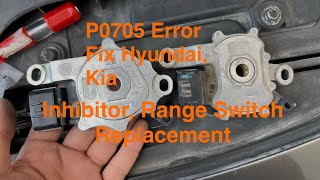

We Have This Part in Stock




The information in this article is provided for general reference and educational purposes only. Vehicle specifications, procedures, and part compatibility can vary by production date, trim level, and region. Always consult your vehicle's factory service manual and verify part numbers before purchasing or performing repairs. Safety-critical components such as airbags, seat belts, and braking systems should be installed by a qualified professional.
- Kia Optima:
- 🧭 Diagnostic Flowchart
- 🎬 Helpful Videos
- 🛍️ Shop This Part
- What's Unique About the 2011-2015 Kia Optima
- Symptoms You May Notice
- Most Likely Causes
- Rare But Worth Checking
- Diagnosis Steps
- Parts You'll Likely Need
- Technical Service Bulletins (TSBs) & Recalls
- Platform-Specific Known Issues
- Mechanic-Grade Diagnostic Values
- Scan Tool Commands That Help
- Wiring & Ground Locations
- Real Owner Repair Stories
- OEM Part Supersession History
- Model Year Variations Within This Range
- Other Known Issues on This Vehicle
- Used vs. New Parts: Buying Guide for This Vehicle
- Real Owner Stories
- 2014 Kia Optima
- 2011-2015 Kia Optima
- 2011-2015 Kia Optima
- Related OBD-II Codes
- Frequently Asked Questions
- 🎟️ Get 5% Off