

P0705 on 2008-2013 Toyota Highlander Hybrid: Transmission Range Sensor Fixes
This code indicates a problem with the Transmission Range Sensor, also known as the Neutral Safety Switch. This can cause a no-start condition, incorrect gear display, or erratic shifting. The most common fix is replacing the sensor itself, which is located on the outside of the transmission, making it a relatively accessible repair.
- P0705 on your Highlander Hybrid means the computer is getting a bad signal about which gear you've selected.
- The most common symptoms are a no-start condition and an incorrect gear display on the dash.
- The problem is almost always a faulty Neutral Safety Switch (also called a Transmission Range Sensor) located on the outside of the transmission.
- Before replacing the sensor, check its electrical connector for corrosion and ensure the shift cable is properly adjusted.
- The correct OEM part number is 84540-07010, which is a common part shared with many other Toyota vehicles.
What's Unique About the 2008-2013 Toyota Highlander
On the 2008-2013 Highlander Hybrid, this code almost always points to a failure of the externally-mounted Transmission Range Sensor (Neutral Safety Switch). Unlike some vehicles where the sensor is inside the transmission and requires extensive labor to replace, the Highlander's sensor is accessible on the outside of the transmission case, making diagnosis and replacement more straightforward. The issue is typically the sensor itself failing from age and exposure to the elements, rather than a more complex wiring or computer problem. The sensor for the hybrid model is the same one used across many non-hybrid Toyota models of the era, such as the Camry, RAV4, and Sienna, making it a widely available part.
Symptoms You May Notice
- Check Engine Light is on.
- Vehicle will not start, or only starts in Neutral but not Park (or vice-versa).
- Gear indicator on the dashboard is blank, incorrect, or does not match the actual gear position.
- Reverse lights do not turn on when the vehicle is in Reverse.
- Backup camera does not activate.
- Harsh or delayed gear engagement.
- Transmission may be stuck in a single gear (limp mode).
- Replacing the starter when the vehicle won't start. The no-start is often due to the faulty neutral safety switch preventing the starter from receiving power, not a bad starter itself.
- Assuming an internal transmission failure. 🎬 Watch: Why you shouldn't replace parts before watching this diagnostic guide. The symptoms can mimic serious transmission problems, but P0705 is almost always related to the external sensor or its circuit.
Most Likely Causes
- Faulty Transmission Range Sensor (Neutral Safety Switch) 🔴 High Probability → Shop Transmission Assembly The sensor is mounted externally on the transmission, exposing it to heat, moisture, and road debris, which can lead to internal corrosion and failure over time. This is the most common point of failure for this code.
How to confirm: Use a scan tool to monitor the sensor's output data while moving the shifter through each gear. If the displayed gear position on the scan tool does not match the shifter's actual position, the sensor is likely faulty. You can also test the sensor's internal resistance with a multimeter according to the service manual specifications. A specific test for some Toyota models involves checking for resistance between specific terminals for each gear position.
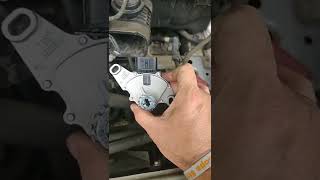
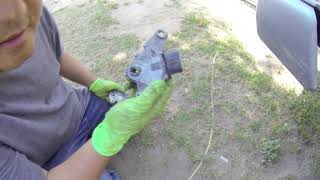
Typical fix: Replace the Transmission Range Sensor. This involves disconnecting the battery, removing the shift linkage from the sensor, disconnecting the electrical connector, unbolting the old sensor, and installing the new one. 🎬 See this walkthrough on how to test and replace the switch. Crucially, the new sensor must be properly aligned; typically, this is done by aligning a mark on the sensor body with a groove on its shaft while the transmission is in Neutral before tightening the bolts.
Est. part cost: $150-$250 - Damaged Wiring or Corroded Connector 🟡 Medium Probability The wiring harness and connector for the sensor are located under the vehicle and are susceptible to damage from road debris, moisture, and corrosion, which can cause shorts or open circuits.
How to confirm: Visually inspect the wiring harness leading to the sensor for any signs of fraying, breaks, or heat damage (e.g., from the exhaust). Unplug the connector and check for bent, corroded, or pushed-out pins. Check for 12V power at the correct pins on the connector with the ignition on.
Typical fix: Repair the damaged section of wire or clean the connector terminals with electrical contact cleaner. If the connector itself is damaged, it may need to be replaced with a pigtail connector.
Est. part cost: $10-$50 - Misadjusted Transmission Range Sensor or Shift Cable ⚪ Low Probability → Shop Transmission Assembly
How to confirm: If the sensor or shift cable is not properly aligned, the sensor will send an incorrect signal. A classic symptom is the vehicle starting in Neutral but not Park, or vice versa. Visually inspect the alignment marks on the sensor body and shaft; they should line up perfectly when the transmission is manually placed in Neutral.
Typical fix: Loosen the sensor's mounting bolts and rotate it slightly until the alignment marks are correct. Tighten the bolts and verify correct operation in all gears. Adjust the shift linkage cable if necessary.
Est. part cost: $0
Rare But Worth Checking
- Faulty Power Management Control ECU (HV CPU): This is extremely rare. Before suspecting the ECU, all other possibilities (sensor, wiring, adjustment) must be exhaustively ruled out. A faulty computer will typically be accompanied by other, often unrelated, trouble codes.
Diagnosis Steps
- Scan for Codes: Use an OBD-II scanner to confirm P0705 is the primary code. Note any other codes present, as they can help differentiate between a sensor failure and a module failure.
- Check Live Data: Use a scanner's live data function to view the gear position reported by the Transmission Range Sensor. Move the shifter through P, R, N, and D. The scanner's reading should match the shifter position instantly. If it's incorrect, intermittent, or delayed, the sensor or its circuit is the likely culprit.
- Visual Inspection: Raise the vehicle safely. Locate the sensor on the side of the transmission where the shift lever connects. Inspect the electrical connector for green/white corrosion or damage. Check the wiring harness for any cuts, melting, or chafing against the linkage or frame.
- Check Adjustment: With the transmission in Neutral, check the alignment marks on the sensor. They should line up perfectly. If they don't, the sensor or shift cable needs adjustment.
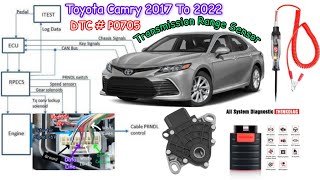
- Test the Circuit: If the visual inspection passes, perform a voltage or resistance test on the sensor's pins using a multimeter, following the specifications in the vehicle's service manual. 🎬 Watch: How to diagnose the circuit using a wiring diagram. This will definitively confirm if the sensor has failed internally.
- Replace the Sensor: If the sensor is confirmed to be faulty, replace it. Ensure the new sensor is correctly aligned in the Neutral position before tightening the mounting bolts.
Parts You'll Likely Need
- Transmission Range Sensor / Neutral Safety Switch
(OEM #84540-07010)— This is the component that fails most often, causing the P0705 code. It contains the electrical contacts that wear out or corrode over time. This part number is widely used across many Toyota models and supersedes part number 84540-33010.
Trusted brands: Toyota (OEM), Aisin, Standard Motor Products (SMP), Beck Arnley
OEM price range: $200-$250
Aftermarket price range: $150-$200
Platform-Specific Known Issues
- While P0705 is straightforward, owners of the Highlander Hybrid should be aware that other complex hybrid system issues can present with no-start or warning light symptoms. It's important to correctly diagnose P0705 and not confuse it with a failing hybrid inverter or brake actuator, which are more severe and costly problems on this platform.
Mechanic-Grade Diagnostic Values
- Resistance check of Park/Neutral Position Switch (disconnected) — expected: For each gear position (P, R, N, D, 2, L), there should be continuity (below 1 Ω) between specific pairs of terminals on the switch connector, and high resistance (10 kΩ or higher) for others. The exact pin pairs vary by manual but follow a logical pattern for each gear.. Failure: No continuity where there should be, or continuity between multiple gear position pins at the same time, indicates a failed switch.
- Voltage check at ECM connector for NSW (Neutral Start Switch) terminal — expected: 0V when in Park or Neutral. Battery voltage (approx. 10-14V) when in any other gear (R, D, 2, L).. Failure: Voltage that does not change when shifting, or is absent in all positions, points to a wiring or switch fault.
Scan Tool Commands That Help
- Toyota Techstream: Data List > A/T > PNP SW (NSW) — This is the primary diagnostic step after retrieving the P0705 code. It allows the technician to see the switch status (ON/OFF) as reported to the ECU in real-time while moving the gear selector. If the status on the screen does not match the physical gear lever position, it strongly indicates a fault in the switch, its adjustment, or the wiring.
Wiring & Ground Locations
- Park/Neutral Position Switch — Mounted externally on the passenger side of the transmission case, where the shift linkage connects.. This is the location of the sensor itself. Its external placement makes it vulnerable to road debris and corrosion but also easier to access for testing and replacement.
- Connector B26 (Varies by specific manual/year) — The electrical connector that plugs directly into the Park/Neutral Position Switch on the transmission.. This connector is a common point of failure due to corrosion from moisture and road salt. Checking for clean, tight pins is a critical diagnostic step.
- Ground Point (General) — The switch circuit grounds to the body. A common ground point for transmission-related components is located on the chassis near the transmission or on the engine block itself.. A corroded or loose ground connection can cause erratic voltage signals from the sensor, mimicking a sensor failure and triggering a P0705 code.
Real Owner Repair Stories
- YouTube video by 'Oz Mechanics' (2014 Toyota Camry (shares sensor and logic with Highlander)) — Check engine light with code P0705 that returned immediately after a new range sensor was installed by another shop.
❌ Tried (didn't work) Replacing the Transmission Range Sensor.
✅ What actually fixed it The technician used a scan tool to analyze the live data and found that multiple gear position signals were 'ON' simultaneously when they shouldn't be. The diagnostic logic pointed to a short circuit. The fault was traced to a damaged wiring harness where wires had chafed and were shorting together, causing the illogical signals. Repairing the wires resolved the code. - NHTSA ODI #11195754 (Cross-manufacturer reference for Toyota Tacoma) — An owner reported that shifting between moving positions (R, D, 3, 2, 1) required significant physical strength, and the P0705 code began appearing intermittently on the dashboard display.
OEM Part Supersession History
84540-33010→84540-07010— Standard part revision and consolidation across multiple vehicle platforms.
Heads up: The parts are interchangeable. 84540-07010 is the correct and current OEM part to order for this repair.
Model Year Variations Within This Range
- 2008-2010 vs 2011-2013: The Highlander Hybrid used a 3.3L 3MZ-FE V6 from 2008-2010. For the 2011 model year facelift, it was updated to the 3.5L 2GR-FXE V6. While the P0705 code and the neutral safety switch part itself (84540-07010) remained the same, the engine control and hybrid system architecture around it changed. However, this does not significantly alter the diagnosis for this specific code.
Diagnostic Flowchart
Other Known Issues on This Vehicle
Issues unrelated to this code that are worth knowing about as an owner of this generation:
- Brake Actuator Assembly Failure 🔴 High — Common on 2008-2010 models. Can cause a loss of braking assist and illuminates multiple brake system warning lights. (Ref: Toyota Customer Support Program ZKC provided extended coverage for this part, but it has since expired. Codes C1391, C1252, C1256, or C1253 are common indicators.)
- Hybrid Inverter Failure 🔴 High — A known issue on 2006-2010 models. Can cause sudden stalling or a no-start condition with 'Check Hybrid System' warnings. Very expensive to repair out of warranty. (Ref: A recall was issued for the Intelligent Power Module (IPM) within the inverter for 2006-2010 models.)
- Steering Intermediate Shaft Noise 🟡 Low — Affects 2008-2013 models, causing a clunk, pop, or knock noise when turning the steering wheel. It is an annoyance but not a safety-critical failure. (Ref: T-SB-0034-13 was issued with an updated part to resolve the noise.)
- VVT-i Oil Line Rupture 🔴 High — Primarily affected early 2GR-FE V6 engines (pre-2010). A rubber section of the oil line could degrade and burst, leading to rapid oil loss and potential engine seizure. (Ref: A recall (LSC 90K) was issued to replace the rubber hose with an all-metal line.)
- Water Pump Failure 🟠 Medium — A common failure point on all 2GR-family engines, often occurring between 60,000 and 100,000 miles. Can cause coolant leaks and overheating.
- Clogged HV Battery Cooling Fan 🟠 Medium — Dust and debris can clog the hybrid battery cooling fan, reducing cooling efficiency and potentially shortening the life of the expensive hybrid battery. (Ref: T-SB-0198-11 describes the inspection and cleaning procedure for vehicles used in certain conditions.)
Used vs. New Parts: Buying Guide for This Vehicle
When a used part is the smart pick: A used sensor from a junkyard can be a cost-effective option if the budget is tight, as this is an external, easily-swapped electronic part. However, given its exposure to the elements and tendency to fail from wear and corrosion, its remaining lifespan is uncertain.
Donor-vehicle mileage cap: roughly under 80000 miles for the part to have meaningful remaining life.
What to inspect on the donor part:
- Look for a donor vehicle from a dry, non-salt-belt region to minimize the risk of corrosion.
- Inspect the electrical connector pins for any signs of green or white corrosion.
- Ensure the plastic housing is not cracked or physically damaged.
- If possible, check that the selector arm rotates smoothly without binding.
OEM-only on this vehicle (don't cheap out):
- While not strictly 'OEM-only', using a genuine Toyota or the OEM manufacturer (Aisin) part is highly recommended for fitment, alignment, and longevity. The cost difference between a quality aftermarket part and OEM is often minimal for this component.
Aftermarket brands forum-validated for this vehicle:
- Aisin: Aisin is a major Toyota OEM supplier, and their aftermarket parts are often identical to the genuine Toyota part, sometimes without the Toyota branding. This is generally considered the best alternative to buying directly from a Toyota dealer.
Brands owners have reported issues with on this vehicle:
- Unbranded, low-cost parts from online marketplaces. Forum discussions and mechanic experience often show these can be poorly calibrated, fail prematurely, or have incorrect internal resistance, leading to the code returning shortly after installation.
Real Owner Stories
Aggregated from forums and TSBs cited above. Mileages and costs reflect what owners reported in those sources.
2008 Highlander Hybrid 3.5L
Symptoms: A catastrophic failure resulting in a no-start condition and 'Check Hybrid System' warnings.
What fixed it: Diagnosis revealed an inverter failure rather than a simple sensor issue, highlighting the high cost of hybrid component repair.
Source hint: Reddit - r/Toyota - 'A catastrophic Hybrid Failure: 2008 Highlander'
Related OBD-II Codes
Frequently Asked Questions
My 2008 Highlander Hybrid won't start and shows a 'Check Hybrid System' warning; is this definitely the P0705 sensor?
Is there a recall for the no-start or stalling issues on the 2006-2010 Highlander Hybrid?
My gear indicator is blank and the backup camera won't turn on. What is the most likely cause?
Can I just adjust the sensor instead of replacing it if my car only starts in Neutral?
Is the brake actuator failure related to the P0705 code on my 2009 Highlander Hybrid?
Are there any known issues with the steering or engine oil lines I should check while fixing the P0705 code?
Helpful Videos

We Have This Part in Stock

The information in this article is provided for general reference and educational purposes only. Vehicle specifications, procedures, and part compatibility can vary by production date, trim level, and region. Always consult your vehicle's factory service manual and verify part numbers before purchasing or performing repairs. Safety-critical components such as airbags, seat belts, and braking systems should be installed by a qualified professional.
- Toyota Highlander:
- 🧭 Diagnostic Flowchart
- 🎬 Helpful Videos
- 🛍️ Shop This Part
- What's Unique About the 2008-2013 Toyota Highlander
- Symptoms You May Notice
- Most Likely Causes
- Rare But Worth Checking
- Diagnosis Steps
- Parts You'll Likely Need
- Platform-Specific Known Issues
- Mechanic-Grade Diagnostic Values
- Scan Tool Commands That Help
- Wiring & Ground Locations
- Real Owner Repair Stories
- OEM Part Supersession History
- Model Year Variations Within This Range
- Other Known Issues on This Vehicle
- Used vs. New Parts: Buying Guide for This Vehicle
- Real Owner Stories
- 2008 Highlander Hybrid 3.5L
- Related OBD-II Codes
- Frequently Asked Questions
- 🎟️ Get 5% Off