

P0706 on 2006-2014 Dodge Charger: Transmission Range Sensor Causes and Fixes
On a 2006-2014 Dodge Charger, P0706 is almost always caused by a faulty internal transmission conductor plate or a leaking 13-pin electrical connector sleeve. This repair requires dropping the transmission pan and valve body, with shop costs typically ranging from $700 to $1,500.
- P0706 on a 2006-2014 Charger points to an internal transmission issue, not a simple external sensor.
- The two most likely culprits are a failed conductor plate and/or a leaking 13-pin electrical connector sleeve.
- Always inspect the 13-pin connector for fluid leaks before ordering internal parts, as this is a tell-tale sign of the common failure mode.
- This is not a beginner-friendly DIY repair. It requires dropping the transmission valve body and having a method to correctly measure and refill the transmission fluid.
- When performing the repair, it is best practice to replace the conductor plate, connector sleeve, filter, and fluid at the same time.
What's Unique About the 2006-2014 Dodge Charger
Most Dodge Chargers in this year range use a Mercedes-Benz-designed 5-speed automatic transmission, known as the NAG1, W5A580, or its original designation, the Mercedes 722.6. Unlike many vehicles with a simple external range sensor, the sensor in the NAG1 is integrated into a complex electronic 'conductor plate' located inside the transmission, on top of the valve body. This design's two most common failure points are the conductor plate itself cracking from heat and age, and the main electrical connector sleeve leaking fluid, which then contaminates the wiring harness. These platform-specific issues are the primary drivers for a P0706 code on a Charger.
Generation note: This range covers the end of the first generation (LX; 2006-2010) and the start of the second generation (LD; 2011-2014) Charger. However, both generations heavily utilized the same NAG1 (W5A580) 5-speed automatic transmission, so the causes, symptoms, and repairs for code P0706 are consistent across this entire year span for V6 and V8 models equipped with that transmission.
Symptoms You May Notice
- Vehicle is stuck in 'limp mode' (will not shift out of a single gear, usually 2nd or 3rd).
- Check Engine Light is on.
- ABS, ESP, and/or Traction Control lights may also be illuminated.
- Harsh or erratic shifting.
- Vehicle will not start, or only starts in Neutral.
- Incorrect gear selection displayed on the instrument cluster.
- Reverse lights do not work.
- Vehicle may not shift out of Park (though this is more famously caused by the separate 'pink thingy' issue in the shifter itself).
- Replacing only the external wiring harness without fixing the leaking 13-pin connector sleeve that caused the contamination.
- Replacing the Transmission Control Module (TCM) before verifying the integrity of the conductor plate and wiring harness.
- Replacing the entire transmission when only the internal conductor plate and connector sleeve are needed.
Most Likely Causes
- Faulty Transmission Conductor Plate 🔴 High Probability → Shop Transmission Assembly The Transmission Range Sensor (TRS) is integrated into the conductor plate, which sits above the hot valve body. Over time, the plastic and embedded electrical traces become brittle and crack, causing intermittent or failed signals. This is the most common point of failure for this code on the NAG1 transmission.
How to confirm: A diagnostic scan tool may show other transmission speed sensor codes (like P0717) along with P0706, strongly pointing to the conductor plate which houses all these sensors. The ultimate confirmation is a visual inspection 🎬 Watch: How to test the conductor plate and solenoids of the plate for cracks after removing the valve body.
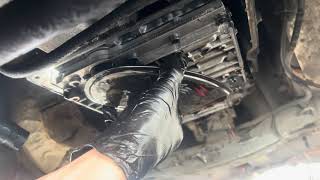
Typical fix: Replace the conductor plate. This is done by 🎬 Watch: Step-by-step conductor plate replacement guide draining the transmission fluid, dropping the pan, and removing the valve body assembly to access the plate. It is critical to also replace the connector sleeve, filter, and fluid at the same time.
Est. part cost: $90-$250 - Leaking 13-Pin Electrical Connector Sleeve 🔴 High Probability The O-rings on the connector sleeve that passes through the transmission case degrade, allowing transmission fluid to leak. This fluid can wick up the entire wiring harness via capillary action, contaminating the connections at the Transmission Control Module (TCM) and causing short circuits that trigger P0706.
How to confirm: Visually inspect the round 13-pin connector on the front passenger side of the transmission. If there is any sign of reddish transmission fluid, the sleeve is leaking. Disconnect the harness and check for fluid inside the plug itself. This is a very common and well-documented failure.
Typical fix: Replace the electrical connector sleeve (Part No. 68021352AA). This is an inexpensive part and should be replaced whenever the conductor plate is serviced, or as soon as a leak is detected. If the harness is saturated, it must be thoroughly cleaned with electrical contact cleaner.
Est. part cost: $15-$40 - Low or Contaminated Transmission Fluid 🟡 Medium Probability → Shop Transmission Assembly The NAG1 transmission is sensitive to correct fluid level and condition. These vehicles do not have a factory-installed dipstick, making it difficult for owners to check the fluid level, which must be done at a specific temperature with a special service tool. Using the incorrect fluid (like ATF+4) instead of the required spec (MB 236.14) can also cause issues.
How to confirm: Using a special transmission dipstick tool (sold separately), check the fluid level while the transmission is at operating temperature (approx. 80°C or 176°F). The fluid should be bright red and not smell 🎬 Watch: How to check NAG1 transmission fluid level burnt.
Typical fix: Perform a transmission fluid and filter service using the correct fluid type. If the fluid is very dark or contains debris, internal damage may be present.
Est. part cost: $80-$150 for fluid and filter - Shift Linkage Misalignment ⚪ Low Probability
How to confirm: With the vehicle safely on a lift, have a helper move the shifter through the gears. Observe the linkage at the transmission to ensure it is moving the selector lever fully into each gear's detent. An incorrect alignment can cause a mismatch between the shifter position and the sensor reading.
Typical fix: Adjust the shift linkage cable at the transmission lever or shifter assembly.
Est. part cost: $0 (labor for adjustment)
Rare But Worth Checking
- Failed Transmission Control Module (TCM): → Shop Transmission Assembly This is rare. The TCM should only be suspected after all other possibilities, especially the conductor plate and wiring harness (including the connector sleeve), have been thoroughly checked and ruled out. Fluid wicking from a leaking connector can damage the TCM, but the leak itself is the root cause.
- Damaged Valve Body: → Shop Transmission Valve Body While the conductor plate that sits on the valve body is the most common failure, the valve body itself can have issues with sticking solenoids or internal cracks. It is often replaced as an assembly with the conductor plate.
- Failed or Misadjusted Shifter Assembly/Cable: Less common for this code, but wear or damage in the shifter mechanism or a stretched cable can lead to a mismatch between the gear selected by the driver and the position registered by the sensor, triggering a P0706 code.
Diagnosis Steps
- Scan the TCM for P0706 and any other related codes (like P0700 or P0717). Note all codes present.
- Perform a thorough visual inspection of the 13-pin electrical connector on the transmission for any signs of fluid leakage. If wet, disconnect it and check for fluid inside the plug. This is a primary suspect.
- Inspect the wiring harness leading from the transmission to the TCM for any signs of damage or fluid contamination. If fluid has wicked up the harness, it must be cleaned.
- Use a scan tool with live data to monitor the Transmission Range Sensor signal while moving the shifter through all gears. Look for erratic, illogical, or missing readings.
- Check the transmission fluid level and condition using the proper service tool and procedure. The fluid level must be checked at a specific operating temperature (approx. 80°C / 176°F). Verify the correct fluid type is being used (NOT ATF+4).
- If external checks do not reveal the issue, the next step is to drain the fluid, remove the transmission pan, and visually inspect the conductor plate for cracks and the valve body for debris.
- If the conductor plate is suspect, it's best practice to replace it along with the 13-pin connector sleeve, the filter, and the pan gasket.
Parts You'll Likely Need
- Transmission Conductor Plate
(OEM #52108308AC)— This is the most common failure point. It contains the Transmission Range Sensor and speed sensors, which are prone to cracking from heat and vibration.
Trusted brands: Mopar, Dorman, Vaico, ATP
OEM price range: $150-$250
Aftermarket price range: $90-$180 - Transmission Electrical Connector Sleeve
(OEM #68021352AA)— The O-rings on this part fail, causing the fluid leak that leads to electrical shorts. It is considered a mandatory replacement part when servicing the conductor plate.
Trusted brands: Mopar, Febi, URO Parts
OEM price range: $20-$40
Aftermarket price range: $10-$25
Related Codes That Often Appear With This One
- P0700 — P0700 is a generic code indicating the Transmission Control Module (TCM) has stored a fault. It almost always appears alongside more specific transmission codes like P0706.
- P0717 — This code is for the Input/Turbine Speed Sensor circuit. Since the speed sensors are also integrated into the same conductor plate as the range sensor, it is very common for them to fail together, triggering both codes.
Technical Service Bulletins (TSBs) & Recalls
- TSB 21-010-06: This Technical Service Bulletin discusses automatic transmission fluid usage. While it primarily focuses on the adoption of ATF+4, it is relevant here because the NAG1 transmission is a notable exception. It must NOT use ATF+4. The correct fluid is typically specified as Shell ATF 134 or an equivalent meeting Mercedes-Benz spec 236.14. Using the wrong fluid can cause shifting problems and damage.
Mechanic-Grade Diagnostic Values
- Solenoid resistance check from TCM connector — expected: Line Pressure Solenoid: ~5.5 Ohms (Pins 38 & 36), 2-3 Shift Solenoid: ~4.5 Ohms (Pins 38 & 16), 3-4 Shift Solenoid: ~4.5 Ohms (Pins 38 & 15), Shift Modulating Pressure Solenoid: ~5.5 Ohms (Pins 38 & 37), Lock-up Clutch Solenoid: ~2.7 Ohms (Pins 38 & 17), 1-2/4-5 Shift Solenoid: ~4.5 Ohms (Pins 38 & 14).. Failure: Readings that are significantly higher (open circuit) or lower (short circuit) than the specified values indicate a problem with the solenoid or internal wiring in the conductor plate.
- Transmission Range Sensor (TRS) resistance — expected: Resistance should vary predictably as the gear selector is moved through each position (e.g., Park, Reverse, Neutral, Drive).. Failure: If the resistance does not change or shows an open/short circuit when the gear position is changed, the sensor within the conductor plate has failed.
Scan Tool Commands That Help
- Professional Scan Tool (e.g., WiTech, JScan, Autel): Reset Learned Adaptives (NAG1) / TCM Quick Learn — This procedure should be performed after replacing the conductor plate, valve body, or TCM to allow the transmission to re-calibrate its baseline shift pressures and timing. Failure to do so can result in poor shift quality. The procedure involves resetting the adaptives with the tool and then performing a specific drive cycle.
- Professional Scan Tool (e.g., WiTech, JScan, Autel): Store Learned Adaptives — After completing the drive cycle for re-learning, this command can be used to manually force the TCM to store the new adaptive values immediately, rather than waiting for the automatic 10-minute interval.
Wiring & Ground Locations
- Transmission Control Module (TCM) — On most 2006-2010 (LX platform) Chargers, the TCM is located under the driver's side dashboard, to the left of the steering column, behind the kick panel. For 2011-2014 (LD platform) models, it is often integrated with the PCM or located in a similar area.. Fluid that leaks from the 13-pin connector can travel up the wiring harness and contaminate the TCM connectors, causing shorts and communication errors that can trigger P0706. Knowing its location is critical for inspection and testing.
- Main Engine/Chassis Grounds — Key ground points include a strap from the firewall to the passenger side cylinder head, a ground point on the K-member near the motor mount, and a ground post under the passenger front seat area.. A poor ground connection for the transmission or TCM can cause erratic voltage signals and communication issues, potentially leading to a P0706 code. Ensuring all grounds are clean and tight is a crucial, though often overlooked, diagnostic step.
- TCM Fuses — Fuses for the TCM are typically located in both the front fuse box (under the hood) and the rear fuse box (in the trunk). For 2011+ models, check fuses F29 (15A) and F37 (10A) in the front box, and F26 in the rear box.. A blown fuse will cut power to the TCM, causing a loss of communication and multiple transmission-related fault codes, including P0706.
Real Owner Repair Stories
- ChargerForums.com user (2006 Dodge Charger 5.7 Hemi with NAG1 transmission) — Vehicle went into limp mode, stuck in second gear.
❌ Tried (didn't work) Initial diagnosis pointed towards a transmission issue.
✅ What actually fixed it A mechanic diagnosed a broken conductor plate. The owner was able to perform the mechanical replacement of the conductor plate themselves, then only needed to have the codes cleared to resolve the issue, confirming that reprogramming was not necessary for this specific repair. - YouTube user comment (2005 Dodge Magnum RT (same platform/transmission)) — Got code P2767 (Input/Turbine Speed Sensor Circuit No Signal) followed by lost communication with TCM and limp mode.
❌ Tried (didn't work) A shop quoted $750 for the repair.
✅ What actually fixed it The user implies that the fix is replacing the conductor plate, which houses the speed sensors that trigger codes like P2767, a common companion to P0706.
Documented NHTSA Reports
- NHTSA ODI #11376471: An owner of a related vehicle from the same manufacturer reported a P0706 TCM issue where the automatic transmission would go into limp mode and sometimes would not go into Drive.
OEM Part Supersession History
52108308AB→52108308AC— Part revision and improvement by the manufacturer. The AC revision is the most current and recommended replacement.
Heads up: Both 52108308AB and 52108308AC are generally interchangeable for this application. Aftermarket parts may also cross-reference Mercedes part number A1402701261.
Model Year Variations Within This Range
- 2011-2014: While the core NAG1 transmission and its common failures remain the same, the location of the TCM and fuse layouts changed with the move to the LD platform in 2011. The TCM is more integrated, and fuse locations in the front and rear power distribution centers are different from the earlier 2006-2010 LX models.
Diagnostic Flowchart
Other Known Issues on This Vehicle
Issues unrelated to this code that are worth knowing about as an owner of this generation:
- Shifter Stuck in Park ('Pink Thingy' Failure) 🔴 High — Extremely common on 2006-2007 models. A small plastic lever in the shifter assembly breaks, preventing the shifter from moving out of Park. (Ref: No recall, but widely documented. Aftermarket metal replacement parts are the preferred, permanent fix.)
- Front Suspension Clunking/Popping Noises 🟠 Medium — Very common across all years. Caused by premature wear of tension struts (forward lower control arms), sway bar bushings, and end links.
- Alternator Failure 🔴 High — A widespread issue. The alternator can fail without warning, causing the battery not to charge and leading to stalling. Symptoms include dimming lights, a battery warning light, and whining noises. (Ref: A recall (NHTSA campaign 14V-634) was issued for some models, but failures are common even on vehicles not covered.)
- Trunk Water Leaks 🟡 Low — Common, especially on 2011-2014 models with the 'racetrack' taillight. Water enters through failing taillight gaskets or spoiler seals, often pooling in the spare tire well and around the battery.
Used vs. New Parts: Buying Guide for This Vehicle
When a used part is the smart pick: A used valve body assembly (with solenoids) from a verified low-mileage donor vehicle can be a cost-effective choice if your original valve body is damaged. However, for the primary causes of P0706, used parts are generally not recommended.
Donor-vehicle mileage cap: roughly under 60000 miles for the part to have meaningful remaining life.
What to inspect on the donor part:
- Verify the donor vehicle's mileage and history if possible.
- Inspect the valve body for any signs of metal shavings or debris.
- Ensure all solenoids are present and their connectors are not damaged.
OEM-only on this vehicle (don't cheap out):
- Transmission Electrical Connector Sleeve: This part is inexpensive, and the failure is due to O-ring degradation. A used part has no remaining life. Always buy this new (Mopar, Febi, or other quality brand).
- Transmission Conductor Plate: This is the primary electronic wear item. A used conductor plate is a significant gamble, as it has likely been subjected to the same heat cycles that caused your original to fail. It is strongly recommended to buy a new OEM (Mopar) or a reputable aftermarket part.
Aftermarket brands forum-validated for this vehicle:
- Conductor Plate: Mopar (OEM), Vaico, Dorman (ensure it is a newer production model, as early versions had issues).
Brands owners have reported issues with on this vehicle:
- Unbranded, no-name conductor plates from online marketplaces. These often have high failure rates and may not last. Given the labor involved in the replacement, using a poor-quality part is a significant risk.
Real Owner Stories
Aggregated from forums and TSBs cited above. Mileages and costs reflect what owners reported in those sources.
2006 Dodge Charger 5.7 Hemi
Symptoms: Vehicle went into limp mode; owner replaced the conductor plate and needed to know if reprogramming was necessary.
What fixed it: Replacing the conductor plate and clearing the diagnostic codes.
Source hint: Reddit r/MechanicAdvice - '2006 Dodge Charger 5.7 Hemi w NAG1... After Changing the Conductor Plate?'
2006 Dodge Charger 3.5 V6
Symptoms: The vehicle entered limp mode immediately after water from the AC condenser dripped onto the transmission housing.
What fixed it: Addressing the sensitivity of the external electrical connections/harness.
Source hint: Reddit r/AskAMechanic - '06 Charger 3.5 V6 with a 5-Speed NAG1 trans'
2006 Dodge Charger
Symptoms: The vehicle experienced a no-crank/no-start condition, but the transmission otherwise seemed okay.
What fixed it: Troubleshooting the Transmission Range Sensor (TRS) which was preventing the starter from engaging.
Source hint: DodgeForum.com - 'P0706 - no crank, but tranny ok?'
NHTSA Reported Incident
Symptoms: An owner reported a P0706 TCM issue where the automatic transmission would go into limp mode and fail to engage Drive at times (NHTSA ODI #11376471).
What fixed it: Diagnostic records indicate this was a documented Transmission Control Module (TCM) issue.
Source hint: NHTSA ODI #11376471
Related OBD-II Codes
Frequently Asked Questions
Can I use ATF+4 fluid in my 2006-2014 Dodge Charger with the NAG1 transmission to fix P0706?
My Charger won't shift out of Park; is this definitely the P0706 range sensor issue?
Do I need to reprogram my Charger's computer after replacing the conductor plate for P0706?
How can I check the transmission fluid level on my 2006-2014 Charger to rule out P0706 causes?
Is it true that a leaking connector can cause P0706 even if the sensor inside the transmission is fine?
Helpful Videos
We Have This Part in Stock

The information in this article is provided for general reference and educational purposes only. Vehicle specifications, procedures, and part compatibility can vary by production date, trim level, and region. Always consult your vehicle's factory service manual and verify part numbers before purchasing or performing repairs. Safety-critical components such as airbags, seat belts, and braking systems should be installed by a qualified professional.
- Dodge Charger:
- 🧭 Diagnostic Flowchart
- 🎬 Helpful Videos
- 🛍️ Shop This Part
- What's Unique About the 2006-2014 Dodge Charger
- Symptoms You May Notice
- Most Likely Causes
- Rare But Worth Checking
- Diagnosis Steps
- Parts You'll Likely Need
- Related Codes That Often Appear With This One
- Technical Service Bulletins (TSBs) & Recalls
- Mechanic-Grade Diagnostic Values
- Scan Tool Commands That Help
- Wiring & Ground Locations
- Real Owner Repair Stories
- Documented NHTSA Reports
- OEM Part Supersession History
- Model Year Variations Within This Range
- Other Known Issues on This Vehicle
- Used vs. New Parts: Buying Guide for This Vehicle
- Real Owner Stories
- 2006 Dodge Charger 5.7 Hemi
- 2006 Dodge Charger 3.5 V6
- 2006 Dodge Charger
- NHTSA Reported Incident
- Related OBD-II Codes
- Frequently Asked Questions
- 🎟️ Get 5% Off