

P0706 on 2007-2014 Ford Edge: Transmission Range Sensor Causes and Fixes
On a 2007-2014 Ford Edge, code P0706 is almost always caused by a faulty internal Transmission Range Sensor (TRS), also known as the lead frame assembly. Because the sensor is located inside the 6F50 transmission and requires removing the valve body, this is a complex repair best left to a professional. Expect costs to be significant due to labor. A specific Ford TSB confirms this is a known issue.
- P0706 on a 2007-2014 Edge points directly to a problem with the Transmission Range Sensor (TRS), which is part of the internal lead frame assembly.
- This is not a simple DIY fix. The sensor is inside the transmission, and replacement requires removing the valve body.
- Symptoms are severe and can include a no-start condition, limp mode, and harsh shifting.
- A Ford TSB (13-5-27) confirms this is a known failure, especially on 2009-2011 models, and provides a specific resistance test to confirm the fault.
- The presence of codes P0720 or P0722 for the output speed sensor alongside P0706 is a strong indicator that the entire lead frame assembly has failed.
What's Unique About the 2007-2014 Ford Edge
On the first-generation Ford Edge with the 6F50 automatic transmission, the Transmission Range Sensor (TRS) is not a simple external part. It is located inside the transmission case and integrated with the valve body as part of a larger component often called the lead frame. This design makes replacement much more difficult and labor-intensive than on many other vehicles, as the transmission side cover and valve body must be removed to access it. Ford issued a Technical Service Bulletin (TSB 13-5-27) for 2009-2011 models due to high failure rates of this internal sensor, confirming it as a known weak point across multiple vehicle platforms using this transmission.
Symptoms You May Notice
- Check Engine Light is on
- Wrench light may illuminate on the dashboard
- Vehicle may not start, or only starts in Neutral
- Harsh or delayed gear engagement
- Transmission gets stuck in one gear (limp mode)
- Incorrect or missing gear selection indicator on the dashboard
- Backup camera may stay on when in Drive (on some models)
- Vehicle may attempt to start from a stop in 5th gear
- Cruise control may become inoperative
- Sudden downshifts while driving at speed, which can cause rear tires to lock up (as reported in NHTSA ODI #11694428)
- Replacing the entire transmission. While the symptoms can seem catastrophic, the issue is often isolated to this one internal component.
- Replacing the PCM. A faulty computer is a rare cause of this code and should be the last item to be diagnosed.
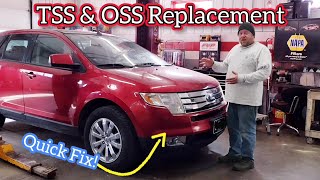
- Replacing external speed sensors (TSS/OSS) without addressing the range sensor. While other sensor failures can cause shifting issues, P0706 specifically points to the range sensor circuit. The TSS/OSS sensors are often part of the same failing lead frame assembly, which can cause confusion. 🎬 Watch: How to replace the TSS and OSS sensors on a Ford Edge
Most Likely Causes
- Internal Transmission Range Sensor (TRS) Failure 🔴 High Probability → Shop Transmission Assembly Ford TSB 13-5-27 was issued for 2009-2011 models due to high resistance in the internal digital TR sensor, indicating a known design or manufacturing issue. This part is also referred to as the lead frame or internal mode switch. Earlier 2007-2008 models were also subject to a TSB (07-21-11) for internal sensor shorting on the same lead frame assembly.
How to confirm: A professional technician will use a diagnostic scan tool to monitor the sensor's output while shifting gears. The TSB outlines a procedure to measure resistance across specific pins on the transmission connector (C168); a reading above 5 Ohms between pin 8 and pins 4, 5, 6, or 7 indicates a faulty sensor.
Typical fix: The transmission side cover and valve body must be removed to replace the internal Transmission Range Sensor/lead frame. The transmission fluid must be drained and refilled with the correct type (e.g., Motorcraft MERCON LV). This is a significant labor-intensive repair.
Est. part cost: $150-$300 for the sensor/lead frame assembly
Rare But Worth Checking
- Damaged Wiring or Connector: While less common than sensor failure on this platform, the wiring harness leading to the transmission can become damaged from road debris or corrosion, causing an identical code. A visual inspection of the main transmission connector (C168) and harness is a wise first step. A mechanic report in NHTSA ODI #11470882 suggested that moisture in the electrical system could potentially trigger these range sensor codes.
- Powertrain Control Module (PCM) Fault: In very rare cases, the module that reads the sensor's signal can fail. This should only be considered after the sensor and wiring have been definitively ruled out as the cause.
- Dirty or Low Transmission Fluid: → Shop Transmission Assembly Extremely dirty or contaminated fluid can potentially interfere with the operation of internal components, though it is more likely to cause other shifting problems before triggering a specific P0706 code.
Diagnosis Steps
- Connect a professional OBD-II scanner capable of reading transmission data.
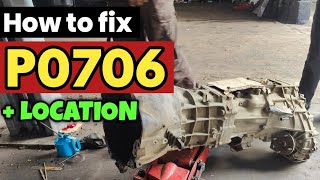
- Verify P0706 and any other related codes are present, paying close attention to P0720 or P0722. 🎬 See this helpful video explaining the P0706 code and its symptoms In some instances, you may also see P0707, P1702, or P1921 (as noted in NHTSA ODI #11650215).
- Monitor the live data stream for the Transmission Range Sensor (TRS) PIDs (e.g., TR_D, TR_V). Observe the readings as you move the gear selector through P, R, N, D, L. The readings should be stable and correspond correctly to each gear position.
- If the signal is erratic, missing, or incorrect, perform a thorough visual inspection of the main transmission electrical connector (C168) and the associated wiring harness for corrosion, moisture, or pushed-out pins.
- Following the procedure in TSB 13-5-27, disconnect connector C168 from the transmission. Measure the resistance between the transmission connector pin 8 and pins 4, 5, 6, and 7. If any of these four measurements is over 5 Ohms, the internal TRS is faulty and must be replaced.
- If the sensor and wiring test good, the issue may be a rare PCM fault, which requires advanced diagnostics.
Parts You'll Likely Need
- Transmission Range Sensor / Lead Frame Assembly
(OEM #AE5Z-7H557-A (superseded by newer numbers like 9E9Z-7H557-B for some applications))— This is the component identified in a Ford TSB as the primary cause of the fault. It fails internally, causing incorrect gear position signals. Dealerships often recommend replacing the molded lead frame along with the main control and gaskets (NHTSA ODI #11650215).
Trusted brands: Motorcraft, Dorman
OEM price range: $200-$300
Aftermarket price range: $150-$250 - Transmission Fluid
(OEM #Motorcraft MERCON LV Automatic Transmission Fluid)— The transmission fluid must be drained to perform the repair and should be replaced with new fluid meeting Ford's specifications.
Trusted brands: Motorcraft, Valvoline, Castrol
OEM price range: $8-$12 per quart
Aftermarket price range: $7-$10 per quart
Related Codes That Often Appear With This One
- P0705 — This code indicates a malfunction in the same Transmission Range Sensor circuit and often appears alongside P0706.
- P0707 — This code for 'Transmission Range Sensor Circuit Low Input' points to the same sensor and wiring harness, indicating a specific type of electrical fault. NHTSA ODI #11725706 notes this as a common companion code that makes the vehicle feel unsafe and unstable to drive.
- P0708 — This code for 'Transmission Range Sensor Circuit High Input' also points to the same sensor and wiring, but for a high voltage condition.
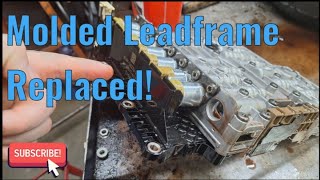
- P0720 / P0722 — These codes for the Output Shaft Speed (OSS) sensor are frequently seen with P0706. This is because the OSS sensor is integrated into the same molded lead frame assembly as the Transmission Range Sensor. The presence of these codes strongly suggests the entire lead frame has failed.
Technical Service Bulletins (TSBs) & Recalls
- TSB 13-5-27: Addresses intermittent slipping, neutral-out, 5th gear starts, backup camera staying on, and other issues on 2009-2011 Edge, Flex, Taurus, MKX, MKS, and MKT models with the 6F50/6F55 transmission due to high resistance in the digital TR sensor.
Platform-Specific Known Issues
- The Transmission Range Sensor is located inside the transmission on the valve body, making replacement a complex and labor-intensive job that is not suitable for most DIY repairs.
- Accessing the transmission side cover may require removing the driver-side wheel, wheel well liner, and potentially loosening the subframe for clearance.
Mechanic-Grade Diagnostic Values
- Digital TR Sensor Resistance Check (per TSB 13-5-27) — expected: Less than 5.0 Ohms. Failure: A resistance reading greater than 5.0 Ohms on any of the four checks.
- Digital TR Sensor State Logic — expected: A specific combination of Open/Closed states for four circuits (TR1-TR4) for each gear position.. Failure: Any deviation from the expected state combination for a given gear selection, as viewed on a scan tool. For example, in Park, the expected state is TR1(Closed), TR2(Open), TR3(Open), TR4(Closed).
Hidden / Shadow Codes Worth Checking
- P0720 / P0722: These codes for the Output Shaft Speed (OSS) sensor circuit are not 'shadow codes' but are critical companion codes. Because the OSS and TRS are integrated into the same molded lead frame, seeing P0706 with P0720/P0722 provides extremely high confidence that the entire lead frame assembly is the root cause of the failure. (see via Any professional OBD-II scanner capable of reading transmission control module codes.)
Scan Tool Commands That Help
- Ford IDS (or equivalent high-level scanner): Live Data PID Monitoring (TR_V, TR_D, TR_DC, TR_FREQ) — This is the primary diagnostic step to observe the raw data from the range sensor in real-time as the shifter is moved. Erratic or illogical readings confirm a fault in the sensor or circuit.
- Ford IDS (or equivalent high-level scanner): Reset Adaptive Memory / TCM Keep Alive Memory — This procedure should be performed after replacing the lead frame/valve body to clear learned shift strategies and allow the TCM to relearn with the new component. Failure to do so can result in poor shift quality after the repair.
Wiring & Ground Locations
- C168 — The main external electrical bulk connector on the 6F50 transmission case.. This is the primary connection point for all internal transmission electronics, including the Transmission Range Sensor. TSB 13-5-27 specifies testing resistance at pins 4, 5, 6, 7, and 8 of this connector to diagnose the sensor.
- C175T — One of the main connectors at the Powertrain Control Module (PCM).. Advanced diagnostics for ruling out a wiring break between the transmission and the computer involve checking for continuity between pins at C168 and the corresponding pins at C175T (e.g., C168-15 to C175T-50).
Real Owner Repair Stories
- Ford F150 Forum user (2012 Ford F-150 with 6R80 transmission (similar lead frame design)) — Transmission fault requiring lead frame replacement.
❌ Tried (didn't work) Awaiting an OEM part from the dealership, which was quoted at over $3,000 with a potential 6-month wait.
✅ What actually fixed it The owner self-installed a Dorman-branded aftermarket lead frame assembly. They reported the part performed just like OEM with no issues, saving significant time and money. - NHTSA Report — An owner reported that their vehicle failed to start due to a transmission range sensor fault, with the diagnostic tool showing codes P0706 and P0707 (NHTSA ODI #11337934).
OEM Part Supersession History
AE5Z-7H557-A→9E9Z-7H557-B (and potentially others)— Part revision to address reliability issues.
Heads up: The OEM part has faced significant backorders, making aftermarket alternatives like Dorman a necessary option for many. While some aftermarket parts work, quality can be inconsistent.
Model Year Variations Within This Range
- 2009-2011 (build dates 3/13/2009 - 6/30/2010): These specific models are covered by TSB 13-5-27, which identifies the failure mode as high resistance in the digital TR sensor. The diagnostic procedure of checking for >5 Ohms is specific to this issue.
- 2007-2008 (build dates before 10/21/2007): These earlier models were subject to TSB 07-21-11, which addressed intermittent shorts in the internal TSS and OSS sensors, which are part of the same lead frame assembly. This indicates a different, but related, failure pattern on the same component for earlier years.
Diagnostic Flowchart
Other Known Issues on This Vehicle
Issues unrelated to this code that are worth knowing about as an owner of this generation:
- Power Transfer Unit (PTU) Failure 🔴 High — Common on AWD models. The unit is located near the hot exhaust with no drain plug, causing the fluid to cook and break down, leading to gear failure. Failures can occur as early as 50,000-75,000 miles.
- Faulty Brake Booster 🟠 Medium — Prevalent in 2007-2015 models, a tear in the internal diaphragm causes a hard or spongy brake pedal and a hissing noise. (Ref: Ford Customer Satisfaction Program 13N02, Recall 23S12 for some years)
- Door Ajar Sensor Failure 🟡 Low — A very common annoyance, particularly on 2011-2013 models. A faulty switch in the door latch causes the 'door ajar' light to stay on, preventing doors from locking and leaving the interior lights on.
- Internal Water Pump Failure (3.5L/3.7L V6) 🔴 High — The water pump is located internally and is driven by the timing chain. When it fails, it can leak coolant directly into the engine oil, leading to catastrophic engine failure if not caught immediately. This is an expensive preventative or corrective repair.
- Cabin Water Leaks 🟠 Medium — Reported in 2007-2014 models, water can leak into the cabin through seals around the doors, windshield, or liftgate, potentially causing mold and electrical issues.
Used vs. New Parts: Buying Guide for This Vehicle
When a used part is the smart pick: Almost never. A used lead frame is a very high-risk purchase. The part has a known high failure rate and the labor to install it is substantial. A used part should only be considered as a last resort if no new OEM or aftermarket parts are available and the vehicle is otherwise inoperable.
Donor-vehicle mileage cap: roughly under 50000 miles for the part to have meaningful remaining life.
What to inspect on the donor part:
- Verify the donor vehicle's mileage, if possible.
- There are no reliable visual cues for an internal electronic part. The purchase is based entirely on trust in the seller and the donor vehicle's history.
OEM-only on this vehicle (don't cheap out):
- Molded Lead Frame Assembly. Motorcraft is the recommended brand for highest reliability, though availability has been a major issue.
Aftermarket brands forum-validated for this vehicle:
- Dorman: Often the only available alternative to a backordered OEM part. Forum reports indicate successful installations, but it is generally considered a step below OEM in terms of expected longevity.
Brands owners have reported issues with on this vehicle:
- Unbranded, 'white-box' parts from online marketplaces should be avoided. The complexity of the part and the high cost of labor make it unwise to use a part with no brand reputation or warranty support.
Real Owner Stories
Aggregated from forums and TSBs cited above. Mileages and costs reflect what owners reported in those sources.
2013 Ford Edge 2.0 Ecoboost
Symptoms: Check engine light with codes P0706, P0707, and P1702.
What fixed it: The user identified the codes as pointing to a faulty transmission range sensor.
Source hint: fordedgeforum.com thread titled 'TRS P0706, P0707 - 2.0L EcoBoost - Ford Edge Forum'
2007 Ford Edge
Symptoms: Wrench light, limp mode, and no-start conditions; required internal transmission sensor repair.
What fixed it: Replacement of internal transmission sensors (TSS/OSS) and a throttle body.
Cost: $1,900
Source hint: fordedgeforum.com - 'TSS & OSS sensor repair cost?'
Manufacturer Service Bulletin Case
Symptoms: A wrench light appeared on the dashboard when a downshift occurred. A dealership diagnosis confirmed error codes P0706, P0707, P1702, and P1921.
What fixed it: The dealership recommended replacing the molded lead frame along with the main control, gaskets, transmission filter, and fluid (NHTSA ODI #11650215).
Documented NHTSA Reports
NHTSA ODI #11694428 describes a dangerous scenario where a vehicle experienced a sudden downshift at 50mph accompanied by a wrench icon; the rear tires locked up, and subsequent scanning revealed codes P0706 and P0707. Another report, NHTSA ODI #11725706, highlights that these range sensor codes can make a vehicle feel unstable to drive at higher mileages, such as 130,000 miles. Additionally, NHTSA ODI #11337934 confirms that a transmission range sensor fault can lead to a total vehicle failure to start.
Related OBD-II Codes
Frequently Asked Questions
Does TSB 13-5-27 apply to my 2011 Ford Edge with the 6F50 transmission?
Can I just replace the Transmission Range Sensor myself on my 2008 Edge?
Why does my Ford Edge start in Neutral but not in Park?
Is there a specific test to confirm the sensor is bad before I pay for the expensive labor?
Should I buy a used lead frame assembly to save money on my 2013 Edge repair?
Could my backup camera staying on while I'm driving forward be related to P0706?
Helpful Videos
We Have This Part in Stock

The information in this article is provided for general reference and educational purposes only. Vehicle specifications, procedures, and part compatibility can vary by production date, trim level, and region. Always consult your vehicle's factory service manual and verify part numbers before purchasing or performing repairs. Safety-critical components such as airbags, seat belts, and braking systems should be installed by a qualified professional.
- Ford Edge:
- 🧭 Diagnostic Flowchart
- 🎬 Helpful Videos
- 🛍️ Shop This Part
- What's Unique About the 2007-2014 Ford Edge
- Symptoms You May Notice
- Most Likely Causes
- Rare But Worth Checking
- Diagnosis Steps
- Parts You'll Likely Need
- Related Codes That Often Appear With This One
- Technical Service Bulletins (TSBs) & Recalls
- Platform-Specific Known Issues
- Mechanic-Grade Diagnostic Values
- Hidden / Shadow Codes Worth Checking
- Scan Tool Commands That Help
- Wiring & Ground Locations
- Real Owner Repair Stories
- OEM Part Supersession History
- Model Year Variations Within This Range
- Other Known Issues on This Vehicle
- Used vs. New Parts: Buying Guide for This Vehicle
- Real Owner Stories
- 2013 Ford Edge 2.0 Ecoboost
- 2007 Ford Edge
- Manufacturer Service Bulletin Case
- Documented NHTSA Reports
- Related OBD-II Codes
- Frequently Asked Questions
- 🎟️ Get 5% Off