

P0706 on 2008-2012 Ford Escape Hybrid: Transmission Range Sensor Causes and Fixes
On a 2008-2012 Escape Hybrid, code P0706 is most often caused by a faulty Transmission Range Sensor (TRS). This can lead to a no-start condition or erratic shifting. Replacing the sensor is the most common fix, costing around $60-$160 for the part. The sensor is located on the outside of the transmission, but can be difficult to access.
- P0706 on your Escape Hybrid almost always points to the Transmission Range Sensor (TRS) or its wiring.
- Symptoms are serious and can include the vehicle not starting or getting stuck in gear.
- The most likely fix is to replace the sensor. The OEM part is Ford GN1Z-7H557-B or Motorcraft SW6274.
- Before replacing parts, check the sensor's wiring and connector for corrosion or damage, and ensure the 12V battery is fully charged and healthy.
- If you've recently had cooling system work done, be aware that coolant may have spilled onto the sensor, causing it to fail.
What's Unique About the 2008-2012 Ford Escape Hybrid
The 2008-2012 Ford Escape Hybrid uses an electronically controlled continuously variable transmission (eCVT) where accurate gear position data is critical for coordinating the gas engine and electric motor. A common issue on the related V6 Escape of the same generation is the location of the range sensor; it sits below the thermostat housing, making it vulnerable to coolant contamination during cooling system repairs, which can cause premature failure. Forum posts confirm this is also a problem on the Hybrid model, as the sensor is in a similar location and can be drenched in coolant during a thermostat or hose replacement, leading to failure.
Symptoms You May Notice
- Check Engine Light is on
- Vehicle will not start
- Engine only starts in Neutral, but not Park (or vice-versa)
- Incorrect gear selection displayed on the instrument cluster
- Delayed or harsh gear engagement
- Vehicle enters 'limp mode' with reduced power
- Reverse lights do not work
- Transmission gear indicator (PRNDL) on the dash may not light up or be incorrect
- Replacing the transmission valve body when the issue is a simple external sensor or wiring problem.
- Replacing the entire transmission when only the range sensor is faulty.
- Mistaking a no-start symptom for a failed starter motor or battery when it's the TRS preventing the start signal.
Most Likely Causes
- Faulty Transmission Range Sensor (TRS) 🔴 High Probability → Shop Transmission Assembly The sensor is an electronic component subject to wear and failure from heat cycles and vibration over time. Its location on the Escape engine makes it highly susceptible to fluid contamination from coolant when servicing the nearby thermostat housing, which can accelerate failure. Water intrusion from the elements can also cause internal corrosion.
How to confirm: Using a scan tool, monitor the sensor's output (PRNDL state) while moving the gear shifter. If the reading is erratic, incorrect, or doesn't change, the sensor is likely bad. You can also test the sensor's output voltage at the connector with a multimeter, comparing it to the vehicle's service manual specifications for each gear position. A visual inspection of the old sensor after removal may show signs of water or coolant intrusion.
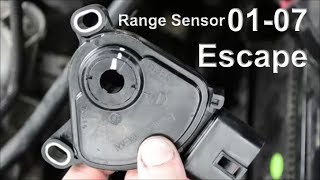
Typical fix: Replace the Transmission Range Sensor. This involves locating it on the side of the transmission, which often requires draining the engine coolant and removing the air intake ducting and thermostat housing for access. After disconnecting the linkage and electrical connector, the old sensor is unbolted and the new one is installed. 🎬 Watch: This walkthrough shows the sensor location and replacement process. The new sensor may require alignment.
Est. part cost: $60 - $160 - Damaged Wiring or Corroded Connector 🟡 Medium Probability The wiring harness leading to the transmission is exposed to road debris, moisture, and heat, which can cause wires to fray, break, or the connector pins to corrode. The connector itself can be damaged by coolant during thermostat service.
How to confirm: Visually inspect the entire wiring harness from the TRS to the PCM/TCM for any signs of damage, melting, or corrosion. Unplug the connector and check for bent, loose, or corroded pins. Perform a continuity test on each wire with a multimeter.
Typical fix: Repair the damaged section of wiring or replace the connector pigtail. Clean any corrosion from the connector pins using an electronic contact cleaner. Ensure the connector is dry and sealed upon reinstallation.
Est. part cost: $15 - $50 - Misaligned Transmission Range Sensor or Shift Linkage ⚪ Low Probability → Shop Transmission Assembly This typically occurs after a transmission replacement or other service where the shift linkage or sensor was disconnected. If not reinstalled and aligned correctly, it will send incorrect signals.
How to confirm: Check if the vehicle starts in Neutral but not Park. This is a classic sign of misalignment. Visually inspect the alignment marks on the sensor and transmission body. A common procedure is to place the shifter in Neutral, then align the marks on the sensor before tightening the bolts.
Typical fix: Loosen the sensor's mounting bolts and adjust its rotational position until the correct gear is reported to the PCM, then retighten. This often requires a helper or a scan tool to confirm the correct gear is being read in real-time. A common field method is to put the vehicle in reverse and rotate the sensor until the reverse lights come on, then tighten it down.
Est. part cost: $0
Rare But Worth Checking
- Failing Transmission Control Module (TCM): → Shop Transmission Assembly While rare, the TCM itself can fail and misinterpret a perfectly good signal from the sensor. This should only be considered after the sensor, wiring, and alignment have been definitively ruled out. Other transmission-related codes are often present when the TCM is at fault.
- Low 12V Battery Voltage: A weak or failing 12-volt battery can cause a multitude of seemingly unrelated electronic issues in modern vehicles, including erratic signals from various modules. Before complex diagnostics, ensure the battery and charging system are healthy.
Diagnosis Steps
- Scan for all codes in the PCM and TCM. Note any other codes that are present, especially P0705, P0707, or P0708.
- Check the 12V battery's health and system voltage. Ensure it is stable and within specification (typically above 12.4V with the engine off).
- With a scan tool, view the live data for the Transmission Range Sensor (PRNDL input).
- Slowly move the gear shifter through all positions (P, R, N, D, L). The scan tool display should match the shifter position instantly and without flickering.
- If the data is incorrect or erratic, proceed to inspect the sensor and wiring. If the data is stable and correct, the issue may be intermittent or elsewhere in the system.
- Gain access to the sensor. On the 2.5L engine, this likely involves removing the air filter housing, battery and tray, and the thermostat housing, which requires draining coolant.
- Visually inspect the TRS connector and wiring harness for any signs of corrosion, coolant contamination, damage, or loose connections.
- If wiring appears intact, test the sensor. This may involve checking for reference voltage and ground at the connector, and then measuring the sensor's output signal on the appropriate wire as you move the shifter. Compare these readings to the service manual specifications.
- If the sensor and wiring test good, check the mechanical shift linkage for looseness or damage and verify the sensor's alignment.
- If all external components are verified to be good, the problem may lie within the Transmission Control Module (TCM).
Parts You'll Likely Need
- Transmission Range Sensor
(OEM #GN1Z-7H557-B)— This is the electronic sensor that fails most frequently, causing the P0706 code. The OEM part number GN1Z-7H557-B supersedes older versions like 9L8Z-7H557-A, 9L8Z-7H557-C, and GN1Z-7H557-A.
Trusted brands: Motorcraft (SW6274), Standard Motor Products (NS319), Dorman (926-900)
OEM price range: $115 - $185
Aftermarket price range: $50 - $100
Related Codes That Often Appear With This One
- P0705 — P0705 indicates a general malfunction in the TRS circuit, while P0706 points to a performance issue. They are closely related and can appear together if the sensor signal is completely lost or highly erratic.
- P0707 — This code indicates 'Transmission Range Sensor Circuit Low Input,' meaning the signal voltage is below the expected range. It points to a specific type of electrical failure within the same circuit as P0706.
- P0708 — This code indicates 'Transmission Range Sensor Circuit High Input,' the opposite of P0707. Its presence with P0706 suggests an intermittent short to power or a failing sensor sending erratic high and low signals.
Platform-Specific Known Issues
- Coolant Contamination During Thermostat Service: A YouTube video for a Ford Escape V6 shows that the TRS is located directly below the thermostat housing. When the housing is removed for service, it's very easy to drench the sensor and its electrical connector in coolant, which can cause the sensor to fail shortly after. A forum post about a non-hybrid Escape confirms the difficult location and the need to remove the thermostat housing to access the sensor. This is a critical point of context for DIYers or technicians performing cooling system work on this engine family.
Mechanic-Grade Diagnostic Values
- Scan Tool PID: TR_FREQ (Transmission Range Sensor Frequency) — expected: 100 to 150 Hz. Failure: A reading outside of this frequency range indicates a problem with the sensor or its circuitry.
- Scan Tool PID: TR_DC (Transmission Range Sensor Duty Cycle) — expected: Varies by gear position (e.g., Park: 8-12%, Reverse: 18-22%, Neutral: 28-32%, Drive: 38-42%). Must be compared to the specific chart in the service manual.. Failure: Duty cycle does not match the chart for the selected gear, or is erratic while wiggling the harness.
- TR Sensor Reference Voltage — expected: Greater than 10 volts. Failure: Voltage below 10V suggests a wiring or PCM issue.
- TR Sensor Circuit Resistance to Ground — expected: Greater than 10,000 ohms. Failure: Resistance below 10,000 ohms indicates a short to ground in the harness.
Scan Tool Commands That Help
- Ford IDS (or equivalent): Live Data Monitoring of PIDs: TR_DC and TR_FREQ — This is the primary diagnostic method for P0706. It allows the technician to see the raw frequency and duty cycle output from the sensor in real-time as the shifter is moved. Wiggling the harness while monitoring these PIDs can expose intermittent connection issues that a static multimeter test would miss.
- Ford IDS (or equivalent): Key ON Engine OFF (KOEO) and Key ON Engine Running (KOER) Self-Tests — These are general diagnostic commands that should be run at the start of any diagnosis. They can reveal other related DTCs that are not immediately apparent and help build a complete picture of the vehicle's electronic health before focusing on the P0706 code.
Wiring & Ground Locations
- G101 — Located at the left rear of the engine.. This ground point serves the Engine Control Module (ECM) and Transmission Control Module (TCM). A poor connection here can cause erratic behavior and fault codes for multiple systems, including the transmission range sensor.
- G104 — Located on the left front of the engine compartment, near the battery junction box.. This is a major chassis ground point in the engine bay. While not directly tied to the TRS, a corroded or loose G104 can introduce electrical noise and unstable voltages to various systems, potentially causing intermittent and hard-to-diagnose sensor faults.
- C168a / C175T — C168a is the main transaxle vehicle harness connector. C175T is the corresponding connector at the PCM.. These are the primary connectors for the TRS circuit between the transmission and the PCM. Pinpoint tests require checking for continuity, shorts, and voltage at specific pins within these connectors to isolate a fault to the wiring, the sensor, or the PCM.
Real Owner Repair Stories
- Ford Truck Enthusiasts Forum (2003 Ford Escape (Note: Earlier generation, but same sensor function and similar symptoms)) — Intermittent shifting in and out of gear, flashing O/D light, Check Engine Light with code P0708 (TRS Circuit High Input), sometimes would not go into reverse.
❌ Tried (didn't work) Replaced the Transmission Range Sensor with a new Ford part (worked for two weeks)., Took to a transmission shop, who could not replicate the fault during test drives., Took to an auto electric shop, who inspected the harness and found no visible problems., Replaced the TRS a second time, along with the connector pigtail (worked for two months).
✅ What actually fixed it The user's post ends without a final resolution, highlighting a common scenario where replacing the sensor and connector does not fix a deeper, intermittent wiring issue. This story serves as a cautionary tale that repeated sensor failures often point to a wiring harness problem that is difficult to find.
Documented NHTSA Reports
- An owner reported a "wrench" icon appearing on the dashboard during downshifts, which was diagnosed as P0706 and P0707; the dealership recommended replacing the molded lead frame with main control (NHTSA ODI #11650215).
- NHTSA ODI #11458070 describes a scenario where the shift indicator light would flash and go off, accompanied by P0706 and P0707 codes, resulting in the vehicle shifting erratically or quitting altogether.
- A report filed under NHTSA ODI #11681756 notes that the dashboard display would lose track of what gear the vehicle was in, with codes P0706 and P0707 appearing randomly.
- NHTSA ODI #11725706 describes a vehicle that became unsafe and unstable to drive when the transmission range sensor "A" circuit reported a low input (P0707) alongside P0706.
- A manufacturer report (NHTSA ODI #11728628) mentions a failed transmission lead frame causing intermittent loss of gear engagement and sudden shift issues associated with DTCs P0706 and P0707.
OEM Part Supersession History
9L8Z-7H557-A→GN1Z-7H557-B— Part has been updated and revised by the manufacturer over time.9L8Z-7H557-C→GN1Z-7H557-B— Part has been updated and revised by the manufacturer over time.GN1Z-7H557-A→GN1Z-7H557-B— Part has been updated and revised by the manufacturer over time.
Model Year Variations Within This Range
- 2008: The 2008 model year (both hybrid and non-hybrid) used the older 4-speed 4F27E automatic transmission or the eCVT. From 2009-2012, non-hybrid models switched to the 6-speed 6F35 transmission, while the Hybrid continued with the eCVT. While the P0706 code can occur on all, the specific sensor part and diagnostic procedures for the 6F35 can differ slightly from the eCVT.
Diagnostic Flowchart
Other Known Issues on This Vehicle
Issues unrelated to this code that are worth knowing about as an owner of this generation:
- Motor Electronics Coolant System (MECS) Pump Failure 🔴 High — Very common. A recall (14S19) was issued for 2005-2008 models, but the issue persists in later models not covered by the recall. Failure can occur anywhere from 50,000 miles onward. (Ref: NHTSA Recall 14V526000 (Ford 14S19) for 2005-2008 models. TSB 08-24-5 also addresses this.)
- Cracked/Corroded Front ABS Tone Rings 🟠 Medium — Common, especially in regions with road salt. Corrosion builds up under the ring on the CV axle, causing it to crack and send erratic speed signals to the ABS module.
- Failing Blend Door Actuators 🟡 Low — Very common across all Escape models of this generation. Owners report a clicking or percolating sound from the dash or rear cargo area (for the battery cooling blend door).
- Transmission Failure (Non-Hybrid Models) 🔴 High → Shop Transmission Assembly — While this article is for the Hybrid, it's notable that the conventional automatic transmissions in 2008-2009 non-hybrid Escapes are frequently reported to fail at higher mileage.
Used vs. New Parts: Buying Guide for This Vehicle
When a used part is the smart pick: A used Transmission Range Sensor is generally not recommended. It is an electronic component exposed to significant heat and potential fluid contamination. The cost savings are minimal compared to the labor required for access, and the risk of premature failure of the used part is high. It is only a viable option if pulling from a known-good, very low-mileage vehicle as a last resort.
Donor-vehicle mileage cap: roughly under 30000 miles for the part to have meaningful remaining life.
What to inspect on the donor part:
- Ensure the donor vehicle did not have any transmission-related trouble codes.
- Inspect the area around the sensor on the donor vehicle for signs of coolant or oil leaks.
- Check the electrical connector pins for any signs of corrosion, moisture, or damage before removal.
Aftermarket brands forum-validated for this vehicle:
- Motorcraft (OEM)
- Standard Motor Products (SMP)
- Dorman
Brands owners have reported issues with on this vehicle:
- No-name or unbranded parts from online marketplaces should be avoided due to inconsistent quality control and high failure rates for electronic components.
Real Owner Stories
Aggregated from forums and TSBs cited above. Mileages and costs reflect what owners reported in those sources.
2001 Ford Escape XLT
Symptoms: Owner described a difficult replacement process for the neutral safety switch/transmission range sensor due to the location.
What fixed it: Replacement of the TRS, which required removing the battery, air duct, and thermostat housing, including draining the coolant.
Source hint: Ford Truck Enthusiasts - '2001 escape xlt neutral safety switch/transmission range sensor'
Ford Escape V6 (Engine Family Context)
Symptoms: P0708 code; sensor failure attributed to fluid exposure.
What fixed it: Replacing the sensor that had been drenched in coolant during a previous thermostat housing repair.
Source hint: YouTube - 'P0708: transmission range sensor circuit high FIX easy repair Ford Escape and others'
Related OBD-II Codes
Frequently Asked Questions
Why did my Ford Escape Hybrid start acting up right after I had the thermostat housing replaced?
My 2008 Escape Hybrid won't start in Park, but it starts in Neutral. Is the sensor broken?
Is there a specific part number for the replacement sensor on my 2008-2011 Mercury Mariner Hybrid?
What components do I need to remove to access the TRS on the 2.5L Duratec engine?
Can I align the sensor myself without a high-end scan tool?
Is there a recall for the cooling issues that might affect my 2008 Escape Hybrid's electronics?
Helpful Videos
We Have This Part in Stock

The information in this article is provided for general reference and educational purposes only. Vehicle specifications, procedures, and part compatibility can vary by production date, trim level, and region. Always consult your vehicle's factory service manual and verify part numbers before purchasing or performing repairs. Safety-critical components such as airbags, seat belts, and braking systems should be installed by a qualified professional.
- Ford Escape Hybrid:
- 🧭 Diagnostic Flowchart
- 🎬 Helpful Videos
- 🛍️ Shop This Part
- What's Unique About the 2008-2012 Ford Escape Hybrid
- Symptoms You May Notice
- Most Likely Causes
- Rare But Worth Checking
- Diagnosis Steps
- Parts You'll Likely Need
- Related Codes That Often Appear With This One
- Platform-Specific Known Issues
- Mechanic-Grade Diagnostic Values
- Scan Tool Commands That Help
- Wiring & Ground Locations
- Real Owner Repair Stories
- Documented NHTSA Reports
- OEM Part Supersession History
- Model Year Variations Within This Range
- Other Known Issues on This Vehicle
- Used vs. New Parts: Buying Guide for This Vehicle
- Real Owner Stories
- 2001 Ford Escape XLT
- Ford Escape V6 (Engine Family Context)
- Related OBD-II Codes
- Frequently Asked Questions
- 🎟️ Get 5% Off