

P0706 on 2012-2016 Honda CR-V: Transmission Range Sensor Causes and Fixes
On a 2012-2016 Honda CR-V, code P0706 is almost always caused by a faulty Transmission Range Sensor. This can cause a flashing 'D' light, no-start issues, or harsh shifting. Replacing the sensor is the most common fix. The part is different for 2012-2014 5-speed automatic models versus 2015-2016 CVT models. OEM parts cost around $130-$200.
- P0706 on a 2012-2016 CR-V points directly to a problem with the Transmission Range Sensor or its circuit.
- The most common symptoms are a flashing 'D' light, no-start conditions, and erratic shifting.
- It is critical to identify your transmission type: 2012-2014 models have a 5-speed automatic, while 2015-2016 models have a CVT. They use different parts.
- Before replacing the sensor, always inspect the wiring and connector for damage or corrosion, as this can also cause the code.
- The most common fix is replacing the sensor, which is a moderately difficult DIY job that requires careful alignment of the new part.
What's Unique About the 2012-2016 Honda CR-V
The 2012-2016 CR-V range spans two different transmissions, which is a critical detail for this code. The 2012-2014 models use a conventional 5-speed automatic transmission. For these, the P0706 code is a well-documented issue pointing to the externally mounted range sensor. The 2015-2016 models were updated with a direct-injected 'Earth Dreams' engine and a Continuously Variable Transmission (CVT). This CVT uses a different range sensor in a different location. While the root cause is the same (a bad sensor), the specific part number and replacement procedure are different depending on the model year.
Generation note: While the 2012-2016 CR-V is all the fourth generation, it includes a significant mid-cycle refresh for the 2015 model year. 2012-2014 models have a 5-speed automatic transmission. 2015-2016 models have a Continuously Variable Transmission (CVT). The transmission range sensor is different between these two versions, requiring different parts and procedures.
Symptoms You May Notice
- Check Engine Light is on
- Flashing 'D' (Drive) indicator light on the dashboard
- Vehicle will not start
- Engine only starts when the shifter is in Neutral, not Park
- Harsh or delayed gear engagement
- Transmission is stuck in one gear (limp mode)
- Reverse lights do not work
- Inability to shift out of Park
- Replacing the entire transmission when only the external sensor is faulty.
- Replacing the sensor without first inspecting the wiring harness, which can lead to the code returning if a broken wire was the true cause.
- Replacing the starter motor for a no-start condition when the issue is the range sensor preventing the start signal.
Most Likely Causes
- Faulty Transmission Range Sensor (Neutral Safety Switch) 🔴 High Probability → Shop Transmission Assembly The sensor is mounted on the exterior of the transmission, where it is exposed to heat, moisture, and road grime, leading to internal corrosion and failure over time. This is a very common failure point for this generation of CR-V and related Honda models.
How to confirm: With a scan tool, monitor the live data for the transmission range sensor while moving the shifter through each gear. If the displayed gear position is erratic, does not match the shifter's actual position, or jumps between values, the sensor is likely bad. You can also test the sensor's continuity at its electrical connector; a faulty sensor will show an open circuit in one or more gear positions.
Typical fix: Replace the transmission range sensor. It is critical to install and align the new sensor correctly, typically with the transmission in the Neutral position, to ensure the PCM receives the correct signals.
Est. part cost: $40-$240 - Damaged Wiring or Corroded Connector 🟡 Medium Probability The wiring harness leading to the sensor can be damaged by road debris, engine vibration, or corrosion from water and salt, causing an open or shorted circuit. The connector pins themselves can also corrode, leading to a poor connection. On Hondas of this era, engine vibration from worn motor mounts can stress the wiring sub-harness, causing wires to break internally right at the connector.
How to confirm: Visually inspect the wiring harness and the connector pins for any signs of damage, fraying, or green/white corrosion. Perform a continuity test with a multimeter from the sensor connector to the PCM connector to check for breaks in the wire.
Typical fix: Repair the broken wire(s) or clean/replace the corroded connector. In some cases, a new harness pigtail may be needed.
Est. part cost: $10-$50 - Misadjusted Transmission Range Sensor ⚪ Low Probability → Shop Transmission Assembly
How to confirm: This usually occurs after a recent repair. Check if the sensor's alignment marks line up correctly with the transmission in Neutral. If misaligned, the PCM will receive an incorrect signal, even with a new sensor.
Typical fix: Loosen the sensor's mounting bolts and rotate it until it is properly aligned. Honda's procedure often involves inserting a 2.0mm feeler gauge or blade into an alignment cutout on the switch to lock it in the neutral position during installation. Tighten the bolts and verify the correct gear is displayed on the scan tool for each shifter position.
Est. part cost: $0
Rare But Worth Checking
- Low or Dirty Transmission Fluid: → Shop Transmission Assembly While less common for this specific electrical code, very low or contaminated fluid can cause erratic transmission behavior that may, in some cases, trigger range/performance codes. Always check the fluid level and condition as a basic step.
- Faulty Starter Cut Relay: A faulty starter cut relay can cause a no-start condition that mimics a P0706 symptom (car won't start in Park). If the car starts in Neutral but not Park, and the range sensor tests good, the starter cut relay located in the passenger compartment fuse box could be the culprit.
- Faulty Powertrain Control Module (PCM): This is extremely rare. The PCM itself can fail, but this should only be considered after all other possibilities (sensor, wiring, fluid, relays) have been exhaustively ruled out.
Diagnosis Steps
- Connect an OBD-II scanner and confirm P0706 is present. Note any other codes like P0700 or P0705.
- Check the level and condition of the automatic transmission fluid. Top off or change if necessary.
- Using the scanner's live data function, monitor the parameter for the Transmission Range Sensor (TRS).
- Slowly move the gear selector from Park through all gears and back. The scanner should display the correct gear for each position.
- If the reading is erratic, jumps between gears, or doesn't change, proceed with inspecting the sensor and wiring.
- Visually inspect the transmission range sensor's electrical connector and wiring harness for any obvious signs of damage, corrosion, or loose connections.
- Test the sensor's ground circuit. Disconnect the 10-pin sensor connector and check for continuity between terminal 6 and the chassis ground. If there is no continuity, repair the open in the ground wire, which connects to ground point G101.
- If the ground is good, test the wiring between the sensor and the PCM. Disconnect the PCM connector B (a 49-pin connector) and check for continuity between the terminals on the sensor connector and their corresponding terminals on the PCM connector, per the service manual. If there is no continuity, repair the open wire.
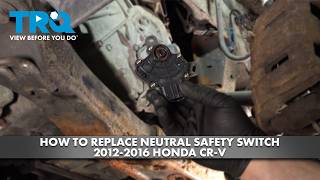
- If all wiring and grounds test good, the sensor itself is the culprit. 🎬 See how to diagnose an open circuit on this sensor. Replace the transmission range sensor.
- After replacement, ensure the new sensor is properly aligned. The common procedure is to put the transmission in Neutral, then insert a 2.0mm blade or feeler gauge into the alignment hole on the new sensor to hold it in place while tightening the mounting bolts. 🎬 Watch: How to align the sensor without using special tools.
- Clear all fault codes and perform a road test, shifting through all gears to confirm the repair.
Parts You'll Likely Need
- Transmission Range Sensor (for 2012-2014 5-Speed AT)
(OEM #28900-RPC-013)— This is the most common failure point for the P0706 code on CR-V models with the 5-speed automatic transmission.
Trusted brands: Honda (Genuine), Dorman, Standard Motor Products (SMP), WVE/NTK
OEM price range: $160-$240
Aftermarket price range: $40-$80 - Transmission Range Sensor (for 2015-2016 CVT)
(OEM #28900-RJ2-003)— This is the correct sensor for the updated CR-V models equipped with the Continuously Variable Transmission (CVT).
Trusted brands: Honda (Genuine), Dorman
OEM price range: $130-$190
Aftermarket price range: $50-$90
Related Codes That Often Appear With This One
- P0705 — P0705 indicates a general malfunction in the same sensor circuit ('Transmission Range Sensor Circuit Malfunction'). P0706 is more specific about a range/performance issue, but they both point to the same component and are often diagnosed together.
- P0700 — P0700 is a generic code from the Transmission Control Module (TCM) that simply means a transmission-related fault has been stored. It acts as a 'heads-up' to check for more specific codes like P0706.
Technical Service Bulletins (TSBs) & Recalls
- While there is no specific TSB for P0706 on this platform, related TSBs for transmission issues exist. TSB 15-086 addresses a 'judder or vibration' on 2012-2014 models, fixed by a software update and fluid change. TSB 15-046 addresses idle vibration on 2015-2016 CVT models. These are separate issues but are important context for transmission health on this vehicle.
Platform-Specific Known Issues
- On crvownersclub.com, a user with a 2013 CR-V described the classic symptoms of a flashing 'D' light and the P0706 code. The issue was resolved by replacing the transmission range sensor (part 28900-RPC-013). The owner noted the repair was straightforward but required careful alignment.
- Another thread on the same forum highlighted a 2012 CR-V that would not start. The owner initially suspected the starter, but after finding the P0706 code, they realized the range sensor was failing to send the 'Park' signal to the PCM. Replacing the sensor fixed the no-start condition.
Mechanic-Grade Diagnostic Values
- Transmission Range Sensor Ground Continuity — expected: Continuity to chassis ground. Failure: No continuity (open circuit). Indicates a break in the ground wire between the sensor and ground point G101.
- Continuity between Sensor Connector and PCM Connector B (49P) — expected: Continuity should exist between the corresponding pins for each signal wire (P, R, N, D, etc.). Failure: No continuity on one or more wires indicates an open circuit in the wiring harness.
- Sensor Alignment Check — expected: With the transmission in Neutral, a 2.0mm object (feeler gauge or drill bit) should slide into the alignment hole on the sensor body.. Failure: The object will not go in, indicating the sensor is rotationally misaligned on the selector shaft.
Scan Tool Commands That Help
- Honda Diagnostic System (HDS): Data List Monitoring (A/T Switches) — This is the primary function used to watch the live status (ON/OFF) of each individual gear position signal (ATP, ATR, ATN, ATD, etc.) as the shifter is moved. An illogical reading confirms a fault in the sensor or circuit.
- Honda Diagnostic System (HDS): Jump SCS Line — This is a specific diagnostic command used to create a controlled state for testing circuit continuity between the sensor connector and the PCM, as part of the official Honda troubleshooting procedure.
Wiring & Ground Locations
- G101 — On the engine block at the left rear of the engine, near the thermostat housing. A bundle of ground wires terminates here.. This is the primary ground termination point for the Powertrain Control Module (PCM) and the Transmission Range Sensor. Corrosion or a loose connection at G101 can cause a floating ground, leading to erratic sensor signals and triggering P0706.
- Transmission Range Sensor Connector — On the front or side of the transmission housing, where the shift linkage connects. It is a 10-pin connector.. This is the main connection point for the sensor. The connector itself and the attached wiring sub-harness are prone to corrosion and vibration damage.
- PCM Connector B (49P) — One of the main connectors on the Powertrain Control Module (PCM) located in the engine compartment.. This connector contains the pins where the signals from the transmission range sensor arrive at the PCM. Continuity tests are performed between this connector and the sensor connector to verify the integrity of the wiring harness.
- Main Transmission Ground Strap — A braided or thick wire strap connecting the transmission case directly to the vehicle's chassis/frame, often near the front subframe.. While G101 is for the sensor circuit, this main ground strap ensures the entire transmission case has a solid ground reference. Corrosion on this strap can cause a variety of electrical issues, including shifting problems and intermittent sensor codes.
Real Owner Repair Stories
- Reddit r/HondaElement user (Honda Element (similar powertrain/electronics to CR-V)) — Check Engine Light with code P0706 returned immediately after clearing.
❌ Tried (didn't work) Replaced the transmission range sensor with an aftermarket part from AutoZone., Replaced the sensor a second time with a genuine Honda OEM part.
✅ What actually fixed it The owner found a broken wire inside the wiring harness right at the connector for the range sensor. The wire was broken internally from stress caused by engine movement due to recently replaced (and likely settling) motor mounts. Soldering the broken wire provided the final fix. - NHTSA ODI #10544028 (Honda Accord - similar powertrain/electronics) — An owner reported the transmission failing due to codes P0705 and P0706. A local dealership suggested a full transmission replacement costing $4800, illustrating how these sensor codes can be misdiagnosed as internal transmission failure.
OEM Part Supersession History
28900-PPV-003, 28900-PPV-013, 28900-RCL-003, 28900-RCR-003, 28900-RPC-003→28900-RPC-013— Part consolidation and potential design revisions over time for the 5-speed automatic transmission sensor.
Model Year Variations Within This Range
- 2012-2014: These models use a 5-speed automatic transmission and require range sensor part number 28900-RPC-013.
- 2015-2016: These models use a Continuously Variable Transmission (CVT) and require range sensor part number 28900-RJ2-003.
Diagnostic Flowchart
Other Known Issues on This Vehicle
Issues unrelated to this code that are worth knowing about as an owner of this generation:
- VTC Actuator Rattle at Cold Start 🟠 Medium — Common on 2012-2014 models with the K24 engine. A loud metallic rattle for 1-3 seconds immediately after a cold start. (Ref: TSB 09-010, TSB 16-012)
- Idle Vibration (2015-2016 CVT Models) 🟡 Low — Widespread complaint on the first CVT models. A noticeable vibration is felt in the cabin when the vehicle is stopped in gear. (Ref: TSB 15-046)
- Transmission Judder/Shudder (2012-2014 5-AT Models) 🟠 Medium → Shop Transmission Assembly — A vibration or shudder felt during light acceleration. Less common than the CVT vibration but well-documented. (Ref: TSB 15-086, TSB 17-040)
- Starter Motor Failure 🟠 Medium — Failures can be intermittent at first, presenting as a no-start condition that may resolve itself temporarily. Affects all years in this generation.
- A/C Compressor Failure 🔴 High — Premature failure of the A/C compressor is a known issue, sometimes leading to debris contaminating the entire system. (Ref: Honda issued a warranty extension for this issue on certain VINs.)
Used vs. New Parts: Buying Guide for This Vehicle
When a used part is the smart pick: A used OEM sensor from a low-mileage junkyard vehicle can be a cost-effective option if you are on a tight budget, but it carries risk. One user reported success with a junkyard part, but it's critical to know what gear the donor car was in (e.g., Park) so you can install it in the same position before attempting alignment.
Donor-vehicle mileage cap: roughly under 80000 miles for the part to have meaningful remaining life.
What to inspect on the donor part:
- Check for a clean connector with no green or white corrosion on the pins.
- Inspect the plastic housing for cracks or signs of extreme heat exposure.
- If possible, find a donor vehicle with front-end damage, which is less likely to have experienced transmission-related issues.
- Ask the salvage yard for the vehicle's mileage if available.
OEM-only on this vehicle (don't cheap out):
- Transmission Range Sensor
Aftermarket brands forum-validated for this vehicle:
- NTK/NGK
- Standard Motor Products (SMP)
Brands owners have reported issues with on this vehicle:
- Unbranded, 'white-box' parts from online marketplaces are frequently cited as being unreliable or failing to resolve the code. While Dorman is a major supplier, owner feedback on their electronic sensors is mixed, with some reporting success and others having issues.
Real Owner Stories
Aggregated from forums and TSBs cited above. Mileages and costs reflect what owners reported in those sources.
2013 Honda CR-V
Symptoms: Flashing 'D' (Drive) indicator light on the dashboard and a P0706 code.
What fixed it: Replacing the transmission range sensor (part 28900-RPC-013) and performing a careful alignment.
Source hint: crvownersclub.com
2012 Honda CR-V
Symptoms: Vehicle would not start; owner initially suspected the starter motor.
What fixed it: Replacing the range sensor after discovering it was failing to send the 'Park' signal to the PCM.
Source hint: crvownersclub.com
Honda Accord Owner (NHTSA ODI #10544028)
Symptoms: The transmission was reported as failing due to codes P0705 and P0706.
What fixed it: While the dealership suggested a $4800 transmission replacement, these codes typically point to the range sensor circuit rather than internal mechanical failure.
Source hint: NHTSA ODI #10544028
Related OBD-II Codes
Frequently Asked Questions
My 2013 CR-V has a flashing 'D' light and P0706; what part do I need?
Why does my 2012 CR-V only start in Neutral but not in Park?
Is there a TSB for the transmission vibration I'm feeling alongside the P0706 code on my 2014 CR-V?
I just replaced the sensor on my Honda but the code is still there. Did I do something wrong?
Can engine vibration cause the P0706 code on this generation of CR-V?
Does the 2015 CR-V with the CVT have the same sensor issues as the older 5-speed models?
Helpful Videos

We Have This Part in Stock


The information in this article is provided for general reference and educational purposes only. Vehicle specifications, procedures, and part compatibility can vary by production date, trim level, and region. Always consult your vehicle's factory service manual and verify part numbers before purchasing or performing repairs. Safety-critical components such as airbags, seat belts, and braking systems should be installed by a qualified professional.
- Honda CR-V:
- 🧭 Diagnostic Flowchart
- 🎬 Helpful Videos
- 🛍️ Shop This Part
- What's Unique About the 2012-2016 Honda CR-V
- Symptoms You May Notice
- Most Likely Causes
- Rare But Worth Checking
- Diagnosis Steps
- Parts You'll Likely Need
- Related Codes That Often Appear With This One
- Technical Service Bulletins (TSBs) & Recalls
- Platform-Specific Known Issues
- Mechanic-Grade Diagnostic Values
- Scan Tool Commands That Help
- Wiring & Ground Locations
- Real Owner Repair Stories
- OEM Part Supersession History
- Model Year Variations Within This Range
- Other Known Issues on This Vehicle
- Used vs. New Parts: Buying Guide for This Vehicle
- Real Owner Stories
- 2013 Honda CR-V
- 2012 Honda CR-V
- Honda Accord Owner (NHTSA ODI #10544028)
- Related OBD-II Codes
- Frequently Asked Questions
- 🎟️ Get 5% Off