

P0706 on 2005-2010 Honda Odyssey: Transmission Range Sensor Causes and Fixes
This code usually means the Transmission Range Sensor (also called a Neutral Safety Switch) has failed. Symptoms include a flashing 'D' light, no-start in Park, and harsh shifting. Replacing the sensor, located on the outside of the transmission, is the most common fix.
- P0706 on a 2005-2010 Odyssey almost always points to a faulty Transmission Range Sensor.
- Key symptoms are a flashing 'D' light and the vehicle not starting when in Park.
- The sensor is located on the outside of the transmission, making it a manageable DIY repair for those with some experience.
- Always check the wiring and connector before replacing the sensor itself.
- Ensure the new sensor is properly aligned in Neutral during installation to prevent further issues.
What's Unique About the 2005-2010 Honda Odyssey
On the 2005-2010 Honda Odyssey, this code is very straightforward. Unlike some vehicles where the sensor is located inside the transmission pan, the Odyssey's range sensor is mounted externally on the transmission case. This makes it significantly easier to access and replace for both DIYers and professional technicians. The issue is common enough that numerous video guides exist showing the exact replacement process for this specific generation of Odyssey.
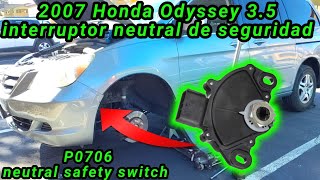
🎬 Watch: Honda Odyssey neutral safety switch replacement guideSymptoms You May Notice
- Flashing 'D' (Drive) indicator light on the dashboard
- Check Engine Light is on
- Vehicle will not start in Park, but may start in Neutral
- Harsh, erratic, or delayed gear engagement
- Gear position indicator on the dashboard is dashboard is blank or incorrect
- Reverse lights do not work
- Vehicle may enter 'limp mode,' stuck in a single gear
- Inability to shift out of Park
- Replacing the transmission solenoid pack. On this Odyssey, the range sensor is a separate, external part and is not integrated into the internal solenoids.
- Condemning the entire transmission. This is a simple sensor or wiring issue far more often than a major mechanical failure.
Most Likely Causes
- Faulty Transmission Range Sensor (Neutral Safety Switch) 🔴 High Probability → Shop Transmission Assembly The internal contacts of the switch wear out over time from repeated shifting, and exposure to heat and moisture under the vehicle degrades the internal components, leading to intermittent or failed signals.
How to confirm: After confirming wiring is intact, test the sensor's output signals with a multimeter while moving the gear selector. The voltage should change predictably for each gear position according to the service manual. A failed test indicates a bad sensor. A scan tool can also monitor the sensor's output in real-time to see if it matches the shifter position.
Typical fix: Replace the transmission range sensor. Some owners have had success opening up the sensor (by drilling out rivets or removing screws), cleaning the internal copper contacts with a pencil eraser or fine-grit sandpaper, applying dielectric grease, and resealing it.
Est. part cost: $45-$150 - Damaged Wiring or Corroded Connector 🟡 Medium Probability The sensor is located under the vehicle and is exposed to moisture, road salt, and debris, which can lead to corrosion in the connector pins or damage to the wiring harness insulation.
How to confirm: Visually inspect the wiring harness and connector leading to the transmission range sensor for any signs of corrosion, frayed wires, or loose pins. Perform a continuity test on the wires between the sensor and the PCM.
Typical fix: Repair the damaged section of wiring or clean the connector terminals carefully. In some cases, a new connector pigtail may need to be spliced in.
Est. part cost: $5-$50 - Misadjusted Transmission Range Sensor ⚪ Low Probability → Shop Transmission Assembly If the sensor has been previously replaced or disturbed, it may not have been aligned correctly. The mounting holes are slotted to allow for precise adjustment.
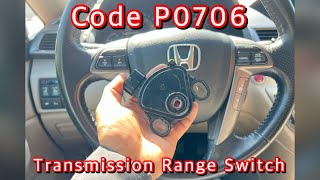
How to confirm: With the gear selector in Neutral, check that the alignment marks on the sensor and the transmission case line up. If they do not, the sensor is misadjusted. A video guide shows this alignment process clearly. 🎬 See: Honda and Acura transmission range switch replacement and alignment
Typical fix: Loosen the sensor's mounting bolts and rotate it until the alignment marks are perfectly aligned, then retighten the bolts. This must be done with the transmission in Neutral.
Est. part cost: $0
Rare But Worth Checking
- Dirty or Low Transmission Fluid: → Shop Transmission Assembly While not a direct cause of an electrical circuit code, very low or degraded fluid can cause erratic transmission behavior that may, in some edge cases, contribute to setting range/performance codes. It should always be checked as a basic maintenance step.
- Faulty Powertrain Control Module (PCM): This is very rare. The PCM should only be considered a potential cause after the sensor, wiring, and connections have been exhaustively tested and proven to be good.
Diagnosis Steps
- Check the level and condition of the automatic transmission fluid. Top off or service if necessary. Honda DW-1 is the specified fluid.
- Scan the PCM for any other transmission-related codes. Address other codes first if present, paying special attention to P0705 or P1717.
- Visually inspect the transmission range sensor, its connector, and the wiring harness for obvious signs of damage, corrosion, or fluid contamination.
- Using a scan tool that can read live data, monitor the sensor's output (often displayed as 'TR_SENS' or similar) as you move the shifter through each gear. Verify that the PCM is reading the correct gear position.
- If the scan tool data is erratic or incorrect, disconnect the sensor.
- Test the sensor's electrical function using a multimeter according to the vehicle's service manual. This typically involves checking for continuity between specific pins for each gear position.
- If the sensor tests good, the problem is likely in the wiring. Check for power, ground, and signal integrity at the sensor connector.
- If the sensor fails the test, it needs to be replaced. Ensure the new sensor is properly aligned upon installation by setting the transmission to Neutral and lining up the scribe marks on the sensor body and the transmission shaft.
- After repairs, clear the code and perform a test drive to ensure the transmission shifts correctly, the gear indicator works, and the code does not return.
Parts You'll Likely Need
- Transmission Range Sensor (Neutral Safety Switch)
(OEM #28900-RGR-003)— This sensor is the most common failure point for code P0706 on this vehicle due to internal wear. The original part may be superseded by 28900-RKE-023.
Trusted brands: Honda (Genuine), Standard Motor Products (NS319), Wells (NS378), Dorman
OEM price range: $120-$180
Aftermarket price range: $45-$90
Related Codes That Often Appear With This One
- P0705 — P0705 indicates a general malfunction in the same Transmission Range Sensor circuit. P0706 is a more specific 'Range/Performance' error, but they often point to the same root cause and faulty part.
- P1717 — This is a Honda-specific code for 'Open in Transmission Range Switch ATPRVS Switch Circuit'. It frequently appears with P0706 and points directly to a failure in the range switch. Some owners report fixing P1717 by simply cleaning the internal contacts of the existing switch.
Technical Service Bulletins (TSBs) & Recalls
- Honda TSB SB-09-053: Addresses a judder from the torque converter lock-up clutch felt between 20-45 MPH. The fix involves a PCM software update to minimize the judder. This is unrelated to P0706 but is a common transmission issue for this platform.
Platform-Specific Known Issues
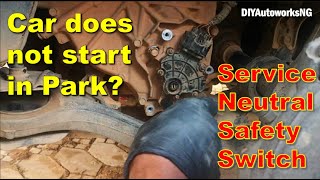
- Owner Experience: Cleaning vs. Replacing for P1717/P0706: A user on Reddit with a 3rd generation Odyssey reported getting code P1717, which is closely related to P0706. Instead of replacing the switch, they removed it, drilled out the five rivets holding it together, and found the internal copper contacts were dirty. After cleaning the contacts and the contact plate, applying dielectric grease, and reassembling with small screws and nuts, the code was resolved. This indicates that for some, the failure is not a broken component but simply dirt and oxidation on the internal contacts, making it a potentially free fix for those willing to do the detailed work. 🎬 Watch: How to clean and service your neutral safety switch
- Forum Repair Story: Intermittent No-Start and Flashing 'D' Light: On Odyclub.com, a common owner complaint begins with an intermittent failure to start in Park, requiring a jiggle of the shifter or shifting to Neutral to get the engine to crank. This is soon followed by the 'D' light flashing while driving and harsh gear engagement. In multiple documented cases, replacing the transmission range sensor (part 28900-RGR-003) and ensuring proper alignment during installation completely resolved all symptoms. This confirms the part as the primary culprit for this specific cluster of symptoms.
Mechanic-Grade Diagnostic Values
- Transmission Range Switch Continuity Test — expected: With the sensor connector unplugged, continuity should exist between specific terminals depending on gear position. For example, in Park (P), there should be continuity between terminals 4 and 5. In Reverse (R), between terminals 4 and 6. A full chart is available in the Honda service manual.. Failure: If continuity does not match the service manual's chart for any given gear position, the switch is faulty.
- Voltage at PCM Connector Pins — expected: With the ignition ON, measure voltage between specific PCM connector pins and ground. For example, on some models, you would measure voltage at pins C9, C10, C11, C12, and C20 while shifting through gears to confirm the PCM is receiving the signal.. Failure: Absence of voltage at the expected pin for a given gear selection points to an open circuit in the wiring between the sensor and the PCM.
Scan Tool Commands That Help
- Honda HDS (Honda Diagnostic System): Live Data Monitoring (Transmission > Data List > TR SENSOR) — This is the primary method to quickly verify the fault. While moving the shifter through P-R-N-D, the technician can watch the live data display on the HDS. The displayed gear should match the shifter position instantly. Any lag, incorrect reading, or glitching confirms a problem in the range sensor circuit, justifying further electrical testing of the sensor and wiring.
Wiring & Ground Locations
- G101 — Typically located on the transmission mount bracket or on the engine block near the transmission.. This is a primary ground point for the engine and transmission assembly. While not directly part of the sensor circuit, a corroded or loose G101 ground can cause a wide range of electrical issues, including erratic sensor readings and transmission problems. It should be inspected, cleaned, and tightened as a preliminary step in diagnosing any electrical fault.
- Transmission Range Sensor Connector — On the front of the transmission, accessible after removing the air filter housing and battery tray.. This is the direct connection point for the sensor. It is exposed to heat and moisture, making it a common point for corrosion or wire fatigue. The pins should be inspected for a green, powdery residue (corrosion) or any signs of being pushed out or damaged.
- PCM Connector A & C — Located in the engine bay, typically near the battery or firewall.. These connectors are the termination point for the range sensor signals at the Powertrain Control Module. Service manuals specify which pins (e.g., A23, A24 for ground, and C9, C10, C11, C12, C20 for gear signals) to back-probe for voltage/continuity tests when diagnosing a wiring harness issue between the sensor and the PCM.
Real Owner Repair Stories
- Odyclub.com forum user (2007 Honda Odyssey EX-L, ~150,000 miles) — Flashing 'D' light, Check Engine Light on with codes P0706 and P1717. Vehicle would sometimes refuse to start in Park, requiring a shift to Neutral. Harsh downshifts when coming to a stop.
❌ Tried (didn't work) Clearing the codes (they returned within a day)., Checking transmission fluid (level and condition were perfect).
✅ What actually fixed it The owner replaced the transmission range sensor (neutral safety switch) with a new OEM part. They noted that after removing the battery and airbox for access, the replacement itself was straightforward. The key was ensuring the new sensor was perfectly aligned in the Neutral position before tightening the bolts. After replacement and clearing the codes, all symptoms disappeared and did not return. - NHTSA ODI #10544028 — While reported on a similar Honda platform, an owner noted the transmission was reported as failing due to codes P0705 and P0706, with a dealership quote of $4800 to replace the entire transmission. This highlights the importance of diagnosing the range sensor first, as it is often misdiagnosed as a total mechanical failure.
OEM Part Supersession History
28900-RGR-003→28900-RKE-023— Standard part evolution, likely for improved durability or manufacturing efficiency. The new part is a direct replacement.
Heads up: There are no known incompatibilities; 28900-RKE-023 is the correct current replacement part for the entire 2005-2010 generation.
Model Year Variations Within This Range
- 2005-2010: While the P0706 code and its primary cause (the range sensor) are consistent across the 2005-2010 generation, there was a minor engine power rating change after 2006 (from 255 hp to 244 hp). However, this had no impact on the transmission hardware, the range sensor part number, or the diagnostic procedure for this code.
Diagnostic Flowchart
Other Known Issues on This Vehicle
Issues unrelated to this code that are worth knowing about as an owner of this generation:
- Variable Cylinder Management (VCM) Issues 🔴 High — Common on EX-L and Touring models. Can manifest as oil consumption, fouled spark plugs, and engine vibrations, often starting after 80,000 miles. A class-action lawsuit was filed over these issues. (Ref: While no specific recall, Honda did issue software updates and warranty extensions for some VCM-related problems like piston ring wear on later generations.)
- Torque Converter Judder / Transmission Shudder 🟠 Medium → Shop Transmission Assembly — A common complaint is a shudder or vibration felt during light acceleration between 20-45 mph. It is often caused by degraded transmission fluid rather than catastrophic failure. (Ref: Honda TSB SB-09-053 addresses this with a PCM software update. A triple drain-and-fill of the ATF is the commonly recommended first step.)
- Power Steering Pump Whine and Hose Leaks 🟠 Medium — Leaks from the high-pressure power steering hose are very common, causing fluid to drip onto the subframe and other components. A whining noise is also common, often caused by a hardened O-ring on the pump inlet allowing air into the system. (Ref: TSB 07-005 addresses a whining noise caused by a faulty reservoir. TSB 11-039 extended the warranty for stiff steering due to pump issues.)
- 5-Speed Automatic Transmission Failure 🔴 High → Shop Transmission Assembly — Particularly prevalent in 2005-2007 models, the 5-speed automatic transmission has a reputation for premature failure, often between 100,000 and 150,000 miles, sometimes due to torque converter issues or internal clutch wear. (Ref: Honda had some warranty extensions, but many failures occurred outside the extended coverage period.)
Used vs. New Parts: Buying Guide for This Vehicle
When a used part is the smart pick: A used transmission range sensor from a junkyard is a poor choice for this repair. The part fails due to internal wear and exposure over time, so a used part has an unknown and likely limited remaining lifespan. Given the relatively low cost of a new aftermarket part and the labor involved in accessing it, installing a used sensor is generally not recommended.
Donor-vehicle mileage cap: roughly under 50000 miles for the part to have meaningful remaining life.
What to inspect on the donor part:
- If buying used is unavoidable, source it from the lowest-mileage vehicle possible.
- Inspect the connector pins for any signs of corrosion (green or white powder).
- Ensure the plastic housing is not cracked or showing signs of extreme heat stress.
- Manually rotate the selector shaft; it should move smoothly with distinct detents, not loosely or with a gritty feeling.
OEM-only on this vehicle (don't cheap out):
- While not strictly 'OEM-only', many forum users report the highest long-term success with the genuine Honda part (28900-RKE-023), making it the most recommended option if the budget allows.
Aftermarket brands forum-validated for this vehicle:
- Standard Motor Products (SMP)
- Wells Vehicle Electronics
- Dorman (often a budget-friendly option with wide availability)
Brands owners have reported issues with on this vehicle:
- Unnamed, no-brand parts from online marketplaces are a gamble and have a higher reported failure rate.
Real Owner Stories
Aggregated from forums and TSBs cited above. Mileages and costs reflect what owners reported in those sources.
2007-2010 Honda Odyssey 3.5L (3rd Generation)
Symptoms: The user reported getting code P1717. Upon inspection, the internal copper contacts of the range switch were found to be dirty and oxidized.
What fixed it: Removed the switch, drilled out the five rivets, cleaned the internal copper contacts and contact plate, applied dielectric grease, and reassembled the unit using small screws and nuts.
Source hint: Reddit r/HondaOdyssey: 'Honda Odyssey 2007 2008 2009 2010 gen 3 transmission range switch is user serviceable... p1717'
2005-2010 Honda Odyssey 3.5L
Symptoms: Intermittent failure to start in Park, requiring a jiggle of the shifter or shifting to Neutral to crank. This progressed to a flashing 'D' light while driving and harsh gear engagement.
What fixed it: Replacing the transmission range sensor (part 28900-RGR-003) and ensuring proper alignment during installation.
Source hint: Odyclub.com forum repair story: 'Intermittent No-Start and Flashing D Light'
2007 Honda Odyssey 3.5L
Symptoms: P0706 code present; vehicle required neutral safety switch replacement.
What fixed it: Replacement of the Neutral Safety Switch (Transmission Range Sensor).
Source hint: YouTube: Jose Mechanics - 2007 Honda Odyssey 3.5 How to Replace the Neutral Safety Switch P0706
Related OBD-II Codes
Frequently Asked Questions
Does Honda TSB SB-09-053 address my P0706 code on my 2005-2010 Odyssey?
Can I repair the transmission range sensor myself instead of buying part 28900-RGR-003?
Why does my Odyssey start in Neutral but not in Park?
What specific transmission fluid should I use when checking for P0706 issues?
How do I know if my range sensor just needs an adjustment instead of replacement?
Helpful Videos

We Have This Part in Stock

The information in this article is provided for general reference and educational purposes only. Vehicle specifications, procedures, and part compatibility can vary by production date, trim level, and region. Always consult your vehicle's factory service manual and verify part numbers before purchasing or performing repairs. Safety-critical components such as airbags, seat belts, and braking systems should be installed by a qualified professional.
- Honda Odyssey:
- 🧭 Diagnostic Flowchart
- 🎬 Helpful Videos
- 🛍️ Shop This Part
- What's Unique About the 2005-2010 Honda Odyssey
- Symptoms You May Notice
- Most Likely Causes
- Rare But Worth Checking
- Diagnosis Steps
- Parts You'll Likely Need
- Related Codes That Often Appear With This One
- Technical Service Bulletins (TSBs) & Recalls
- Platform-Specific Known Issues
- Mechanic-Grade Diagnostic Values
- Scan Tool Commands That Help
- Wiring & Ground Locations
- Real Owner Repair Stories
- OEM Part Supersession History
- Model Year Variations Within This Range
- Other Known Issues on This Vehicle
- Used vs. New Parts: Buying Guide for This Vehicle
- Real Owner Stories
- 2007-2010 Honda Odyssey 3.5L (3rd Generation)
- 2005-2010 Honda Odyssey 3.5L
- 2007 Honda Odyssey 3.5L
- Related OBD-II Codes
- Frequently Asked Questions
- 🎟️ Get 5% Off