

P0706 on 2009-2015 Honda Pilot: Transmission Range Sensor Causes and Fixes
On a 2009-2015 Honda Pilot, code P0706 is most often caused by a faulty transmission range sensor. Expect to pay around $75-$120 for an OEM sensor and another $100-$200 for labor if you take it to a shop. It is a manageable DIY repair (2/5 difficulty).
- P0706 on a 2009-2015 Pilot is almost always caused by a bad transmission range sensor.
- A flashing 'D' on your dashboard is your Honda's way of telling you there's a transmission fault; don't ignore it.
- The replacement part is relatively inexpensive, and the repair is accessible for a DIYer with basic tools.
- Before replacing any parts, always check the sensor's wiring and connector for corrosion or damage, as this can be a simple fix.
- Ensure the replacement sensor is properly adjusted; misalignment can cause the code to return.
What's Unique About the 2009-2015 Honda Pilot
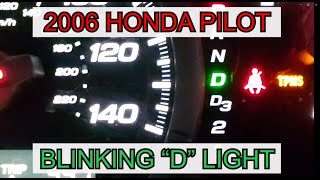
On Honda vehicles like the Pilot, transmission-related electrical faults often present with a unique and very noticeable symptom: a blinking 'D' (Drive) indicator light on the dashboard. While the P0706 code is generic, the flashing 'D' is a hallmark Honda warning that points directly to a problem within the transmission system, often a faulty sensor or switch. Owners frequently report this symptom as the first sign of trouble, even before experiencing significant drivability issues.
Symptoms You May Notice
- Blinking 'D' (Drive) indicator light on the instrument cluster.
- Check Engine Light is on.
- Vehicle fails to start or only starts in Neutral.
- Difficulty or inability to shift the lever out of Park.
- Harsh, delayed, or erratic gear shifting.
- Transmission may enter 'limp mode', getting stuck in a single gear.
- Incorrect gear position displayed on the dashboard.
- Replacing the battery when the vehicle fails to start, without checking for trouble codes first.
- Assuming a major internal transmission failure without diagnosing the external electronic sensors first.
Most Likely Causes
- Faulty Transmission Range Sensor (Neutral Safety Switch) 🔴 High Probability → Shop Transmission Assembly The sensor is an external component subject to wear, moisture, and corrosion over time, leading to internal failure of its electrical contacts.
How to confirm: With the vehicle in Park or Neutral, try wiggling the gear shifter while attempting to start the engine. If it starts intermittently, the sensor is likely failing. A more definitive test involves using a multimeter to check for correct voltage/resistance at the sensor's connector for each gear position, as specified in the service manual.
Typical fix: Replace the transmission range sensor.
Est. part cost: $60-$120 - Damaged Wiring or Corroded Connector 🟡 Medium Probability The sensor and its wiring are located on the transmission, exposing them to road debris, moisture, and heat, which can lead to corrosion or physical damage over time.
How to confirm: Visually inspect the wiring harness and connector leading to the transmission range sensor. Look for green/white corrosion on the pins, chafed or broken wires, or a loose-fitting connector.
Typical fix: Clean the connector terminals with an electrical contact cleaner or repair/replace the damaged section of the wiring harness.
Est. part cost: $5-$50 - Misadjusted Sensor or Shift Linkage ⚪ Low Probability
How to confirm: If the sensor has been recently replaced or the transmission serviced, it may not be properly aligned. Check if the gear indicator on the dash perfectly matches the gear selected by the lever. The sensor has slotted mounting holes to allow for fine adjustment; ensure it's aligned correctly per the service manual's procedure.
Typical fix: Loosen the sensor's mounting bolts and rotate it slightly until the Neutral position is perfectly aligned, then retighten the bolts.
Est. part cost: $0
Rare But Worth Checking
- Faulty Powertrain Control Module (PCM): This is very uncommon. The PCM should only be considered after all other possibilities, including the sensor, wiring, and adjustment, have been thoroughly ruled out.
Diagnosis Steps
- Scan the vehicle for all stored trouble codes. Note if P0706 is accompanied by other codes like P0705 or P0700.
- Check for the classic Honda symptom: a flashing 'D' indicator light.
- Inspect the transmission fluid level and condition. While not a direct cause, low or burnt fluid indicates other potential issues.
- Locate the transmission range sensor on the front of the transmission.
- Visually inspect the sensor's electrical connector and wiring harness for any signs of corrosion, damage, or looseness.
- If the wiring looks good, test the sensor's functionality. A common method is to try starting the vehicle while wiggling the shifter. If it starts, the sensor is bad.
- For a more precise test, use a multimeter to verify the resistance or voltage across the sensor's pins for each gear position (P, R, N, D) and compare the readings to the specifications in a service manual.
- If the sensor and wiring test good, check the adjustment of the shift linkage and the sensor itself.
- If all else fails, the issue may be with the PCM, but this is extremely rare and should be diagnosed by a professional.
Parts You'll Likely Need
- Transmission Range Sensor
(OEM #28900-RYF-023)— This sensor is the most common point of failure for code P0706. It contains mechanical and electrical components that wear out over time.
Trusted brands: Honda (Genuine), Standard Motor Products (Intermotor), WVE
OEM price range: $90-$120
Aftermarket price range: $40-$70
Related Codes That Often Appear With This One
- P0705 — This code indicates a malfunction in the sensor circuit, often appearing with P0706 as they both relate to the same component's function.
- P0700 — This is a generic Transmission Control System Malfunction code. It's a general request from the Transmission Control Module (TCM) to the main engine computer (ECM) to turn on the Check Engine Light, and it will always be accompanied by a more specific transmission code like P0706.
Platform-Specific Known Issues
- The flashing 'D' (Drive) light is a well-documented symptom for transmission control system faults on this generation of Honda Pilot.
Mechanic-Grade Diagnostic Values
- Voltage at PCM connector C20 (ATP D) with ignition ON (II) and shifter in Drive — expected: Battery Voltage. Failure: No voltage indicates an open in the wire between the PCM and the transmission range switch.
- Voltage at PCM connector C15 (ATP R) with ignition ON (II) and shifter in Reverse — expected: Battery Voltage. Failure: No voltage indicates an open in the wire between the PCM and the transmission range switch.
- Continuity between PCM connector terminals A23/A24 and body ground — expected: Continuity should exist.. Failure: No continuity indicates a repair is needed for an open in the wire between the PCM and ground G101, or a poor G101 ground.
Scan Tool Commands That Help
- Honda HDS (or equivalent): Clear DTCs / Reset PCM — After replacing the transmission range sensor or repairing wiring, the PCM must be reset to clear the stored fault codes and allow the system to re-learn. On some models, this can be done by removing the No. 20 ECU fuse (15A) for over 10 seconds.
Wiring & Ground Locations
- G101 — Top front of the engine, near the intake manifold.. This is a primary ground point for multiple engine and transmission sensors, including the transmission range switch. A loose or corroded G101 ground can cause erratic signals and trigger a P0706 code even if the sensor itself is good.
- G401 — Under the left side of the dash.. This is a secondary ground point that serves various interior modules. While less likely to be the primary cause, a fault at G401 can contribute to general electrical issues that may affect PCM communication.
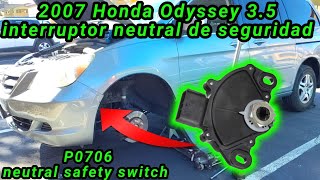
- Transmission Range Sensor Connector — On the front, exterior of the transmission case, where the shift cable attaches. Access often requires removing the battery and battery tray.. This is the primary connection point for the sensor. It is exposed to heat, moisture, and vibration, making it a common failure point due to corrosion on the pins or physical damage to the connector housing or wires.
Real Owner Repair Stories
- YouTube video by a professional technician (2004 Chrysler (demonstrating a universal P0706 diagnostic process)) — All gear indicator lights (PRNDL) were lit up on the dash, transmission was in fail-safe (limp mode), and code P0706 was stored.
❌ Tried (didn't work) Replacing the transmission range sensor (which was internal on this model) did not fix the problem.
✅ What actually fixed it After testing, the technician confirmed the new range switch was sending the correct voltage signals for each gear position all the way to the computer connector. Since the sensor and wiring tested good, the Powertrain Control Module (PCM) itself was diagnosed as the faulty component. Replacing the PCM resolved the issue. - Cross-Manufacturer Reference (Honda Accord): NHTSA ODI #10544028 describes a situation where a transmission was reported as failing due to codes P0705 and P0706. In this instance, a dealership suggested a full transmission replacement, highlighting the importance of verifying whether the issue is internal or simply a sensor failure before committing to major repairs.
OEM Part Supersession History
28900-RYF-013→28900-RYF-023— Standard part revision by the manufacturer, likely for improved durability or material changes.
Heads up: The new part number (28900-RYF-023) is a direct replacement for the old one and is fully compatible.
Model Year Variations Within This Range
- 2012-2015: For the 2012 model year refresh, Honda introduced a 6-speed automatic transmission to replace the previous 5-speed on Touring models, and it became standard on all trims for 2013-2015. While the P0706 code's meaning is the same, the physical location and diagnostic procedures for the range sensor may differ slightly between the 5-speed and 6-speed transmissions. The 6-speed is identifiable by a traditional gear shift lever, whereas later generations with 9-speeds used a push-button selector.
Diagnostic Flowchart
Used vs. New Parts: Buying Guide for This Vehicle
When a used part is the smart pick: A used transmission range sensor from a reputable salvage yard can be a cost-effective option, especially if you can verify the donor vehicle is a low-mileage, later-model-year vehicle from within the 2009-2015 range. Given the external mounting, it's easy to inspect and remove.
Donor-vehicle mileage cap: roughly under 80000 miles for the part to have meaningful remaining life.
What to inspect on the donor part:
- Check for a clean, corrosion-free connector. Avoid parts with any green or white powder on the pins.
- Inspect the plastic housing for cracks or signs of heat damage.
- Ensure the manual lever arm is not bent or damaged.
- If possible, choose a part from a vehicle that was not in a front-end collision.
OEM-only on this vehicle (don't cheap out):
- While not strictly 'OEM-only', it is highly recommended to use a genuine Honda (OEM) or a top-tier aftermarket brand like Standard Motor Products for this sensor. Cheaper, no-name aftermarket sensors are known to have higher failure rates or incorrect voltage outputs, which can cause the P0706 code to return.
Aftermarket brands forum-validated for this vehicle:
- Standard Motor Products (Intermotor)
- WVE
- Rostra Precision Controls
Brands owners have reported issues with on this vehicle:
- Unbranded, low-cost sensors from online marketplaces are generally not recommended as they often lead to repeat failures.
Real Owner Stories
Aggregated from forums and TSBs cited above. Mileages and costs reflect what owners reported in those sources.
2009-2015 Honda Pilot
Symptoms: The 'D' indicator light was flashing on the instrument cluster, which is a common indicator for transmission sensor issues.
What fixed it: Replacing the transmission range sensor or transmission pressure switches.
Source hint: reddit.com/r/hondapilot
2009-2015 Honda Pilot
Symptoms: Flashing 'D' light on the dashboard, signaling a transmission control system fault.
What fixed it: Addressing transmission sensor issues as corroborated by other owners on the forum.
Source hint: piloteers.org
Related OBD-II Codes
Frequently Asked Questions
What does it mean if the 'D' indicator is blinking on my 2009-2015 Honda Pilot dashboard?
My Pilot only starts when I'm in Neutral or if I wiggle the shifter. Is this related to P0706?
Can I use a used Transmission Range Sensor from a salvage yard for my 2012 Pilot?
Are there specific aftermarket brands I should look for or avoid for this repair?
Why is my Honda Pilot stuck in one gear and driving poorly after the Check Engine Light came on?
Is the P0706 code caused by low transmission fluid in the Pilot?
Helpful Videos


We Have This Part in Stock

The information in this article is provided for general reference and educational purposes only. Vehicle specifications, procedures, and part compatibility can vary by production date, trim level, and region. Always consult your vehicle's factory service manual and verify part numbers before purchasing or performing repairs. Safety-critical components such as airbags, seat belts, and braking systems should be installed by a qualified professional.
- Honda Pilot:
- 🧭 Diagnostic Flowchart
- 🎬 Helpful Videos
- 🛍️ Shop This Part
- What's Unique About the 2009-2015 Honda Pilot
- Symptoms You May Notice
- Most Likely Causes
- Rare But Worth Checking
- Diagnosis Steps
- Parts You'll Likely Need
- Related Codes That Often Appear With This One
- Platform-Specific Known Issues
- Mechanic-Grade Diagnostic Values
- Scan Tool Commands That Help
- Wiring & Ground Locations
- Real Owner Repair Stories
- OEM Part Supersession History
- Model Year Variations Within This Range
- Used vs. New Parts: Buying Guide for This Vehicle
- Real Owner Stories
- 2009-2015 Honda Pilot
- 2009-2015 Honda Pilot
- Related OBD-II Codes
- Frequently Asked Questions
- 🎟️ Get 5% Off