

P0706 on 2004-2017 Toyota Camry: Transmission Range Sensor Causes and Fixes
On a 2004-2017 Toyota Camry, code P0706 is most often caused by a faulty transmission range sensor, also known as a neutral safety switch. This can prevent the car from starting or cause shifting issues. Replacing the sensor costs around $90 for the part and is a moderately difficult DIY job. The sensor is external and prone to failure from weather exposure.
- P0706 on a Toyota Camry almost always points to a problem with the Transmission Range Sensor (Neutral Safety Switch).
- Symptoms can be severe, including a no-start condition or dangerous shifting behavior.
- The most likely fix is replacing the sensor, which is a moderately difficult DIY job that requires careful alignment.
- Before replacing parts, check for proper sensor alignment and inspect the wiring for any visible damage or corrosion.
- Due to the safety implications (car potentially starting in gear), professional service is recommended if you are not confident in performing the diagnosis and repair.
What's Unique About the 2004-2017 Toyota Camry
Across the 2004-2017 Camry generations (XV30, XV40, and XV50), the P0706 code is a straightforward and common issue. The transmission range sensor is mounted externally on the transmission case, making it susceptible to weather and road grime, but also relatively easy to access for replacement compared to internal components. While the part number may differ slightly between generations, the function, symptoms, and repair process are remarkably consistent for these reliable but aging sedans. Owners on forums frequently discuss intermittent no-start conditions related to this sensor.
Generation note: This guide covers three Toyota Camry generations: the XV30 (2004-2006), XV40 (2007-2011), and XV50 (2012-2017). The location and general replacement procedure for the transmission range sensor are similar across these generations, typically requiring removal of the air filter box for access. However, specific part numbers for the sensor may vary, so it's crucial to verify the correct part for your specific year and model. For example, part number 84540-06021 supersedes older numbers like 84540-33020 and 84540-33021 for many of these years.
Symptoms You May Notice
- Check Engine Light is on.
- Vehicle will not start, or only starts intermittently (may start in Neutral but not Park).
- Engine may start in a gear other than Park or Neutral.
- Incorrect gear position displayed on the dashboard.
- Harsh or delayed shifting between gears.
- Transmission may enter 'limp mode' (stuck in one gear).
- Reverse lights do not work.
- Replacing the transmission valve body when the issue is a much cheaper external sensor.
- Assuming the entire transmission has failed without first diagnosing the range sensor and its circuit.
- Replacing the starter when the root cause is an intermittent no-start signal from the neutral safety switch.
Most Likely Causes
- Faulty Transmission Range Sensor (Neutral Safety Switch) 🔴 High Probability → Shop Transmission Assembly The sensor is an electro-mechanical part mounted on the exterior of the transmission, exposed to heat, moisture, and vibration. Internal contacts wear down or corrode over time, leading to poor signal quality or complete failure.
How to confirm: Use a scan tool to monitor the sensor's output data while shifting gears. If the data is erratic or doesn't match the shifter position, the sensor is likely bad. You can also test the sensor's circuits with a multimeter according to the service manual. A common real-world symptom is an intermittent no-start that is temporarily resolved by jiggling the shifter.
Typical fix: Replace the transmission range sensor and ensure the new one is correctly aligned.
Est. part cost: $70-$150 - Misadjusted Transmission Range Sensor 🟡 Medium Probability → Shop Transmission Assembly Vibrations or previous incorrect installation can cause the sensor to shift out of alignment, leading to incorrect gear position readings. This can happen after other transmission work.
How to confirm: Inspect the alignment marks on the sensor and the transmission case. With the transmission manually placed in Neutral, the alignment marks on the sensor body and shaft should line up.
Typical fix: Loosen the sensor mounting bolts, align it correctly according to the service manual procedure (aligning the groove on the shaft with the neutral line on the switch body), and retighten the bolts.
Est. part cost: $0 - Damaged Wiring or Corroded Connector ⚪ Low Probability The wiring harness leading to the sensor is located in the engine bay and can be susceptible to corrosion from moisture or damage from heat, vibration, or impact from road debris over time.
How to confirm: Visually inspect the wiring harness and connector for any signs of corrosion (green crust), frayed wires, or loose pins. Perform a continuity test on the wires between the sensor and the transmission control module (TCM).
Typical fix: Repair the damaged section of wiring or clean the connector terminals with an electrical contact cleaner and apply dielectric grease.
Est. part cost: $10-$50
Rare But Worth Checking
- Faulty Powertrain/Transmission Control Module (PCM/TCM): → Shop Transmission Assembly This is extremely rare. Before condemning the control module, all other possibilities (sensor, wiring, adjustment) must be exhaustively ruled out. A mechanic may test the circuit at the computer to confirm the computer itself is the issue.
Diagnosis Steps
- Verify the code P0706 is present using an OBD-II scanner.
- Check for any other related transmission codes, such as P0705.
- Using the scanner's live data function, monitor the transmission range sensor input as you move the gear selector through P, R, N, D, etc. Note any discrepancies between the shifter position and the sensor reading.
- Visually inspect the transmission range sensor, its connector, and the wiring harness for any obvious signs of damage, corrosion, or looseness.
- Place the vehicle in Neutral (ensure parking brake is set and wheels are chocked). Check the alignment of the sensor. There are typically marks on the sensor body and the transmission shaft that should line up perfectly in Neutral.
- If the sensor appears misaligned, loosen the mounting bolts, adjust it until the marks align, and re-tighten. Clear the codes and re-test.
- If alignment is correct, test the sensor's electrical circuits using a multimeter according to the factory service manual specifications. This involves checking for correct voltage and resistance at specific pins.
- If the sensor tests bad, replace it. It is critical that the transmission remains in Neutral throughout the replacement process.
- If the sensor and its adjustment are good, perform a continuity and voltage drop test on the wiring harness between the sensor and the TCM/PCM to rule out a wiring issue.
- If all wiring and the sensor are confirmed to be good, the issue may lie with the control module, which requires professional diagnosis.
Parts You'll Likely Need
- Transmission Range Sensor / Neutral Safety Switch
(OEM #84540-06021 (supersedes 84540-33021, 84540-33020, 84540-06020))— This is the component that reads the gear selector position. It is the most common failure point for code P0706 due to wear and environmental exposure.
Trusted brands: Aisin (OEM supplier), Denso, Standard Motor Products (SMP)
OEM price range: $120-$180
Aftermarket price range: $70-$110
Related Codes That Often Appear With This One
- P0705 — P0705 is a closely related code for a general malfunction in the same sensor circuit, whereas P0706 specifically points to a range/performance issue. They often appear together or indicate the same root cause.
Technical Service Bulletins (TSBs) & Recalls
- While no TSBs directly address P0706 for this generation, a related TSB for 2012-2014 models is T-SB-0312-17, which deals with torque converter shudder. It's important not to confuse shudder symptoms with the shifting issues from P0706, though they can co-exist.
Platform-Specific Known Issues
- On a 2010 Camry, a DIY repair video on YouTube shows the replacement process, emphasizing the need to remove the airbox for access and to ensure the vehicle stays in Neutral during the entire job to maintain alignment.
- A forum thread on ToyotaNation for a '94 Camry (an older but mechanically similar setup) details a common owner experience: an intermittent no-start in Park that eventually gets worse, but the car will start in Neutral. This points directly to a failing neutral safety switch.
Mechanic-Grade Diagnostic Values
- Transmission Range Sensor 'A' Voltage (Live Data) — expected: Park ≈ 0 V, Reverse ≈ 5 V, Neutral ≈ 2.5 V, Drive ≈ 4 V. Deviations beyond ±0.5 V are problematic.. Failure: Voltage readings that are stuck, erratic, or do not correspond to the selected gear.
- Neutral Safety Switch Continuity Test (at switch terminals) — expected: Continuity (near zero ohms) should be present when the shifter is in Park or Neutral. No continuity (Open Line/OL) should be present in Reverse or Drive.. Failure: No continuity in Park/Neutral, or continuity in Reverse/Drive indicates a faulty switch.
Scan Tool Commands That Help
- Toyota Techstream: Data List for Engine and ECT — To monitor the live data from the transmission range sensor and compare it with the actual gear selector position. This is the primary software-based diagnostic step to see what the computer is reading from the sensor.
- Toyota Techstream: Active Test — While not directly testing the range sensor itself (as it's an input sensor), Active Tests can be used to command solenoids and other transmission actuators to verify the rest of the system is responding correctly, helping to isolate the fault to the sensor circuit.
Wiring & Ground Locations
- Main Battery Ground (Engine) — One of the two main wires from the negative battery terminal bolts directly to a bracket on the top of the transmission housing.. A poor main ground connection between the battery and the transmission can cause floating voltages and erratic behavior in all transmission sensors, including the range sensor.
- Main Battery Ground (Chassis) — The second main wire from the negative battery terminal bolts to the chassis, typically under the battery tray.. This provides the ground reference for the vehicle's body and the Engine Control Module (ECM). A bad chassis ground can cause a wide range of electrical issues, including incorrect sensor readings.
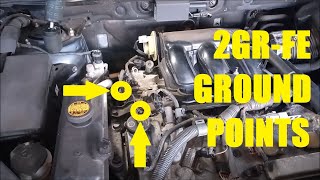
- Engine Harness Grounds (2GR-FE V6) — On V6 models (like the 2GR-FE), there are ground wires from the harness that bolt directly to bosses on the side of each cylinder head/valve cover, often near the strut towers.. These are the primary grounds for the engine sensor harness. A loose or corroded ground at these points can directly cause false sensor readings and trigger codes like P0706.
OEM Part Supersession History
84540-33020→84540-06020, which is then superseded by 84540-06021— Part consolidation and design updates by Toyota over the years.
Heads up: While 84540-06021 is the most common final replacement, always verify the part number with the vehicle's VIN. Some earlier models may have used different base numbers like 84540-12230 or 84540-32110 before being superseded.84540-33021→84540-06021— Part consolidation and design updates.
Heads up: This is a direct supersession. If a parts supplier lists 84540-33021, the updated 84540-06021 is the correct modern replacement.84540-33010→84540-07010— Part update for specific transmission/engine combinations.
Heads up: This part number chain seems to apply to many V6 and later 4-cylinder models. It's crucial to check against the VIN as this part may have different mounting or connector from the 84540-06021 family.
Model Year Variations Within This Range
- 2004-2009: These earlier models, particularly those with the U241E/U250E 4 and 5-speed transmissions, often use a 9-pin connector for the neutral safety switch.
- 2010-2017: Later models, especially those with the U760E/U660E 6-speed transmissions, may use a different sensor and connector design. The part number supersession to 84540-06021 or 84540-07010 is more common for these years.
Diagnostic Flowchart
Other Known Issues on This Vehicle
Issues unrelated to this code that are worth knowing about as an owner of this generation:
- Excessive Oil Consumption (2AZ-FE Engine) 🔴 High — Widespread in 2007-2011 models with the 2.4L 4-cylinder engine. Caused by a piston ring design flaw that leads to clogged oil return holes. Can start as early as 60,000 miles. (Ref: Toyota had a Warranty Enhancement Program (ZE7) which has since expired. The fix involves replacing pistons and rings.)
- Torque Converter Shudder (XV50) 🟠 Medium — Common in 2012-2014 models with the U760E 6-speed automatic, typically appearing between 80,000-120,000 miles. Feels like driving over rumble strips at light throttle between 25-50 mph. (Ref: T-SB-0312-17 (supersedes T-SB-0034-14) and a Limited Service Campaign (LSC E03) were issued. The fix involves a software update and, if the problem persists, replacement of the torque converter.)
- Melting/Sticky Dashboard (XV40) 🟡 Low — Affects 2007-2011 models, especially in high-heat, high-humidity climates. The dashboard material can degrade, becoming shiny, sticky, or cracking. (Ref: Toyota issued Warranty Enhancement Program ZE6, which extended the warranty for this specific issue. The program covered replacement of the dashboard.)
Used vs. New Parts: Buying Guide for This Vehicle
When a used part is the smart pick: Buying a used transmission range sensor is generally not recommended. It is an external electronic component prone to failure from heat, moisture, and internal wear. The cost savings are minimal compared to the risk of the used part failing soon after installation, requiring the labor to be done a second time.
Donor-vehicle mileage cap: roughly under 60000 miles for the part to have meaningful remaining life.
What to inspect on the donor part:
- Check the connector pins for any signs of green or white corrosion.
- Inspect the plastic housing for cracks or signs of heat damage.
- Ensure the selector shaft moves smoothly without binding.
- If possible, test the continuity of the used part in Park and Neutral before purchasing.
Aftermarket brands forum-validated for this vehicle:
- Aisin (often the Original Equipment Manufacturer for Toyota)
- Standard Motor Products (SMP)
- Beck Arnley
- Wells
Brands owners have reported issues with on this vehicle:
- Unbranded, 'white-box' parts from online marketplaces should be avoided due to inconsistent quality control and high failure rates.
Real Owner Stories
Aggregated from forums and TSBs cited above. Mileages and costs reflect what owners reported in those sources.
1994 Toyota Camry
Symptoms: Intermittent no-start in Park, but the car will start in Neutral. The issue eventually got worse over time.
What fixed it: Replacement of the neutral safety switch, although some users suggested cleaning the switch located on the transmission side facing the radiator.
Source hint: ToyotaNation Forums thread titled '94 Camry neutral safety switch'
2021 Toyota Camry
Symptoms: P0706 code triggered; owner concerned about drivetrain reliability.
What fixed it: Diagnosis confirmed the primary causes remain consistent with older models: either a defective sensor, wiring issues, or misadjustment.
Source hint: Camry Forums thread 'concerned mom'
2010 Toyota Camry
Symptoms: P0706 code present, requiring sensor replacement.
What fixed it: Replaced the transmission range sensor by removing the airbox for access and keeping the transmission in Neutral to maintain alignment.
Source hint: vehicle_specific_issues: 2010 Camry DIY repair video
Related OBD-II Codes
Frequently Asked Questions
My 2012 Camry has a transmission shudder; is this related to the P0706 code?
I have a 2010 Camry and want to fix P0706 myself; what is a key tip for the repair?
My Camry won't start in Park but starts in Neutral; is this a common symptom?
Can I just clean the sensor on my older Camry instead of spending $70-$150 on a new one?
Is there a specific alignment procedure for the Camry range sensor?
Does the 2007-2011 Camry dashboard issue have anything to do with transmission codes?
Helpful Videos


We Have This Part in Stock

The information in this article is provided for general reference and educational purposes only. Vehicle specifications, procedures, and part compatibility can vary by production date, trim level, and region. Always consult your vehicle's factory service manual and verify part numbers before purchasing or performing repairs. Safety-critical components such as airbags, seat belts, and braking systems should be installed by a qualified professional.
- Toyota Camry:
- 🧭 Diagnostic Flowchart
- 🎬 Helpful Videos
- 🛍️ Shop This Part
- What's Unique About the 2004-2017 Toyota Camry
- Symptoms You May Notice
- Most Likely Causes
- Rare But Worth Checking
- Diagnosis Steps
- Parts You'll Likely Need
- Related Codes That Often Appear With This One
- Technical Service Bulletins (TSBs) & Recalls
- Platform-Specific Known Issues
- Mechanic-Grade Diagnostic Values
- Scan Tool Commands That Help
- Wiring & Ground Locations
- OEM Part Supersession History
- Model Year Variations Within This Range
- Other Known Issues on This Vehicle
- Used vs. New Parts: Buying Guide for This Vehicle
- Real Owner Stories
- 1994 Toyota Camry
- 2021 Toyota Camry
- 2010 Toyota Camry
- Related OBD-II Codes
- Frequently Asked Questions
- 🎟️ Get 5% Off