

P0715 on 2007-2008 Ford Edge: Input/Turbine Speed Sensor Failure Causes and Fixes
On a 2007-2008 Ford Edge, code P0715 is almost always caused by a failed internal Turbine Shaft Speed (TSS) sensor. This is a complex repair requiring removal of the transmission's side cover. It's highly recommended to replace the Output Shaft Speed (OSS) sensor at the same time. A Ford TSB specifically addresses this known issue on early models.
- P0715 on a 2007-2008 Edge points directly to a problem with the Turbine Shaft Speed (TSS) sensor circuit.
- The sensor is located inside the transmission, making this a labor-intensive repair that is not recommended for DIY beginners.
- A Ford TSB (07-21-11) confirms this is a known issue for this vehicle, specifically for models built before October 21, 2007.
- To prevent a repeat repair, always replace both the Turbine Shaft Speed (TSS) and Output Shaft Speed (OSS) sensors at the same time.
What's Unique About the 2007-2008 Ford Edge
A critical issue for the 2007-2008 Ford Edge is that the Turbine Shaft Speed (TSS) sensor is located *inside* the 6F50 automatic transmission. Unlike many vehicles where this is a simple external sensor, replacing it on the Edge requires draining the fluid and removing the transmission's side cover and other components to gain access. Ford issued a Technical Service Bulletin (TSB 07-21-11) for these models, acknowledging that an intermittent short in the TSS or OSS sensor is a known issue on transmissions built before October 21, 2007. 🎬 Watch: Why these 6F50 transmission sensors fail Another manufacturer service bulletin, TSB 07-3-11, also addresses these 6F50 transaxles, noting that affected vehicles may experience harsh engagement or a "fifth gear only" condition alongside DTC P0715.
Symptoms You May Notice
- Harsh, erratic, or delayed shifting
- Vehicle enters 'fail-safe' or 'limp' mode with limited power
- Check Engine Light or Wrench Light is illuminated
- Failure to upshift, possibly stuck in one gear (often 5th gear only)
- Decreased fuel economy
- Inaccurate or malfunctioning speedometer (more common with related OSS code P0720)
- Sudden loss of power while driving
- Replacing only the TSS sensor without also replacing the OSS sensor. Since the labor is identical, not replacing both often leads to a repeat repair in the near future.
- Replacing the PCM without first thoroughly testing the sensor and its circuit, which is explicitly advised against by Ford's TSB for this issue.
Most Likely Causes
- Failed Turbine Shaft Speed (TSS) Sensor 🔴 High Probability Ford TSB 07-21-11 specifically identifies intermittent shorts within the TSS and OSS sensors as a known issue on 6F50 transmissions built before 10/21/2007. The internal location exposes the sensor to constant heat and immersion in transmission fluid, which can degrade the electronics over time.
How to confirm: A professional technician will use a scan tool to monitor live data from the sensor (PID). An erratic or flat reading that doesn't correspond to engine RPM confirms a sensor circuit problem. The TSB directs technicians to follow pinpoint test C in the workshop manual, and if the cause isn't found by step C9, to replace the sensor.
Typical fix: Replace the Turbine Shaft Speed (TSS) sensor. It is strongly recommended to also replace the Output Shaft Speed (OSS) sensor at the same time, as the labor to access both is identical.
Est. part cost: $30-$60 - Damaged Wiring or Connectors ⚪ Low Probability While not specific to the platform, wiring issues are always a possibility. However, since the sensor and its immediate wiring are internal, external damage is less likely unless other major work has been performed.
How to confirm: Visually inspect the main wiring harness leading to the transmission for any signs of damage, corrosion, or loose connections. Test for continuity and proper voltage at the main connector before opening the transmission.
Typical fix: Repair or replace the damaged section of the external wiring harness or the connector itself.
Est. part cost: $20-$100
Rare But Worth Checking
- Faulty Powertrain Control Module (PCM) or Transmission Control Module (TCM): → Shop Transmission Assembly This is extremely rare. TSB 07-21-11 specifically advises against replacing the PCM for this issue until the sensor has been replaced and the problem is confirmed to persist.
- Internal Transmission Mechanical Failure: → Shop Transmission Assembly If the sensor's magnetic tip is covered in excessive metal shavings upon removal, it indicates a more severe internal problem that a new sensor will not fix. This could point to worn bearings or other failing components.
Diagnosis Steps
- Verify the code with a professional-grade OBD-II scanner capable of reading live transmission data.
- Check for any Technical Service Bulletins (TSBs) related to the vehicle and code. TSB 07-21-11 is directly relevant for vehicles built before 10/21/2007.
- Inspect the transmission fluid level and condition. Burnt or dirty fluid can indicate larger problems.
- Inspect the external transmission wiring harness and connectors for any visible damage, corrosion, or loose pins.
- Using a scan tool, monitor the Turbine Speed (Input Shaft Speed) PID. Observe if the value is erratic, absent, or does not change with engine RPM.
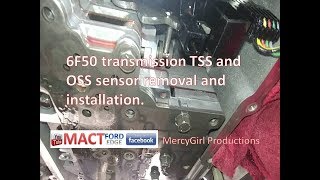
- If external wiring is okay and the scan tool data is abnormal, the next step involves accessing the internal sensors. This requires draining the transmission fluid and removing the side cover. 🎬 Watch: Full TSS and OSS sensor replacement walkthrough
- Once accessed, visually inspect the TSS and OSS sensors and their wiring inside the transmission.
- Test the resistance of the TSS sensor with a multimeter. An open or shorted sensor is faulty.
- If the sensor and wiring test good, the issue may be with the PCM, but this is highly unlikely and should be the last resort.
Parts You'll Likely Need
- Turbine Shaft Speed (TSS) Sensor
(OEM #8A8Z-7M101-A)— This is the primary component that fails and triggers the P0715 code, as identified in a Ford TSB. This part may be superseded by AA5Z-7M101-B.
Trusted brands: Motorcraft, Standard Motor Products, Dorman
OEM price range: $40-$70
Aftermarket price range: $25-$50 - Output Shaft Speed (OSS) Sensor
(OEM #8A8Z-7H103-A)— This sensor is also prone to failure, is located next to the TSS sensor, and requires the same labor to access. It should always be replaced at the same time. This part may be superseded by AA5Z-7H103-B.
Trusted brands: Motorcraft, Standard Motor Products, Dorman
OEM price range: $40-$70
Aftermarket price range: $25-$50 - Transmission Fluid
(OEM #XT-10-QLVC (Motorcraft MERCON LV))— The transmission must be drained to access the sensors. A fluid and filter change is required as part of the repair. Use only Motorcraft MERCON LV or a compatible equivalent.
Trusted brands: Motorcraft, Valvoline MaxLife, Castrol Transmax
OEM price range: $8-$12 per quart
Aftermarket price range: $7-$10 per quart - Transmission Side Cover Gasket — The side cover must be removed to access the sensors. A new gasket is required for reassembly to prevent leaks.
Trusted brands: Ford, Fel-Pro
OEM price range: $20-$40
Aftermarket price range: $15-$30
Related Codes That Often Appear With This One
- P0717 — This code means 'Input/Turbine Speed Sensor 'A' Circuit No Signal,' which is a more specific version of P0715, indicating a complete loss of signal. They often appear together and are covered by the same TSB.
- P0720 — This code relates to the Output Shaft Speed (OSS) sensor. Since the TSB points to potential failure of both sensors and they are located together, it's common to see faults for both.
- P0722 — This code means 'Output Speed Sensor Circuit No Signal' and is the OSS equivalent of P0717. It is also covered under TSB 07-21-11.
Technical Service Bulletins (TSBs) & Recalls
- TSB 07-21-11: Addresses harsh engagement, no upshift, and DTCs including P0715, P0717, P0720, P0722 due to intermittent shorts in the TSS or OSS sensors on 6F50 transmissions built prior to 10/21/2007.
- TSB 07-3-11: Specifically notes that 6F50 transaxles built prior to 1/1/2007 may exhibit DTC P0715, P0717, P0718, P0720, P0721, P0722 and/or harsh engagement, no upshift, or operation in fifth gear only.
Platform-Specific Known Issues
- TSB 07-21-11 was issued by Ford for 2007-2008 Edge models with the 6F50 transmission built before 10/21/2007. It specifically addresses DTCs P0715, P0717, and others caused by an intermittent short in the TSS or OSS sensor. The fix is to replace the affected sensor.
- Owner forums are filled with accounts of this exact failure, with many confirming the wrench light, limp mode, and the necessity of replacing both sensors at once to resolve the issue.
Diagnostic Flowchart
Other Known Issues on This Vehicle
Issues unrelated to this code that are worth knowing about as an owner of this generation:
- Power Transfer Unit (PTU) Failure 🔴 High — Common on AWD models. The PTU fluid overheats due to proximity to the exhaust, leading to seal failure and internal damage. Symptoms include a burning oil/propane smell and grinding/whining noises. (Ref: TSB 19-2017 (for later models, but describes the same failure mechanism))
- Brake Booster Failure 🔴 High — A torn internal diaphragm can cause a hissing noise when the brake pedal is pressed, a spongy pedal feel, and increased stopping effort. This was common enough that Ford issued a warranty extension program (13N02). (Ref: Customer Satisfaction Program 13N02)
- Door Ajar Warning Light Stays On 🟡 Low — A faulty switch inside the door latch mechanism fails to register that the door is closed, causing the interior lights to stay on and draining the battery. It is a very common complaint for this generation.
- Transmission Fluid Leaks at Axle Area 🟠 Medium → Shop Transmission Assembly — Leaks can develop from the axle seals on either the transmission (red fluid) or the PTU (brown fluid).
- Takata Airbag Inflator Recall 🔴 High — Like millions of other vehicles, the 2007-2008 Edge was subject to recalls for dangerous Takata airbag inflators that could rupture during deployment. (Ref: Recalls 16S26, 17S01)
Real Owner Stories
Aggregated from forums and TSBs cited above. Mileages and costs reflect what owners reported in those sources.
2008 Ford Edge 6-cyl — 58000 miles
Symptoms: Trouble shifting from park to reverse; transmission sounded broken. The vehicle would stick in gear, shift erratically, and became unresponsive to the gas pedal, even shutting off while driving.
What fixed it: The dealership replaced both the output shaft sensor (OSS) and turbine shaft sensor (TSS).
Cost: $700
Source hint: CarComplaints.com
2007 Ford Edge
Symptoms: Wrench light keeps coming on; codes P0715 and P0717 are present.
What fixed it: Replacing TSS and OSS sensors, though the owner noted the importance of avoiding potential issues with aftermarket parts or the need for a PCM relearn.
Source hint: Ford Edge Forum: 'Wrench light keeps coming on after replacing TSS and OSS sensors - code P0715 & P0717'
NHTSA Reported Incident
Symptoms: An owner reported that their vehicle displayed code P0715, referring to the turbine input speed shaft sensor, and expressed concern that this is a safety issue (NHTSA ODI #10794985).
NHTSA Reported Incident
Symptoms: NHTSA ODI #10692963 describes a situation where a vehicle experienced DTC P0715 along with other codes like P0717 and P0720, noting symptoms of harsh engagement, no upshift, and being limited to fifth gear only.
Related OBD-II Codes
Frequently Asked Questions
Does TSB 07-21-11 apply to my 2007 Ford Edge?
Should I replace both the TSS and OSS sensors at the same time on my Edge?
Why is my 2008 Ford Edge stuck in 5th gear and showing a wrench light?
Is the P0715 code related to the Takata airbag recall on my 2007 Edge?
Can I fix P0715 by just resetting the computer on my Ford Edge?
Are other vehicles like the Lincoln MKX affected by this same sensor issue?
Helpful Videos
We Have This Part in Stock

The information in this article is provided for general reference and educational purposes only. Vehicle specifications, procedures, and part compatibility can vary by production date, trim level, and region. Always consult your vehicle's factory service manual and verify part numbers before purchasing or performing repairs. Safety-critical components such as airbags, seat belts, and braking systems should be installed by a qualified professional.
- Ford Edge:
- 🧭 Diagnostic Flowchart
- 🎬 Helpful Videos
- 🛍️ Shop This Part
- What's Unique About the 2007-2008 Ford Edge
- Symptoms You May Notice
- Most Likely Causes
- Rare But Worth Checking
- Diagnosis Steps
- Parts You'll Likely Need
- Related Codes That Often Appear With This One
- Technical Service Bulletins (TSBs) & Recalls
- Platform-Specific Known Issues
- Other Known Issues on This Vehicle
- Real Owner Stories
- 2008 Ford Edge 6-cyl — 58000 miles
- 2007 Ford Edge
- NHTSA Reported Incident
- NHTSA Reported Incident
- Related OBD-II Codes
- Frequently Asked Questions
- 🎟️ Get 5% Off