

P0715 on 2012-2018 Ford Focus: Input Speed Sensor and TCM Fault Guide
On a 2012-2018 Ford Focus, P0715 most often indicates a failure of the Input Speed Sensor 'A' or its wiring. However, it is frequently a symptom of a failing Transmission Control Module (TCM), a widespread and well-documented issue with the DPS6 automatic transmission. Owners should investigate warranty extensions for the TCM before paying for repairs.
- P0715 on a 2012-2018 Focus is a serious code that requires prompt attention to avoid being stranded.
- The code can be caused by a bad input speed sensor or wiring, but a failing Transmission Control Module (TCM) is a very common cause on this specific vehicle.
- Do not automatically replace the speed sensor without proper diagnosis; the root cause is often the TCM.
- Due to the complexity of diagnosis and the need for programming, this repair is best left to a professional familiar with Ford transmissions.
- Check with a Ford dealer to see if your vehicle's VIN is covered under any extended warranty programs for the TCM or transmission clutch.
What's Unique About the 2012-2018 Ford Focus
The 2012-2018 Ford Focus is equipped with the DPS6 PowerShift, a dry dual-clutch automatic transmission with a notorious reputation for reliability problems. While P0715 can be a simple sensor failure, it is very often an early indicator of a failing Transmission Control Module (TCM). The original TCMs used compliant pin connections that could fail over time; updated versions use more robust soldered connections. The TCM is the subject of multiple warranty extensions and customer satisfaction programs from Ford due to high failure rates. Owners should be aware that this code may point to a more complex and expensive TCM issue rather than just a faulty sensor.
Symptoms You May Notice
- Check Engine Light is on
- Transmission warning light (wrench icon) is illuminated
- Harsh, erratic, or delayed gear shifts
- Transmission bangs into gear when shifting from Park to Drive or Reverse.
- Transmission gets stuck in one gear (limp-home mode)
- Vehicle may hesitate or shudder on acceleration
- Complete loss of power or inability to move
- Reduced fuel economy
- Replacing the input speed sensor when the root cause is a faulty Transmission Control Module (TCM). This is a very common mistake that leads to the code returning, as experienced by many owners in online forums.
- Replacing the input speed sensor when the root cause is a damaged wiring harness or a backed-out pin in the main connector.
Most Likely Causes
- Failing Transmission Control Module (TCM) 🔴 High Probability → Shop Transmission Assembly The DPS6 transmission's TCM is known for high failure rates due to heat, vibration, and faulty internal compliant pin connections, leading to numerous internal circuit faults that can manifest as sensor codes. Ford has acknowledged this with Customer Satisfaction Program 14M02, extending the warranty on the TCM to 10 years or 150,000 miles.
How to confirm: After confirming the sensor and wiring are good, a diagnostic scan tool may show other TCM-related codes (like U0100, U0101, P0606). Diagnosis is often made by ruling out all other possibilities. A dealer can confirm by checking against known issues described in TSBs and warranty programs.
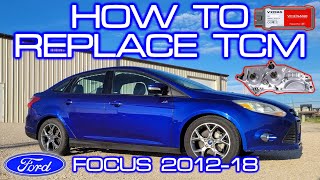
Typical fix: Replace the Transmission Control Module. This part must be programmed to the vehicle by a Ford dealer or a properly equipped independent shop. The replacement part should be the updated version with more durable soldered connections.
Est. part cost: $500-$900 for the module - Faulty Input/Turbine Speed Sensor 'A' (ISS) 🟡 Medium Probability → Shop Automatic Transmission Input Shaft Speed Sensor The sensors are electronic components that can fail from heat cycles and vibration. On the DPS6, Input Speed Sensor 'A' is gray and located below the black Input Speed Sensor 'B' on the top side of the transmission, accessible after removing the battery and tray.
How to confirm: Use a scan tool to monitor the live data for Input Speed Sensor 'A'. If the reading is zero, erratic, or does not change with engine RPM while in gear, the sensor or its circuit is faulty. The sensor's resistance can also be tested with a multimeter. Visually inspect the connector for damage.
Typical fix: Replace the Input Speed Sensor 'A'. The DPS6 has two input speed sensors (A and B) and one output speed sensor (OSS); ensure the correct one is replaced. 🎬 See this guide to identifying and replacing DPS6 sensors It is often recommended to replace both input sensors at the same time.
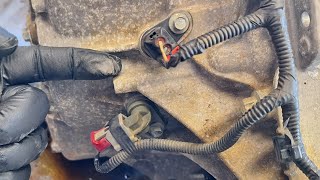
Est. part cost: $40-$100 - Damaged Wiring or Connector ⚪ Low Probability The wiring harness to the transmission can be damaged by road debris, improper service, or corrosion at the connector pins. The wires near the sensor connectors are known to chafe. In some cases, pins can back out of the main transmission harness connector.
How to confirm: Visually inspect the wiring harness leading to the input speed sensor for any signs of chafing, breaks, or corrosion. Perform a continuity test on the wires between the sensor connector and the TCM connector. Check for backed-out pins in the main harness connector.
Typical fix: Repair the damaged section of the wiring harness or replace the connector pigtail. The pigtail connector may be the same part number as the ABS wheel speed sensor connectors.
Est. part cost: $20-$50 for a pigtail connector
Rare But Worth Checking
- Internal Transmission Failure: → Shop Transmission Assembly While rare to cause only P0715, mechanical issues like worn bearings or clutch failure can produce metallic debris that sticks to the magnetic tip of the speed sensor, disrupting its signal. This would typically be accompanied by other symptoms like grinding noises or severe shifting problems.
- Poor Main Battery Ground: A known issue on this platform is a poor ground connection from the battery negative terminal to the chassis, often due to the connection point being painted at the factory. This can cause a variety of seemingly unrelated electrical and drivability issues, including erratic transmission behavior. Cleaning the ground points is a simple and recommended first step for any electrical diagnosis.
Diagnosis Steps
- Scan for all DTCs: Use an OBD-II scanner to read all codes from the PCM and TCM. Note any other codes present, especially communication codes (U-codes) or codes for the 'B' speed sensor, as they provide critical diagnostic context.
- Check for Warranty Extensions: Before any repair, check with a Ford dealer or on the Ford recall website with your VIN to see if Customer Satisfaction Program 14M02 (TCM warranty extension to 10yr/150k miles) is still active for your vehicle.
- Check Live Data: Monitor the live data stream for 'Input Speed Sensor A'. The RPM reading should be stable and correspond to engine speed when the transmission is engaged. A reading of zero or one that jumps erratically points to a problem in the circuit.
- Inspect Wiring and Connector: Visually inspect the wiring harness going to the transmission. Look for any signs of physical damage, melting, or corrosion, especially at the main connector to the TCM and the individual sensor connectors. Pay close attention to areas where the harness might chafe.
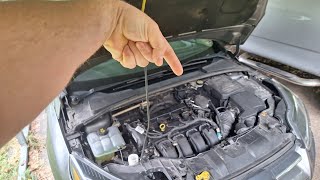
- Locate and Test the Sensor: To access the input speed sensors, remove the battery and battery tray. Input Speed Sensor 'A' is the gray connector located below the black connector for Sensor 'B' on top of the transmission. If accessible, disconnect the sensor and test its internal resistance with a multimeter. Compare the reading to the manufacturer's specifications.
- Evaluate the TCM: If the sensor and wiring test good, the suspicion falls heavily on the TCM. This is the most likely cause on this specific vehicle. Professional diagnosis is recommended to definitively condemn the TCM before replacement.
- Check Grounds: As a precautionary step, inspect and clean the main battery-to-chassis ground connection points under the airbox. A poor ground can cause numerous, difficult-to-diagnose electrical issues.
Parts You'll Likely Need
- Transmission Control Module (TCM)
(OEM #AE8Z-7Z369-F (and superseding numbers like AE8Z-7Z369-D, E, etc.))— This is the most common point of failure on the DPS6 transmission and is often the true cause of speed sensor codes. Covered under warranty extension 14M02 for many vehicles.
Trusted brands: Motorcraft (Ford OEM)
OEM price range: $600-$900
Aftermarket price range: $400-$700 (Remanufactured) - Transmission Input Speed Sensor — If the TCM is not at fault, the sensor itself is the next most likely component to have failed. Sensor 'A' (gray) and 'B' (black) are different but often replaced together.
Trusted brands: Motorcraft, Delphi, Bosch
OEM price range: $70-$120
Aftermarket price range: $40-$80
Related Codes That Often Appear With This One
- P0717 — Indicates 'Input/Turbine Speed Sensor 'A' Circuit No Signal', which is a more specific version of the general fault detected by P0715.
- P2765 — This code relates to the Input/Turbine Speed Sensor 'B' circuit. Seeing codes for both sensors (A and B) strongly suggests a fault with the TCM or a shared power/ground circuit, rather than two simultaneously failed sensors.
- U0100, U0101, P0606 — These codes indicate a loss of communication with the TCM or an internal TCM processor fault. Their presence alongside P0715 is a very strong indicator that the TCM is the root cause of the problem.
Technical Service Bulletins (TSBs) & Recalls
- Customer Satisfaction Program 14M02: Extends warranty coverage for the DPS6 Transmission Control Module (TCM) to 10 years or 150,000 miles.
- TSB 16-0129: Details diagnostic procedures for DPS6 transmission issues including no-start or loss of power with codes like U0100, U0101, and P0606, pointing towards TCM failure.
- TSB 15-0120: Details service procedures for addressing excessive clutch shudder, which involves reprogramming and potentially replacing clutch components.
- TSB 16-0105: This TSB is for the HF35 transmission in Fusion/C-Max models and is NOT relevant to the DPS6 in the Focus.
- Bulletin #SSM 50861: Notes that for certain Ford transmissions, diagnostic trouble codes P0715 and P0717 may be caused by the direct clutch cylinder/tone wheel inadvertently forcing the snap ring out of position.
- TSB 07-3-11: Describes issues on 6F50 transaxles where DTC P0715 and P0717 are associated with harsh engagement, no upshift, or the vehicle being stuck in fifth gear only.
Platform-Specific Known Issues
- DPS6 Transmission Failures & Warranty Extensions: The 2012-2018 Focus is subject to multiple Ford customer satisfaction programs and warranty extensions for its DPS6 transmission. Program 14M02 specifically extends the warranty for the Transmission Control Module (TCM) to 10 years or 150,000 miles for symptoms including loss of power and check engine lights, which can be caused by P0715. Owners experiencing this code should immediately check their VIN for eligibility before authorizing any repairs.
Mechanic-Grade Diagnostic Values
- Continuity/Resistance of ISS 'A' circuit wiring — expected: Less than 5.0 Ω. Failure: Resistance greater than 5.0 Ω indicates an open or high resistance in the wiring between the sensor and the TCM.
- Voltage Reference at Sensor Connector — expected: Approximately 5.0V DC. Failure: Voltage significantly lower than 5.0V, unstable voltage, or no voltage indicates a problem with the TCM's power supply to the sensor or a short in the wiring.
- General Resistance of Input Speed Sensor — expected: Typically 500–1,200 Ω (check specific part data if available). Failure: A reading far outside this range or an open/shorted circuit (infinite or zero ohms) indicates a failed sensor.
Scan Tool Commands That Help
- FORScan: Perform Transmission Adaptive Learning — This procedure is required after replacing the TCM or clutch assembly to make the module learn clutch engagement points and shift fork positions.
- FORScan: Reset All Adaptations — Can be used as a first step for harsh shifting complaints to force the TCM to relearn its shifting strategy.
- Ford IDS (or equivalent J2534 tool): Module Programming — This dealer-level function is mandatory when installing a new Transmission Control Module to flash it with the correct vehicle-specific calibration and link it to the car's VIN.
Wiring & Ground Locations
- TCM Connector C1750B — The large multi-pin connector at the Transmission Control Module, which is mounted on the driver's side of the transmission case.. This is where the Input Speed Sensor 'A' circuit terminates. Pin 10 and Pin 21 are the specific terminals for the ISS 'A' circuit and must be tested for continuity back to the sensor connector (C143).
- Ground Point G104 — Located in the engine compartment on the left side, typically under the air filter box assembly.. This is a primary chassis ground point for the transmission and TCM. It is notoriously bolted over a painted surface from the factory, which can lead to high resistance and cause a wide range of erratic electronic faults, including sensor codes like P0715.
- Input Speed Sensor 'A' Connector (C143) — The gray connector on the top side of the transmission, below the black connector for sensor 'B'. Accessible after removing the battery and battery tray.. This is the starting point for any circuit test. The connector itself or the wiring pigtail can become damaged or corroded. Pins 1 and 2 connect to pins 10 and 21 at the TCM, respectively.
Real Owner Repair Stories
- YouTube User Comment (2014 Ford Focus) — P0715 code for Input Speed Sensor 'A'.
❌ Tried (didn't work) Replaced the input speed sensor 'A'.
✅ What actually fixed it The problem was not resolved by replacing the sensor, indicating the fault was elsewhere in the circuit (wiring or TCM). The user was still diagnosing but confirmed the sensor was not the fix. - YouTube Video (doublewide6 Repairs LLC) (2012 Ford Focus) — Transmission failure warnings on the dash, erratic shifting, going into neutral, skipping gears (e.g., only using 1st, 3rd, 5th).
❌ Tried (didn't work) Initial diagnosis pointed towards a failing TCM.
✅ What actually fixed it The owner performed the 'ground mod' by removing the airbox, locating the main ground points on the chassis, grinding the paint off to create a bare metal connection, and re-securing the ground wires. A commenter on the video with a 2012 Focus confirmed this procedure fixed their jerking transmission and unstable voltage readings. - YouTube Video (on a Ford Fusion with same codes) (2015 Ford Fusion) — P0715 and P0717 codes, transmission banging hard into gear, no manual mode display, sluggish acceleration.
❌ Tried (didn't work) A repair shop diagnosed the issue and quoted a $3,727 transmission rebuild.
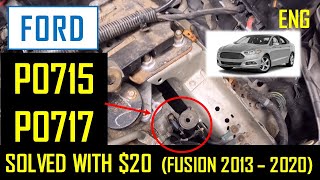
✅ What actually fixed it The owner inspected the wiring harness for the input speed sensor and found a pin backing out of the connector. Replacing the connector pigtail ($20 part) completely resolved all symptoms. - NHTSA ODI #11464253 — An owner reported that the transmission sticks or will not shift, accompanied by a flashing wrench icon and code P0715. The owner noted that if the vehicle does shift, it is hard and jerks.
- NHTSA ODI #11681679 — A report describes a failure confirmed by a service department where DTC codes P0715-00 and P0717-00 were retrieved, indicating the turbine speed sensor signal was lost and forcing the transmission into limp mode.
OEM Part Supersession History
AE8Z-7Z369-A, B, C, D, E; BV6Z-7Z369-A→AE8Z-7Z369-F— The original TCMs used compliant pin connections for internal components. Over time, these connections can loosen and fail due to heat and vibration. The updated/remanufactured modules use more robust soldered connections to prevent these failures.
Diagnostic Flowchart
Other Known Issues on This Vehicle
Issues unrelated to this code that are worth knowing about as an owner of this generation:
- Faulty Canister Purge Valve 🟠 Medium — Very common. Can cause rough idle, stalling after refueling, and difficulty starting. Often throws codes like P1450 or P144A. (Ref: Recall 18S32 was issued to reprogram the PCM to prevent fuel tank deformation that could result from a stuck-open purge valve.)
- Faulty Door Latches 🔴 High — Extremely widespread, affecting millions of Ford vehicles. A component in the latch can break, preventing the door from closing securely or causing it to open while driving. (Ref: Multiple recalls, including 16S30 and 20S30, were issued to inspect and replace the faulty latches.)
- Electric Power Steering Failure 🔴 High — Common, particularly in the 2012-2014 model years. Can result in a sudden loss of power steering assist, making the vehicle very difficult to steer. Often caused by internal failure of the steering rack/motor assembly. (Ref: No specific recall, but a well-documented issue. Fault codes often include U3000.)
- Engine Mount Failure 🟡 Low — The passenger-side hydraulic engine mount is known to wear out prematurely, leading to excessive engine vibration felt in the cabin, especially at idle.
Used vs. New Parts: Buying Guide for This Vehicle
When a used part is the smart pick: A used Input Speed Sensor from a low-mileage donor vehicle is a reasonable choice as it is a simple magnetic sensor with a low failure rate compared to the TCM. A used wiring harness pigtail is also acceptable if in good condition. A used TCM is NOT recommended.
Donor-vehicle mileage cap: roughly under 50000 miles for the part to have meaningful remaining life.
What to inspect on the donor part:
- For sensors, ensure the magnetic tip is free of heavy metallic debris.
- For wiring connectors, check for brittle plastic, corrosion on pins, and ensure the locking tabs are intact.
- Verify the donor vehicle did not have transmission-related trouble codes or a known collision.
OEM-only on this vehicle (don't cheap out):
- Transmission Control Module (TCM) — Due to the known design flaw with pin connections in early models, only a new OEM part or a professionally remanufactured unit with updated soldered connections should be used. A used TCM from a junkyard is highly likely to have the same defect and fail prematurely.
Aftermarket brands forum-validated for this vehicle:
- Motorcraft (OEM for sensor and TCM)
- Bosch (Sensor)
- Delphi (Sensor)
Brands owners have reported issues with on this vehicle:
- Unknown, no-name brand TCMs sold on auction sites without a warranty or clear information about whether the internal connections have been updated/soldered.
Real Owner Stories
Aggregated from forums and TSBs cited above. Mileages and costs reflect what owners reported in those sources.
2012-2018 Ford Focus 2.0L Ti-VCT GDI I4
Symptoms: The owner replaced the Turbine Shaft Speed Sensor (Input Speed Sensor) only to have the P0715 code return immediately.
What fixed it: The source suggests the issue was likely a misdiagnosis where the sensor was blamed for a fault actually residing in the wiring or the control module.
Source hint: Ford Truck Enthusiasts Forums (ford-trucks.com) thread titled 'Code P0715 Turbine Shaft Speed Sensor...how to replace'
2012-2018 Ford Focus 2.0L Ti-VCT GDI I4
Symptoms: Loss of power and check engine lights associated with the DPS6 transmission.
What fixed it: Replacement of the Transmission Control Module (TCM) under Customer Satisfaction Program 14M02.
Source hint: Customer Satisfaction Program 14M02
2012-2018 Ford Focus 2.0L Ti-VCT GDI I4
Symptoms: Dashboard wrench icon illuminated and the car entered limp mode with codes P0715 and P0717.
What fixed it: Tracing and repairing a wiring problem, as described in NHTSA ODI #11437142.
Source hint: NHTSA ODI #11437142
Related OBD-II Codes
Frequently Asked Questions
Is the P0715 code on my 2012 Ford Focus covered under a special warranty?
My Focus is throwing P0715 and won't move. Could this be the TCM instead of the sensor?
Does TSB 16-0105 apply to my 2014 Focus with the 2.0L GDI engine?
Where is the Input Speed Sensor 'A' located on the DPS6 transmission?
Can a bad ground cause transmission codes like P0715 on this car?
I replaced the sensor but the P0715 code came back immediately. What should I check next?
Helpful Videos
We Have This Part in Stock


The information in this article is provided for general reference and educational purposes only. Vehicle specifications, procedures, and part compatibility can vary by production date, trim level, and region. Always consult your vehicle's factory service manual and verify part numbers before purchasing or performing repairs. Safety-critical components such as airbags, seat belts, and braking systems should be installed by a qualified professional.
- Ford Focus:
- 🧭 Diagnostic Flowchart
- 🎬 Helpful Videos
- 🛍️ Shop This Part
- What's Unique About the 2012-2018 Ford Focus
- Symptoms You May Notice
- Most Likely Causes
- Rare But Worth Checking
- Diagnosis Steps
- Parts You'll Likely Need
- Related Codes That Often Appear With This One
- Technical Service Bulletins (TSBs) & Recalls
- Platform-Specific Known Issues
- Mechanic-Grade Diagnostic Values
- Scan Tool Commands That Help
- Wiring & Ground Locations
- Real Owner Repair Stories
- OEM Part Supersession History
- Other Known Issues on This Vehicle
- Used vs. New Parts: Buying Guide for This Vehicle
- Real Owner Stories
- 2012-2018 Ford Focus 2.0L Ti-VCT GDI I4
- 2012-2018 Ford Focus 2.0L Ti-VCT GDI I4
- 2012-2018 Ford Focus 2.0L Ti-VCT GDI I4
- Related OBD-II Codes
- Frequently Asked Questions
- 🎟️ Get 5% Off