

P0715 on 2010 Toyota Camry: Input Speed Sensor Failure Causes and Fixes
On a 2010 Toyota Camry, especially with the 2.5L engine and U760E transmission, code P0715 is almost always caused by a failed internal transmission input speed sensor. Toyota issued a Technical Service Bulletin (T-SB-0116-10) for this known issue, which also affects some 2009-2010 Highlander and Venza models. The fix requires replacing the sensor, which is a labor-intensive job involving the removal of the transmission valve body.
- P0715 on a 2010 Camry is a well-known problem with a specific fix.
- The cause is a faulty internal transmission input speed sensor, confirmed by Toyota TSB T-SB-0116-10.
- The repair is not simple; it requires removing the transmission valve body and should likely be performed by a professional.
- Do not replace other parts like solenoids or the entire transmission before confirming the sensor's signal with a scanner.
- Always use the revised OEM sensor (part number 89413-06010) and specified Toyota ATF WS fluid for the repair.
What's Unique About the 2010-2010 Toyota Camry
The 2010 Toyota Camry, particularly models with the 2.5L 2AR-FE engine and U760E 6-speed automatic transmission, has a well-documented history with code P0715. Toyota acknowledged a high failure rate for the original transmission revolution sensor (input speed sensor) by releasing Technical Service Bulletin T-SB-0116-10. The bulletin confirms the issue for the 2010 Camry and also for 2009-2010 Highlander and Venza models using the same U760E transaxle. It provides the procedure for replacing the faulty original sensor with a revised part, making this a known pattern failure rather than a random event.
Symptoms You May Notice
- Check Engine Light is on
- Harsh, erratic, or delayed gear shifts.
- Transmission gets stuck in one gear (fail-safe or 'limp' mode).
- Noticeable 'thud' or 'clunk' when shifting from Park to Drive or during low-speed acceleration.
- Poor acceleration from a stop.
- Reduced fuel economy.
- Vehicle may stall during gear changes.
- Replacing the entire transmission
- Replacing transmission solenoids (The TSB notes that a faulty speed sensor can trigger solenoid performance DTCs like P0746, P0776, P2714, etc. These are often phantom codes caused by the bad sensor signal).
- Replacing the vehicle speed sensor (VSS) on the outside of the transmission (This is a different sensor that measures output speed)
- Assuming low transmission fluid is the cause (While low fluid can cause many issues, it's unlikely to be the root cause of a P0715 code on this specific model).
Most Likely Causes
- Failed Transmission Input/Turbine Speed Sensor 🔴 High Probability → Shop Automatic Transmission Input Shaft Speed Sensor The original sensor was prone to internal failure, leading Toyota to issue a Technical Service Bulletin (T-SB-0116-10) and release an updated part. This is the most common cause by a wide margin.
How to confirm: Use an OBD-II scanner with live data to monitor the Input Speed Sensor RPM (often labeled 'SPD (NT)' or 'NT Sensor Speed'). While driving at a steady speed over 31 mph (50 km/h), if the reading is 0, less than 300 RPM, or erratic, the sensor has failed. 🎬 Watch how to test a turbine speed sensor
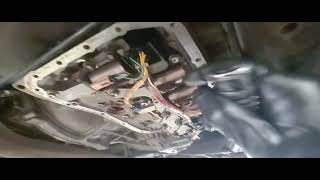
Typical fix: Replace the transmission revolution sensor located inside the transmission case. This involves draining the fluid, removing the oil pan, disconnecting the wiring, and then removing the valve body to access the sensor. After replacement, the transmission must be refilled with Toyota ATF WS fluid.
Est. part cost: $150-$300
Rare But Worth Checking
- Wiring Harness or Connector Damage: While possible, this is much less likely than sensor failure on this specific vehicle. The TSB advises addressing the sensor first. A fault could exist in the external wiring to the transmission or the internal harness that connects to the sensor. A technician was able to diagnose a faulty internal harness by wiggling it with the valve body removed. Check for damage to the wiring leading to the transmission case if a new sensor does not resolve the issue.
- Transmission Control Module (TCM) Failure: → Shop Transmission Assembly This is a very rare cause for this code. The TCM (which may be part of the main Engine Control Module or ECM on this vehicle) processes the signal from the speed sensor. All other possibilities, especially the sensor itself and its wiring, should be exhausted before considering the TCM as the culprit.
Diagnosis Steps
- Connect an OBD-II scanner and confirm P0715 is present. Check for other related codes like P0717, P0791, P0793, or any solenoid performance codes.
- Use the scanner's live data function to monitor the 'Input Speed Sensor' or 'SPD (NT)' parameter.
- Safely drive the vehicle. Observe the sensor reading. If it remains at 0 RPM, is erratic, or stays below 300 RPM when vehicle speed exceeds 31 mph (50 km/h), the sensor is confirmed to be faulty.
- If the sensor data seems correct, inspect the transmission wiring harness for any visible signs of damage, corrosion, or loose connections from the outside.
- Given the high probability of sensor failure on this model, if the live data test confirms a bad signal, proceed with replacing the sensor as outlined in TSB T-SB-0116-10.
- If a new sensor does not fix the issue, the internal transmission wiring harness should be inspected, followed by the very unlikely possibility of a TCM/ECM fault.
Parts You'll Likely Need
- Transmission Revolution Sensor
(OEM #89413-73010)— This is the component that fails, as documented by Toyota's TSB. The original part number was 89413-73010, which has been superseded by the revised, more reliable part 89413-06010.
Trusted brands: Toyota (Genuine), Aisin
OEM price range: $150-$250
Aftermarket price range: $80-$150 - Automatic Transaxle Oil Pan Gasket
(OEM #35168-73010)— Required to be replaced when the transmission oil pan is removed for the repair. This part is explicitly listed in the TSB.
Trusted brands: Toyota (Genuine)
OEM price range: $20-$40
Aftermarket price range: $10-$25 - Toyota Genuine ATF WS (World Standard) Fluid
(OEM #00289-ATFWS)— The transmission must be drained for the service and refilled with this specific fluid after the repair. Several quarts will be needed.
Trusted brands: Toyota (Genuine)
OEM price range: $10-$15 per quart
Aftermarket price range: N/A - Oil Strainer O-Ring
(OEM #90301-27010)— This O-ring for the transmission filter (strainer) is listed as a required part in TSB T-SB-0116-10 and should be replaced during the service.
Trusted brands: Toyota (Genuine)
OEM price range: $5-$10
Aftermarket price range: $2-$5
Related Codes That Often Appear With This One
- P0717 — P0717 (Input/Turbine Speed Sensor Circuit No Signal) is often set with P0715 as it indicates a complete loss of signal, which is a common failure mode of the sensor. T-SB-0116-10 explicitly lists this code.
- P0791 — P0791 (Intermediate Shaft Speed Sensor 'A' Circuit) can also be triggered by the same faulty revolution sensor assembly per Toyota's TSB.
- P0793 — P0793 (Intermediate Shaft Speed Sensor 'A' Circuit No Signal) is another code mentioned in the TSB that points to the same faulty sensor.
- P2714 — P2714 (Pressure Control Solenoid 'D' Performance/Stuck Off) is a solenoid performance code that the TSB warns may be falsely triggered by the faulty speed sensor. The TSB advises fixing the P0715 issue first before diagnosing any solenoid codes.
Technical Service Bulletins (TSBs) & Recalls
- T-SB-0116-10: MIL 'ON' DTC P0715, P0717, P0791, and/or P0793 (U760) - This bulletin, dated April 28, 2010, details the known issue with the transmission revolution sensor, lists affected vehicles (2010 Camry, 2009-2010 Highlander/Venza), provides the official repair procedure, and lists all necessary part numbers.
Platform-Specific Known Issues
- A known pattern failure of the input speed sensor on 2010 Camrys with the U760E transmission, officially recognized by Toyota via TSB T-SB-0116-10.
Mechanic-Grade Diagnostic Values
- Input Speed Sensor (NT) Signal Voltage at TCM — expected: A fluctuating pulse signal that varies with input shaft speed.. Failure: The TCM will store DTC P0715 if the input voltage is less than 0.1V or greater than 1.9V for 4.5 seconds or more.
- Live Data Comparison: Input vs. Output Speed — expected: Input speed 'SPD (NT)' should increase smoothly with engine RPM and correlate with output speed.. Failure: Code P0717 (No Signal) is set if the input speed (NT) is less than 300 RPM for 5 seconds while the output speed is over 1,000 RPM (vehicle speed > 31 mph).
Scan Tool Commands That Help
- Toyota Techstream: Powertrain / ECT / Utility / Reset Memory — This function should be used after replacing the sensor or performing any transmission repair. It clears the learned shift adaptations from the TCM, allowing it to relearn with the new, correct sensor data, which can prevent post-repair shift quality issues.
Wiring & Ground Locations
- Transmission Main Harness Connector — The large, multi-pin connector on the outside of the U760E transmission case.. This is a critical failure point. A loose connection here, due to missing bolts or a bent bracket, can cause intermittent loss of voltage to the internal speed sensors, mimicking a sensor failure.
- TCM Connector E7 / Transmission Wire Connector E50 — E7 is one of the main connectors at the TCM/ECM. E50 is the external connector on the transmission case.. These are the start and end points for testing the wiring harness continuity between the control module and the transmission if a sensor replacement does not fix the issue.
- Transmission Ground Wire — A ground wire attached to the automatic transmission assembly with a single bolt.. A poor ground connection here can cause a variety of electrical issues within the transmission, including erratic sensor readings. The bolt should be torqued to 5.4 N·m (48 in-lbf).
Real Owner Repair Stories
- YouTube Channel 'Drive Safe Automotive' (2016/2017 Toyota Camry with U760E (same transmission family, demonstrating a relevant failure mode)) — Multiple transmission codes including 'input turbine speed sensor a circuit', no shifting, and other solenoid electrical faults.
❌ Tried (didn't work) The previous owner had replaced the PCM/ECM, which did not solve the problem.
✅ What actually fixed it The mechanic found the external transmission harness connector was loose with missing bolts and a bent bracket. Wiggling the connector caused the sensor voltage to appear and disappear on the scan tool. The final diagnosis was a faulty internal and external wiring harness connection, not the sensor itself. Securing the connector and manipulating the harness restored function temporarily, confirming the harness as the root cause.
OEM Part Supersession History
89413-73010→89413-06010— The original sensor had a high failure rate, prompting Toyota to release a revised, more durable part.89413-33030→N/A— This is another part number used in similar Toyota/Lexus applications with the same transmission family.
Heads up: Considered functionally identical and interchangeable with 89413-06010 and 89413-73010, with minor differences in packaging or labeling, not performance.
Diagnostic Flowchart
Other Known Issues on This Vehicle
Issues unrelated to this code that are worth knowing about as an owner of this generation:
- Excessive Oil Consumption (2AR-FE) 🟠 Medium — Moderately common, especially at higher mileage (over 80,000 miles). Owners report consuming a quart of oil every 700-2000 miles. (Ref: While a well-known warranty enhancement existed for the previous 2.4L (2AZ-FE) engine, the 2.5L (2AR-FE) in most 2010 models does not have a formal program, but the issue is widely reported by owners.)
- Sticky / Melting Dashboard 🟡 Low — Very common in regions with high heat and humidity. The dashboard surface can become shiny, sticky, and easily damaged. (Ref: Toyota issued a Warranty Enhancement Program (ZE6) that extended coverage for this issue on 2007-2011 Camrys, but the primary coverage period has expired.)
- VVT Actuator Rattle on Cold Start 🟠 Medium — Some owners report a brief rattling or grinding noise from the engine on cold startups, which can indicate a failing VVT gear/actuator. Repair can be expensive.
- Hesitation on Acceleration 🟡 Low — A common complaint where the automatic transmission may hesitate or feel sluggish when accelerating from a stop or at low speeds.
Used vs. New Parts: Buying Guide for This Vehicle
When a used part is the smart pick: For this specific repair, using a used part from a junkyard is NOT recommended. The original sensor is a known high-failure part, and the labor required to access it is significant. The risk of a used sensor failing shortly after installation outweighs any potential cost savings.
What to inspect on the donor part:
- Not applicable as used parts are not advised for this component.
OEM-only on this vehicle (don't cheap out):
- Transmission Revolution Sensor (Input Speed Sensor)
Aftermarket brands forum-validated for this vehicle:
- Aisin: Aisin is a Toyota group company and the original equipment manufacturer for many Toyota transmission components. An Aisin-branded sensor is widely considered to be of equivalent quality to the Genuine Toyota part.
Brands owners have reported issues with on this vehicle:
- Unnamed, low-cost 'white box' brands. While tempting, the quality control on critical electronic sensors can be poor, leading to premature failure and requiring the expensive labor to be repeated.
Real Owner Stories
Aggregated from forums and TSBs cited above. Mileages and costs reflect what owners reported in those sources.
2010 Toyota Camry
Symptoms: Difficulty in changing gears, hard shifts, and thudding noises. The owner noted the transmission felt like it 'thinks' the throttle is down when it isn't.
What fixed it: Replacement of the faulty input speed sensor.
Source hint: Reddit r/MechanicAdvice - 'Difficulty in Changing Gears + Error Code P0715'
Related OBD-II Codes
Frequently Asked Questions
Is there an official Toyota bulletin for P0715 on the 2010 Camry?
What specific part does Toyota recommend to fix this issue?
Can I use a used sensor from a junkyard to save money?
Which aftermarket brands are reliable for the 2010 Camry speed sensor?
Does this P0715 issue affect other Toyota models from the same era?
What live data parameter should I look for to confirm the sensor is bad?
Is the sticky dashboard on my 2010 Camry related to this transmission code?
Helpful Videos

We Have This Part in Stock

The information in this article is provided for general reference and educational purposes only. Vehicle specifications, procedures, and part compatibility can vary by production date, trim level, and region. Always consult your vehicle's factory service manual and verify part numbers before purchasing or performing repairs. Safety-critical components such as airbags, seat belts, and braking systems should be installed by a qualified professional.
- Toyota Camry:
- 🧭 Diagnostic Flowchart
- 🎬 Helpful Videos
- 🛍️ Shop This Part
- What's Unique About the 2010-2010 Toyota Camry
- Symptoms You May Notice
- Most Likely Causes
- Rare But Worth Checking
- Diagnosis Steps
- Parts You'll Likely Need
- Related Codes That Often Appear With This One
- Technical Service Bulletins (TSBs) & Recalls
- Platform-Specific Known Issues
- Mechanic-Grade Diagnostic Values
- Scan Tool Commands That Help
- Wiring & Ground Locations
- Real Owner Repair Stories
- OEM Part Supersession History
- Other Known Issues on This Vehicle
- Used vs. New Parts: Buying Guide for This Vehicle
- Real Owner Stories
- 2010 Toyota Camry
- Related OBD-II Codes
- Frequently Asked Questions
- 🎟️ Get 5% Off