

P0715 on 2009-2013 Toyota Corolla: Input Speed Sensor Failure Causes and Fixes
On a 2009-2013 Corolla, code P0715 is almost always a failed Input/Turbine Speed Sensor. It's located externally on top of the transmission and is a straightforward DIY fix after removing the air filter box. Expect to pay $40-$90 for an aftermarket sensor or $120-$180 for an OEM part.
- P0715 on a 2009-2013 Corolla points directly to a problem with the Input Speed Sensor circuit, most often the sensor itself.
- Unlike other Toyotas, the sensor on the U341E transmission is external and relatively easy to access and replace, making it a good DIY task.
- Symptoms are severe and include limp mode and harsh shifting, but the fix is usually simple and inexpensive.
- Always test the sensor's resistance (560-680 Ω) and check the wiring harness for damage before condemning other, more expensive components like the PCM.
What's Unique About the 2009-2013 Toyota Corolla
The 2009-2013 Corolla with the 1.8L 2ZR-FE engine uses a 4-speed automatic transmission known as the U341E. Unlike many other transmissions which have an internal input speed sensor requiring major work to replace, the sensor on this Corolla's U341E transmission is located externally. It sits on top of the transmission case, making it accessible by removing the battery and air filter housing. This design turns a potentially major transmission repair into a simple and inexpensive DIY job.
Symptoms You May Notice
- Check Engine Light is on
- Vehicle enters "limp mode" (stuck in one gear, often 2nd or 3rd)
- Harsh, erratic, or delayed gear shifts
- Slipping transmission
- Poor acceleration
- Engine RPMs are higher than usual for the speed
- Decreased fuel economy
- VSC (Vehicle Stability Control) and ABS lights may also illuminate
- Stalling when coming to a stop
- Replacing the entire transmission when only the inexpensive external sensor is needed.
- Replacing the output speed sensor instead of the input speed sensor.
- Assuming the sensor is internal and requires dropping the transmission pan, which is not true for this specific vehicle.
Most Likely Causes
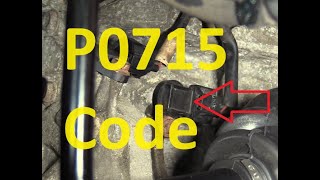
- Failed Input/Turbine Speed Sensor 🔴 High Probability → Shop Automatic Transmission Input Shaft Speed Sensor The sensor is an electronic component that can fail over time due to heat cycles and vibration. It is the most common cause for a P0715 code. 🎬 Watch: Causes and fixes for the P0715 code
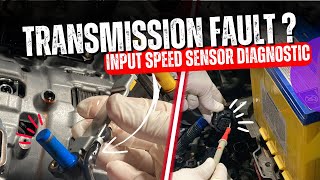
How to confirm: After accessing the sensor, disconnect its electrical connector and measure the resistance between the two pins using a multimeter. 🎬 See this diagnostic video on testing the sensor and wiring The reading should be between 560 and 680 Ohms at room temperature (68°F/20°C). A reading that is open (infinite resistance) or shorted (zero resistance) confirms the sensor is bad. Also inspect the magnetic tip of the sensor for excessive metallic debris, which can interfere with its reading.
Typical fix: Replace the input speed sensor. The sensor is held in by a single 10mm bolt. 🎬 Watch: How to replace an input shaft speed sensor
Est. part cost: $40-$180 - Damaged Wiring or Connector 🟡 Medium Probability The wiring harness is located in the engine bay and can be susceptible to damage from heat, vibration, or rodents. Corrosion can also form in the connector pins.
How to confirm: Visually inspect the wiring leading to the input speed sensor for any signs of cracking, fraying, melting, or corrosion at the connector. Perform a continuity test from the sensor connector to the PCM/ECM connector if the sensor itself tests good. A user on a Yaris forum with a similar transmission fixed a P0715 code by having an electrician correct faulty wiring.
Typical fix: Repair the damaged section of wire or replace the connector pigtail.
Est. part cost: $10-$30 - Low or Dirty Transmission Fluid ⚪ Low Probability → Shop Transmission Assembly Neglected maintenance can lead to fluid breakdown or low levels, which can cause erratic transmission behavior. While less likely to cause a specific sensor circuit code, it should always be checked first with any transmission issue.
How to confirm: Check the transmission fluid level and condition using the dipstick. The fluid should be at the 'HOT' mark when the engine is warm and running, and it should be reddish-pink and not smell burnt. The U341E transmission has a dipstick for easy checking.
Typical fix: Perform a transmission fluid drain-and-fill using Toyota Genuine ATF WS fluid. If the fluid is very dark or contains metal particles, the transmission may have internal damage.
Est. part cost: $50-$100 for fluid
Rare But Worth Checking
- Faulty Powertrain Control Module (PCM): This is very rare. The PCM is the car's main computer. All other possibilities, especially the sensor and wiring, should be exhaustively ruled out before considering a PCM failure.
- Internal Transmission Mechanical Issues: → Shop Transmission Assembly Problems like a failing torque converter or damaged reluctor ring can trigger a P0715 code, but would likely be accompanied by other symptoms like noise or more severe shifting problems.
Diagnosis Steps
- Check the transmission fluid level and condition. Ensure it is full and clean.
- Use an OBD-II scanner to confirm the P0715 code and check for any other related codes. A scanner with live data can also show the 'Input Shaft Speed' reading to see if it's erratic or zero.
- Locate the input speed sensor. On the 2009-2013 Corolla, this requires removing the air filter housing and possibly the battery and battery tray to access the top of the transmission.
- The sensor is held in by a single 10mm bolt.
- Visually inspect the sensor's wiring harness and connector for any obvious damage, corrosion, or loose connections.
- Disconnect the sensor and test its resistance with a multimeter. A good sensor will read between 560-680 Ohms. If the reading is out of this range, the sensor is faulty and must be replaced.
- If the sensor tests good, the next step is to check the wiring for continuity between the sensor connector and the PCM. Check for 5V reference voltage and good ground at the connector with the ignition on.
- If both the sensor and wiring are good, the issue may be with the PCM, but this is extremely unlikely.
Parts You'll Likely Need
- Input Speed Sensor (Transmission Revolution Sensor)
(OEM #89413-32010)— This sensor is the most common failure point for code P0715 on this vehicle. This part number is widely used across many Toyota models.
Trusted brands: Toyota Genuine, Denso (often the OEM manufacturer), NTK/NGK, Standard Motor Products (SMP)
OEM price range: $120-$180
Aftermarket price range: $40-$90
Related Codes That Often Appear With This One
- P0717 — P0717 (Input/Turbine Speed Sensor 'A' Circuit No Signal) is a more specific version of P0715, indicating a complete loss of signal. They are often caused by the exact same failed sensor or wiring break.
- P0500 — P0500 (Vehicle Speed Sensor 'A' Malfunction) can sometimes appear if the computer sees a major discrepancy between different speed readings. However, P0715 is specific to the transmission input sensor.
- P0725 — P0725 (Engine Speed Input Circuit Malfunction) can appear alongside P0715 as the TCM compares engine speed with transmission input speed to detect clutch slippage or sensor faults.
Platform-Specific Known Issues
- Real-World Forum Experience: A Reddit user with an unspecified vehicle described experiencing a 'THUD' noise when shifting from Park to Drive and during initial acceleration, which was later diagnosed as a P0715 code after a shop initially misdiagnosed other sensors. This highlights how the mechanical symptoms can be directly tied to the sensor's failure to provide a correct speed reading.
- Wiring as a Confirmed Cause: On a Toyota Yaris forum, a user with a similar transmission and P0715 code reported that after a sensor replacement failed to fix the issue, a third mechanic discovered and repaired faulty wiring, which ultimately cleared the code. This confirms that wiring should be thoroughly checked if a new sensor doesn't solve the problem.
Mechanic-Grade Diagnostic Values
- Input/Turbine Speed Sensor (NT) Resistance — expected: 560 - 680 Ω at 20°C (68°F). Failure: Open circuit (infinite resistance) or short circuit (near zero resistance).
- Sensor Power Supply Voltage at Connector — expected: Approx. 5V. Failure: No voltage or significantly lower voltage indicates a wiring or ECM issue.
- Sensor Signal Voltage (Live Data) — expected: Should not be less than 0.1V or higher than 1.9V.. Failure: A voltage outside this range for more than 2-4 seconds will trigger the DTC.
- Live Data - Input Turbine Speed (SPD NT) — expected: RPM should rise smoothly with engine RPM in Park/Neutral and correspond to vehicle speed and gear.. Failure: Reading is always 0 while driving, or is less than 300 RPM when vehicle speed is over 31 mph (50 km/h).
- Wiring Harness Continuity (Sensor to ECM) — expected: Below 1 Ω. Failure: Higher resistance indicates a break or corrosion in the wire.
Scan Tool Commands That Help
- Toyota Techstream: Data List -> Powertrain / ECT -> SPD (NT) — Use this to monitor the live RPM reading from the input speed sensor while the engine is running and during a test drive. A reading of 0 or an erratic reading that doesn't correlate with engine speed points to a fault in the sensor or its circuit.
- Toyota Techstream: Active Test -> Control the Shift — While not a direct test of the sensor, this can help determine if the transmission's solenoids and mechanical components are responding to commands from the ECM. If the transmission shifts correctly during the active test but not during normal driving, it further isolates the problem to the sensor input side (like the P0715).
Wiring & Ground Locations
- Input Speed Sensor Connector (B48) — On top of the U341E transmission case, accessible after removing the air filter housing.. This is the primary connection point for the sensor. Checking for voltage, ground, and signal at this 2-pin connector is the first step in electrical diagnosis.
- ECM Connector (B22/B23) — Located in the engine bay, typically near the passenger side firewall.. The wires from the input speed sensor terminate here. Specifically, pins B22-125 (NTO) and B22-126 (NTB) on LHD models are where the sensor signal arrives at the ECM. Checking for continuity between the sensor connector and these pins is critical if the sensor itself tests good.
- Engine/Transmission Ground Point — A primary ground strap connects from the negative battery terminal to a bolt on the top of the transmission case.. A poor ground connection at the transmission can cause floating voltages and erratic behavior from any sensor mounted on it, including the input speed sensor. This should be checked for corrosion and tightness.
- Engine Block Ground — A ground point is located on the engine block, just above the alternator.. The engine harness relies on solid ground connections. While less direct, a faulty engine ground can introduce electrical noise that may interfere with sensitive sensor signals.
OEM Part Supersession History
89413-0C011→89413-32010— Part consolidation and potential minor internal revisions.
Heads up: 89413-32010 is the widely accepted replacement and is backward compatible. Some parts suppliers note that 89413-32010 itself is out of production but that replacements will fit, though this may refer to OEM stock, not aftermarket availability.
Model Year Variations Within This Range
- 2009-2010: These model years were subject to the 'Smart Stop Technology' recall which involved an ECM recalibration. This update changed torque management logic, which can affect shift feel. While not directly causing P0715, an owner might notice different shifting behavior after the recall was performed. It's important to verify if this recall was completed.
Diagnostic Flowchart
Other Known Issues on This Vehicle
Issues unrelated to this code that are worth knowing about as an owner of this generation:
- Excessive Oil Consumption 🔴 High — Common in early 2ZR-FE engines, particularly 2009 models. Caused by faulty piston ring design. Some owners report adding a quart of oil every 1,000-2,000 miles. Toyota addressed this in TSB T-SB-0094-11 for the related 2AZ-FE engine, but the 2ZR-FE is also known for this issue. (Ref: While TSB T-SB-0094-11 was for the 2.4L 2AZ-FE engine also found in some 2009 Corollas, the 1.8L 2ZR-FE has a widely documented, similar issue.)
- Water Pump Failure 🟠 Medium — A known weak spot for this generation, with failures reported anywhere from 30,000 to 100,000 miles. Symptoms include a whining/grinding noise, and visible pink coolant leaks from the passenger side of the engine.
- Faulty Master Power Window Switch 🟡 Low — The driver's side master window switch is known to fail, causing one or more windows to become inoperable from the master control panel. This is a simple DIY replacement.
- Starter Motor Failure 🟡 Low — Can fail at higher mileage, presenting as a single click with no engine crank, even with a good battery.
Used vs. New Parts: Buying Guide for This Vehicle
When a used part is the smart pick: A used sensor is generally not recommended as it's an electronic wear item with an unknown history. However, sourcing a used wiring harness pigtail from a junkyard is a very smart and cost-effective choice if only the connector is damaged. A complete used transmission from a low-mileage donor car is a viable option if major internal damage is diagnosed, but not for a P0715 code alone.
Donor-vehicle mileage cap: roughly under 80000 miles for the part to have meaningful remaining life.
What to inspect on the donor part:
- For a wiring pigtail, ensure the plastic isn't brittle and the locking tab is intact.
- Check the wires for any signs of previous repair, cracking, or heat damage.
- Look for a donor vehicle from a dry climate to minimize corrosion risk.
- Verify the donor vehicle has low mileage (under 80k miles is ideal for major components).
OEM-only on this vehicle (don't cheap out):
- Powertrain Control Module (PCM/ECM) — Aftermarket or used modules often have programming and compatibility issues.
Aftermarket brands forum-validated for this vehicle:
- Denso (often the OEM supplier)
- NTK/NGK
- Standard Motor Products (SMP)
Brands owners have reported issues with on this vehicle:
- Unbranded, 'white-box' sensors from online marketplaces often have high failure rates and may not meet OEM resistance or voltage specifications.
Real Owner Stories
Aggregated from forums and TSBs cited above. Mileages and costs reflect what owners reported in those sources.
Toyota Corolla
Symptoms: Experienced a 'THUD' noise when shifting from Park to Drive and during initial acceleration; a shop initially misdiagnosed other sensors before finding the P0715 code.
What fixed it: Diagnosis of the P0715 code and addressing the input speed sensor failure.
Source hint: Reddit r/MechanicAdvice: 'Difficulty in Changing Gears + Error Code P0715'
Toyota Yaris (U341E Transmission)
Symptoms: P0715 code persisted even after the input speed sensor was replaced.
What fixed it: An electrician discovered and repaired faulty wiring in the sensor circuit.
Source hint: Toyota Yaris Forums: 'P0715 - Input/Turbine Speed Sensor'
Related OBD-II Codes
Frequently Asked Questions
Where is the input speed sensor located on my 2009-2013 Toyota Corolla?
What is the correct resistance for a new input speed sensor on the U341E transmission?
Can I use any transmission fluid to fix shifting issues related to P0715?
Does the 2009-2013 Toyota Matrix share this same P0715 issue?
Is there a TSB for the oil consumption issue mentioned in the known issues for my 2009 Corolla?
What size tool do I need to remove the input speed sensor?
Helpful Videos

We Have This Part in Stock

The information in this article is provided for general reference and educational purposes only. Vehicle specifications, procedures, and part compatibility can vary by production date, trim level, and region. Always consult your vehicle's factory service manual and verify part numbers before purchasing or performing repairs. Safety-critical components such as airbags, seat belts, and braking systems should be installed by a qualified professional.
- Toyota Corolla:
- 🧭 Diagnostic Flowchart
- 🎬 Helpful Videos
- 🛍️ Shop This Part
- What's Unique About the 2009-2013 Toyota Corolla
- Symptoms You May Notice
- Most Likely Causes
- Rare But Worth Checking
- Diagnosis Steps
- Parts You'll Likely Need
- Related Codes That Often Appear With This One
- Platform-Specific Known Issues
- Mechanic-Grade Diagnostic Values
- Scan Tool Commands That Help
- Wiring & Ground Locations
- OEM Part Supersession History
- Model Year Variations Within This Range
- Other Known Issues on This Vehicle
- Used vs. New Parts: Buying Guide for This Vehicle
- Real Owner Stories
- Toyota Corolla
- Toyota Yaris (U341E Transmission)
- Related OBD-II Codes
- Frequently Asked Questions
- 🎟️ Get 5% Off