

P0715 on 2009-2010 Toyota Highlander: Input/Turbine Speed Sensor Failure Causes and Fixes
On a 2009-2010 Toyota Highlander, code P0715 is almost always caused by a failed internal transmission revolution sensor. This is a known issue addressed by Toyota TSB T-SB-0116-10. The repair is labor-intensive, requiring removal of the transmission valve body, and is best left to a professional.
- P0715 on a 2009-2010 Highlander is a known issue directly addressed by Toyota TSB T-SB-0116-10.
- The cause is a faulty internal transmission revolution sensor, not an easily accessible external one.
- The repair is complex, requiring removal of the transmission valve body, and should be performed by a professional.
- Always check for associated codes like P0717, P0791, and various solenoid codes, as they are likely symptoms of the same root cause per the TSB.
What's Unique About the 2009-2010 Toyota Highlander
The 2009-2010 Highlander, particularly models with the U760E 6-speed automatic transmission, is known for this specific failure. Toyota issued a Technical Service Bulletin (T-SB-0116-10) acknowledging that the original transmission revolution sensor was prone to failure and released an updated part to correct the issue. Unlike some vehicles where this sensor is easily accessible on the outside of the transmission, on this Highlander, the sensor is located inside the transmission and requires removing the valve body to replace it.
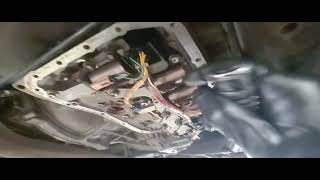
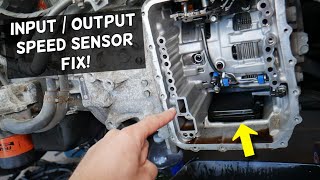
🎬 Watch: U760E transmission teardown and sensor replacement walkthroughSymptoms You May Notice
- Check Engine Light is on
- Vehicle enters "limp mode" (stuck in one gear, usually 3rd)
- Harsh, erratic, or delayed gear shifts
- Poor or hesitant acceleration
- Vehicle may stall when shifting or coming to a stop
- Decreased fuel economy.
- Replacing the externally mounted speed sensors. The 2009-2010 Highlander has wheel speed sensors (for ABS) and may have an output speed sensor on the transmission case. However, the P0715 code, as per TSB T-SB-0116-10, refers to the *internal* input/revolution sensor. Replacing external sensors will not fix this specific issue.
Most Likely Causes
- Failed Internal Transmission Revolution Sensor 🔴 High Probability → Shop Transmission Assembly This is a well-documented failure addressed by Toyota Technical Service Bulletin T-SB-0116-10. The original sensor was known to be faulty, and an updated part was released.
How to confirm: Confirm with a scanner that P0715 is present. A professional technician can use a scan tool to monitor live data for the input turbine speed; a reading that is erratic, zero, or does not change with engine RPM points to a failed sensor or circuit.
Typical fix: Replace the transmission revolution sensor. This requires removing the transmission oil pan and valve body to access the sensor.
Est. part cost: $150-$300
Rare But Worth Checking
- Wiring or Connector Damage: The wiring harness leading to the transmission could be damaged, corroded, or have a loose connection, mimicking a sensor failure. This should be inspected before condemning the internal sensor.
- Low or Dirty Transmission Fluid: → Shop Transmission Assembly Extremely low or contaminated fluid can cause a variety of transmission issues, including erratic sensor readings or harsh shifting. Always check fluid level and condition first.
- Faulty Transmission Control Module (TCM): → Shop Transmission Assembly In very rare cases, the computer itself can fail, causing it to misinterpret a good sensor signal. This is unlikely and should only be considered after all other possibilities are exhausted.
Diagnosis Steps
- Read the trouble codes with an OBD-II scanner.
- Check for TSB T-SB-0116-10 applicability based on your vehicle's VIN and production date. Note that this TSB is the primary diagnostic path.
- Check the transmission fluid level and condition. Ensure it is full and not burnt or contaminated.
- Using an advanced scan tool, monitor the live data for 'Input Turbine Speed' (SPD NT). Observe if the reading is zero, erratic, or does not change as expected with engine RPM. A faulty signal is defined in service documents as a voltage above 1.9V or below 0.1V for more than 4.5 seconds.
- If the signal is faulty, inspect the external transmission wiring harness and connectors for any visible damage, corrosion, or loose pins.
- If wiring is intact and live data confirms a sensor issue per the TSB, the internal transmission revolution sensor is the confirmed cause and should be replaced along with associated gaskets and seals.
Parts You'll Likely Need
- Transmission Revolution Sensor
(OEM #89413-73010)— This is the component identified by Toyota in TSB T-SB-0116-10 as the root cause of the P0715 code for this vehicle.
Trusted brands: Toyota (Genuine)
OEM price range: $150-$250
Aftermarket price range: $70-$150 - Automatic Transaxle Oil Pan Gasket
(OEM #35168-73010)— The oil pan must be removed to access the valve body and sensor. The gasket is a one-time use part and must be replaced.
Trusted brands: Toyota (Genuine), Fel-Pro, Mahle
OEM price range: $30-$50
Aftermarket price range: $15-$30 - O-ring, Oil Strainer
(OEM #90301-27010)— This O-ring seals the oil strainer (filter) to the valve body. It must be replaced when the strainer is removed to access the valve body.
Trusted brands: Toyota (Genuine)
OEM price range: $5-$10 - Toyota Genuine ATF WS Fluid
(OEM #00289-ATFWS)— The transmission fluid must be drained for the repair and refilled with the correct OEM-specified fluid to ensure proper transmission function.
Trusted brands: Toyota (Genuine)
OEM price range: $10-$15 per quart
Related Codes That Often Appear With This One
- P0717 — This code means 'Input Speed Sensor Circuit No Signal' and is often set along with P0715, as it indicates a complete loss of the signal from the same failing sensor.
- P0791 / P0793 — These codes relate to the 'Intermediate Shaft Speed Sensor'. The TSB T-SB-0116-10 notes that these can also be triggered by the same faulty transmission revolution sensor.
- P0746, P0776, P0796, P2714, P2808 — These are solenoid performance codes. The TSB states that a faulty revolution sensor can cause these codes to set as well, as the TCM cannot properly command the solenoids without a correct speed reading.
Technical Service Bulletins (TSBs) & Recalls
- T-SB-0116-10: MIL "ON" DTC P0715, P0717, P0791, and/or P0793 (U760). This TSB confirms the cause is a faulty transmission revolution sensor and provides the repair procedure, updated part number, and a labor time of 2.4 hours under warranty.
Platform-Specific Known Issues
- Toyota issued Technical Service Bulletin T-SB-0116-10 on April 28, 2010, specifically for 2009-2010 Highlander models (among others) with the U760 transmission that may exhibit a MIL 'ON' with code P0715 due to a faulty transmission revolution sensor.
Mechanic-Grade Diagnostic Values
- Live Data: Input Turbine Speed (SPD NT) vs. Engine Speed — expected: With the transmission in Park or Neutral, or when the lock-up clutch is engaged, the Input Turbine Speed (SPD NT) should be equal to the engine RPM.. Failure: A reading of 0 RPM, an erratic signal that drops out, or a value below 300 RPM when vehicle speed is over 31 mph (50 km/h) indicates a fault.
- Sensor Circuit Voltage at TCM — expected: Normal operating voltage is between 0.1V and 1.9V.. Failure: The TCM will set code P0715 if the voltage is above 1.9V or below 0.1V for 4.5 seconds or more.
- Wiring Harness Resistance (TCM connector to sensor connector) — expected: Below 1 Ω between the corresponding terminals.. Failure: Resistance higher than 1 Ω indicates a problem in the wiring harness.
- Wiring Harness Resistance to Ground — expected: 10 kΩ or higher between each sensor terminal and the vehicle body ground.. Failure: Resistance below 10 kΩ indicates a short to ground in the harness.
Scan Tool Commands That Help
- Toyota Techstream: Powertrain / ECT / Utility / Reset Memory — This function should be used after replacing the transmission revolution sensor or valve body to clear the learned values (adaptations) from the TCM. This allows the module to relearn shift patterns with the new components.
- Toyota Techstream: Road Test (Shift Pattern Learning) — After a 'Reset Memory' command, a specific drive cycle must be performed to allow the TCM to relearn shift timing. This typically involves accelerating from a stop with light throttle (under 15%) and then again with heavier throttle (over 25%) until shifts are smooth.
Wiring & Ground Locations
- Transmission Bulkhead Connector — External connector on the driver's side of the U760E transmission case, where the main vehicle harness connects to the internal transmission harness.. A loose or corroded connection at this main plug can cause intermittent loss of signal from the internal input speed sensor, mimicking a sensor failure. In one documented case, missing bolts on this connector caused intermittent P0715 and other solenoid codes.
- Engine/Transaxle Ground Wire — There is an earth wire that bolts to the automatic transmission assembly.. A poor ground connection for the transmission can introduce electrical noise or voltage drops, potentially affecting the signals from various sensors, including the input speed sensor.
Real Owner Repair Stories
- YouTube channel 'Drive Safe Automotive' (2016/2017 Toyota Camry with U760E (flood vehicle)) — Check engine light with multiple speed sensor and solenoid codes, including P0715. No speed sensor signal.
❌ Tried (didn't work) The PCM had already been replaced. Clearing codes was only temporary as they would return immediately.
✅ What actually fixed it The technician found the external transmission harness connector was loose due to missing bolts. By wiggling the connector, the speed sensor voltage readings on the scan tool would appear and disappear. Securing the connector and repairing the harness resolved the intermittent signal and cleared the codes.
OEM Part Supersession History
89413-0E010→89413-73010— The original sensor was prone to failure, leading to TSB T-SB-0116-10. The new part is a revised, more reliable version.
Heads up: While the original part may physically fit, it is the known faulty component and should not be used. Always install the updated part number.89413-73010→89413-06010— Standard part number consolidation and updates by Toyota.
Heads up: Parts catalogs show 89413-73010 is replaced by 89413-06010. Both are considered valid replacements for this repair, but it's best to confirm with the dealer using the vehicle's VIN.
Diagnostic Flowchart
Other Known Issues on This Vehicle
Issues unrelated to this code that are worth knowing about as an owner of this generation:
- VVT-i Oil Line Rupture (2GR-FE V6) 🔴 High — Common on early 2GR-FE engines; the original rubber hose section degrades and can burst without warning, causing rapid oil loss and catastrophic engine failure. (Ref: Limited Service Campaign (LSC) & T-SB-0201-11 issued to replace the rubber line with an all-metal part (15767-31020).)
- Melting / Sticky Dashboard 🟠 Medium — Widespread issue in regions with high heat and humidity, where the dashboard material degrades, becomes sticky, and creates a dangerous glare on the windshield. (Ref: Toyota acknowledged the issue and offered an extended warranty enhancement program after facing class-action lawsuits.)
- Power Liftgate Failure 🟠 Medium — Common complaint where the power liftgate motor or actuator fails, preventing the rear door from opening or closing automatically. Repairs can be very expensive. (Ref: A service bulletin was issued in 2012 for 2008-2012 models regarding improper closing, and a class-action lawsuit was filed over the issue.)
- Water Pump Failure (2GR-FE V6) 🟠 Medium — The water pump on the V6 engine is a known failure point, often leading to coolant leaks.
Used vs. New Parts: Buying Guide for This Vehicle
When a used part is the smart pick: For this specific repair, using a used part is generally not recommended for the sensor itself. The original sensor is a known failure point, and a used part from a junkyard is highly likely to be the old, failure-prone version or have significant wear. A used valve body or complete transmission assembly could be considered if the cost is significantly lower than a new part and it comes from a low-mileage donor vehicle, but the sensor should still be replaced with a new OEM part during the installation.
Donor-vehicle mileage cap: roughly under 60000 miles for the part to have meaningful remaining life.
What to inspect on the donor part:
- Verify the donor vehicle's year to ensure it's as new as possible.
- Ask for the VIN to check if the TSB T-SB-0116-10 repair was ever performed by a dealer.
- Inspect the transmission fluid from the donor if possible; dark, burnt fluid is a major red flag.
- If buying a complete transmission, ensure the external harness connector is intact with no broken clips or corrosion.
OEM-only on this vehicle (don't cheap out):
- Transmission Revolution Sensor (Input Speed Sensor)
- Toyota Genuine ATF WS Fluid
Brands owners have reported issues with on this vehicle:
- Unnamed, no-brand sensors from online marketplaces. Given the high labor cost to access this internal part, using a cheap, unverified sensor is a significant risk that could lead to doing the job twice.
Real Owner Stories
Aggregated from forums and TSBs cited above. Mileages and costs reflect what owners reported in those sources.
2010 Toyota Highlander
Symptoms: The owner experienced a complex repair process where the installation of certain parts was tricky and required multiple attempts by the dealer to get right.
What fixed it: Dealer repair involving the installation of internal transmission components.
Source hint: Edmunds.com Car Forums: In a discussion about the 2010 Highlander
Related OBD-II Codes
Frequently Asked Questions
Does Technical Service Bulletin T-SB-0116-10 apply to my 2009-2010 Toyota Highlander?
What is the specific repair procedure recommended by Toyota for P0715 on this model?
Can I use a used sensor from a salvage yard to fix the P0715 code?
How long should the P0715 sensor replacement take at a repair shop?
Are there other common issues on the 2009-2010 Highlander I should check while fixing the transmission?
What specific transmission fluid should be used when refilling after the sensor repair?
Helpful Videos
We Have This Part in Stock

The information in this article is provided for general reference and educational purposes only. Vehicle specifications, procedures, and part compatibility can vary by production date, trim level, and region. Always consult your vehicle's factory service manual and verify part numbers before purchasing or performing repairs. Safety-critical components such as airbags, seat belts, and braking systems should be installed by a qualified professional.
- Toyota Highlander:
- 🧭 Diagnostic Flowchart
- 🎬 Helpful Videos
- 🛍️ Shop This Part
- What's Unique About the 2009-2010 Toyota Highlander
- Symptoms You May Notice
- Most Likely Causes
- Rare But Worth Checking
- Diagnosis Steps
- Parts You'll Likely Need
- Related Codes That Often Appear With This One
- Technical Service Bulletins (TSBs) & Recalls
- Platform-Specific Known Issues
- Mechanic-Grade Diagnostic Values
- Scan Tool Commands That Help
- Wiring & Ground Locations
- Real Owner Repair Stories
- OEM Part Supersession History
- Other Known Issues on This Vehicle
- Used vs. New Parts: Buying Guide for This Vehicle
- Real Owner Stories
- 2010 Toyota Highlander
- Related OBD-II Codes
- Frequently Asked Questions
- 🎟️ Get 5% Off