

P0716 on 2015-2019 Hyundai Sonata: Input Speed Sensor Causes and Fixes
On a 2015-2019 Sonata with the A6MFx 6-speed automatic transmission, P0716 means the transmission's internal input speed sensor is sending erratic signals. This is a very common issue where the sensor, which is part of an internal wiring harness assembly, fails due to heat and age. The official fix requires removing the transmission valve body to replace the entire harness assembly. This is a complex, professional job costing between $715 and $954.
- P0716 on a 2015-2019 Sonata points to a failing transmission input speed sensor.
- Symptoms are serious and include harsh shifting and potential limp mode.
- This is not a DIY-friendly repair. The sensor is inside the transmission, and replacement is a complex job for a professional mechanic.
- Expect a repair cost of approximately $715 to $954, with the majority of the cost being labor.
- It is wise to replace the internal wiring harness at the same time as the sensor to prevent future issues.
What's Unique About the 2015-2019 Hyundai Sonata
The 2015-2019 Hyundai Sonata (LF generation) uses a 6-speed automatic transmission (models like the A6MF1 or A6MF2) where the input and output speed sensors are integrated into a single internal wiring harness assembly. Unlike some vehicles where these sensors are easily accessible from the outside of the transmission case, on this Sonata, the entire harness assembly is located inside, mounted to the valve body. This design choice makes replacement significantly more labor-intensive, as the transmission pan and valve body must be removed to access the part. The official Hyundai repair procedure, outlined in TSBs, calls for replacing the entire harness, not just a single sensor.
Symptoms You May Notice
- Harsh, erratic, or delayed gear shifts.
- Vehicle enters 'limp mode,' often getting stuck in 2nd or 3rd gear.
- Check Engine Light is illuminated.
- Flashing transmission service warning light.
- Sluggish acceleration as the engine revs but the car doesn't speed up accordingly.
- Inaccurate or fluctuating speedometer readings in some cases.
- Engine may idle roughly or stall when coming to a stop. 🎬 See: P0716 code symptoms, causes, and solutions explained
- Replacing the entire transmission. While the symptoms can be severe, the root cause is often a much cheaper (though still labor-intensive) sensor and wiring harness assembly inside the transmission.
- Replacing external wheel speed sensors. The P0716 code refers specifically to the transmission's internal input shaft speed sensor, not the ABS wheel speed sensors used for wheel speed monitoring.
Most Likely Causes
- Failing Internal Transmission Wiring Harness (with Integrated Speed Sensors) 🔴 High Probability → Shop Transmission Assembly The internal wiring harness, which includes the input and output speed sensors, is a known high-failure part in this transmission family (A6MFx). It is constantly submerged in hot transmission fluid, causing the plastic and wiring insulation to become brittle and fail over time, leading to sensor signal degradation.
How to confirm: A professional technician will use a diagnostic scan tool (like Hyundai's GDS) to monitor live data from the Input Speed Sensor while driving. An erratic or illogical signal that jumps, drops to zero, or doesn't correlate with engine RPM confirms the sensor circuit is faulty. The sensor's resistance can also be tested and should be within 270-330 Ω at room temperature.
Typical fix: Replace the entire internal transmission wiring harness assembly. This involves draining the fluid, removing the transmission pan and then the valve body to access the harness. Both input and output sensors are replaced as part of this single assembly. The OEM part is Hyundai P/N 46307-3B650. 🎬 Watch: Hyundai transmission harness and sensor replacement walkthrough
Est. part cost: $140-$200 - Damaged Internal Wiring Harness or Connectors 🟡 Medium Probability → Shop Transmission Wiring Harness The wiring harness that connects the speed sensors is also located inside the transmission, exposed to the same heat and fluid as the sensor. Over time, the plastic and wires can become brittle and fail.
How to confirm: During the sensor replacement process, the technician should visually inspect the wiring harness for any signs of brittleness, cracking, or damage to the connectors. A continuity test can also be performed.
Typical fix: If the harness is damaged, it must be replaced. This is typically done at the same time as the sensor replacement.
Est. part cost: $150-$300 - Low or Contaminated Transmission Fluid ⚪ Low Probability → Shop Transmission Assembly While not a design flaw, neglecting transmission service can lead to fluid breakdown, which can cause shifting issues and potentially interfere with sensor operation due to debris or altered hydraulic properties.
How to confirm: Check the transmission fluid level and condition according to the manufacturer's procedure. The fluid should be at the correct level, red in color, and not smell burnt. Dark, dirty, or burnt-smelling fluid indicates a problem.
Typical fix: Perform a transmission fluid drain and fill using Hyundai-specific SP-IV fluid. If the fluid is heavily contaminated, a more thorough flush may be needed, but this should be done with caution on high-mileage transmissions.
Est. part cost: $100-$200
Rare But Worth Checking
- Faulty Transmission Control Module (TCM): → Shop Transmission Assembly This is rare. The TCM is the computer that controls the transmission. It should only be considered after all other possibilities (sensor, wiring, fluid) have been exhaustively ruled out by testing.
- Mechanical Failure in Transmission: → Shop Transmission Assembly In some cases, internal mechanical issues like a damaged clutch pack or debris on the turbine can cause the shaft to rotate irregularly, leading the sensor to report erratic speeds. This is less common than an electronic failure.
Diagnosis Steps
- Connect a high-quality OBD-II scanner capable of reading live transmission data.
- Verify that P0716 is the primary code. Note any other codes present, such as P0717 or P0721, as they point to the same root cause.
- Monitor the live data stream for the Input Speed Sensor (TSS or ISS) and Output Speed Sensor (OSS).
- While safely driving the vehicle, observe the sensor's readings. The Input Speed Sensor RPM should rise and fall smoothly with engine RPM and gear changes. Erratic jumps, dropouts to zero, or a flat reading while the vehicle is moving indicate a problem with the sensor or its circuit.
- Check the transmission fluid level and condition. Low or dirty fluid can cause a host of issues and should be addressed first.
- If the fluid is fine but the sensor signal is erratic, the next step is to inspect the sensor and its wiring. Given its internal location on the Sonata, this means proceeding with the transmission pan and valve body removal.
- Once inside, visually inspect the wiring harness for any obvious damage, corrosion, or brittle plastic. The most common failure is the harness itself.
- It is highly recommended to replace the entire internal wiring harness (Hyundai P/N 46307-3B650) which contains both the input and output speed sensors. This is the standard repair procedure.
- After reassembly, fill with the correct type of Hyundai-specific transmission fluid (SP-IV), clear the codes, and perform a road test to verify the repair. A TCM adaptive learning reset may be required. 🎬 Watch: How to replace an input shaft speed sensor
Parts You'll Likely Need
- Transmission Internal Wiring Harness
(OEM #46307-3B650)— This is the most common cause of failure. The part is a single assembly that includes both the input and output speed sensors and the wiring that connects them. It is the official replacement part per Hyundai TSBs.
Trusted brands: Hyundai Genuine
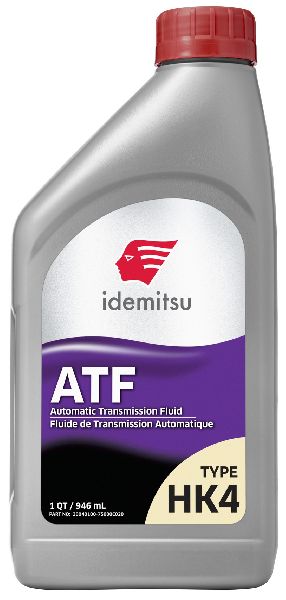
OEM price range: $140-$200 - Hyundai SP-IV Automatic Transmission Fluid — The transmission fluid must be drained to perform the repair and must be refilled with the correct OEM-specific fluid to ensure proper transmission function.
Trusted brands: Hyundai Genuine
OEM price range: $15-$25 per quart - Transmission Pan Gasket — The transmission pan must be removed, and the gasket should be replaced to prevent leaks upon reassembly.
Trusted brands: Hyundai Genuine, Fel-Pro
OEM price range: $20-$40
Aftermarket price range: $10-$25
Related Codes That Often Appear With This One
- P0717 — P0717 indicates 'Input Speed Sensor No Signal'. P0716 (erratic signal) often precedes or accompanies P0717 as the sensor and its wiring harness fail completely.
- P0721 — This code is for the 'Output Speed Sensor Range/Performance'. Since the TCM compares input and output speeds to determine gear ratio and slip, a fault in the input sensor can cause the computer to flag a correlated issue with the output sensor. The fix, replacing the harness, addresses both.
- P0700 — This is a generic code that simply means the Transmission Control Module has stored a fault. It will almost always appear alongside a more specific transmission code like P0716.
Technical Service Bulletins (TSBs) & Recalls
- TSB 20-AT-011H: Addresses DTCs P0717, P0721, and P0722 for a wide range of Hyundai vehicles, including the 2015-2019 Sonata, that use the 'Generation1' 6-speed automatic. It confirms the repair procedure is to replace the internal harness.
- TSB 22-AT-006H: A newer bulletin that covers similar codes on newer transmissions but reinforces the diagnostic principle of checking sensor signals and replacing internal components as a set.
- TSB 16-AT-003: An older, superseded bulletin that was the precursor to 20-AT-011H, indicating this has been a known issue for a long time.
Mechanic-Grade Diagnostic Values
- Input/Output Speed Sensor Resistance — expected: 270 - 330 Ω (Ohms) at 68°F (20°C). Failure: A reading of open loop (infinite resistance) or a value significantly outside the specified range indicates a failed sensor coil.
- Input Speed Sensor Signal Wire Voltage (at TCM connector) — expected: A clean, square wave signal (on an oscilloscope) that increases in frequency with engine RPM.. Failure: A noisy, erratic, or absent signal when back-probing the TCM connector pin for the ISS, while the vehicle is in gear and wheels are turning, points to a wiring or sensor fault.
Scan Tool Commands That Help
- Hyundai GDS (or equivalent high-end scanner): Resetting Auto T/A Values / Reset Adaptive Values — This MUST be performed after replacing the internal wiring harness or valve body. It erases the TCM's learned shift parameters, which were adapted to the old, failing sensor. Failure to reset can result in continued harsh shifting even with the new part installed.
Wiring & Ground Locations
- Main Transaxle Connector — The large, multi-pin electrical connector located on the exterior of the transmission case, where the main vehicle harness connects to the transmission.. Before condemning the internal harness, this external connector should be disconnected, inspected for corrosion or pushed-back pins, cleaned with contact cleaner, and secured with dielectric grease. A poor connection here can mimic an internal sensor failure.
- Input Speed Sensor Signal Pin — Pin 71 (Green wire with Black stripe) on the Powertrain Control Module (PCM) connector C100-A for a 2016 Sonata 2.4L. This can be back-probed to test the signal directly at the computer.. Testing the signal at the PCM is the definitive way to determine if the fault is with the sensor/wiring (bad signal at PCM) or the PCM itself (good signal at PCM, but code persists).
- Transmission Case Ground — A ground strap or wire bolted directly from the transmission housing to the vehicle's chassis or engine block.. A loose or corroded main ground for the transmission can cause erratic behavior in all transmission electronics, including the speed sensors. Verifying this ground is clean and tight is a crucial preliminary step in diagnosing any electronic transmission fault.
Real Owner Repair Stories
- Hyundai-Forums user (2015 Hyundai Sonata with A6MF transmission) — Harsh shifting, particularly from 2nd to 3rd gear, and eventually getting stuck in limp mode (3rd gear) with codes P0716 and P0717.
❌ Tried (didn't work) Clearing codes (they returned immediately).
✅ What actually fixed it The user replaced the internal transmission wiring harness (part number 46307-3B650) themselves. They noted the difficulty of the job but confirmed that replacing the harness completely resolved all shifting issues and cleared the codes permanently. They stressed the importance of using the OEM part. - Kia Optima owner (shared A6MF transmission) (Kia Optima with 6-speed automatic transmission) — Check engine light on, transmission stuck in 3rd gear, manual shifting did not work.
❌ Tried (didn't work) Initial diagnosis was inconclusive without looking at TSBs.
✅ What actually fixed it A shop replaced the internal wiring harness assembly. The owner reported that after the repair, the car shifted "like new" and the problem was completely solved. This cross-platform story validates the harness as the common failure point.
OEM Part Supersession History
46307-3B610, 46307-3B620→46307-3B650— The 3B650 part is an updated design with improved heat and oil resistance for the wiring insulation and sensor plastics to increase longevity.
Heads up: While earlier part numbers might physically fit, it is critical to use the latest 46307-3B650 revision for this repair to prevent premature failure. Do not install an older version.
Model Year Variations Within This Range
- 2015-2019: While the Sonata had a significant cosmetic and feature refresh for the 2018 model year, the 6-speed automatic transmission (A6MFx) and the associated P0716 fault remained consistent across the entire 2015-2019 generation for models equipped with the 2.4L and 2.0T engines. The part number 46307-3B650 is the correct harness for this entire range.
Diagnostic Flowchart
Other Known Issues on This Vehicle
Issues unrelated to this code that are worth knowing about as an owner of this generation:
- Theta II Engine Failure (2.0L & 2.4L GDI) 🔴 High — Widespread issue affecting 2011-2019 models. Manufacturing debris can lead to connecting rod bearing failure, causing engine knocking, seizing, and potential fires. (Ref: Multiple recalls and a class-action lawsuit settlement have been issued. Hyundai extended warranties and implemented a Knock Sensor Detection System (KSDS) software update to mitigate failures.)
- Excessive Oil Consumption 🟠 Medium — Common on GDI engines, particularly the 2.4L Theta II. Can be caused by carbon buildup or faulty piston rings. Owners report needing to add oil between changes. (Ref: Hyundai has issued TSBs (e.g., 23-EM-008H) outlining an oil consumption test procedure. If consumption exceeds 1 quart per 1,000 miles, repairs like engine cleaning or replacement may be covered.)
- Steering Column Knock or Click 🟡 Low — A common annoyance where the flexible rubber coupler in the Motor Driven Power Steering (MDPS) column wears out, causing a clicking or knocking sound when turning the wheel at low speeds. (Ref: Not a recall, but a well-known issue. The coupler is an inexpensive part, but labor can be several hours.)
- Paint Peeling (Especially White) 🟡 Low — Many owners of white Sonatas from this generation have reported large sheets of paint peeling off, particularly on the roof and hood. This is a cosmetic, not mechanical, issue. (Ref: No recall, but Hyundai has offered goodwill repairs or extended paint warranties in some cases after customer complaints.)
- Infotainment System Glitches 🟡 Low — Some owners report issues with the touchscreen freezing, becoming unresponsive, or Bluetooth connectivity problems. (Ref: Software updates from the dealer can sometimes resolve these issues. In other cases, a head unit replacement is required.)
Used vs. New Parts: Buying Guide for This Vehicle
When a used part is the smart pick: For this specific repair, a used part from a salvage yard is STRONGLY DISCOURAGED. The internal wiring harness is a known high-failure component due to heat and age. A used harness is likely to have suffered the same degradation and will probably fail soon after installation, forcing you to redo the very labor-intensive job.
Donor-vehicle mileage cap: roughly under 30000 miles for the part to have meaningful remaining life.
What to inspect on the donor part:
- If you must consider used, only pull from a very low-mileage, rear-ended vehicle.
- Inspect the plastic connectors for any signs of brittleness or cracking.
- Flex the wiring; if it feels stiff or makes crackling sounds, it is already degraded and should be avoided.
OEM-only on this vehicle (don't cheap out):
- Transmission Internal Wiring Harness (46307-3B650)
Aftermarket brands forum-validated for this vehicle:
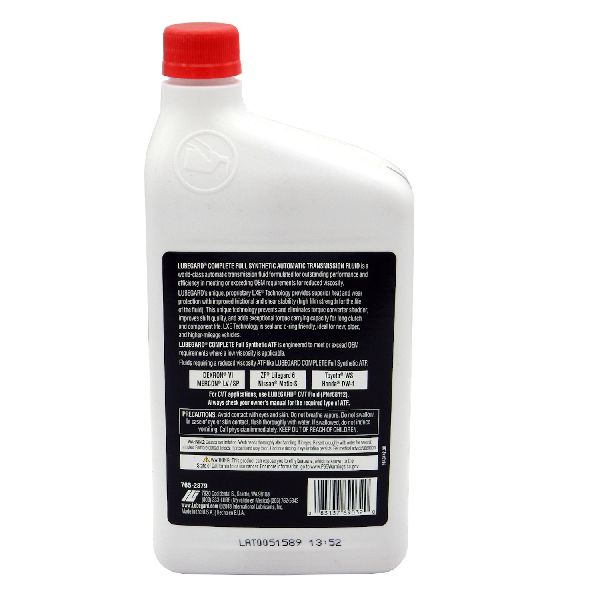
- For transmission fluid, while OEM Hyundai SP-IV is safest, Valvoline MaxLife Full Synthetic ATF is widely cited in forums as a compatible and high-quality alternative for out-of-warranty vehicles.
Brands owners have reported issues with on this vehicle:
- Generic or unbranded aftermarket wiring harnesses sold on marketplaces like Amazon or eBay. Forum reports indicate these often fail within months, whereas the updated OEM part provides a much longer service life. The significant labor cost makes using a cheap part a poor economic choice.
Real Owner Stories
Aggregated from forums and TSBs cited above. Mileages and costs reflect what owners reported in those sources.
2015-2019 Hyundai Sonata
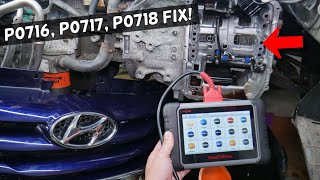
Symptoms: Check engine light on with codes P0716, P0717, and P0718; the video demonstrates the fault is located internally on the valve body.
What fixed it: Replacement of the internal transmission speed sensors/harness assembly.
Source hint: HYUNDAI CODE P0716 P0717 P0718 FIX ELANTRA SONATA SANTA FE TUCSON VELOSTER ACCENT - YouTube
2011-2019 Kia Optima
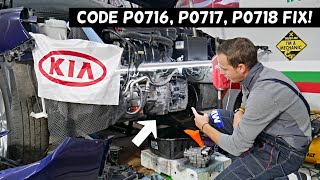
Symptoms: Engine light on with input speed sensor codes P0716, P0717, and P0718; vehicle shares the same transmission and fault as the Sonata.
What fixed it: Replacement of the internal sensors located within the transmission.
Source hint: KIA CODE P0716 P0717 P0718 INPUT SPEED SENSOR ENGINE LIGHT ON - YouTube
Related OBD-II Codes
Frequently Asked Questions
Does TSB 20-AT-011H apply to my 2015-2019 Hyundai Sonata regarding the P0716 code?
What is the specific Hyundai part number required to fix the P0716 code on my Sonata?
Can I just replace the Input Speed Sensor alone to clear P0716?
Why does my Sonata get stuck in 2nd or 3rd gear when the P0716 code triggers?
Is the P0716 code related to the Theta II engine recalls on the 2015-2019 Sonata?
What type of transmission fluid should be used when refilling the transmission after a P0716 repair?
Helpful Videos


We Have This Part in Stock



The information in this article is provided for general reference and educational purposes only. Vehicle specifications, procedures, and part compatibility can vary by production date, trim level, and region. Always consult your vehicle's factory service manual and verify part numbers before purchasing or performing repairs. Safety-critical components such as airbags, seat belts, and braking systems should be installed by a qualified professional.
- Hyundai Sonata:
- 🧭 Diagnostic Flowchart
- 🎬 Helpful Videos
- 🛍️ Shop This Part
- What's Unique About the 2015-2019 Hyundai Sonata
- Symptoms You May Notice
- Most Likely Causes
- Rare But Worth Checking
- Diagnosis Steps
- Parts You'll Likely Need
- Related Codes That Often Appear With This One
- Technical Service Bulletins (TSBs) & Recalls
- Mechanic-Grade Diagnostic Values
- Scan Tool Commands That Help
- Wiring & Ground Locations
- Real Owner Repair Stories
- OEM Part Supersession History
- Model Year Variations Within This Range
- Other Known Issues on This Vehicle
- Used vs. New Parts: Buying Guide for This Vehicle
- Real Owner Stories
- 2015-2019 Hyundai Sonata
- 2011-2019 Kia Optima
- Related OBD-II Codes
- Frequently Asked Questions
- 🎟️ Get 5% Off