

P0716 on 2008-2013 Toyota Highlander: Input Speed Sensor Causes and Fixes
On a 2008-2013 Highlander, code P0716 often points to more than just a bad sensor. It's frequently a symptom of a known internal transmission (U660E/F) issue where metal debris from case wear contaminates the system. Diagnosis is critical; a simple sensor swap is a difficult, high-labor job and may not fix the root cause, leading to a quick return of the code.
- P0716 on a 2008-2013 Highlander is a serious code that requires immediate attention.
- The most important diagnostic step is to check the transmission fluid for metal 'glitter', which indicates a severe internal failure specific to this U660E/F transmission.
- The input speed sensor is located inside the transmission, making its replacement a labor-intensive job for a professional.
- Do not mistake this for a simple external sensor swap; generic guides are misleading for this specific vehicle.
- If metal is found in the fluid, replacing just the sensor will not fix the problem; the transmission will need to be rebuilt or replaced.
What's Unique About the 2008-2013 Toyota Highlander
The 2008-2013 Highlander uses the U660E (FWD) or U660F (AWD) transmission, which has two critical, platform-specific quirks for this code. First, the input speed sensor is located *inside* the transmission, requiring removal of the oil pan and valve body to access it. Second, this transmission is known for a design issue where a main gear train support bearing wears out the transmission case, generating fine metal particles that contaminate the fluid. This metal debris can disrupt the magnetic speed sensor's reading or clog the valve body, making P0716 a potential early warning sign of a much more serious internal transmission failure requiring a rebuild or replacement.
Symptoms You May Notice
- Harsh, erratic, or delayed gear shifts.
- Transmission gets stuck in one gear (limp mode).
- Check Engine Light is on.
- Vehicle hesitates or feels sluggish during acceleration.
- Reduced fuel economy.
- Flashing or illuminated transmission warning light on the dash.
- Transmission whine noise, which may change with engine speed.
- Torque converter clutch (TCC) shudder or erratic engagement.
- Replacing an external speed sensor. Many generic guides show an easily accessible external sensor, but on the U660E/F transmission in this Highlander, the input sensor is internal.
- Assuming it's only a bad sensor. On this specific transmission, the P0716 code is a very common symptom of the larger internal case-wear problem. Replacing only the sensor without addressing the metal contamination will likely result in the code returning.
Most Likely Causes
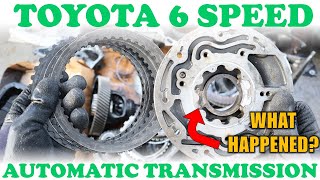
- Internal Transmission Wear (Bearing/Case Failure) 🔴 High Probability → Shop Transmission Assembly The U660E is prone to case wear where the main gear train bearing support is mounted. High torque loads can cause the bearing's outer race to spin in its bore, generating fine metallic debris that circulates through the fluid.
How to confirm: Check the transmission fluid condition by draining a small amount. If the fluid is dark and contains a significant amount of fine, metallic, 'glitter-like' particles, this is a strong indicator of this failure. This is the most critical diagnostic step.
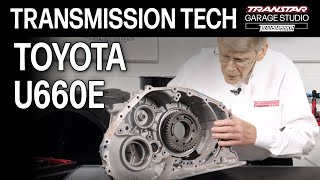
Typical fix: This is a catastrophic failure requiring a transmission rebuild (with a sleeved/repaired case) or a complete replacement with a remanufactured unit that has addressed the case wear issue. 🎬 Watch: Common issues with the Toyota U660E transmission
Est. part cost: $2500-$4500 for a remanufactured transmission. - Faulty Input/Turbine Speed Sensor 🟡 Medium Probability → Shop Automatic Transmission Input Shaft Speed Sensor The sensor itself can fail electronically, or its magnetic tip can become contaminated with normal clutch material or, more seriously, the metal debris from the case wear issue.
How to confirm: Requires using a high-end scan tool (like Toyota Techstream) to monitor the live data from the input speed sensor. If the signal drops out, spikes, or is noisy while engine RPM is steady, the sensor circuit is faulty. Confirming the sensor itself is at fault requires accessing it, which is labor-intensive.
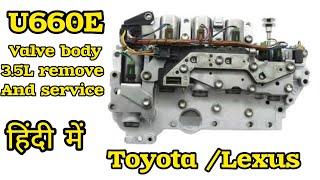
Typical fix: Replace the input speed sensor. This requires draining the fluid, dropping the transmission pan, and removing the valve body to access the sensor. 🎬 Watch: How to remove and service the valve body
Est. part cost: $50-$150 for the sensor itself. - Low or Dirty/Contaminated Transmission Fluid 🟡 Medium Probability → Shop Transmission Assembly
How to confirm: Check the transmission fluid level and condition according to the specific procedure for the U660E, which does not have a dipstick and requires a scan tool to monitor temperature (see T-SB-0036-13). The fluid should be reddish/pink, not dark brown or black, and free of excessive debris.
Typical fix: Perform a transmission fluid drain-and-fill using the correct Toyota World Standard (WS) fluid. If the fluid is heavily contaminated with metal, this will not fix the root cause.
Est. part cost: $100-$250 for fluid and a filter. - Damaged Wiring or Connector ⚪ Low Probability
How to confirm: Visually inspect the external transmission wiring harness leading to the main connector for any signs of chafing, corrosion, or damage. Test for continuity and shorts between the TCM and the transmission connector. The TCM on the U660E is often bolted directly to the transmission case, making external wiring runs shorter.
Typical fix: Repair or replace the damaged section of the wiring harness.
Est. part cost: $20-$100 for wiring repair supplies.
Rare But Worth Checking
- Faulty Transmission Control Module (TCM): → Shop Transmission Assembly This is rare. The TCM on U660E models is bolted to the transmission and can fail, often setting circuit performance codes. However, it should only be considered a cause after all other possibilities, including the sensor, wiring, and internal mechanical condition of the transmission, have been exhaustively ruled out.
Diagnosis Steps
- Scan for all codes. Note any other transmission or engine codes, especially P0717 or TCC-related codes.
- Check transmission fluid level and condition. This is the most critical first step. Drain a small sample. Look for dark, burnt fluid or the presence of fine metallic particles ('glitter'). If significant metal is present, stop diagnosis; the transmission has failed internally.
- If fluid is clean or only slightly dirty, use a professional scan tool to monitor live data for the Input Speed Sensor (NT) and Output Speed Sensor (NC) while driving.
- Observe the Input Speed Sensor reading. Look for erratic jumps, dropouts to zero, or a noisy signal that doesn't correspond smoothly with engine RPM. This indicates a fault in the sensor's circuit.
- Inspect the external transmission wiring harness and the main connector at the TCM for any visible damage, corrosion, or loose connections.
- If the signal is erratic and the external wiring is good, the fault is internal, pointing to either the sensor itself, the internal harness, or the TCM. This requires removing the transmission pan and valve body for further inspection and testing.
- Once the valve body is removed, the input speed sensor can be accessed, visually inspected for debris, and tested for resistance.
Parts You'll Likely Need
- Input/Turbine Speed Sensor
(OEM #89413-48010 (supersedes 89413-08010, 89413-33010))— This is the component that the code directly identifies as having a performance issue. It may have failed electronically or become contaminated with debris.
Trusted brands: Toyota OE, Denso, NGK/NTK
OEM price range: $100-$200
Aftermarket price range: $50-$150 - Remanufactured U660E/U660F Transmission — If the root cause is the known internal case wear, a complete transmission replacement with a unit where the case has been repaired (sleeved) is the most reliable and common professional repair.
Trusted brands: Toyota Genuine Remanufactured, Jasper, Transtar
OEM price range: $4000-$5000
Aftermarket price range: $2500-$4000 - Toyota World Standard (WS) Automatic Transmission Fluid
(OEM #00289-ATFWS)— This is the required fluid for any service. At a minimum, a fluid and filter change is necessary when accessing internal components.
Trusted brands: Toyota OE, Aisin (OEM supplier)
OEM price range: $10-$15 per quart
Aftermarket price range: $8-$12 per quart (from licensed brands like Aisin)
Related Codes That Often Appear With This One
- P0717 — P0717 indicates 'No Signal' from the same sensor. These codes are closely related and can appear together if the sensor is failing intermittently before failing completely.
- P0721 — This is a similar 'Range/Performance' code but for the Output Speed Sensor. If both appear, it could point to a widespread electrical issue, contamination affecting both sensors, or a failing TCM.
- P0741 — This code for 'Torque Converter Clutch Circuit Performance or Stuck Off' can appear if metal debris from internal wear is affecting the TCC solenoid or valve body.
Technical Service Bulletins (TSBs) & Recalls
- T-SB-0036-13
Platform-Specific Known Issues
- The U660E/F transmission is known for a design flaw where a bearing wears the transmission case, creating metal debris that leads to various failures, including faulty speed sensor readings (P0716).
- The Transmission Control Module (TCM) for the U660E is mounted directly on the transmission, which can subject it to heat and vibration, though failures are still considered rare.
- There is no transmission dipstick; fluid level checks are complex and require a scan tool to monitor fluid temperature.
Mechanic-Grade Diagnostic Values
- Input/Turbine Speed Sensor Resistance — expected: 500–1500 Ω at room temperature. Failure: A reading outside this range, or an open/short circuit, indicates a faulty sensor.
Hidden / Shadow Codes Worth Checking
- Information Code / Detail Code: Toyota systems may store a more specific two-digit information code along with the P0716 DTC. This code can specify the exact nature of the signal fault (e.g., intermittent dropout, excessive noise) but requires a dealer-level scan tool to be read. (see via Toyota Techstream software connected to the DLC3 port.)
Scan Tool Commands That Help
- Toyota Techstream: Live Data Monitoring: Input Speed Sensor (NT) — This is the primary diagnostic step. Graph the NT sensor data against engine RPM and the Output Speed Sensor (NC) data during a test drive. Look for dropouts, spikes, or noise in the NT signal that is not correlated with the other two, which indicates a fault in the sensor circuit.
- Toyota Techstream: Utility -> Reset Memory — After replacing the transmission, valve body, or TCM, this function must be used to clear the old adaptive learning values. Failure to do so can result in poor shift quality even with new parts.
- Toyota Techstream: Utility -> A/T Code Reset — This function resets the transaxle compensation code. It is required after replacing major components like the valve body assembly or the entire transmission to allow the TCM to learn the characteristics of the new parts. A road test procedure must be performed afterward.
Wiring & Ground Locations
- Transmission Case Ground — A bolt on the metal case of the U660E/F transmission where a main ground wire from the harness connects.. The input speed sensor is a magnetic sensor that generates a very low voltage signal. A clean, tight, and corrosion-free ground connection at the transmission case is critical for a stable reference. A poor ground can introduce electrical noise into the sensor circuit, causing an erratic signal and triggering a P0716 code even if the sensor itself is good.
- TCM Connector — The Transmission Control Module (TCM) is bolted directly to the transmission assembly on U660E models. The main harness connector is located on the TCM itself.. Technicians can perform continuity and resistance checks of the input speed sensor circuit (sensor and internal harness) from this connector without first removing the transmission oil pan, helping to isolate the fault to an internal or external wiring issue.
Real Owner Repair Stories
- Transmission Digest / Transtar Industries (Multiple Toyota/Lexus models with U660E transmission, 2007+) — Erratic shifting, harsh shifts, engagement problems, converter clutch issues.
❌ Tried (didn't work) Fluid and filter change., Solenoid replacement., Valve body replacement.
✅ What actually fixed it The root cause was found to be the counterdrive gear double ball bearing rotating in its bore in the transmission case, generating fine metal debris. This is a design flaw. The only permanent fix is to replace the transmission with a remanufactured unit that has a repaired (sleeved) case or a new case. A simple bearing replacement is not possible as it's press-fit and the case itself is worn.
OEM Part Supersession History
89413-08010, 89413-33010→89413-48010— Standard part consolidation and potential minor revisions for reliability.
Heads up: The parts are interchangeable. No incompatibilities are noted for this supersession.
Model Year Variations Within This Range
- 2008-2013: While the fundamental U660E/F design and its case wear flaw are present across this range, Toyota may have implemented minor, undocumented running changes to internal components or TCM software. However, no major design revision that eliminates the root cause of the bearing wear is known to have occurred within this generation. The 4-cylinder Highlander uses the different U760E transmission, which is not covered here.
Diagnostic Flowchart
Other Known Issues on This Vehicle
Issues unrelated to this code that are worth knowing about as an owner of this generation:
- Rupturing VVT-i Oil Line (Rubber Portion) 🔴 High — Common on early 2GR-FE V6 engines (approx. 2006-2010). Failure can be sudden and lead to catastrophic engine failure from oil starvation. (Ref: Limited Service Campaign (LSC) to replace the rubber hose with an all-metal line.)
- Clunking or Popping Noise from Steering 🟠 Medium — A widely reported issue where the intermediate steering shaft develops play, causing noise when turning. (Ref: T-SB-0034-13 describes the issue and replacement with an updated part (45220-48171).)
- Timing Cover and Oil Cooler Line Leaks 🟠 Medium — The 3.5L 2GR-FE engine is prone to developing oil leaks from the timing cover and oil cooler lines, which can be labor-intensive to repair.
- Water Pump Failure 🟠 Medium — The water pump on the 2GR-FE engine is a common failure point, often identified by a coolant leak near the passenger side of the engine.
- Faulty Door Lock Actuators 🟡 Low — It is common for one or more door lock actuators to fail, preventing the door from locking or unlocking electronically.
Used vs. New Parts: Buying Guide for This Vehicle
When a used part is the smart pick: For this specific P0716 issue, buying a used transmission from a junkyard is extremely high-risk and generally not recommended. The primary cause is a known design flaw leading to case wear, and a used unit is highly likely to have the same problem or develop it soon. A used sensor is also a poor choice due to the high labor cost to install it.
Donor-vehicle mileage cap: roughly under 60000 miles for the part to have meaningful remaining life.
What to inspect on the donor part:
- If forced to consider a used transmission, it MUST be from a low-mileage, verifiable wreck (not a high-mileage vehicle that was junked for unknown reasons).
- CRITICAL: Before purchase, the seller must allow for the removal of the transmission pan. The presence of any metallic 'glitter' in the fluid or on the pan magnets is an immediate deal-breaker.
- Obtain the VIN of the donor vehicle to check its service history for any record of transmission fluid changes.
OEM-only on this vehicle (don't cheap out):
- Transmission Fluid (Toyota World Standard - WS)
- Remanufactured Transmission (A Toyota Genuine Remanufactured unit is the safest bet, as they are most likely to have the updated case repair).
Aftermarket brands forum-validated for this vehicle:
- Aisin (for transmission fluid, as they are the OEM supplier)
- Denso or NTK (for the speed sensor if replacing it as a standalone part)
- Jasper or Transtar (for remanufactured transmissions; they are aware of the U660E case wear issue and have processes to address it)
Brands owners have reported issues with on this vehicle:
- Unknown or 'white-box' online marketplace sensors. The signal quality is critical, and a poor-quality sensor can cause issues even if it's new.
- Any transmission rebuilder who is not explicitly aware of and does not have a specific fix for the U660E case bearing bore wear.
Real Owner Stories
Aggregated from forums and TSBs cited above. Mileages and costs reflect what owners reported in those sources.
2007-2012 Lexus ES350 (U660E)
Symptoms: Owner reported significant shift flares and harsh shifting quality that had been a known issue for years.
What fixed it: The issue was addressed via TSB TC007-07 regarding shift flares, though many owners eventually required transmission replacement due to the U660E's internal design flaws.
Source hint: ClubLexus.com thread titled 'Newest U660E Transmission TSIB'
2008-2013 Toyota Highlander (V6)
Symptoms: Harsh shifting and P0716 code; upon inspection, the transmission fluid was dark and contained fine metallic debris.
What fixed it: Complete transmission replacement with a remanufactured unit because the bearing support in the case had failed, circulating metal through the system.
Source hint: Gears Magazine article 'Toyota’s Aging Front-Wheel Drive Six-Speeds'
2007-2017 Toyota Camry (V6)
Symptoms: Vehicle experienced shift flares and erratic behavior similar to the Highlander's U660E powertrain.
What fixed it: Transmission replacement or rebuild due to the bearing's outer race spinning in the case bore.
Source hint: ToyotaNation.com threads discussing U660E transmission flare and P0716
Related OBD-II Codes
Frequently Asked Questions
How can I check the transmission fluid level on my 2008-2013 Highlander since there is no dipstick?
Is there a TSB for the shifting issues and P0716 code on the U660E transmission?
What is the 'glitter' test mentioned for the Highlander's transmission?
Can I just replace the Input Speed Sensor to fix P0716?
Is the TCM failure common on the 2008-2013 Highlander?
Does the Highlander share this transmission issue with other Toyota models?
Helpful Videos
We Have This Part in Stock

The information in this article is provided for general reference and educational purposes only. Vehicle specifications, procedures, and part compatibility can vary by production date, trim level, and region. Always consult your vehicle's factory service manual and verify part numbers before purchasing or performing repairs. Safety-critical components such as airbags, seat belts, and braking systems should be installed by a qualified professional.
- Toyota Highlander:
- 🧭 Diagnostic Flowchart
- 🎬 Helpful Videos
- 🛍️ Shop This Part
- What's Unique About the 2008-2013 Toyota Highlander
- Symptoms You May Notice
- Most Likely Causes
- Rare But Worth Checking
- Diagnosis Steps
- Parts You'll Likely Need
- Related Codes That Often Appear With This One
- Technical Service Bulletins (TSBs) & Recalls
- Platform-Specific Known Issues
- Mechanic-Grade Diagnostic Values
- Hidden / Shadow Codes Worth Checking
- Scan Tool Commands That Help
- Wiring & Ground Locations
- Real Owner Repair Stories
- OEM Part Supersession History
- Model Year Variations Within This Range
- Other Known Issues on This Vehicle
- Used vs. New Parts: Buying Guide for This Vehicle
- Real Owner Stories
- 2007-2012 Lexus ES350 (U660E)
- 2008-2013 Toyota Highlander (V6)
- 2007-2017 Toyota Camry (V6)
- Related OBD-II Codes
- Frequently Asked Questions
- 🎟️ Get 5% Off