

P0720 on 1999-2024 Ford E-350 Super Duty: Output Speed Sensor Causes and Fixes
On a Ford E-350, code P0720 is most often caused by a failed Output Speed Sensor (OSS) located on the transmission. The specific part and location vary by transmission type (4R100, 5R110W, 6R140). Expect to pay $30-$100 for a new sensor. In some cases, a bad ignition coil or alternator can create electrical noise that falsely triggers this code. On 2016+ models, an internal molded lead frame is a common culprit.
- P0720 on a Ford E-350 is most commonly a failed Output Speed Sensor (OSS), but the specific part depends on the transmission (4R100, 5R110W, or 6R140).
- A failing alternator causing electrical noise is a very common and often misdiagnosed cause for this code on Ford trucks and vans.
- For models 2016 and newer, a faulty internal molded lead frame is a likely culprit and a more involved repair.
- Symptoms include erratic shifting, a flashing O/D light, and an inoperative speedometer.
- Always check wiring and test for AC voltage from the alternator before replacing the sensor itself to avoid misdiagnosis.
What's Unique About the 1999-2024 Ford E-350 Super Duty
The Ford E-350's long production run from 1999 to 2024 means it used several different automatic transmissions, primarily the 4R100, 5R110W TorqShift, and 6R140 TorqShift. The cause and fix for P0720 are highly dependent on which transmission is in the vehicle, as the sensor design, location, and failure modes differ. For example, early models have a simple external sensor, while later models may have the sensor integrated into a 'molded lead frame' inside the transmission, which is a more complex repair. Additionally, these heavy-duty vans and their truck counterparts (F-Series) are known to have electrical issues, like failing alternators or ignition coils, that can mimic a sensor failure by inducing electrical noise (AC ripple) in the system, a common misdiagnosis.
Generation note: The 1999-2024 range covers multiple E-Series generations and, more importantly, several key transmission changes: - 4R100 (approx. 1999-2003): Uses a distinct, externally mounted OSS on the top, driver's side of the transmission housing, near the rear. The OEM part number is F81Z-7M101-AA. - 5R110W TorqShift (approx. 2003-2015): Also uses an external OSS, located on the driver's side rear of the transmission. The OEM part number is 3C3Z-7H103-AA. - 6R140 TorqShift (approx. 2016-2024): On these models, the OSS is integrated into the molded lead frame (connector plate) inside the transmission oil pan. A failure here is more complex than a simple sensor swap and is a known issue.
Symptoms You May Notice
- Check Engine Light is on
- Flashing 'O/D Off' or 'Tow/Haul' light
- Erratic, harsh, or delayed shifting
- Transmission stuck in one gear ('limp mode')
- Speedometer reads 0 mph or behaves erratically
- Engine stalls when coming to a stop or when put into gear
- Cruise control does not work
- Illumination of the orange wrench light or MIL in the instrument cluster (as noted in Bulletin #19N01-S3)
- Replacing the rear differential speed sensor (VSS). The P0720 code specifically refers to the Output Speed Sensor on the transmission, not the sensor on the rear axle which is used for the ABS system and may trigger other codes like P0500.
- Replacing the OSS sensor when the actual fault is a failing alternator creating electrical interference. This is a very common misdiagnosis on this platform.
Most Likely Causes
- Faulty Output Speed Sensor (OSS) 🔴 High Probability The sensor is exposed to extreme heat and vibration on the transmission housing, leading to eventual electronic failure. On older models, they are known to get stuck in the housing, requiring prying to remove.
How to confirm: Use a scan tool to monitor the OSS PID while driving. If the speed reading is zero, erratic, or doesn't match the vehicle's actual speed, the sensor is likely bad. You can also test the sensor's internal resistance with a multimeter against its specifications.
Typical fix: Replace the Output Speed Sensor. Location varies by transmission (4R100: F81Z-7M101-AA; 5R110W: 3C3Z-7H103-AA).
Est. part cost: $30-$100 - Damaged Wiring or Connector 🟡 Medium Probability The wiring harness to the transmission is located under the vehicle, exposed to road debris, heat, and moisture, which can cause wires to break, chafe, or corrode at the connector pins.
How to confirm: Visually inspect the wiring harness leading to the OSS for any signs of breaks, chafing, or corrosion at the connector. Perform a continuity test on the wires between the sensor connector and the PCM.
Typical fix: Repair the damaged section of wiring or replace the connector pigtail. This often involves soldering and heat-shrinking the new wires.
Est. part cost: $10-$30 - Faulty Molded Lead Frame (6R140/6R80 Transmission) 🟡 Medium Probability → Shop Transmission Valve Body For E-350s from approximately 2016 and newer with the 6R140 transmission (and related 6R80), the OSS is integrated into a molded lead frame inside the transmission. This component was subject to Ford's Customer Satisfaction Program 19N01 for other vehicles due to high failure rates of the integrated sensor, which causes DTCs P0720 and P0722. Manufacturer Bulletin #19N01-S3 notes that this failure can also store P0731 and P1500.
How to confirm: This is difficult to confirm without ruling out other causes. If the vehicle has a 6R140 and the external wiring is good, the lead frame is the next logical suspect. NHTSA ODI #11475327 describes a case where a dealer confirmed a faulty molded lead frame after pulling codes P0706, P0707, P0720, and P0722.
Typical fix: Replace the molded lead frame, which requires dropping the transmission pan and valve body. 🎬 Watch this walkthrough for replacing a faulty molded lead frame.
Est. part cost: $150-$300 - Low or Contaminated Transmission Fluid ⚪ Low Probability → Shop Transmission Assembly While not a direct cause of a circuit fault, metallic debris from normal wear in high-mileage work vans can accumulate on the magnetic tip of the OSS, interfering with its reading and causing an erratic signal.
How to confirm: Check the transmission fluid level and condition using the dipstick (if equipped). The fluid should be at the correct level and reddish-pink, not brown, black, or smelling burnt. Inspect the sensor tip for metal shavings upon removal.
Typical fix: Perform a transmission fluid and filter change. Clean the magnetic sensor tip during replacement. If the fluid is full of metal shavings, the transmission may have severe internal damage.
Est. part cost: $50-$200 for fluid and filter
Rare But Worth Checking
- Electrical Interference from Faulty Ignition Coil(s) or Alternator: → Shop Alternator This is a well-documented issue on Ford trucks and vans. A failing alternator can produce excessive AC ripple voltage that interferes with the sensitive OSS signal. Similarly, a failing Coil-On-Plug (COP) can create electrical noise. NHTSA ODI #11597108 reports an instance where a P0720 malfunction was associated with engine misfires in cylinder 7.
- Faulty Powertrain Control Module (PCM): → Shop Engine Control Module (ECM) This is very rare. The PCM itself can fail, but all other possibilities, especially wiring and electrical noise issues, should be exhausted before considering PCM replacement.
Diagnosis Steps
- Check for other codes. Pay special attention to gear ratio codes (P073x) or 'no signal' codes (P0722).
- Inspect Transmission Fluid. Check the level and condition of the transmission fluid. Dark, burnt fluid or fluid with metal particles indicates a more serious internal transmission problem.
- Inspect the OSS Connector and Wiring. Locate the OSS on the transmission. Visually inspect the connector for corrosion and the harness for any signs of damage, chafing, or melting.
- Monitor OSS Signal. Use an OBD-II scanner with live data capability to monitor the Output Shaft Speed (OSS) PID. Watch the reading as you drive. It should increase smoothly with vehicle speed. If it's stuck at zero, jumps around erratically, or drops out, you have confirmed a problem in the circuit.
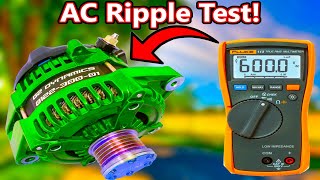
- Test for Electrical Noise. This is a critical step on Ford vans/trucks. With the vehicle running, use a multimeter set to AC voltage and check across the battery terminals. 🎬 See how to perform an alternator AC ripple test. A reading of more than 0.5V AC (500mV) indicates a faulty alternator diode leaking AC voltage, which can disrupt the OSS signal.
- Test the Sensor and Circuit. Disconnect the sensor. Check the sensor's internal resistance with a multimeter and compare it to the manufacturer's specification (typically in the hundreds or low thousands of ohms). Then, check the wiring harness for continuity to the PCM and for any shorts to ground or power.
- If all else fails, and especially on 2016+ models with a 6R140 transmission, investigate the molded lead frame as the potential point of failure, as this is a known issue covered by Ford's Customer Satisfaction Program 19N01 for similar transmissions.
Parts You'll Likely Need
- Output Speed Sensor (for 4R100 Transmission)
(OEM #F81Z-7M101-AA)— This is the specific sensor for E-350s from approx. 1999-2003. It's the most common failure point for the P0720 code on these model years.
Trusted brands: Motorcraft
OEM price range: $50-$90
Aftermarket price range: $25-$50 - Output Speed Sensor (for 5R110W Transmission)
(OEM #3C3Z-7H103-AA)— This is the specific sensor for E-350s from approx. 2003-2015. It is a common failure point for P0720 on these models.
Trusted brands: Motorcraft
OEM price range: $55-$85
Aftermarket price range: $30-$60 - Molded Lead Frame (for 6R140 Transmission) — For E-350s from approx. 2016+, the OSS is integrated into this internal transmission component. It is a known failure point covered under Customer Satisfaction Program 19N01 for other Ford vehicles with similar transmissions.
Trusted brands: Motorcraft
OEM price range: $200-$300
Aftermarket price range: $150-$250
Related Codes That Often Appear With This One
- P0722 — P0722 indicates 'Output Speed Sensor Circuit No Signal', which is a more specific version of P0720. They often appear together if the sensor has completely failed or a wire is broken. This code is explicitly mentioned in Ford's TSBs regarding lead frame failure.
- P0731, P0732, etc. — These are codes for 'Incorrect Gear Ratio' in gears 1, 2, etc. They can be triggered as a consequence of the P0720 fault, as the PCM cannot verify correct shifting without a reliable OSS signal.
- P1500 — This code is also associated with output speed sensor circuit issues and is cited in manufacturer Bulletin #19N01-S3 as a potential stored DTC during lead frame failure.
Platform-Specific Known Issues
- A Customer Satisfaction Program (19N01) was issued for some Ford vehicles (like the F-150) with 6R series transmissions for a faulty molded lead frame that causes P0720, among other codes. While the E-350 was not explicitly named in the documents found, the 6R140 transmission it uses is of a similar design, making this a highly relevant potential issue on 2016+ models.
Mechanic-Grade Diagnostic Values
- Alternator AC Ripple Voltage — expected: < 0.1 Volts AC (100mV). Failure: A reading greater than 0.5V AC (500mV) indicates a definitive failure. Many technicians consider any reading consistently above 100-150mV AC to be a likely source of electrical interference for sensitive sensors.
- Output Speed Sensor (OSS) Resistance - 4R100 Transmission — expected: 781 - 1979 Ohms. Failure: A resistance reading outside of this range, or an open circuit (OL), indicates a failed sensor.
- Output Speed Sensor (OSS) Resistance - 5R110W Transmission — expected: 325 - 485 Ohms @ 70°F. Failure: A resistance reading outside of this range indicates a failed sensor.
- Shift Solenoid Resistance - 5R110W Transmission — expected: 4.7 - 4.9 Ohms. Failure: While not a direct cause of P0720, a shorted solenoid can cause electrical issues in the transmission. A reading outside this range indicates a bad solenoid.
Scan Tool Commands That Help
- Ford IDS (Integrated Diagnostic System): Datalogger - OSS_SRC, VSS — When diagnosing an intermittent P0720, graphing the OSS (Output Shaft Speed) and VSS (Vehicle Speed Sensor from ABS) PIDs simultaneously can reveal dropouts or erratic signals from the OSS that are not present in the VSS signal, confirming the fault is isolated to the transmission speed sensor circuit.
Wiring & Ground Locations
- G100 / G101 — G100 is at the left front of the engine compartment, at the upper radiator support. G101 is in the corresponding position on the right side.. These are primary engine bay grounds. A poor connection at these points can introduce electrical noise and cause issues for various sensors, including the transmission sensors which are grounded through the engine block and harness.
- G107 — Right side of the engine, near the starter motor.. This is a critical ground for the engine block. A loose or corroded ground here can cause the starter to seek a ground path through other components, including the transmission, potentially damaging sensitive electronics. Ford has specifically advised against grounding accessories to the transmission case.
- Transmission Harness Chafing — The main wiring harness where it passes over the top of the transmission case and bellhousing.. Due to engine and transmission movement, the harness can rub against the top of the transmission case. Over time, this can wear through the loom and insulation, causing wires for the OSS to short to ground on the transmission case, leading to an intermittent or constant P0720 code.
Real Owner Repair Stories
- YouTube user 'T Nutz and Boltz' (Ford Van (E-series implied)) — Check engine light, flashing O/D light, speedometer not working, slow and sluggish upshifts.
❌ Tried (didn't work) Initial assumption was a bad sensor.
✅ What actually fixed it Found a broken wire in the harness leading to the OSS. The creator suspected a rat had chewed the wire. The transmission had to be lowered slightly to gain access to solder and repair the broken wire in the harness. - Ford Truck Enthusiasts Forums user (2000 Ford V10 (likely F-250/350 or E-350)) — P0720 code, transmission going into failure mode (limp mode).
❌ Tried (didn't work) The user was about to replace the OSS sensor.
✅ What actually fixed it The user was advised to first check for AC ripple from the alternator. After testing, the user confirmed a bad alternator was the cause. Replacing the alternator resolved the P0720 code and transmission issues.
Documented NHTSA Reports
- An owner reported in NHTSA ODI #11492951 that while driving at highway speeds, everything on the instrument panel stopped working except for the RPMs, and the truck became stuck in 5th gear with a P0720 code.
- According to NHTSA ODI #11578725, a technician addressed DTCs P0720 and P0722 by reprogramming the PCM and output shaft speed sensor, noting that the vehicle was stuck in a specific gear.
- NHTSA ODI #11475327 describes a situation where a vehicle was taken to a dealer after throwing codes P0706, P0707, P0720, and P0722, which the dealer confirmed was caused by a faulty molded lead frame.
OEM Part Supersession History
3C3Z-7H103-AA→8C3Z-7H103-C— Part has been updated or revised by Ford over time.
Heads up: The original part number 3C3Z-7H103-AA has been superseded multiple times, including by 7C3Z-7H103-A/AA and 8C3Z-7H103-A/B, with the latest being 8C3Z-7H103-C. Using the latest part number is recommended for compatibility with 5R110W transmissions.F81Z-7M101-AA→F81Z-7M101-AA (also listed as DY1229 by Motorcraft)— No direct supersession found, but the part number is cross-referenced to a different Motorcraft number.
Heads up: This part number for the 4R100 appears to be stable, but it's important to ensure you are getting the correct sensor as F81Z-7M101-BA is a different part for the Turbine Speed Sensor (TSS) on some applications, though they look similar.
Model Year Variations Within This Range
- 2016-2024 (approx.): Vehicles in this range are likely equipped with the 6R140 transmission. Unlike earlier models, the OSS is not a simple external sensor but is integrated into the internal molded lead frame. This makes diagnosis more complex as the wiring and sensor are inside the transmission, and the repair is a much more involved, labor-intensive process that requires dropping the valve body.
Diagnostic Flowchart
Other Known Issues on This Vehicle
Issues unrelated to this code that are worth knowing about as an owner of this generation:
- Ford 6.0L Powerstroke Engine Failures 🔴 High — Extremely common on 2003-2007 models. Issues include failed EGR coolers, clogged oil coolers, head gasket failure, and injector stiction.
- Ford 5.4L 3-Valve Triton Spark Plug Breakage 🔴 High — Common on 2004-2008 models. The two-piece spark plug design leads to the lower part seizing in the cylinder head, often breaking during removal.
- Ford 5.4L 2-Valve Triton Spark Plug Ejection 🔴 High — Common on approx. 1999-2003 models. Insufficient thread engagement in the aluminum heads can cause spark plugs to be forcibly ejected, stripping the threads.
- Front End 'Death Wobble' 🟠 Medium — Can occur on many model years, especially 4x4 models. A violent, uncontrolled shaking of the front wheels, typically triggered by hitting a bump at highway speeds. Often caused by worn track bar bushings, ball joints, or incorrect alignment caster. (Ref: Ford has issued recalls and TSBs for steering dampers on various model years to mitigate the issue.)
- Ignition Coil and Boot Failure 🟠 Medium — Widespread across many gasoline engine models. Failure of the coil-on-plug (COP) units or their boots leads to rough running, misfires, and poor acceleration.
Used vs. New Parts: Buying Guide for This Vehicle
When a used part is the smart pick: For an external Output Speed Sensor (OSS) on 4R100 or 5R110W transmissions, a used part from a low-mileage donor vehicle can be a cost-effective option, especially if it's a genuine Motorcraft part. For a complete transmission replacement, a used unit is a common repair strategy.
Donor-vehicle mileage cap: roughly under 100000 miles for the part to have meaningful remaining life.
What to inspect on the donor part:
- For sensors, check for physical damage, cracks in the plastic, or heavy corrosion on the pins.
- For a complete transmission, ask for maintenance records if possible.
- Check the color and smell of the transmission fluid from the donor vehicle; it should be reddish and not smell burnt.
- Ensure the donor vehicle was not involved in a severe front-end collision that could have damaged the transmission or wiring.
OEM-only on this vehicle (don't cheap out):
- Molded Lead Frame (6R140): While aftermarket options exist, the OEM Motorcraft part is highly recommended due to the high failure rate of this component and the significant labor involved in replacement. Using a proven OEM part reduces the risk of a repeat failure.
Aftermarket brands forum-validated for this vehicle:
- Rostra (for sensors and harnesses)
Brands owners have reported issues with on this vehicle:
- Unnamed, no-brand 'white box' sensors from online marketplaces are a gamble. Given the diagnostic difficulty, sticking to OEM or a known quality aftermarket brand is safer.
Real Owner Stories
Aggregated from forums and TSBs cited above. Mileages and costs reflect what owners reported in those sources.
2001 Ford F-250 6.8L V10 — ~150000 miles
Symptoms: The O/D light was flashing intermittently. The owner replaced the OSS, but the issue returned.
What fixed it: The source suggests the fix involves addressing intermittent wiring issues or electrical noise rather than just the sensor.
Source hint: Ford Truck Enthusiasts thread titled 'P0720- Replaced Sensor & Still Need Help - Ford Truck Enthusiasts'
2001 Ford F-350 7.3L Powerstroke — ~175000 miles
Symptoms: O/D light flashing and code P0720. A dealer replaced the OSS but the problem persisted.
What fixed it: The discussion suggests looking for intermittent shorts or corrosion in the connectors.
Source hint: Ford Truck Enthusiasts thread titled '2001 F350 O/D Light Flashing Code P0720 - Ford Truck Enthusiasts'
Ford Owner Report — NHTSA ODI #11597108
Symptoms: An owner reported a P0720 output speed sensor circuit malfunction that caused engine misfires in cylinder 7.
What fixed it: The report highlights the connection between the sensor circuit fault and engine performance issues.
Related OBD-II Codes
Frequently Asked Questions
I have a 2017 E-350 with the 6R140 transmission. Is there a specific part known to cause P0720 on this model?
Where is the Output Speed Sensor located on my E-350 Super Duty?
Can a bad alternator cause a P0720 code on my Ford van?
What are the specific Ford part numbers for the OSS on an E-350?
Why is my speedometer reading 0 mph while I'm driving my E-350?
Does the Customer Satisfaction Program 19N01 explicitly cover the E-350 Super Duty?
Helpful Videos


We Have This Part in Stock

The information in this article is provided for general reference and educational purposes only. Vehicle specifications, procedures, and part compatibility can vary by production date, trim level, and region. Always consult your vehicle's factory service manual and verify part numbers before purchasing or performing repairs. Safety-critical components such as airbags, seat belts, and braking systems should be installed by a qualified professional.
- Ford E-350 Super Duty:
- 🧭 Diagnostic Flowchart
- 🎬 Helpful Videos
- 🛍️ Shop This Part
- What's Unique About the 1999-2024 Ford E-350 Super Duty
- Symptoms You May Notice
- Most Likely Causes
- Rare But Worth Checking
- Diagnosis Steps
- Parts You'll Likely Need
- Related Codes That Often Appear With This One
- Platform-Specific Known Issues
- Mechanic-Grade Diagnostic Values
- Scan Tool Commands That Help
- Wiring & Ground Locations
- Real Owner Repair Stories
- Documented NHTSA Reports
- OEM Part Supersession History
- Model Year Variations Within This Range
- Other Known Issues on This Vehicle
- Used vs. New Parts: Buying Guide for This Vehicle
- Real Owner Stories
- 2001 Ford F-250 6.8L V10 — ~150000 miles
- 2001 Ford F-350 7.3L Powerstroke — ~175000 miles
- Ford Owner Report — NHTSA ODI #11597108
- Related OBD-II Codes
- Frequently Asked Questions
- 🎟️ Get 5% Off