

P0720 on 2007-2014 Ford Edge: Output Speed Sensor Failure Causes and Fixes
On a 2007-2014 Ford Edge, code P0720 almost always means the internal Output Speed Sensor (OSS) in the 6F50 transmission has failed. This is a common, well-documented issue, especially on 2007-2010 models, and is addressed in Ford TSB 07-21-11. The sensor is inside the transmission, requiring significant labor to replace, so expect a shop cost of $700-$1200. It's critical to replace the Turbine Speed Sensor (TSS) at the same time.
- P0720 on a 2007-2014 Edge is a serious code indicating a likely failure of the internal Output Speed Sensor.
- Symptoms include severe shifting problems, a non-functional speedometer, and the vehicle entering a low-power 'limp mode'.
- This is not a simple DIY repair. The sensor is inside the transmission and requires 4-6 hours of professional labor.
- To avoid a repeat repair, always replace both the Output Speed Sensor (OSS) and the Turbine Speed Sensor (TSS) at the same time.
- The issue is most common on 2007-2010 models but can happen to any 1st generation Edge.
What's Unique About the 2007-2014 Ford Edge
On the 2007-2014 Ford Edge with the 6F50 automatic transmission, the Output Speed Sensor (OSS) and the related Turbine Speed Sensor (TSS) are located *inside* the transmission housing. This is a critical distinction, as on many other vehicles these sensors are mounted externally and are easy to replace. This internal placement makes the repair significantly more complex and labor-intensive, as the transmission's side cover and valve body must be removed for access. Early first-generation models (2007-2010) are particularly known for this sensor failure, a fact acknowledged by Ford in Technical Service Bulletin (TSB) 07-21-11, which specifically addresses this issue for vehicles built before October 2007.
Generation note: This covers the entire first generation of the Ford Edge (2007-2014), which received a facelift in 2011. The speed sensor failure is noted to be more frequent in the pre-facelift 2007-2010 models, as highlighted in TSB 07-21-11, but can still occur on 2011-2014 models which use the same basic 6F50 transmission design. The repair procedure is the same across the generation.
Symptoms You May Notice
- Harsh, erratic, or delayed gear shifts.
- Transmission 'hunting' for the correct gear, especially on hills.
- Sudden jolt or 'bump' as if being rear-ended, especially during downshifts.
- Speedometer needle drops to zero or behaves erratically while driving.
- Odometer stops working.
- Check Engine Light and/or wrench light are illuminated.
- Vehicle enters 'limp mode' with very little acceleration from a stop.
- Loud clunk or bang when shifting from Park into Drive or Reverse.
- Cruise control becomes inoperative.
- Replacing the entire transmission. While the sensor is internal, the transmission itself is often mechanically sound. A targeted sensor replacement is the correct and much more affordable repair.
- Replacing only the valve body. The sensors are separate components from the valve body, though the valve body must be removed to access them.
- Replacing an external wheel speed sensor. P0720 refers specifically to the transmission's Output Speed Sensor, not the ABS/wheel speed sensors at the wheels.
Most Likely Causes
- Internal Output Speed Sensor (OSS) Failure 🔴 High Probability The sensors used in the early 6F50 transmissions have a known high failure rate. Being located internally, they are subject to constant heat and immersion in transmission fluid, which can degrade the electronics over time. Ford TSB 07-21-11 was issued to address intermittent shorts in these sensors on early build models.
How to confirm: A professional technician will use a high-end scan tool to monitor the OSS data stream (PID) while driving. A lack of signal, or an erratic signal that doesn't correspond to vehicle speed, confirms the failure. Given the high failure rate and difficult access, it's often replaced based on the code and symptoms alone after ruling out external wiring issues.
Typical fix: Replace the internal Output Speed Sensor. It is strongly recommended to also replace the Turbine Speed Sensor (TSS) at the same time, as the labor is identical. This requires draining the transmission, removing the side cover, and removing the valve body to access the sensors. After replacement, some service centers recommend a PCM reflash to clear adaptive tables.
Est. part cost: $40-$80 for both sensors (OSS and TSS). - Damaged Wiring or Connectors ⚪ Low Probability While the sensor itself is internal, the wiring harness passes through the transmission case. It's possible for the external connector to become damaged or for wires to break or corrode, though this is far less common than sensor failure.
How to confirm: Visually inspect the main transmission harness connector for corrosion, damage, or loose pins. Perform a continuity test on the wires from the PCM/TCM to the transmission connector.
Typical fix: Repair the damaged section of the wiring harness or replace the connector pigtail.
Est. part cost: $20-$50
Rare But Worth Checking
- Powertrain Control Module (PCM) Failure: → Shop Engine Control Module (ECM) This is very rare. TSB 07-21-11 explicitly warns against replacing the PCM for this issue until the sensor has been replaced and re-verified. Before condemning the PCM, all other possibilities, especially the sensor and wiring, must be exhaustively ruled out.
- Low or Contaminated Transmission Fluid: → Shop Transmission Assembly Extremely low or dirty fluid can cause a host of transmission problems, including erratic shifting that might be misinterpreted by sensors. While unlikely to be the direct cause of a P0720 circuit code, it can contribute to the overall failure and should be checked first.
Diagnosis Steps
- Use an OBD-II scanner to confirm P0720 and check for any other related transmission codes like P0722, P0715, or P0717.
- Check the transmission fluid level and condition. The fluid should be at the correct level on the dipstick (after warming up the transmission) and should not appear burnt or full of debris.
- Using an advanced scan tool, monitor the live data for the Output Speed Sensor (OSS) PID while driving. The speed should increase smoothly and correspond to the speedometer.
- If the OSS signal is absent or erratic, the fault is confirmed. Due to the sensor's internal location, the next step is proceeding with the replacement.
- Inspect the main external transmission electrical connector for any signs of damage, corrosion, or moisture.
- If the sensor and external wiring are confirmed good, the final step would be to test the PCM, though this is extremely unlikely to be the cause.
Parts You'll Likely Need
- Transmission Output Speed Sensor (OSS)
(OEM #8A8Z-7H103-A (Supersedes 7T4Z-7H321-A))— This is the primary failure point for code P0720 on this vehicle, as documented in TSB 07-21-11.
Trusted brands: Motorcraft, Standard Motor Products (SMP), NTK
OEM price range: $40-$60
Aftermarket price range: $20-$40 - Transmission Turbine Speed Sensor (TSS)
(OEM #8A8Z-7M101-A)— This sensor is located next to the OSS and has a similar failure rate. It requires the exact same labor to access, so it should always be replaced at the same time to prevent a repeat repair job in the near future.
Trusted brands: Motorcraft, Standard Motor Products (SMP), NTK
OEM price range: $40-$60
Aftermarket price range: $20-$40 - Transmission Side Cover Gasket and Fluid — The transmission side cover must be removed, requiring a new gasket and a fluid drain and refill (approx. 5-7 quarts). Use only the specified fluid (Motorcraft MERCON LV).
Trusted brands: Motorcraft, Fel-Pro
OEM price range: $100-$150
Aftermarket price range: $70-$120
Related Codes That Often Appear With This One
- P0722 — P0722 means 'Output Speed Sensor Circuit No Signal.' It's a more specific version of P0720 and often appears alongside it, indicating a complete failure of the sensor rather than an intermittent one.
- P0715 — P0715 indicates a fault with the Turbine/Input Speed Sensor (TSS). Since the TSS and OSS are a common failure point and are located together, it's common for both to fail around the same time or for one to be replaced and the other to fail shortly after.
- P0717 — P0717 means 'Input/Turbine Speed Sensor Circuit No Signal.' It is the 'No Signal' equivalent of P0715 and points directly to the other sensor (TSS) that should be replaced along with the OSS.
Technical Service Bulletins (TSBs) & Recalls
- TSB 07-21-11: Specifically addresses DTCs P0720, P0722, P0715, etc., on 2007-2008 Edge/MKX and other models with 6F50 transmissions built before 10/21/2007. It points to an intermittent short in the OSS or TSS sensor and advises replacement of the sensor, not the PCM.
- TSB 07-3-11: This bulletin also covers 6F50 transaxles built prior to 1/1/2007, addressing DTCs P0715, P0717, P0718, P0720, P0721, P0722 and symptoms including harsh engagement, no upshift, or being stuck in fifth gear only (NHTSA ODI #10692963).
Platform-Specific Known Issues
- The 6F50 transmission in 2007-2010 models has a well-documented history of the internal TSS and OSS failing, leading to symptoms like harsh shifting, loss of speedometer, and limp mode. This is officially acknowledged in Ford TSB 07-21-11.
Mechanic-Grade Diagnostic Values
- OSS Sensor Internal Wiring Continuity — expected: < 5.0 Ohms. Failure: A reading higher than 5.0 Ohms indicates high resistance or an open circuit in the solenoid body's internal wiring to the sensor.
- Transmission Range (TR) Sensor Circuit Resistance at Connector C168 — expected: < 5.0 Ohms. Failure: A reading higher than 5.0 Ohms on any of the tested pin combinations indicates high resistance in the TR sensor, which can cause similar symptoms to an OSS failure.
Scan Tool Commands That Help
- Ford IDS, FORScan, or equivalent professional scan tool: Clear Transmission Adaptive Tables — After replacing the OSS/TSS sensors, this procedure should be performed to reset the transmission's learned shift strategies and allow it to relearn with the new, accurate sensor data.
- Ford IDS, FORScan, or equivalent professional scan tool: Solenoid Body Strategy Programming — This is not required for sensor replacement alone, but it is critical if the entire solenoid body is replaced. The unique strategy ID from the new solenoid body tag must be written to the PCM/TCM for the transmission to function correctly.
Wiring & Ground Locations
- C168 — The main external electrical bulk connector on the 6F50 transmission case.. This is the primary point for testing the transmission's external wiring harness without opening the transmission. All signals from the internal OSS and TSS sensors pass through this connector to the PCM.
- OSS Connector Pins (Internal) — Inside the transmission, where the OSS sensor plugs into the solenoid body harness.. A pinpoint test involves checking continuity between Pin 10 (Signal) and Pin 9 (Ground) on the main solenoid body connector and the corresponding pins on the OSS sensor connector to isolate a fault to the sensor vs. the internal harness.
- G104 — On the chassis in the left front of the engine compartment.. This is a major engine and chassis ground point. A corroded or loose ground here can cause erratic voltage and signal issues for various sensors, including those related to the powertrain, potentially contributing to intermittent fault codes.
Real Owner Repair Stories
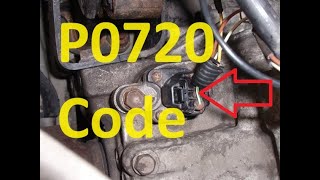
- YouTube channel 'Mark's Garage' (Ford vehicle with P0720 code (demonstrating a common issue)) — Check engine light, flashing overdrive light, speedometer not working, slow and sluggish upshifts.
❌ Tried (didn't work) Initial diagnosis pointed to the sensor itself.
✅ What actually fixed it Upon inspection, the wiring harness leading to the Output Speed Sensor was found to be chewed through by a rodent. The final fix was to lower the transmission for access and solder the broken wires back together, then protect them with heat shrink tubing. - NHTSA ODI #11101113: An owner reported that an independent mechanic diagnosed their vehicle with code P0720 (speed control sensor) after a failure occurred.
- NHTSA ODI #10965788: One owner reported spending $2,300 on spark plugs, fuel injectors, and an ECM/PCM reflash, only for the vehicle to die 20 miles later with P0720 and P0722 errors still present.
- NHTSA ODI #10627285: A report describes a case where a dealer pulled codes P0720 and P0722 and followed TSB 07-21-11. The final resolution required replacing both the Output Speed Sensor and the Turbine Speed Sensor.
OEM Part Supersession History
7T4Z-7H321-A→8A8Z-7H103-A— The original sensor had a high rate of intermittent short failures. The updated part number is a revised design for improved durability and reliability.
Model Year Variations Within This Range
- 2007-2008 (specifically builds before 10/21/2007): These models are most susceptible to the internal shorting of the OSS and TSS sensors, as documented in TSB 07-21-11. Later models used updated sensors from the factory, though failures can still occur.
- 2009-2011 (specifically builds from 3/13/2009 to 6/30/2010): This range of vehicles may experience similar symptoms (slipping, 5th gear start) due to a different issue: high resistance in the Digital Transmission Range (TR) sensor, addressed by TSB 13-5-27. This can be misdiagnosed as an OSS/TSS failure if not properly tested.
Diagnostic Flowchart
Other Known Issues on This Vehicle
Issues unrelated to this code that are worth knowing about as an owner of this generation:
- Power Transfer Unit (PTU) Fluid Leak/Failure 🔴 High — Common on AWD models, especially over 80,000 miles. The factory fill is considered a 'lifetime' fluid, but it often overheats and breaks down, leading to seal failure and gear damage. A burning gear oil smell is a key symptom. (Ref: TSB 16-0005)
- Brake Booster Failure 🔴 High — Common enough to warrant a warranty extension (13N02). The diaphragm can tear, causing a loss of power brake assist and a loud 'whooshing' or 'hissing' sound when the brake pedal is pressed. (Ref: Customer Satisfaction Program 13N02)
- Door Ajar Sensor Failure 🟡 Low — Very common across many Ford models. The switch inside the door latch fails, causing the 'door ajar' light to stay on, interior lights to remain on, and preventing doors from locking while driving. It can also lead to parasitic battery drain.
- Water Pump Failure (3.5L/3.7L V6) 🔴 High — The internal, timing-chain-driven water pump can fail, leaking coolant directly into the engine oil. This is a catastrophic failure if not caught immediately, often requiring engine replacement. Onset can be from 60,000 to 120,000 miles.
Used vs. New Parts: Buying Guide for This Vehicle
When a used part is the smart pick: For this specific repair, using a used part is NEVER recommended. The OSS and TSS sensors are known high-failure items, and they are buried inside the transmission. The labor cost to access them is extremely high ($700+), while the new OEM parts are relatively inexpensive ($40-$80 each). The risk of a used sensor failing shortly after installation far outweighs any small cost savings.
What to inspect on the donor part:
- Not applicable. Do not use a salvaged OSS or TSS sensor for this repair.
OEM-only on this vehicle (don't cheap out):
- Transmission Output Speed Sensor (OSS)
- Transmission Turbine Speed Sensor (TSS)
Aftermarket brands forum-validated for this vehicle:
- Motorcraft (OEM)
- Standard Motor Products (SMP)
- NTK
Brands owners have reported issues with on this vehicle:
- Unbranded, 'white-box' sensors from online marketplaces should be avoided due to the critical nature and high labor cost of this repair. The quality control is often unknown, and failure could mean repeating the entire expensive job.
Real Owner Stories
Aggregated from forums and TSBs cited above. Mileages and costs reflect what owners reported in those sources.
2007 Ford Edge
Symptoms: Intermittent issue where the speedometer drops to zero while driving on the highway, the odometer shows no data, and the wrench light illuminates. Codes P0720 and P0722 were present.
What fixed it: Replaced both the Turbine Speed Sensor (TSS) and the Output Speed Sensor (OSS).
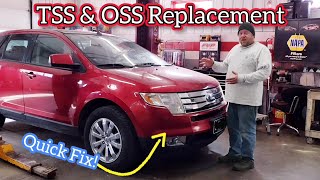
Source hint: YouTube comment by EvanWells07 on 'How To Replace Transmission TSS And OSS - Ford Edge' by Ev
2008 Ford Edge
Symptoms: Wrench light came on and the vehicle entered limp mode, becoming very slow to move from a stop.
What fixed it: Internal OSS/TSS sensor replacement.
Source hint: fordedgeforum.com - '2008 Edge PowerTrain Malfunction'
2007 Ford Edge
Symptoms: The transmission acted up during a road trip and triggered a P0720 code.
What fixed it: DIY replacement of both TSS and OSS sensors.
Source hint: fordedgeforum.com - 'Replacing TSS & OSS sensors'
Related OBD-II Codes
Frequently Asked Questions
Does TSB 07-21-11 apply to my 2008 Ford Edge?
My speedometer dropped to zero and the wrench light came on; is this related to P0720?
Can I just replace the OSS sensor, or do I need a new PCM?
Why is my Ford Edge 'hunting' for gears and jolting during downshifts?
Is it true I should replace both the TSS and OSS sensors at the same time?
Will a P0720 code cause my Ford Edge to lose power?
Helpful Videos
We Have This Part in Stock




The information in this article is provided for general reference and educational purposes only. Vehicle specifications, procedures, and part compatibility can vary by production date, trim level, and region. Always consult your vehicle's factory service manual and verify part numbers before purchasing or performing repairs. Safety-critical components such as airbags, seat belts, and braking systems should be installed by a qualified professional.
- Ford Edge:
- 🧭 Diagnostic Flowchart
- 🎬 Helpful Videos
- 🛍️ Shop This Part
- What's Unique About the 2007-2014 Ford Edge
- Symptoms You May Notice
- Most Likely Causes
- Rare But Worth Checking
- Diagnosis Steps
- Parts You'll Likely Need
- Related Codes That Often Appear With This One
- Technical Service Bulletins (TSBs) & Recalls
- Platform-Specific Known Issues
- Mechanic-Grade Diagnostic Values
- Scan Tool Commands That Help
- Wiring & Ground Locations
- Real Owner Repair Stories
- OEM Part Supersession History
- Model Year Variations Within This Range
- Other Known Issues on This Vehicle
- Used vs. New Parts: Buying Guide for This Vehicle
- Real Owner Stories
- 2007 Ford Edge
- 2008 Ford Edge
- 2007 Ford Edge
- Related OBD-II Codes
- Frequently Asked Questions
- 🎟️ Get 5% Off