

P0720 on 2006-2012 Ford Fusion: Output Speed Sensor Causes and Fixes
P0720 on a 2006-2012 Ford Fusion most often means the Output Speed Sensor (OSS) or its wiring has failed. On later models with the 6F35 transmission (common from 2010-2012), the sensor is inside the transmission as part of a failure-prone molded leadframe, making replacement a complex job. For earlier models with the FNR5 transmission, it is a much simpler external repair.
- P0720 on a 2006-2012 Fusion points to a problem with the Output Speed Sensor (OSS) circuit, causing serious shifting problems.
- The single most important diagnostic step is to identify the vehicle's specific automatic transmission, as this dictates the sensor's location and the repair's difficulty.
- On Fusions with the 6F35 or Aisin 6-speed automatic, the sensor is internal, and replacement is a complex job requiring valve body removal. This is not a beginner-level DIY repair.
- Before condemning an internal sensor, always thoroughly inspect the external wiring harness for damage, as this is a common and much cheaper fix.
- Due to the risk of causing more severe transmission damage, it is best to stop driving the vehicle and have it diagnosed promptly if you experience harsh shifting or limp mode.
What's Unique About the 2006-2012 Ford Fusion
The key challenge for this code on the first-generation Ford Fusion is identifying the transmission, as sensor location varies drastically. Early 4-cylinder models (2.3L) often used the FNR5 5-speed automatic, which has an externally mounted and easily accessible OSS. 🎬 Watch: Locate the input and output sensors on early models V6 models (3.0L) from 2006-2009 used the Aisin TF-81SC 6-speed, and later 4-cylinder (2.5L) and 3.0L V6 models from 2010-2012 widely adopted the Ford 6F35 6-speed automatic. On both the 6F35 and Aisin transmissions, the Output Speed Sensor is located *inside* the transmission housing, requiring removal of the valve body to replace. This turns a simple sensor swap into a significant, labor-intensive repair.
Symptoms You May Notice
- Check Engine Light or wrench light is on
- Harsh, erratic, or delayed gear shifts
- Transmission gets stuck in a high gear (e.g., 3rd or 5th gear) after coming to a stop.
- Speedometer reads incorrectly, reads zero, or not at all
- Odometer display shows dashes ('-------') instead of mileage
- Flashing 'O/D Off' (Overdrive Off) light on the instrument cluster
- Vehicle stalling when coming to a stop
- Reduced fuel economy
- Airbag light may illuminate simultaneously
- Replacing the entire transmission without first diagnosing the sensor or wiring. Since the sensor is internal on many Fusions, some shops may default to a full replacement, which is often unnecessary.
- Replacing the Input Speed Sensor (TSS) instead of the Output Speed Sensor (OSS). They are separate sensors with different functions, though on the 6F35 they are both part of the same molded leadframe assembly.
Most Likely Causes
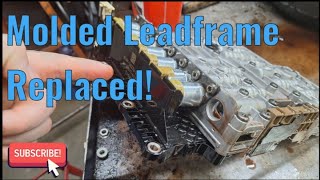
- Faulty Output Speed Sensor (OSS) / Molded Leadframe 🔴 High Probability On models with the 6F35 transmission (2010-2012), the OSS is integrated into an internal 'molded leadframe' assembly. This component is a well-documented failure point on many Ford vehicles of this era, known to cause P0720 and P0722 codes. Ford issued Customer Satisfaction Program 19N01 for other vehicles with similar transmissions (6R80) for this exact issue, acknowledging the design weakness. 🎬 See how the molded leadframe is replaced on Ford transmissions
How to confirm: Use a high-end scan tool to monitor the OSS data stream while driving. If the speed reading is erratic, drops to zero, or doesn't change with vehicle speed, the sensor is likely bad. For external sensors (FNR5), test resistance with a multimeter. For internal sensors (6F35), this test is not feasible; diagnosis relies on scan tool data and ruling out wiring. The presence of codes P0722 or P0731 alongside P0720 strongly points to this component.
Typical fix: Replace the Output Speed Sensor. For 6F35 and Aisin transmissions, this involves draining the fluid, removing the transmission side cover, and removing the valve body to access the sensor/leadframe. For FNR5 transmissions, the sensor is external and can be unbolted from the outside of the case.
Est. part cost: $40-$250 - Damaged Wiring or Corroded Connector 🟡 Medium Probability The wiring harness leading to the transmission is exposed to road debris, moisture, and heat, which can cause wires to break or connectors to corrode. Rodent damage is also a possible cause, as owners have found chewed wires near the transmission housing. Poor factory grounds are also a known issue; grounds on the strut tower can corrode under the bolt head where it's not visible.
How to confirm: Visually inspect the entire wiring harness leading to the transmission's main electrical connector. Check for chafed, broken, or melted wires. Unplug the connector and check for corrosion. Perform a continuity test on the OSS circuit wires from the PCM to the transmission connector. Remove, clean, and re-secure main body and engine grounds, especially G100, G102, and G104.
Typical fix: Repair the damaged section of wiring by soldering in a new piece of wire and protecting it with heat-shrink tubing. If the connector is corroded, it may need to be cleaned or replaced. Clean chassis ground points with a wire wheel to ensure a good metal-to-metal connection before re-tightening.
Est. part cost: $5-$50 - Low or Contaminated Transmission Fluid ⚪ Low Probability → Shop Transmission Assembly
How to confirm: Check the transmission fluid level and condition using the dipstick (if equipped). The fluid should be at the correct level, red in color, and not smell burnt. If the fluid is dark, brown, or contains metal particles, it indicates internal wear.
Typical fix: If the fluid is low, top it off with the correct type (e.g., Motorcraft MERCON V or MERCON LV, depending on the transmission). If the fluid is dirty or contaminated, perform a transmission fluid and filter change. This may resolve the issue if it's causing erratic hydraulic pressure or solenoid function.
Est. part cost: $50-$150
Rare But Worth Checking
- Faulty Powertrain Control Module (PCM): → Shop Engine Control Module (ECM) This is very rare. The PCM should only be considered after all other possibilities, including the sensor, wiring, and fluid, have been thoroughly ruled out. A faulty PCM can fail to interpret a good sensor signal correctly.
- Internal Transmission Mechanical Failure: → Shop Transmission Assembly Damage to the tone ring that the OSS reads, or other internal mechanical issues, can cause this code. This is usually accompanied by other symptoms like grinding noises or severe slipping and often other trouble codes.
- Failing Alternator / Bad Charging System: → Shop Alternator A failing alternator can introduce AC ripple (electrical noise) into the vehicle's DC electrical system. The PCM can misinterpret this noise as a valid speed signal, even when stopped, leading to erratic shifting and a P0720 code without a battery warning light.
Diagnosis Steps
- Scan for Codes: Use an OBD-II scanner to confirm P0720 and check for any other related transmission codes like P0722 or P0731.
- Check Transmission Fluid: Verify the transmission fluid is at the correct level and in good condition. Low or burnt fluid can cause a host of issues.
- Inspect External Wiring: Carefully inspect the wiring harness going to the main transmission connector. Look for any signs of damage, corrosion, or loose connections. Pay special attention to chassis grounds (G100, G102, G104) and clean them.
- Monitor Live Data: Use a scan tool capable of reading live data to monitor the 'Output Shaft Speed' PID. While driving, watch the reading to see if it is smooth and corresponds to vehicle speed. If it's erratic, jumps around, or drops to zero, the problem is likely the sensor or its immediate circuit.
- Test the Circuit: If the sensor is external (FNR5 transmission), unplug it and test for resistance across the sensor's pins with a multimeter; expect 400-700 Ohms. If it's internal (6F35/Aisin), test the circuit's continuity from the main transmission connector back to the PCM to rule out an external wiring break.
- Check for AC Ripple: With the engine running, use a multimeter set to AC volts to check for electrical noise at the battery terminals. A reading above 0.5V AC indicates a potential issue with the alternator's diodes, which can cause false sensor signals.
- Access and Replace Sensor: If the wiring, grounds, and charging system are confirmed good, the sensor itself is the likely culprit. For Fusions with the 6F35 or Aisin transmission, this requires accessing the valve body inside 🎬 Watch: Step-by-step 2010 Fusion output sensor removal guide the transmission. For models with an external sensor, it's a much simpler replacement.
Parts You'll Likely Need
- Transmission Output Speed Sensor (OSS)
(OEM #XS4Z-7H103-AB (For FNR5))— This is the most common component to fail, either as a standalone external sensor (FNR5) or as part of the internal molded leadframe assembly (6F35).
Trusted brands: Motorcraft, Rostra, Dorman
OEM price range: $70-$120
Aftermarket price range: $40-$80 - Molded Leadframe Assembly (6F35)
(OEM #AL3Z-7G276-D (Supersedes AL3Z-7G276-A and -B))— For 2010-2012 models with the 6F35 transmission, this entire assembly, which includes both the OSS and TSS, is the common failure point.
Trusted brands: Motorcraft
OEM price range: $150-$250
Aftermarket price range: $100-$180 - Transmission Fluid and Filter/Pan Gasket — Required for any repair that involves opening the transmission pan or side cover to access an internal sensor. Use Motorcraft MERCON LV for the 6F35.
Trusted brands: Motorcraft
OEM price range: $80-$150
Aftermarket price range: $50-$100
Related Codes That Often Appear With This One
- P0722 — This code means 'Output Speed Sensor Circuit No Signal,' which is a more specific version of P0720, indicating a complete loss of signal rather than just an erratic one. Both codes often point to a failed molded leadframe.
- P0731 — This code means 'Gear 1 Incorrect Ratio.' It often appears with P0720 because if the PCM can't read the output speed, it can't verify if the transmission is in the correct gear ratio, leading to ratio error codes.
Platform-Specific Known Issues
- For models equipped with the 6F35 transmission (common in 2010-2012 models), the OSS is part of the internal molded leadframe assembly. This design is a known weak point. Ford issued TSB 13-6-8 for other models with similar transmissions (6R80) instructing dealers to replace the leadframe for P0720/P0722 codes.
- Manufacturer TSB Bulletin #19N01-S3 confirms that leadframe failure may result in an illuminated MIL or wrench light with DTCs P0720, P0722, P0731 and/or P1500 stored in the PCM.
- Ford also initiated Customer Satisfaction Program 19N01, extending the warranty on the molded leadframe for certain trucks to 10 years/150,000 miles due to high failure rates causing these codes, indicating a known design weakness with this technology. While the Fusion was not explicitly covered, the failure mode is identical.
- On Fusions with the earlier FNR5 5-speed transmission, the OSS is external and much easier to replace. A common owner experience on forums involves replacing this external sensor only to find the issue was contaminated fluid or a wiring problem.
Mechanic-Grade Diagnostic Values
- Output Speed Sensor (OSS) Resistance (FNR5 Transmission) — expected: 400 - 700 Ohms. Failure: An open circuit (infinite resistance) or a reading significantly outside the expected range.
- Alternator AC Ripple Voltage — expected: Less than 0.5 Volts AC. Failure: A reading greater than 0.5V AC at the battery terminals with the engine running indicates failing alternator diodes, which can create electrical noise that disrupts sensor signals.
- Output Speed Sensor (OSS) Bolt Torque (6F35 Transmission) — expected: 10 Nm (89 lb-in). Failure: N/A - This is an installation specification.
Scan Tool Commands That Help
- ForScan: Clear Transmission Adaptive Tables — This function must be performed after replacing the valve body or the entire transmission to reset the learned shift pressure values. Failure to do so can result in continued harsh shifting even with new parts.
- ForScan: Transmission Characterization Update (Solenoid Strategy Programming) — Required when replacing the valve body or molded leadframe on a 6F35 transmission. This function allows the tech to input the 13-digit solenoid strategy number from the sticker on the new part into the PCM. The software then downloads the correct calibration file. This is critical for proper solenoid operation.
- Generic OBD-II Scanner (Live Data): Monitor Output Shaft Speed (OSS) PID — This is the primary diagnostic step. The OSS reading should be 0 at a stop and increase smoothly with vehicle speed. Erratic jumps, dropouts to zero while moving, or a non-zero reading when stopped all indicate a fault in the sensor, wiring, or a potential interference issue like AC ripple.
Wiring & Ground Locations
- G100 — On the left front strut tower, near the battery junction box.. This is a primary chassis ground. A poor connection here due to corrosion can cause widespread electrical issues, including faulty sensor readings for the PCM/TCM.
- G102 / G104 — G102 is at the left rear of the engine compartment; G104 is at the right front of the engine compartment.. These are key engine and powertrain-related grounds. Technicians have noted that Ford often painted the chassis before installing grounds, leading to poor long-term connections that can cause intermittent and hard-to-diagnose sensor faults.
- FNR5 OSS Sensor Wires (at TCM Connector) — On the FNR5 transmission, the OSS Signal wire is Brown-Green (BN-GN) and the signal return is Gray-Violet (GY-VT) at the Transmission Control Module (TCM) connector.. Knowing these wire colors allows for a continuity test from the sensor connector back to the control module, definitively ruling out a wiring break in the harness.
- S110 — A factory splice located in the engine control sensor harness, near the breakout to the OSS sensor on FNR5-equipped models.. Factory splices are potential failure points for corrosion or vibration-induced breaks. If sensor and PCM connections are good, checking the integrity of this splice is a next logical step.
Real Owner Repair Stories
- YouTube user 'Brians Mobile1' (2010 Ford Fusion 3.0L with 6F35 transmission) — Car drove fine on startup, but after stopping, it would get stuck in 5th gear. Reverse was also very harsh. Check engine light was on with code P0720.
❌ Tried (didn't work) Draining and refilling the transmission fluid., Replacing the easily accessible Input Speed Sensor (TSS).
✅ What actually fixed it The problem was the internal Output Speed Sensor (OSS). The user documented dropping the transmission side pan and the valve body with the transmission still in the car to access and replace the faulty sensor. - YouTube user 'Ford Tech Makuloco' (Ford F-150 with 6R80 transmission (similar design to 6F35)) — Harsh/erratic shifts, speedometer dropping to zero, wrench light, codes P0720, P0722, P0731.
❌ Tried (didn't work) Clearing codes (they would return immediately).
✅ What actually fixed it The internal molded leadframe, which contains the OSS and TSS sensors, had failed. The fix was to drop the pan and valve body to replace the entire leadframe assembly, the transmission bulkhead connector sleeve, and perform a fluid/filter service. This is the definitive fix for this common failure. - YouTube user 'jimthecarguy' (Ford vehicle with external speed sensor) — P0720, speedometer not working, delayed shifts, flashing O/D light.
❌ Tried (didn't work) Initial resistance test of the sensor passed (read 439 ohms), suggesting the sensor was good.
✅ What actually fixed it The wiring harness leading to the sensor had been chewed through by a rodent. The final repair was to solder the broken wires and protect them with heat shrink tubing. This highlights the importance of a thorough visual inspection of the harness.
"I Checked Everything" — The Actual Cause
- A failing alternator with worn diodes can introduce AC voltage (ripple) into the vehicle's electrical system. This electrical 'noise' can be misinterpreted by the PCM as a signal from the output speed sensor, causing P0720, erratic shifting, and a speedometer that reads speed even when stopped. Standard circuit tests for wiring and sensor resistance will all pass, making this difficult to diagnose. The fix is to test for AC voltage at the battery terminals while the engine is running; a reading over ~0.5V AC confirms a bad alternator.
Documented NHTSA Reports
- An owner reported in NHTSA ODI #11715554 that their vehicle downshifted from gear 6 to gear 4, displayed a wrench icon, and would not come out of 4th gear due to code P0720.
- NHTSA ODI #11578725 describes a situation where an orange wrench and MIL light appeared followed by a solid check engine light; the dealership confirmed DTC P0720 and P0722 were present.
- According to NHTSA ODI #11492951, a failure occurred where everything on the instrument panel stopped working except for the RPM gauge and the vehicle became stuck in 5th gear with a P0720 code.
- NHTSA ODI #11597108 notes an instance where a P0720 output speed sensor circuit malfunction was reported to cause engine misfires in addition to transmission issues.
OEM Part Supersession History
AL3Z-7G276-A, AL3Z-7G276-B→AL3Z-7G276-D— Revision to improve reliability of the internal sensors and plastic leadframe structure on the 6F35/6R80 transmissions.
Heads up: The 'A', 'B', and 'D' revisions are generally interchangeable, but it is critical to always install the latest available revision ('D' as of late 2010s) to get the most updated and reliable part.
Model Year Variations Within This Range
- 2006-2009: Early 4-cylinder (2.3L) models primarily used the FNR5 5-speed automatic with an easily accessible, external OSS. V6 models used an Aisin 6-speed with an internal sensor.
- 2010-2012: Facelift models with the 2.5L I4 and 3.0L V6 predominantly used the Ford 6F35 6-speed automatic. On these models, the OSS is internal and part of the failure-prone molded leadframe, making the repair significantly more labor-intensive.
Diagnostic Flowchart
Other Known Issues on This Vehicle
Issues unrelated to this code that are worth knowing about as an owner of this generation:
- Electronic Throttle Body Failure 🔴 High — Very common. Can occur at any mileage, often causing sudden loss of power and 'limp mode'. (Ref: Ford issued Customer Satisfaction Program 13N03, extending warranty coverage on the throttle body for many models, though some owners reported Hybrid models were excluded.)
- Electric Power Steering (EPS) Failure 🔴 High — Widespread, particularly on 2010-2012 models. Often results in a sudden loss of power steering assist, making the vehicle very difficult to steer at low speeds. (Ref: Multiple recalls (e.g., NHTSA 15V340000) and warranty extensions were issued. The fix often involved a software update, but many owners required a full replacement of the steering rack.)
- Harsh Shifting / Transmission Faults (General) 🟠 Medium → Shop Transmission Assembly — Commonly reported, especially on 2006-2009 models, with symptoms appearing around 80,000-120,000 km. Can sometimes be addressed with a PCM reprogram, but may require valve body or transmission replacement.
- Takata Airbag Inflator Recall 🔴 High — Affects all model years from 2006-2012. Part of the massive, industry-wide Takata recall. (Ref: Multiple NHTSA recalls (e.g., 21S12) were issued for both driver and passenger side inflators.)
- ABS Hydraulic Control Unit (HCU) Failure 🟠 Medium — Valves within the HCU can stick, potentially affecting brake pedal feel and increasing stopping distance. (Ref: Ford issued a recall for 2006-2010 models to address this issue.)
- Power Steering Fluid Leaks 🟡 Low — Common on earlier models (2006-2009) with hydraulic power steering. Leaks often develop from hoses near the pump.
Used vs. New Parts: Buying Guide for This Vehicle
When a used part is the smart pick: For models with the FNR5 transmission, a used external Output Speed Sensor from a low-mileage donor vehicle is a reasonable, low-risk option. For the 6F35 transmission, a complete used transmission may be more cost-effective than paying a shop for the labor-intensive leadframe replacement on your original unit, provided the donor unit has a verifiable history and low mileage.
Donor-vehicle mileage cap: roughly under 80000 miles for the part to have meaningful remaining life.
What to inspect on the donor part:
- For a used transmission, ask for a video of the donor car running and driving, if possible.
- Check the color and smell of the transmission fluid from the donor unit; it should be reddish and not smell burnt.
- Ensure the junkyard or seller offers at least a 30-day warranty.
- Inspect the electrical connector pins on the part for any corrosion or damage.
OEM-only on this vehicle (don't cheap out):
- Molded Leadframe Assembly (6F35/6R80)
Aftermarket brands forum-validated for this vehicle:
- Rostra (for external sensors and solenoids)
Brands owners have reported issues with on this vehicle:
- Unbranded/"refurbished" leadframes from Amazon or eBay. Forum users and technicians report extremely high rates of out-of-the-box failure or failure within a few months. The labor is too intensive to risk using a part of unknown quality.
Real Owner Stories
Aggregated from forums and TSBs cited above. Mileages and costs reflect what owners reported in those sources.
2007 Ford Fusion (FNR5 transmission)
Symptoms: The speedometer became erratic and the odometer display flatlined with dashes. The owner found the transmission fluid was 'BLACK not red at all'.
What fixed it: While the owner initially replaced the external OSS, the context suggests the issue was related to contaminated fluid fouling the system.
Source hint: Ford Fusion Forum - Speedometer problems
2010 Ford Fusion 3.0L V6 (6F35 transmission)
Symptoms: The vehicle would go straight to 5th gear after coming to a stop and experienced very harsh reverse engagement.
What fixed it: Replacement of the internal Output Speed Sensor located on the valve body.
Source hint: YouTube - 2010 Ford Fusion p0720 output sensor removal
2011 Ford Fusion (6F35 transmission) — ~150000 miles
Symptoms: Vehicle getting stuck in gear, speedometer dropping to zero, and the airbag light illuminating simultaneously.
What fixed it: Replacement of the molded leadframe assembly.
Cost: $500-$1600
Source hint: Ford F150 Forum - Output speed sensor P0720
Related OBD-II Codes
Frequently Asked Questions
Is my 2010-2012 Ford Fusion covered under the 19N01 Customer Satisfaction Program for the OSS failure?
Why is my speedometer reading zero and my odometer showing dashes ('-------') on my 2007 Fusion?
I have a 2010 Fusion with the 6F35 transmission; can I replace the OSS myself?
Could a bad alternator cause a P0720 code on my Ford Fusion?
Where are the main ground points I should check for P0720 on my Fusion?
Is the OSS easier to fix on the 5-speed FNR5 transmission versus the 6-speed 6F35?
Helpful Videos

We Have This Part in Stock

The information in this article is provided for general reference and educational purposes only. Vehicle specifications, procedures, and part compatibility can vary by production date, trim level, and region. Always consult your vehicle's factory service manual and verify part numbers before purchasing or performing repairs. Safety-critical components such as airbags, seat belts, and braking systems should be installed by a qualified professional.
- Ford Fusion:
- 🧭 Diagnostic Flowchart
- 🎬 Helpful Videos
- 🛍️ Shop This Part
- What's Unique About the 2006-2012 Ford Fusion
- Symptoms You May Notice
- Most Likely Causes
- Rare But Worth Checking
- Diagnosis Steps
- Parts You'll Likely Need
- Related Codes That Often Appear With This One
- Platform-Specific Known Issues
- Mechanic-Grade Diagnostic Values
- Scan Tool Commands That Help
- Wiring & Ground Locations
- Real Owner Repair Stories
- "I Checked Everything" — The Actual Cause
- Documented NHTSA Reports
- OEM Part Supersession History
- Model Year Variations Within This Range
- Other Known Issues on This Vehicle
- Used vs. New Parts: Buying Guide for This Vehicle
- Real Owner Stories
- 2007 Ford Fusion (FNR5 transmission)
- 2010 Ford Fusion 3.0L V6 (6F35 transmission)
- 2011 Ford Fusion (6F35 transmission) — ~150000 miles
- Related OBD-II Codes
- Frequently Asked Questions
- 🎟️ Get 5% Off