

P0720 on 2004-2012 GMC Canyon: Output Speed Sensor Failure Causes and Fixes
P0720 on a first-generation GMC Canyon almost always points to a failed transmission Output Speed Sensor (OSS), also called the Vehicle Speed Sensor (VSS) on this platform. This can cause erratic shifting, an inoperative speedometer, and cruise control failure. Replacing the externally-mounted sensor is a common, affordable DIY fix, with the part costing around $25-$85.
- P0720 on your Canyon most likely means the Output Speed Sensor has failed.
- Symptoms to watch for are poor shifting, a non-functional speedometer, and the Check Engine Light.
- The most probable fix is replacing the Output Speed Sensor, which is an accessible and affordable part located on the outside of the transmission.
- Before replacing parts, always perform a visual inspection of the sensor's wiring and connector for any obvious damage.
- While less common, check your transmission fluid level and condition, as low or dirty fluid can contribute to this code.
What's Unique About the 2004-2012 GMC Canyon
The first-generation GMC Canyon (and its twin, the Chevrolet Colorado) uses the reliable 4L60-E automatic transmission. For this P0720 code, the cause is overwhelmingly a simple, externally-mounted speed sensor failure. Unlike many other vehicles where this code could point to complex internal transmission issues or module failures, the fix on these trucks is typically straightforward. The sensor is located on the tail housing of the transmission (2WD models) or on the transfer case (4WD models), making it easily accessible for replacement.
Symptoms You May Notice
- Check Engine Light is on
- Harsh, erratic, or delayed gear shifts
- Speedometer reads incorrectly or not at all
- Cruise control is inoperative
- Engine stalling when coming to a stop
- Reduced fuel economy
- ABS or Traction Control lights may illuminate
- Replacing internal transmission components like shift solenoids before verifying the OSS signal is the root cause.
- Assuming the entire transmission has failed without first diagnosing the speed sensor circuit.
- Confusing the Output Speed Sensor (OSS/VSS) with the Input Speed Sensor (ISS) or the ABS wheel speed sensors.
Most Likely Causes
- Defective Output Speed Sensor (OSS/VSS) 🔴 High Probability Sensors can fail over time due to heat cycles and internal wear. It's the most common point of failure in this circuit for the 4L60-E transmission used in these trucks.
How to confirm: Use a scan tool to monitor the output speed signal while driving. If the signal is erratic, drops to zero, or doesn't match the vehicle's actual speed, the sensor is likely bad. You can also test the sensor's internal resistance with a multimeter; a typical 2-wire sensor should read between 560-680 Ohms, but consult a service manual for exact specs.
Typical fix: Replace the Output Speed Sensor. On 2WD models, it is located on the driver's side of the transmission tail housing. On 4WD models, it is on the rear of the transfer case. It is held in by a single bolt.
Est. part cost: $25-$85 - Damaged Wiring or Connector 🟡 Medium Probability The wiring harness to the sensor is located underneath the truck and is exposed to road debris, moisture, and heat from the exhaust, which can lead to corrosion, chafing, or loose connections over time.
How to confirm: Visually inspect the wiring harness and connector leading to the OSS for any signs of damage, corrosion, or melting. Perform a continuity test on the wires between the sensor and the PCM. A "wiggle test" on the harness while monitoring live data can also reveal intermittent connection issues.
Typical fix: Repair the damaged section of wiring or replace the connector pigtail. Ensure the connection is clean and secure. Applying dielectric grease can help prevent future corrosion.
Est. part cost: $10-$30 - Contaminated or Low Transmission Fluid ⚪ Low Probability → Shop Transmission Assembly While not a direct cause of a circuit code, metal shavings from normal wear can accumulate on the magnetic tip of the speed sensor, disrupting its signal. Extremely low or burnt fluid can cause a variety of shifting issues that may be misdiagnosed.
How to confirm: Check the transmission fluid level and condition with the engine running and warm. If the fluid is dark, smells burnt, or has visible metal particles, it needs service. When removing the old sensor, inspect its tip for metal debris.
Typical fix: Perform a transmission fluid and filter change. Clean the magnetic tip of the new sensor before installation.
Est. part cost: $50-$150 (for fluid and filter)
Rare But Worth Checking
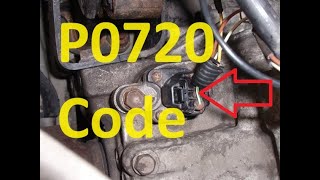
- Faulty Powertrain Control Module (PCM) or Transmission Control Module (TCM): → Shop Engine Control Module (ECM) This is very uncommon. Before condemning the control module, all other possibilities, including the sensor and its entire circuit, must be thoroughly tested and ruled out. A PCM failure is the least likely cause. 🎬 Watch: Learn how to diagnose and fix a P0720 code
Diagnosis Steps
- Scan for Codes: Use an OBD-II scanner to confirm P0720 is present and check for any other related codes, such as P0700, P0500, P0721, or P0722.
- Inspect Fluid: Check the transmission fluid level and condition. Ensure it is at the proper level and does not appear burnt or contaminated.
- Visual Inspection: Locate the sensor on the transmission tail housing (2WD) or transfer case (4WD). Visually inspect the sensor, its connector, and the wiring harness for any obvious signs of damage, corrosion, melting from exhaust heat, or loose connections.
- Monitor Live Data: Use a scan tool capable of reading live data to monitor the Output Shaft Speed while driving. Watch for the signal to drop out, become erratic, or fail to increase with vehicle speed. This is the most effective diagnostic step.
- Test the Sensor: If the wiring appears okay but the signal is bad, remove the sensor for inspection. Check for metal debris on the magnetic tip. If you have a multimeter, test the sensor's internal resistance and compare it to the manufacturer's specifications (often 560-680 Ohms for a 2-wire sensor).
- Test the Circuit: If the sensor tests good, check for proper voltage and ground at the sensor's connector. Perform a continuity check on the signal and ground wires between the sensor connector and the PCM connector to rule out a break in the wiring.
- Replace the Sensor: If the sensor is confirmed to be faulty, replace it with a new one. This is the most common resolution.
- Clear Codes and Test Drive: After replacement, clear the trouble codes and perform a test drive to ensure the issue is resolved and the code does not return.
Parts You'll Likely Need
- Automatic Transmission Output Shaft Speed Sensor
(OEM #24225896)— This sensor is the most common failure point for the P0720 code. It directly measures the output shaft speed, and an internal failure will cause the erratic signal detected by the computer.
Trusted brands: ACDelco (GM Original Equipment), GM Genuine Parts, Delphi, SKP, NTK
OEM price range: $35-$55
Aftermarket price range: $15-$45
Related Codes That Often Appear With This One
- P0700 — P0700 is a general transmission fault code. It means the Transmission Control Module (TCM) has detected a problem and has requested the main engine computer (PCM) to turn on the Check Engine Light. It will almost always appear alongside a more specific transmission code like P0720.
- P0500 — P0500 relates to a Vehicle Speed Sensor (VSS) circuit malfunction. Since the OSS data is used to calculate vehicle speed, a fault in the OSS circuit can sometimes trigger this code as well. On this platform, the OSS and VSS are often the same component.
- P0721 — P0721 indicates the Output Speed Sensor signal is erratic. This is a more specific version of the P0720 fault and often points directly to a failing sensor or a loose wiring connection.
- P0722 — P0722 means there is no signal from the Output Speed Sensor circuit. This could be a completely failed sensor, a broken wire, or a disconnected plug.
Platform-Specific Known Issues
- Sensor Location Varies by Drivetrain: It is critical to know whether you have a 2-wheel drive or 4-wheel drive model. On 2WD trucks, the sensor is on the driver's side of the transmission's tail housing. On 4WD models, the sensor is located on the rear output of the transfer case.
Mechanic-Grade Diagnostic Values
- VSS Resistance — expected: 500 Ω ± 10%. Failure: A reading far outside this specification indicates an internal sensor fault.
- VSS Signal at PCM — expected: The sensor generates an AC signal that is converted to a digital DC signal by a buffer module before reaching the PCM. A scan tool should show a smooth increase in Output RPM that corresponds to vehicle speed.. Failure: A scan tool reading that is erratic, drops to zero, or shows a sudden large change (over 1000-2050 RPM in less than 2 seconds) will trigger the code.
Wiring & Ground Locations
- PCM Connector C2 (Blue) — Located on the right rear corner of the engine compartment.. This is where the VSS signals terminate. The VSS High Signal (Dark Green/White wire) goes to Pin 21, and the VSS Low Signal (Purple/White wire) goes to Pin 20. Testing for a signal at these pins can confirm the integrity of the entire wiring harness from the sensor to the PCM.
- VSS Connector — On the sensor itself, located at the transmission tail housing (2WD) or transfer case (4WD).. This is the most common point for corrosion, loose pins, or physical damage due to its exposed location underneath the truck. A visual inspection here is a critical first step.
Real Owner Repair Stories
- 355nation.net forum user (2006 Chevrolet Colorado (GMC Canyon platform twin)) — Check engine light on, hard shifting from 1st to 2nd gear, speedometer not working.
❌ Tried (didn't work) Initial diagnosis pointed towards the speed sensor.
✅ What actually fixed it The user replaced the Vehicle Speed Sensor (VSS) on the transmission, which resolved all symptoms and cleared the P0720 code. The repair was noted as being simple.
OEM Part Supersession History
10456520→24225896— Standard part number update and consolidation by GM.
Heads up: The new part number, 24225896, is the correct direct replacement for 2WD models within this generation. 4WD models use a different sensor located on the transfer case.
Model Year Variations Within This Range
- 2005-2012: Beginning in 2005, the transmission control function was split from the main Powertrain Control Module (PCM) into a separate Transmission Control Module (TCM) located on the transmission case itself. This can slightly alter diagnostic paths, as the VSS wiring on these later models goes to the TCM first, not directly to the main engine computer. Additionally, an Input Speed Sensor (ISS) was introduced in mid-2005, which changed some internal transmission components, but the external Output Speed Sensor (VSS) function and diagnosis for P0720 remain largely the same.
Diagnostic Flowchart
Other Known Issues on This Vehicle
Issues unrelated to this code that are worth knowing about as an owner of this generation:
- Worn Valve Seats (3.5L & 3.7L Engines) 🔴 High — Common on early 3.5L engines, less so on the later 3.7L. Can cause persistent misfire codes (P0300) and rough idle. (Ref: PIP4013D)
- PassLock Anti-Theft System Failure 🟠 Medium — A very common issue causing intermittent no-start or crank-no-start conditions. The security light will often be flashing.
- Failed Blower Motor Resistor 🟡 Low — Extremely common failure. Results in the HVAC fan only working on the highest setting (or not at all). Often melts the connector as well.
- Cracked Exhaust Manifold (5-Cylinder Engines) 🟠 Medium — The cast iron manifold is prone to cracking over time, causing an exhaust leak noise (ticking) that is most noticeable when the engine is cold.
- Body Control Module (BCM) Malfunctions 🟠 Medium — Can cause a wide range of strange electrical issues, including problems with power locks, windows, interior lights, and intermittent battery drain.
- Prematurely Worn Fan Clutch 🟡 Low — The fan clutch can fail, causing it to be stuck engaged (loud roaring noise) or disengaged (potential for overheating at low speeds).
Used vs. New Parts: Buying Guide for This Vehicle
When a used part is the smart pick: For this specific repair, buying a used Output Speed Sensor is NOT recommended. The sensor is an inexpensive, high-failure electronic part. A used wiring pigtail/connector could be a viable option if the original is physically damaged and a new pigtail is unavailable.
What to inspect on the donor part:
- For a wiring pigtail: ensure the plastic is not brittle or cracked, the locking tab is intact, and there is sufficient wire length for splicing.
- Check for any signs of corrosion on the metal terminals inside the connector.
OEM-only on this vehicle (don't cheap out):
- While not strictly 'OEM-only', using a GM Genuine or ACDelco OE sensor is highly recommended for reliability and correct signal output.
Aftermarket brands forum-validated for this vehicle:
- Delphi
- NTK
- Standard Motor Products (SMP)
Brands owners have reported issues with on this vehicle:
- Unnamed, low-cost sensors from online marketplaces are frequently reported on forums to be dead-on-arrival or fail prematurely.
Real Owner Stories
Aggregated from forums and TSBs cited above. Mileages and costs reflect what owners reported in those sources.
GMC Canyon / Chevrolet Colorado
Symptoms: Erratic shifting and the speedometer stopped working.
What fixed it: Replacing the VSS (Vehicle Speed Sensor/Output Speed Sensor).
Source hint: https://www.355nation.net/threads/p0720-output-speed-sensor-circuit.49881/
GMC Canyon / Chevrolet Colorado
Symptoms: Output speed sensor circuit malfunction code P0720.
What fixed it: Replacement of the sensor; the owner noted the fix was easy to perform.
Source hint: https://coloradofans.com/threads/p0720-output-speed-sensor-circuit-malfunction.401733/
Related OBD-II Codes
Frequently Asked Questions
Where is the Output Speed Sensor located on my 4WD GMC Canyon?
Can I use a used Output Speed Sensor from a donor vehicle to fix P0720?
Does the GMC Canyon share this P0720 issue with any other vehicles?
My 3.5L Canyon has a rough idle and P0300; is this related to the P0720 code?
What should the resistance be when testing the OSS on my 2004-2012 Canyon?
Why is my speedometer acting erratic and my cruise control not working?
Helpful Videos
We Have This Part in Stock

The information in this article is provided for general reference and educational purposes only. Vehicle specifications, procedures, and part compatibility can vary by production date, trim level, and region. Always consult your vehicle's factory service manual and verify part numbers before purchasing or performing repairs. Safety-critical components such as airbags, seat belts, and braking systems should be installed by a qualified professional.
- GMC Canyon:
- 🧭 Diagnostic Flowchart
- 🎬 Helpful Videos
- 🛍️ Shop This Part
- What's Unique About the 2004-2012 GMC Canyon
- Symptoms You May Notice
- Most Likely Causes
- Rare But Worth Checking
- Diagnosis Steps
- Parts You'll Likely Need
- Related Codes That Often Appear With This One
- Platform-Specific Known Issues
- Mechanic-Grade Diagnostic Values
- Wiring & Ground Locations
- Real Owner Repair Stories
- OEM Part Supersession History
- Model Year Variations Within This Range
- Other Known Issues on This Vehicle
- Used vs. New Parts: Buying Guide for This Vehicle
- Real Owner Stories
- GMC Canyon / Chevrolet Colorado
- GMC Canyon / Chevrolet Colorado
- Related OBD-II Codes
- Frequently Asked Questions
- 🎟️ Get 5% Off