

P0720 on 1999-2018 GMC Sierra 1500: Output Speed Sensor Causes and Fixes
P0720 on a GMC Sierra 1500 most often means the Output Speed Sensor (OSS) has failed or its wiring is damaged. If the sensor is external (common on 4-speed 4L60-E models), it's an easy DIY fix for under $50. If it's internal to the transmission (common on 6-speed 6L80 and later models), professional repair is needed as the valve body must be removed.
- P0720 on a GMC Sierra points to a problem with the Output Speed Sensor (OSS) circuit, which is critical for proper transmission shifting and speedometer function.
- The most likely cause is a failed sensor, followed by damaged wiring.
- Before buying parts, determine if your truck's sensor is external (easy DIY fix) or internal to the transmission (requires professional repair). This is the biggest factor affecting repair cost and difficulty.
- Always check your transmission fluid level and condition first, as low or dirty fluid can cause shifting problems.
- Driving with this code can be unsafe due to erratic shifting and a non-functional speedometer, and may lead to more severe transmission damage.
What's Unique About the 1999-2018 GMC Sierra 1500
For the 1999-2018 GMC Sierra, the key difference across generations is the location of the Output Speed Sensor. On earlier models with transmissions like the 4L60-E, the sensor is typically mounted externally on the transmission's tail housing (2WD) or the transfer case (4WD), making it an easy part to replace. However, on later models equipped with the 6-speed (6L80) or 8-speed automatic transmissions (common from 2009 onwards), the sensor is located inside the transmission and is often integrated into a single assembly with the input speed sensor, which significantly increases the complexity and cost of repair.
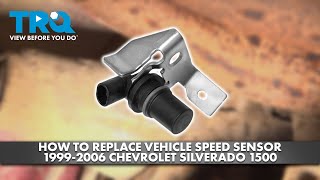
Generation note: This guide covers three generations of the Sierra 1500: - GMT800 (1999-2007): Typically uses an external, easily accessible Output Speed Sensor on the transmission tail shaft (4L60-E) or transfer case. 🎬 Watch: 1999-2006 Silverado and Sierra speed sensor replacement guide - GMT900 (2007-2013): Early models (2007-2008) may still use the 4L60-E with an external sensor. Later models with the 6L80 transmission (from 2009) have an internal sensor. - K2XX (2014-2018): Commonly features the 6L80 or 8-speed transmissions where the OSS is internal, requiring removal of the transmission oil pan and valve body for access.
Symptoms You May Notice
- Harsh, erratic, or delayed shifting
- Transmission stuck in one gear (limp mode)
- Inaccurate or non-working speedometer
- Check Engine Light is on
- Cruise control not working
- ABS or Brake warning light may illuminate
- Stalling when coming to a stop
- Rough or low idle speed
- Replacing the Input Speed Sensor (ISS) instead of the Output Speed Sensor (OSS).
- Condemning the entire transmission without first diagnosing the sensor and its circuit.
- Replacing the PCM/TCM before ruling out a simple wiring or sensor fault.
Most Likely Causes
- Failed Output Speed Sensor (OSS/VSS) 🔴 High Probability The sensor is exposed to heat, vibration, and contaminated fluid, leading to eventual electronic failure. On 4WD models, its location on the transfer case can expose it to off-road debris and moisture.
How to confirm: Use a scan tool to monitor the output speed sensor data while driving. If the reading is erratic, intermittent, or zero while the vehicle is moving, the sensor is likely faulty. You can also test the sensor's internal resistance with a multimeter; a typical 2-wire sensor should read between 560 and 680 Ohms.
Typical fix: Replace the Output Speed Sensor. For internal sensors on 6L80/6L90 transmissions, the input and output sensors are often replaced as a single assembly.
Est. part cost: $25-$75 - Damaged Wiring or Connector 🟡 Medium Probability The wiring harness leading to the transmission is susceptible to damage from road debris, heat from the exhaust, or corrosion, especially in regions with harsh winters. The plastic connector can become brittle and crack over time.
How to confirm: Visually inspect the wiring harness and connector for any signs of cracking, fraying, melting, or corrosion. Perform a continuity and resistance test on the circuit between the sensor and the control module.
Typical fix: Repair the damaged section of wiring or replace the connector pigtail.
Est. part cost: $10-$50 - Low or Contaminated Transmission Fluid ⚪ Low Probability → Shop Transmission Assembly Neglected maintenance can lead to fluid breakdown or leaks, which can affect the operation of internal components and sensors.
How to confirm: Check the transmission fluid level and condition using the dipstick (on applicable models). The fluid should be at the correct level, pinkish-red, and not smell burnt. Metal shavings in the fluid indicate a more serious internal transmission problem.
Typical fix: Perform a transmission fluid and filter change. If the fluid is heavily contaminated, a transmission flush may be necessary.
Est. part cost: $50-$150
Rare But Worth Checking
- Faulty Powertrain or Transmission Control Module (PCM/TCM): → Shop Transmission Assembly This is an uncommon cause. The PCM/TCM should only be suspected after the sensor and its entire circuit have been thoroughly tested and confirmed to be in good working order.
- Metal Debris on Sensor: The OSS is a magnetic sensor. Internal transmission wear can cause metallic particles to stick to the sensor's tip, disrupting its signal. Removing and cleaning the sensor can be a temporary fix, but it indicates a more serious underlying transmission issue requiring a potential rebuild.
Diagnosis Steps
- Check the transmission fluid level and condition. Top off or change if necessary.
- Use an OBD-II scanner to confirm P0720 and check for any other related codes.
- Use the scanner's live data function to monitor the Output Shaft Speed while driving. The reading should increase smoothly with vehicle speed.
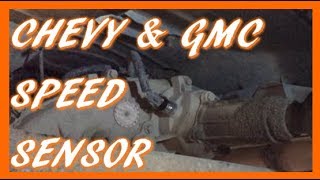
- If the signal is absent or erratic, locate the Output Speed Sensor. On 2WD models with the 4L60-E, it's typically on the driver's side of the transmission's tail housing. On 4WD models, it's often on the rear of the transfer case. 🎬 See: How to replace the speed sensor on older GMC trucks For later models (approx. 2009+ with 6L80), confirm it is internal.
- Inspect the sensor's connector and wiring for any visible damage, corrosion, or loose connections.
- If the wiring appears okay, disconnect the sensor and test its resistance with a multimeter. Compare the reading to the manufacturer's specification (typically around 560-680 Ω for a 2-wire sensor).
- If the sensor tests good, check for voltage and ground at the connector. Then, perform a continuity test on the wiring between the sensor connector and the PCM/TCM.
- If the sensor and wiring are confirmed to be good, the issue may lie with the PCM/TCM, which requires advanced diagnostics.
Parts You'll Likely Need
- Automatic Transmission Output Shaft Speed Sensor
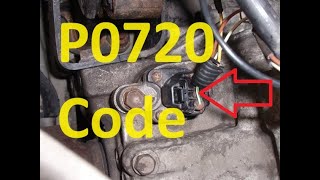
(OEM #ACDelco 24225896 (For 2WD 4L60-E/4L65-E models))— This is the most common component to fail, directly causing the P0720 code. 🎬 Watch: Diagnosing P0720 output speed sensor circuit codes
Trusted brands: ACDelco, Standard Motor Products, Delphi
OEM price range: $40-$90
Aftermarket price range: $25-$60 - Input/Output Speed Sensor Assembly (6L80/6L90)
(OEM #Varies by year. Early 6L80 (pre-2012) and late 6L80 (2012+) use different sensors with different colored brackets (silver vs. black).)— For later model trucks with the 6-speed automatic, the input and output sensors are internal and often replaced as a complete unit.
Trusted brands: ACDelco, GM Genuine
OEM price range: $60-$120
Aftermarket price range: $40-$80
Related Codes That Often Appear With This One
- P0700 — P0700 is a general Transmission Control System Malfunction code. It often appears alongside more specific transmission codes like P0720 to indicate that the TCM has requested the Check Engine Light to be turned on.
- P0500 — P0500 stands for Vehicle Speed Sensor (VSS) Malfunction. Since the OSS often serves as the primary VSS on these trucks, this code can appear with P0720.
- P0721, P0722, P0723 — These are related codes that point to specific faults within the Output Speed Sensor circuit, such as range/performance issues (P0721), no signal (P0722), or an intermittent signal (P0723).
Platform-Specific Known Issues
- A recall was issued for 2014-2018 Sierra 1500 models (among others) for an issue where a failing wheel speed sensor could cause the Electronic-Brake Control Module (EBCM) software to activate the driveline-protection system, resulting in unintended braking. While not directly P0720, it highlights the sensitivity of the vehicle's speed sensing systems.
- On 6L80 transmissions, the internal wiring harness and the Transmission Electro-Hydraulic Control Module (TEHCM), which houses the solenoids and communicates with the sensors, can also be a point of failure, sometimes mimicking sensor issues.
Mechanic-Grade Diagnostic Values
- Output Speed Sensor (OSS) Circuit Voltage — expected: A stable 5V reference voltage from the PCM/TCM at the sensor connector with the key on, engine off.. Failure: Voltage below 4.5V or above 5.5V, or no voltage at all, points to a wiring issue or a problem with the control module's 5V reference circuit.
- Output Speed Sensor (OSS) Ground Circuit Resistance — expected: Less than 0.1 Ω between the ground pin at the sensor connector and a known-good chassis ground.. Failure: High resistance (anything over a few ohms) indicates a corroded, loose, or broken ground wire, which can cause an erratic signal.
- Live Data - Transmission Output Speed (Scan Tool) — expected: The OSS PID should show a smooth, increasing speed reading that directly correlates with the vehicle's actual speed while driving.. Failure: Readings that are erratic, jumpy, drop to zero while moving, or do not change with vehicle speed strongly suggest a faulty sensor or circuit.
Scan Tool Commands That Help
- GDS2/Tech2 or equivalent professional scanner: Live Data - Transmission Output Speed — This is the primary diagnostic step to confirm a faulty sensor or circuit. It allows you to watch the sensor's reported speed in real-time while driving to see if it's dropping out, erratic, or absent.
- GDS2/Tech2 or high-end bidirectional scanner (e.g., Autel MS906): Service Fast Learn Adapts / Transmission Service Fast Learn — This procedure should be performed after replacing an internal transmission component like the valve body, TEHCM, or the internal speed sensor assembly on 6L80/6L90 transmissions. It resets and relearns the transmission's shift adapts to ensure smooth operation.
Real Owner Repair Stories
- YouTube video by user 'FordTechMakuloco' (on a Ford, but identical failure mode) (Ford truck with similar symptoms (CEL, no speedo, harsh shifts)) — Check engine light on, speedometer not working, slow and sluggish upshifts, flashing overdrive light.
❌ Tried (didn't work) Initial assumption was a failed sensor.
✅ What actually fixed it A rodent had chewed through the wiring harness leading to the output speed sensor. The transmission had to be slightly lowered to gain access to repair the broken wires. The fix involved soldering the wires and using heat shrink tubing.
OEM Part Supersession History
24259852→24060366— Standard part evolution and supplier changes.
Heads up: Part number 24259852 is often listed interchangeably with 24275800, 24244593, and others for 6T40/6T45/6L80 applications. While the core sensor may be the same, always verify the correct part number for the specific vehicle's VIN, as bracket designs and connector orientations can differ.
Model Year Variations Within This Range
- 2009-2013 vs 2014-2018 (6L80 Transmissions): The internal speed sensor assembly for the 6L80 transmission can differ between early GMT900 models and later K2XX models. The sensors are often identified by the color of their plastic bracket (e.g., silver vs. black). Installing the incorrect version can result in no signal or an incorrect signal, even if it physically fits. It is critical to match the replacement part to the specific model year or VIN.
Diagnostic Flowchart
Other Known Issues on This Vehicle
Issues unrelated to this code that are worth knowing about as an owner of this generation:
- Active Fuel Management (AFM) Lifter Failure 🔴 High — Common on 5.3L and 6.2L V8s, typically after 80,000 miles. Can lead to misfires (P0300), ticking noises, and eventually camshaft damage. (Ref: Multiple TSBs exist, including 15-06-01-002L, addressing the condition.)
- Cracked Dashboard (GMT900) 🟡 Low — Extremely common on 2007-2013 models. Cracks typically appear near the passenger airbag and instrument cluster surround due to material defects. (Ref: No recall was issued, considered a cosmetic issue by GM.)
- Intermediate Steering Shaft Clunk 🟠 Medium — Prevalent on GMT800 and GMT900 platforms. A clunking or popping noise is felt in the steering wheel, especially at low speeds. Caused by a lack of grease in the shaft's slip joint. (Ref: TSB #00-02-35-003R and updated parts (P/N 19153614) were issued to address the problem.)
- Rocker Panel and Cab Corner Rust (GMT800) 🔴 High — Very common on 1999-2007 trucks, especially in the rust belt. The design traps moisture, leading to severe corrosion that can compromise structural integrity.
- HVAC Mode Door Actuator Failure 🟠 Medium — Common across all generations. Results in inability to change airflow direction (e.g., stuck on defrost) or control temperature. Often makes a clicking sound behind the dash.
- Excessive Oil Consumption (AFM Engines) 🔴 High — A known issue on 2007-2013 models with the 5.3L engine, related to the AFM system and piston ring design. (Ref: Subject of a class-action lawsuit.)
- Harsh Shifting / Shudder (6L80 & 8-Speed Transmissions) 🟠 Medium — Reported on GMT900 and K2XX models. Can sometimes be resolved with a transmission fluid flush using an updated fluid type and a software re-calibration. (Ref: Various TSBs address shift quality concerns.)
Used vs. New Parts: Buying Guide for This Vehicle
When a used part is the smart pick: For externally mounted sensors on older 4L60-E transmissions (typically 1999-2008), a used sensor from a reputable auto recycler is a reasonable, low-cost option. The part is easy to access and replace, so the labor investment is minimal if the used part fails.
Donor-vehicle mileage cap: roughly under 120000 miles for the part to have meaningful remaining life.
What to inspect on the donor part:
- Inspect the plastic connector for cracks or brittleness.
- Ensure the mounting tab is intact.
- Check that the electrical pins are clean and not corroded or bent.
- Ask for the donor vehicle's mileage if possible.
OEM-only on this vehicle (don't cheap out):
- Transmission Electro-Hydraulic Control Module (TEHCM) - Due to the required VIN-specific programming, aftermarket or used TEHCMs are extremely difficult to install correctly and are not recommended.
Aftermarket brands forum-validated for this vehicle:
- ACDelco (OEM supplier)
- Delphi
- Standard Motor Products (SMP)
- NTK/NGK
Brands owners have reported issues with on this vehicle:
- Ultra-low-cost, unbranded sensors from online marketplaces can have high failure rates or poor-quality O-rings that lead to leaks.
Real Owner Stories
Aggregated from forums and TSBs cited above. Mileages and costs reflect what owners reported in those sources.
2010 GMC Sierra 1500
Symptoms: Harsh shifting and a P0720 code.
What fixed it: Replacing the internal input/output sensor assembly during a transmission service, which involved dropping the valve body.
Source hint: silveradosierra.com
1999-2007 GMC Sierra 1500 (GMT800)
Symptoms: P0720 code present.
What fixed it: Simple external sensor replacement.
Source hint: gmtrucks.com
2014-2018 GMC Sierra 1500
Symptoms: Unintended braking caused by the driveline-protection system activating due to speed sensing issues.
What fixed it: Recall service addressing the wheel speed sensor and Electronic-Brake Control Module (EBCM) software.
Source hint: vehicle_specific_issues
Related OBD-II Codes
Frequently Asked Questions
Where is the Output Speed Sensor located on my 4WD GMC Sierra 1500?
I have a 2014 Sierra 1500 with speed sensing issues; is there a relevant recall?
My 2010 Sierra has a P0720 and shifting issues; is this an external sensor fix?
Can I test the resistance of the Output Speed Sensor on my 1999-2007 GMT800 Sierra?
Could my P0720 code be related to the Transmission Electro-Hydraulic Control Module (TEHCM)?
Will a transmission fluid change help with my P0720 code?
Helpful Videos
We Have This Part in Stock

The information in this article is provided for general reference and educational purposes only. Vehicle specifications, procedures, and part compatibility can vary by production date, trim level, and region. Always consult your vehicle's factory service manual and verify part numbers before purchasing or performing repairs. Safety-critical components such as airbags, seat belts, and braking systems should be installed by a qualified professional.
- GMC Sierra 1500:
- 🧭 Diagnostic Flowchart
- 🎬 Helpful Videos
- 🛍️ Shop This Part
- What's Unique About the 1999-2018 GMC Sierra 1500
- Symptoms You May Notice
- Most Likely Causes
- Rare But Worth Checking
- Diagnosis Steps
- Parts You'll Likely Need
- Related Codes That Often Appear With This One
- Platform-Specific Known Issues
- Mechanic-Grade Diagnostic Values
- Scan Tool Commands That Help
- Real Owner Repair Stories
- OEM Part Supersession History
- Model Year Variations Within This Range
- Other Known Issues on This Vehicle
- Used vs. New Parts: Buying Guide for This Vehicle
- Real Owner Stories
- 2010 GMC Sierra 1500
- 1999-2007 GMC Sierra 1500 (GMT800)
- 2014-2018 GMC Sierra 1500
- Related OBD-II Codes
- Frequently Asked Questions
- 🎟️ Get 5% Off