

P0720 on 2006-2011 Mercedes-Benz M-Class: Conductor Plate and Speed Sensor Fixes
On a 2006-2011 M-Class (W164), P0720 almost always means the transmission conductor plate has failed. This is a known, widespread issue with the 7G-Tronic (722.9) transmission. The output speed sensor (Y3/8n3) is integrated into this plate and is not sold separately by Mercedes. The fix involves replacing the conductor plate inside the transmission or sending the original unit out for repair. Replacement requires special programming (SCN coding), making this a job for a professional that can cos
- P0720 on a 2006-2011 M-Class indicates a serious transmission issue, almost always a failed conductor plate.
- The vehicle will enter 'limp mode,' making it unsafe to drive. You should have it towed to a repair shop.
- This is not a simple or cheap DIY fix. The repair requires specialized tools and electronic programming (SCN coding) of the new part.
- Always check the 13-pin connector for leaks, as this is a common related issue that should be fixed at the same time.
- Do not let a shop convince you to replace the entire transmission without first diagnosing the conductor plate, which is the most likely culprit.
What's Unique About the 2006-2011 Mercedes-Benz M-Class
The 2006-2011 M-Class (W164 generation) primarily uses the 7G-Tronic (722.9) automatic transmission. Unlike many vehicles where the output speed sensor is a simple, external part, on this transmission it is integrated into a complex electronic board called the conductor plate (also known as the valve body control unit or mechatronics). This plate, which also houses the Transmission Control Module (TCM) and other speed sensors, is a very common and well-documented failure point. The delicate internal circuits and aluminum bond wires for the speed sensors degrade and break from constant thermal cycles and vibration. As a result, a P0720 code on this vehicle rarely points to a simple sensor swap; it almost always indicates a failure of the entire conductor plate assembly.
Symptoms You May Notice
- Transmission is stuck in 'limp mode' (usually 2nd or 3rd gear).
- Harsh, jerky, or delayed gear shifts.
- Check Engine Light is on.
- Vehicle will not accelerate properly and engine RPMs are high.
- In some cases, the vehicle may refuse to move from a stop.
- ABS and ESP warning lights may also illuminate.
- Speedometer may behave erratically or drop to zero, though often it continues to work using wheel speed sensor data.
- Replacing the entire transmission. The issue is almost always electronic (the conductor plate) and not a mechanical failure of the transmission itself.
- Replacing only the external 13-pin connector without checking the conductor plate. While the connector is a common leak point, it is less likely to be the sole cause of the P0720 code compared to the conductor plate.
Most Likely Causes
- Failed Transmission Conductor Plate (VGS/TCM) 🔴 High Probability → Shop Transmission Assembly The internal speed sensors (Y3/8n1, Y3/8n2, Y3/8n3) on the 722.9 transmission's conductor plate are a known high-failure item. Heat, vibration, and time cause the delicate internal circuits and bond wires to fail, leading to a loss of signal. This is the most common cause by a wide margin.
How to confirm: A professional scan tool (like Mercedes STAR/Xentry) will show specific fault codes pointing to the Y3/8n3 output speed sensor, such as Mercedes code 0722 ('The signal from component Y3/8n3 (Output speed sensor (VGS)) is not available') or 0723 ('Component Y3/8n3 (Output speed sensor (VGS)) is defective'). This confirms an internal conductor plate fault.
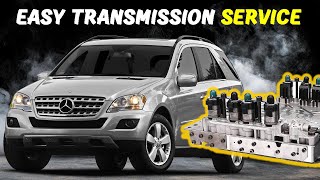
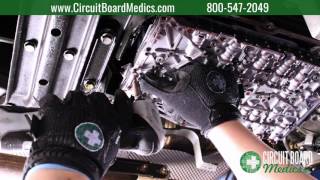
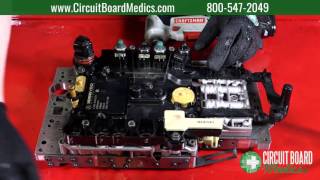
Typical fix: Replace the conductor plate assembly or send the original unit for repair. Replacement requires SCN coding. Repairing the original unit is often plug-and-play, with no coding needed, 🎬 See how to repair common conductor plate fault codes and is a popular, cost-effective alternative offered by specialists like Circuit Board Medics.
Est. part cost: $300-$900 - Leaking 13-Pin Electrical Connector 🟡 Medium Probability The O-rings on the transmission's main electrical connector plug are a common failure point, allowing transmission fluid to leak. This fluid can wick up the wiring harness and contaminate the connections at the TCM, causing various electrical faults.
How to confirm: Visually inspect the round 13-pin connector where the wiring harness attaches to the transmission (typically on the passenger side). Look for signs of red transmission fluid weeping or saturating the connector and harness.
Typical fix: Replace the connector plug and its O-rings. This is an inexpensive part and is often done preventatively when replacing the conductor plate. If fluid has wicked up the harness, the harness and TCM may need to be cleaned or, in severe cases, replaced.
Est. part cost: $15-$40 - Low or Contaminated Transmission Fluid ⚪ Low Probability → Shop Transmission Assembly While not a design flaw, neglected fluid service can lead to poor performance, overheating, and increased stress on electronic components like the conductor plate.
How to confirm: Check the transmission fluid level and condition according to the manufacturer's procedure. The 722.9 transmission does not have a dipstick and requires a special tool and knowledge of the correct fluid temperature (typically 45°C) for an accurate reading.
Typical fix: Perform a transmission fluid and filter service. This is always done as part of a conductor plate replacement.
Est. part cost: $100-$200
Rare But Worth Checking
- Faulty ESP/ABS Module or Wheel Speed Sensor: The transmission controller uses wheel speed sensor data to check the plausibility of the transmission's internal speed sensor readings. In rare cases, a fault in the ABS/ESP system, such as a corroded wheel speed sensor connector, can confuse the TCM and trigger transmission codes like P0720.
- Damaged Wiring Harness: Physical damage to the wiring between the 13-pin connector and the TCM can cause a loss of signal, but this is much less common than the conductor plate failing internally.
- Weak Vehicle Battery: Low system voltage from an aging battery can cause a cascade of seemingly unrelated electronic faults in Mercedes-Benz vehicles, including transmission control module errors. One owner on an MBClub UK forum reported that a new battery resolved transmission fault codes that had prompted a conductor plate repair.
Diagnosis Steps
- Confirm the presence of P0720 with a standard OBD-II scanner.
- For a definitive diagnosis, use a Mercedes-Benz specific scan tool (like Xentry/DAS) to check for more detailed transmission codes. Look for codes 0717, 0718 (Input Sensor), 0722, 0723 (Output Sensor), 2767, or 2768 (Internal Sensor). The presence of any of these strongly points to conductor plate failure.
- Visually inspect the 13-pin transmission connector for any signs of fluid leakage. If wet, fluid may have contaminated the connection, requiring replacement of the connector plug.
- Check the transmission fluid level and condition using the proper procedure for the 722.9 transmission. This requires a special tool and checking at a specific temperature (45°C).
- If codes confirm an internal speed sensor fault, the conductor plate is the confirmed point of failure.
- If no fluid leaks are found and codes point directly to an internal speed sensor, proceed with conductor plate repair or replacement.
Parts You'll Likely Need
- Transmission Conductor Plate (VGS)
(OEM #A0034460310)— This is the most common failure point for code P0720 on the 722.9 transmission, as it houses the faulty output speed sensor. Note: Part number must be verified by VIN. There are multiple versions (VGS1, VGS2, VGS3), and the correct one must be used. A new plate requires online SCN coding.
Trusted brands: Mercedes-Benz Genuine, Dorman (Aftermarket), Remanufactured (various suppliers)
OEM price range: $400-$900
Aftermarket price range: $300-$600 - Conductor Plate Repair Service — A popular and cost-effective alternative to buying a new plate. Sending the original unit for repair avoids the need for expensive and complex SCN coding, as it retains the vehicle's original programming. This is often the preferred method for both DIYers and independent shops.
Trusted brands: Circuit Board Medics, Xemodex, Various eBay vendors
OEM price range: N/A
Aftermarket price range: $250-$500
Related Codes That Often Appear With This One
- P0715 — This code is for the Input/Turbine Speed Sensor (Y3/8n1). Since both the input and output speed sensors are housed on the same conductor plate, it's very common for them to fail together, often throwing codes like 0717 or 0718 on a Mercedes-specific scanner.
- P2767 / P2768 — These codes relate to the internal speed sensor (Y3/8n2), which is also located on the conductor plate. Its failure is another strong indicator that the entire plate needs repair or replacement.
- 0722 / 0723 (Mercedes-specific) — These are manufacturer-specific codes that a professional scanner will find. They provide more detail about the P0720 fault, such as 'The signal from component Y3/8n3 (Output speed sensor (VGS)) is not available' or 'Component Y3/8n3 (Output speed sensor (VGS)) is defective', directly confirming the conductor plate as the source of the problem.
Technical Service Bulletins (TSBs) & Recalls
- While no specific TSB number for P0720 was found, Mercedes-Benz has issued bulletins regarding the 722.9 conductor plate. For example, TSB LI27.60-P-049774 addresses harsh engagement issues and may involve software updates or valve body/conductor plate replacement, indicating factory awareness of problems with this unit.
Platform-Specific Known Issues
- source — A user on MBWorld with a 2007 ML350 experienced intermittent limp mode three times in two weeks, with codes for the speed sensor. This is a classic presentation of a failing conductor plate.
- source — An owner on MBWorld with an ML320 experienced multiple warning lights (BAS/ESP, ABS, etc.) and limp mode, with codes P0720 and P0600. The dealership found transmission fluid had leaked through the 13-pin connector into the TCU, quoting over $2000 for the repair, illustrating a common diagnostic path.
- source — A forum thread on MBClub UK discusses the pros and cons of repairing the original conductor plate versus buying a new one. Repairing via a service like ACTronics is highlighted as a way to avoid dealer coding issues, while a new part from Mercedes costs around £400 but presents programming challenges.
Mechanic-Grade Diagnostic Values
- Live Data - Output Speed Sensor (Y3/8n3) — expected: A plausible RPM value that increases with vehicle speed and correlates with input (Y3/8n1) and internal (Y3/8n2) speed sensor readings.. Failure: A reading of 0 RPM while the vehicle is moving, or an erratic/implausible value that doesn't match other speed signals. The scan tool may also explicitly state 'The signal... is not available'.
- Live Data - Plausibility Check — expected: The transmission output speed (Y3/8n3) should be plausible when compared to the wheel speed RPM signal from the ESP/ABS module.. Failure: A significant mismatch between the transmission output speed and wheel speed can trigger fault code 0721, indicating an implausible signal even if the sensor is not completely dead.
Hidden / Shadow Codes Worth Checking
- 0721: The transmission output speed signal is implausible when compared to the wheel rpm signal. This is a more specific fault than the generic P0720 and points to a sensor that is providing erratic data rather than no data at all. (see via Mercedes-Benz STAR/Xentry or a high-level professional scanner capable of reading manufacturer-specific transmission codes.)
- 0722: The signal from component Y3/8n3 (Output Speed Sensor VGS) is not available. This is the direct Mercedes equivalent of P0720 and explicitly confirms a total loss of signal from the output speed sensor on the conductor plate. (see via Mercedes-Benz STAR/Xentry or a high-level professional scanner.)
Scan Tool Commands That Help
- Mercedes STAR/Xentry, Thinkcar Pro, Autel: Initial Startup / Teach-in Process for selection range sensor — This is a mandatory procedure after installing a new or reprogrammed conductor plate. The function guides the technician to shift through P-R-N-D to allow the new control unit to learn the positions of the range sensor.
- Mercedes STAR/Xentry: SCN (Software Calibration Number) Coding — This is required when installing a brand new or 'virginized' conductor plate. It's an online process that connects to Mercedes-Benz servers to download vehicle-specific software and lock the new part to the car's VIN.
- Specialized Bench Programming Tools (e.g., Abrites, CGDI MB, VVDI MB): TCU Cloning / Virginizing — Used by third-party repair specialists. 'Cloning' copies all data from the old, faulty conductor plate to a compatible used donor plate, making it plug-and-play. 'Virginizing' erases the VIN data from a used plate, allowing it to be treated like a new part and programmed via SCN coding.
Wiring & Ground Locations
- Y3/8 (VGS Conductor Plate) — Inside the transmission, bolted to the top of the valve body. The Transmission Control Module (TCM) is integrated into this plate.. This is the component that houses the failing Y3/8n3 output speed sensor. Diagnosis confirms the fault is internal to this unit, not external wiring.
- 13-pin Connector (Pilot Bushing) — On the passenger side of the transmission housing, where the main vehicle wiring harness connects to the transmission.. This is the single point of entry for all signals going to and from the conductor plate. A common leak at its O-rings can allow fluid to contaminate the pins and wick up the harness, causing various electrical faults, including speed sensor codes.
- ABS/ESP Module Ground — On some models, a key ground wire for the ABS/ESP module attaches to the front left fender area under the hood.. In rare cases, a poor ground here can disrupt the wheel speed signals sent from the ABS/ESP module to the TCM. The TCM uses this data for plausibility checks against its own internal speed sensors, and a bad ground can cause communication errors that may trigger a P0720.
Real Owner Repair Stories
- MBWorld.org Forums user (2007 E320 Bluetec (W211 with 722.9 transmission)) — Car would not shift out of 2nd gear, running at 4000 RPM at 30 mph. Initially, the issue was intermittent and would resolve after restarting the car.
❌ Tried (didn't work) Restarting the car provided a temporary fix but the problem always returned and eventually became permanent.
✅ What actually fixed it The user scanned the car and found code P2767 (Input / Turbine Speed Sensor B Circuit No Signal). Having previously had the conductor plate rebuilt for a P0717 code 80,000 miles prior, they recognized it as another conductor plate failure. They removed the valve body and conductor plate themselves to send it out for repair, which is the same procedure required for a P0720 fault.
OEM Part Supersession History
VGS1 Conductor Plate→N/A - Must be replaced with Valve Body— First generation design used from approx. 2004-2007. If a new VGS1 conductor plate is required from the dealer, it must be purchased as a complete assembly with the valve body.
Heads up: VGS1 is not directly interchangeable with VGS2 or VGS3.VGS2 Conductor Plate (e.g., A0335457332)→VGS3 Conductor Plate (e.g., A0034460310)— VGS3 is an updated design with more reliable speed sensors. When ordering a new part from a dealer for a car that originally had a VGS2, you will typically receive a VGS3 unit.
Heads up: A VGS2 car can be upgraded to a VGS3 plate, but it requires correct SCN coding at a dealer or specialist to work. Mixed results have been reported by people attempting this, so it must be done by a competent shop.
Model Year Variations Within This Range
- 2006-2008: These earlier W164 models are more likely to be equipped with the VGS2 version of the 722.9 conductor plate.
- 2009-2011: Following the 2009 model year facelift, later W164 models are more likely to have the updated VGS3 conductor plate from the factory. While failures still occur, the VGS3 design is generally considered an improvement over VGS2.
Diagnostic Flowchart
Other Known Issues on This Vehicle
Issues unrelated to this code that are worth knowing about as an owner of this generation:
- M272/M273 Engine Balance Shaft Sprocket Wear 🔴 High — Common on engines built before serial number 2729..30 468993 (approx. pre-2009 models). Failure can occur between 60,000-100,000 miles. (Ref: Subject of a class-action lawsuit and internal service bulletins. Repair is extremely labor-intensive, often requiring engine removal.)
- Airmatic Suspension Failure (Air Springs and Compressor) 🟠 Medium — Very common. Air springs (bellows) develop leaks due to age and wear, typically after 60,000-80,000 miles. This forces the compressor to overwork and burn out.
- Rear SAM Module Water Damage 🟠 Medium — Common due to failing taillight housing gaskets, which allow water to leak directly onto the Rear Signal Acquisition and Actuation Module (SAM) located in the right rear cargo area, causing a host of electrical problems.
- Intake Manifold Swirl Flap Lever Failure 🟠 Medium — The plastic linkages and levers that control the intake manifold's swirl flaps become brittle from heat and break. This can cause a check engine light and poor performance.
- Power Tailgate Motor/Latch Failure 🟡 Low — The motor for the power liftgate is a common failure point, leading to a tailgate that won't open or close electronically.
Used vs. New Parts: Buying Guide for This Vehicle
When a used part is the smart pick: A 'used' part only makes sense in two scenarios: 1) Sending your car's ORIGINAL faulty conductor plate to a specialist for repair and re-installation. This is the most popular cost-saving method as it requires no programming. 2) Purchasing a compatible used conductor plate AND sending it along with your original plate to a specialist who can 'clone' the data from your old one to the used one. A random junkyard part will not work as it is VIN-locked to its original vehicle.
Donor-vehicle mileage cap: roughly under 80000 miles for the part to have meaningful remaining life.
What to inspect on the donor part:
- Must have the exact same VGS version (e.g., VGS2, VGS3) as your original.
- Part numbers should match exactly (e.g., A0335457332).
- No physical damage to the plastic housing or connector pins.
- Seller should have a good reputation and offer a warranty on the cloning service.
OEM-only on this vehicle (don't cheap out):
- New Conductor Plate. This part is considered 'theft-relevant' by Mercedes-Benz and can only be purchased new from and programmed by an authorized dealer or a highly specialized independent shop with an online Xentry subscription.
Aftermarket brands forum-validated for this vehicle:
- Repair/Cloning Services: Circuit Board Medics, Xemodex, and various reputable eBay/online vendors offer reliable repair or cloning services.
- Remanufactured Units: Dorman offers remanufactured conductor plates, but programming is still required.
Brands owners have reported issues with on this vehicle:
- Unknown/unbranded 'pre-programmed' units from marketplaces without extensive positive reviews. The programming is complex and critical; a poorly programmed unit will not work and may cause further issues.
Real Owner Stories
Aggregated from forums and TSBs cited above. Mileages and costs reflect what owners reported in those sources.
2007 ML350
Symptoms: Experienced intermittent limp mode three times in two weeks, with codes for the speed sensor.
What fixed it: Failing conductor plate (speed sensor failure).
Source hint: MBWorld.org forums thread titled 'ML350 transmission goes into limp mode'
ML320
Symptoms: Multiple warning lights (BAS/ESP, ABS, etc.) and limp mode, with codes P0720 and P0600.
What fixed it: The dealership found transmission fluid had leaked through the 13-pin connector into the TCU.
Cost: $2000-$2100
Source hint: MBWorld.org forums thread titled 'p0720 p0600 limp mode'
2006-2011 M-Class (722.9 Transmission)
Symptoms: Owner weighing the pros and cons of repairing the original conductor plate versus buying a new one to avoid dealer coding issues.
What fixed it: Repairing the original conductor plate via a service like ACTronics.
Source hint: MBClub UK forum thread titled '722.9 conductor plate advise needed'
Related OBD-II Codes
Frequently Asked Questions
Does TSB LI27.60-P-049774 apply to the harsh shifting I'm experiencing with code P0720?
My ML350 is in 'limp mode' and stuck in 2nd gear. Is this common for the 2006-2011 M-Class?
Can I fix the P0720 code on my M-Class without expensive SCN coding at a dealership?
Is it true that a simple leak can cause the P0720 code on my Mercedes?
Why does my M-Class speedometer drop to zero when the Check Engine Light comes on?
What specific Mercedes-specific codes should I look for to confirm a conductor plate failure?
Helpful Videos

We Have This Part in Stock

The information in this article is provided for general reference and educational purposes only. Vehicle specifications, procedures, and part compatibility can vary by production date, trim level, and region. Always consult your vehicle's factory service manual and verify part numbers before purchasing or performing repairs. Safety-critical components such as airbags, seat belts, and braking systems should be installed by a qualified professional.
- Mercedes-Benz M-Class:
- 🧭 Diagnostic Flowchart
- 🎬 Helpful Videos
- 🛍️ Shop This Part
- What's Unique About the 2006-2011 Mercedes-Benz M-Class
- Symptoms You May Notice
- Most Likely Causes
- Rare But Worth Checking
- Diagnosis Steps
- Parts You'll Likely Need
- Related Codes That Often Appear With This One
- Technical Service Bulletins (TSBs) & Recalls
- Platform-Specific Known Issues
- Mechanic-Grade Diagnostic Values
- Hidden / Shadow Codes Worth Checking
- Scan Tool Commands That Help
- Wiring & Ground Locations
- Real Owner Repair Stories
- OEM Part Supersession History
- Model Year Variations Within This Range
- Other Known Issues on This Vehicle
- Used vs. New Parts: Buying Guide for This Vehicle
- Real Owner Stories
- 2007 ML350
- ML320
- 2006-2011 M-Class (722.9 Transmission)
- Related OBD-II Codes
- Frequently Asked Questions
- 🎟️ Get 5% Off