

P0720 on 2013-2021 Mitsubishi Outlander: Output Speed Sensor Circuit Causes and Fixes
This code indicates a problem with the transmission's output speed sensor circuit. The most common fix is replacing the output speed sensor itself, which is a relatively inexpensive part. However, wiring issues, a faulty connector, or problems with the CVT transmission fluid can also be the cause. On this vehicle, the issue is often a precursor to or symptom of broader CVT health problems.
- P0720 on a 2013-2021 Outlander most often points to a faulty transmission output speed sensor.
- Before replacing parts, check the wiring and connector to the sensor for damage, as this is a common and cheaper fix.
- The health of the Jatco CVT is highly dependent on clean, correct-spec fluid. If the fluid is old, a fluid and filter service is a wise step.
- Symptoms include a 'Transmission Service Required' warning, erratic shifting, and a potentially non-functional speedometer.
- While a DIY-er can replace the external sensor, professional diagnosis is recommended to avoid unnecessary repairs on the sensitive CVT system.
What's Unique About the 2013-2021 Mitsubishi Outlander
Most 2013-2021 Mitsubishi Outlanders with 4-cylinder engines use a Jatco-sourced Continuously Variable Transmission (CVT), specifically the JF011E or a later variant. These CVTs are notoriously sensitive to fluid quality, level, and cooling. While P0720 directly points to a sensor circuit, it can be an early indicator of more significant underlying CVT problems like fluid degradation, internal wear from abrasion powder, or hydraulic circuit issues, which are the subject of a class-action lawsuit against Mitsubishi. Unlike models with the more robust 6-speed automatic (found in V6 GT trims), the CVT's health is paramount, and this code should be treated with high urgency.
Symptoms You May Notice
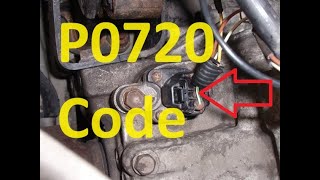
- "Transmission Service Required" message on the dashboard. 🎬 Watch: Diagnosing the P0720 code on a Mitsubishi Outlander
- Check Engine Light is on.
- Flashing 'D' (Drive) indicator.
- Erratic, harsh, or delayed shifting.
- Transmission feels like it's slipping, shuddering, or hesitating, especially on acceleration.
- Vehicle enters 'limp mode' with reduced power and may not shift past a certain gear.
- Speedometer reads incorrectly or not at all.
- Sudden, unexpected downshifts at highway speeds.
- Replacing the entire transmission when only an external sensor or its wiring is at fault.
- Replacing the input speed sensor (P0715) instead of the output speed sensor (P0720). The two sensors are distinct but work together.
- Ignoring the code or simply clearing it without addressing the root cause, which can lead to progressive CVT damage.
Most Likely Causes
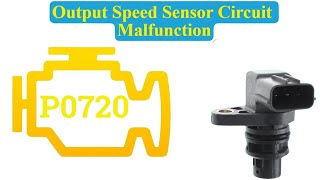
- Failed Output Speed Sensor (OSS) 🔴 High Probability Sensors are electronic components that can fail over time due to extreme heat cycles and vibration within the transmission environment. This is the most direct cause of a P0720 code. 🎬 See common causes and fixes for the P0720 code
How to confirm: Use a scan tool to monitor live data for the output/secondary speed sensor. If the reading is zero, erratic, or does not increase with vehicle speed while the input sensor reads normally, the sensor is likely bad. It can also be tested with a multimeter for correct resistance against service manual specifications; the expected resistance is typically 560-680 Ω at 20°C (68°F).
Typical fix: Replace the output speed sensor. On the Outlander, this sensor is located on the rear of the transmission housing. Access requires removing the air filter box and intake ducting. It is held in by a single 10mm bolt.
Est. part cost: $40-$110 - Damaged Wiring or Connector 🟡 Medium Probability The wiring harness to the sensor is in the engine bay and can be damaged by heat, vibration, or corrosion. The connector itself can become brittle and fail, leading to a poor connection.
How to confirm: Visually inspect the wiring harness and the 3-pin connector for fraying, melting, corrosion, or loose pins. Perform a continuity test on each wire between the sensor connector (B-113) and the TCM connector (C-40) to check for opens or shorts.
Typical fix: Repair the damaged section of the wiring harness or replace the connector pigtail. One owner documented cutting out the old connector and splicing in a new one wire-by-wire to ensure a solid connection.
Est. part cost: $15-$50 for a pigtail connector - Low, Dirty, or Incorrect Transmission Fluid 🟡 Medium Probability → Shop Transmission Assembly The Jatco CVT is extremely sensitive to fluid condition. Degraded fluid or fluid contaminated with metal shavings can affect hydraulic pressure and cause components to malfunction, which may lead to sensor codes.
How to confirm: Check the transmission fluid level and condition. The fluid should be translucent, not dark, black, or burnt-smelling. Many of these CVTs lack a traditional dipstick, so the procedure may require a professional. Using any fluid other than the specified Mitsubishi Diamond CVTF-J4 is a major risk.
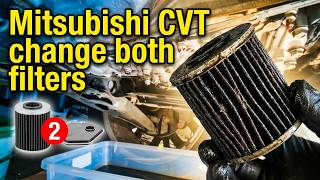
Typical fix: Perform a transmission fluid drain and fill, or a full fluid exchange, using only Mitsubishi CVTF-J4 fluid. It is also critical to replace the CVT filters (cartridge and cooler filters) at the same time. Some owners on forums recommend a 30,000-mile service interval to prevent issues.
Est. part cost: $150-$350 for fluid and filters
Rare But Worth Checking
- Faulty Transmission Control Module (TCM) or Powertrain Control Module (PCM): → Shop Engine Control Module (ECM) This is a rare cause. Before condemning the control module, all other possibilities, including the sensor, wiring, and fluid, must be thoroughly ruled out. This is a last resort in the diagnostic process.
- Internal CVT Failure (Belt/Pulley Damage): While less common as a direct cause for an isolated P0720, this code can be a symptom of a larger internal problem. If the CVT belt is slipping or pulleys are damaged, the sensor will report erratic speeds. This is often accompanied by shuddering, whining noises, and other transmission performance codes.
Diagnosis Steps
- Use an OBD-II scanner to confirm P0720 and document any other stored codes in the engine (ECU) and transmission (TCM) modules.
- With a capable scan tool (like Mitsubishi's M.U.T.-III), monitor the live data stream for the transmission input (primary) and output (secondary) speed sensors while driving. The output speed should increase smoothly and correlate with the vehicle's speedometer reading. A reading of zero or erratic jumps points to a fault.
- Visually inspect the output speed sensor and its 3-pin connector. The sensor is on the back of the transmission case, accessible after removing the air filter box. Check for corrosion, damage, or loose connections.
- Inspect the wiring harness leading to the sensor for breaks, frays, or heat damage from the engine or exhaust components.
- If wiring looks good, test the sensor circuit. Disconnect the sensor and use a multimeter to check for resistance, which should be 560-680 Ω at 20°C (68°F). Test the harness for correct voltage from the TCM and for continuity to ground.
- Check the transmission fluid level and condition. Ensure it is clean, at the proper level, and is the specified Mitsubishi CVTF-J4 fluid. A fluid change with filter replacement is a wise step if the history is unknown.
- If the sensor, wiring, and fluid are all good, the problem may be a more complex internal CVT issue or a faulty TCM. At this point, professional diagnosis is strongly recommended.
Parts You'll Likely Need
- Transmission Output Speed Sensor
(OEM #2702A036)— This is the most common component to fail and directly cause the P0720 code.
Trusted brands: Mitsubishi Genuine, NTK, Standard Motor Products, VEMO, Metzger
OEM price range: $100-$130
Aftermarket price range: $40-$70 - Output Speed Sensor Connector Pigtail — The connector can become brittle and cause an intermittent connection, mimicking a sensor failure. Replacing it is often done as a precaution.
Trusted brands: Dorman, Standard Motor Products
OEM price range: N/A
Aftermarket price range: $15-$40
Related Codes That Often Appear With This One
- P0715 — This code relates to the Input (Primary) Speed Sensor. The TCM constantly compares input and output speeds; a fault in one can trigger a code for the other if the ratio is implausible.
- P0722 — This code means 'Output Speed Sensor Circuit No Signal', which is a more specific and severe version of the P0720 fault, indicating a complete loss of signal.
- P0868 — This code indicates 'Transmission Fluid Pressure Low'. On Mitsubishi CVTs, this is a very common and serious code often related to fluid degradation, clogged filters, or a failing pump, which can occur alongside other transmission faults like P0720.
- P0730 — Stands for 'Incorrect Gear Ratio'. This code is often set when the CVT belt is slipping, a condition that would cause the output speed sensor readings to be inconsistent with the input speed and engine RPM.
Technical Service Bulletins (TSBs) & Recalls
- TSB-22-23-001REV: Addresses potential shudder/surge conditions in CVT-8 transmissions due to hydraulic issues and belt slip, which can contaminate the system. While not directly for P0720, it describes the root cause of many CVT failures in these vehicles.
Platform-Specific Known Issues
- The Jatco CVT-8 (F1CJC/W1CJC) used in these Outlanders is the subject of TSB-22-23-001REV, which addresses shudder, surge, and hesitation issues caused by poor hydraulic pressure reaction and internal contamination from belt slip. While P0720 is not listed in this specific TSB, the underlying conditions it describes can lead to sensor faults.
- A class-action lawsuit (Hardy et al. v. Mitsubishi Motors North America, Inc.) alleges that the CVTs in 2014-present Outlanders (and other models) are defective, causing shuddering, delayed acceleration, and premature catastrophic failure. The P0720 code can be a symptom of these larger, systemic issues.
- A YouTube video by 'Auto MEG Diagnostics And Repairs' provides a detailed, real-world walkthrough of diagnosing and replacing a faulty connector and sensor on a 2016 Outlander with P0720, confirming the sensor's location and the repair process.
Mechanic-Grade Diagnostic Values
- Output Speed Sensor Resistance — expected: 560 - 680 Ω at 20°C (68°F). Failure: A reading significantly outside this range indicates a faulty sensor.
- Output Speed Sensor Signal Frequency (Live Data) — expected: Approx. 588 Hz at a constant vehicle speed of 30 km/h (18.6 mph) in Drive.. Failure: A reading of 0 Hz, or a signal that is erratic and does not correspond to vehicle speed, indicates a fault in the sensor or circuit.
- TCM Judgment Criteria for setting P0720 — expected: The secondary pulley speed should be above 150 RPM when the primary pulley speed is over 1,000 RPM.. Failure: If the secondary speed is 150 RPM or less for 5 seconds under these conditions, the code will be set.
Scan Tool Commands That Help
- Mitsubishi M.U.T.-III: Data List - Item 2: Secondary speed sensor signal — This is the primary function used to monitor the live signal from the output speed sensor while driving to confirm if it is reading correctly, erratically, or not at all.
- Generic OBD-II Scanner with Live Data: Vehicle Speed Sensor (VSS) or Transmission Output Shaft Speed PID — Used to observe the speed reading reported by the sensor. The reading should be smooth and directly correlate with the speedometer. Jumps, dropouts, or a constant zero reading while the vehicle is moving indicate a problem.
Wiring & Ground Locations
- B-113 — Connector for the secondary/output pulley speed sensor, located on the transmission case.. This is the direct connection point to the sensor. Corrosion or damage here will cause a loss of signal and trigger P0720.
- C-40 — Connector at the Transmission Control Module (TCM).. This is the destination for the sensor's signal. A continuity check is performed between pin 36 of this connector and pin 2 of the B-113 sensor connector.
- G17 — Ground point located behind the left kick panel.. This is a major ground distribution point for several dash and control module components. A poor ground here can cause various electrical issues, potentially affecting the TCM.
- G9 — Ground point located in the left rear corner of the vehicle.. This ground serves components in the rear of the vehicle. While less direct, ensuring all major chassis grounds are clean and tight is a best practice when diagnosing elusive electrical codes.
Real Owner Repair Stories
- YouTube channel 'Auto MEG Diagnostics And Repairs' (Mitsubishi Outlander (year not specified, but within 3rd gen)) — "Transmission Service Required" message appeared on the dash after a few minutes of driving.
❌ Tried (didn't work) The initial diagnosis pointed to the output speed sensor.
✅ What actually fixed it The sensor itself was functional, but the plastic connector pigtail was faulty. The technician cut off the old connector and spliced in a new one, which resolved the P0720 code and the dashboard warning message. - YouTube channel 'AutoMotoCha9L' (2010 Mitsubishi Outlander (2nd Gen, but with the same Jatco CVT)) — Jerking and jumping feeling on the highway, RPMs fluctuating while holding a steady speed. Eventually led to a complete transmission failure.
❌ Tried (didn't work) A transmission fluid change at the dealership did not solve the problem.
✅ What actually fixed it The internal steel belt of the CVT had failed due to wear and tear at 114,000 miles. The entire transmission had to be replaced under an extended warranty. This story highlights how sensor codes can be a symptom of a terminal mechanical failure.
OEM Part Supersession History
2702A036→2702A036 (current)— No supersession found. This part number appears to be consistent for the applicable models.
Model Year Variations Within This Range
- 2016-2021: The 2016 model year received a significant facelift with platform and suspension revisions. While the core powertrain (2.4L I4 with CVT) remained, some electrical connectors and harness routing may have changed.
- 2018-2021: A Plug-in Hybrid (PHEV) version was introduced. The PHEV models do not use a conventional CVT and are not subject to this specific failure mode; they use a GKN Multi-Mode eTransmission.
- 2013-2021 (GT Trim): The V6 GT models were equipped with a conventional 6-speed automatic transmission, not a CVT. This P0720 article is not applicable to the V6 models.
Diagnostic Flowchart
Other Known Issues on This Vehicle
Issues unrelated to this code that are worth knowing about as an owner of this generation:
- Premature CVT Failure (Shudder, Hesitation, Whining) 🔴 High — Widespread issue, subject of a class-action lawsuit. Can occur under 100,000 miles, sometimes as low as 50,000. Preventative fluid changes every 30k miles are highly recommended by owners. (Ref: TSB-22-23-001REV)
- Excessive Oil Consumption (2.4L Engine) 🟠 Medium — Some owners report needing to add oil between changes. Regular monitoring of the oil level is required to prevent engine damage from low lubrication.
- A/C Compressor or Pressure Switch Failure 🟠 Medium — The A/C compressor or its pressure switch is prone to premature failure, causing the A/C to stop blowing cold air.
- Prematurely Worn Sway Bar Links 🟡 Low — Front sway bar end links can wear out quickly, causing rattling or clunking noises over bumps.
- Rear Brake Caliper Sticking 🟠 Medium — A recall was issued for 2013-2016 models because the automatic adjuster in the rear calipers could rust and seize, potentially affecting parking brake performance. (Ref: Recall)
- Easily Chipped Exterior Paint 🟡 Low — A commonly reported complaint is that the factory paint is thin and chips easily from normal road debris.
Used vs. New Parts: Buying Guide for This Vehicle
When a used part is the smart pick: A used part is generally not recommended for this repair. The primary failure parts are the electronic sensor and its connector, which are inexpensive to buy new. Given the high failure rate and sensitivity of these parts, a new component with a warranty is a much smarter investment than a used one with unknown history and remaining lifespan.
Donor-vehicle mileage cap: roughly under 40000 miles for the part to have meaningful remaining life.
What to inspect on the donor part:
- If buying a used sensor is unavoidable, ensure the connector pins are clean, straight, and free of any corrosion.
- Visually inspect the plastic housing for any cracks, melting, or signs of heat damage.
- Ask for the donor vehicle's mileage; a low-mileage donor is always preferable for electronic components.
OEM-only on this vehicle (don't cheap out):
- Transmission Control Module (TCM)
Aftermarket brands forum-validated for this vehicle:
- NTK
- Standard Motor Products (SMP)
- VEMO
- Metzger
Brands owners have reported issues with on this vehicle:
- Unbranded, no-name sensors from online marketplaces should be avoided, as their quality control and accuracy can be highly suspect, leading to repeat failures.
Real Owner Stories
Aggregated from forums and TSBs cited above. Mileages and costs reflect what owners reported in those sources.
2016 Mitsubishi Outlander
Symptoms: The dashboard displayed a 'Transmission Service Required' message. Diagnostic revealed code P0720.
What fixed it: The owner replaced both the output speed sensor and the 3-pin connector pigtail, splicing the new connector in wire-by-wire.
Source hint: YouTube - Auto MEG Diagnostics And Repairs: A 2016 Outlander owner documents the entire diagnostic and repair process for P0720
2014 Mitsubishi Outlander — ~50000 miles
Symptoms: Shuddering, delayed acceleration, and premature catastrophic failure of the transmission.
What fixed it: The source describes these as systemic defects subject to legal action rather than a simple sensor fix.
Source hint: Class-action lawsuit (Hardy et al. v. Mitsubishi Motors North America, Inc.)
Related OBD-II Codes
Frequently Asked Questions
Does TSB-22-23-001REV apply to the shifting issues I'm having with my Outlander's CVT-8?
Where is the Output Speed Sensor located on my Outlander and is it hard to reach?
What is the correct resistance for the Output Speed Sensor if I test it with a multimeter?
Can I use any CVT fluid to fix the shuddering associated with this code?
Is there a known defect with the transmissions in 2014 and newer Outlanders?
How often should I change the transmission fluid to prevent P0720 and other CVT issues?
Helpful Videos
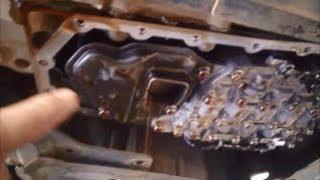
![Transmission Service Required [P0720"Secondary/Output Speed Signal"]](https://img.youtube.com/vi/vDZqH4vwsnU/mqdefault.jpg)
We Have This Part in Stock

The information in this article is provided for general reference and educational purposes only. Vehicle specifications, procedures, and part compatibility can vary by production date, trim level, and region. Always consult your vehicle's factory service manual and verify part numbers before purchasing or performing repairs. Safety-critical components such as airbags, seat belts, and braking systems should be installed by a qualified professional.
- Mitsubishi Outlander:
- 🧭 Diagnostic Flowchart
- 🎬 Helpful Videos
- 🛍️ Shop This Part
- What's Unique About the 2013-2021 Mitsubishi Outlander
- Symptoms You May Notice
- Most Likely Causes
- Rare But Worth Checking
- Diagnosis Steps
- Parts You'll Likely Need
- Related Codes That Often Appear With This One
- Technical Service Bulletins (TSBs) & Recalls
- Platform-Specific Known Issues
- Mechanic-Grade Diagnostic Values
- Scan Tool Commands That Help
- Wiring & Ground Locations
- Real Owner Repair Stories
- OEM Part Supersession History
- Model Year Variations Within This Range
- Other Known Issues on This Vehicle
- Used vs. New Parts: Buying Guide for This Vehicle
- Real Owner Stories
- 2016 Mitsubishi Outlander
- 2014 Mitsubishi Outlander — ~50000 miles
- Related OBD-II Codes
- Frequently Asked Questions
- 🎟️ Get 5% Off