

P0720 on 2001-2015 Toyota Sienna: Output Speed Sensor Causes and Fixes
On a 2001-2015 Toyota Sienna, code P0720 almost always points to a failed transmission Output Speed Sensor. This is a common failure item that causes harsh shifting and an erratic speedometer. Replacing the sensor is the typical fix, with parts costing between $40 and $180. Accessing the sensor usually requires removing the airbox and sometimes the battery tray.
- P0720 on a Toyota Sienna is most often caused by a failed Output Speed Sensor.
- Symptoms are serious and include harsh shifting, an inoperative speedometer, and disabled cruise control.
- The fix is usually replacing the sensor, which is located on the outside of the transmission and is accessible for a DIYer with basic tools after removing the airbox.
- Before replacing the sensor, always check the wiring and connector for damage, as this is another common cause.
- Driving with this code is not recommended as it can cause further wear and damage to the transmission.
What's Unique About the 2001-2015 Toyota Sienna
Across three generations of the Sienna (XL10, XL20, XL30), the P0720 code is a straightforward and common issue, almost always leading back to the sensor itself. Unlike some vehicles where this code can be a sign of deeper mechanical transmission failure, on the Sienna it's typically an electronic component failure due to age and heat cycles. The sensors are located externally on the transmission case, making them a relatively simple DIY replacement. The 1st gen (2001-2003) uses the U140E/F 4-speed transmission, while the 2nd and 3rd gen (2004-2015) use the U151E/F 5-speed and later a 6-speed. Despite transmission differences, the cause and fix for P0720 remain consistent.
Generation note: The 2001-2015 range covers three Sienna generations: the 1st gen (XL10, 2001-2003) with the U140E/F 4-speed transmission, the 2nd gen (XL20, 2004-2010) with the U151E/F 5-speed, and the first half of the 3rd gen (XL30, 2011-2015) which continued with the U151 and later introduced a 6-speed. While the P0720 code has the same meaning and is a common issue across all, the specific OEM part number for the sensor and its exact location on the transmission case vary slightly. The diagnostic and repair process, however, remains fundamentally the same: remove the airbox for access and replace the sensor. A notable exception is the 2012 Sienna with the 2.7L engine, where the sensor is located internally, requiring removal of the valve body for access.
Symptoms You May Notice
- Check Engine Light is on
- Harsh, jerky, or delayed gear shifts
- Speedometer behaving erratically or not working at all
- Cruise control is inoperable
- Vehicle may feel like it's stuck in one gear (limp mode)
- Possible stalling when coming to a stop
- Transmission may not shift into the highest gear on the highway
- Replacing the Input Speed Sensor instead of the Output Speed Sensor. The transmission has two similar-looking sensors; P0720 specifically refers to the output sensor.
- Assuming the entire transmission needs to be rebuilt. On the Sienna, P0720 is very commonly just a simple sensor failure, not a major mechanical problem.
Most Likely Causes
- Failed Output Speed Sensor (OSS) 🔴 High Probability The sensor is an electronic component that wears out over time due to constant heat cycles from the transmission. It's considered a common failure part on these models.
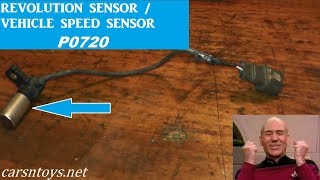
How to confirm: Use a scan tool with live data to monitor the output speed sensor signal while driving. If the signal is erratic, drops to zero, or doesn't increase with vehicle speed, the sensor is faulty. You can also test the sensor's internal resistance with a multimeter and compare it to the manufacturer's specification (typically looking for a value between 560-680 Ω when cold, but consult the specific repair manual). 🎬 See how to test and replace the revolution sensor
Typical fix: Replace the Output Speed Sensor. It is located on the exterior of the transmission housing and is typically held in by a single 10mm or 12mm bolt. Access requires removing the air filter box and possibly the battery tray.
Est. part cost: $40-$180 - Damaged Wiring or Connector 🟡 Medium Probability The wiring harness leading to the sensor is located under the vehicle and can be susceptible to damage from road debris, heat, or corrosion over time. Rodent damage is also a possibility.
How to confirm: Visually inspect the wiring harness and the connector that plugs into the sensor. Look for any signs of frayed wires, corrosion on the pins, or a loose connection. Perform a continuity test on the wires between the sensor connector and the ECM/TCM.
Typical fix: Repair the damaged section of wire or replace the connector pigtail.
Est. part cost: $15-$50 - Low or Dirty Transmission Fluid ⚪ Low Probability → Shop Transmission Assembly
How to confirm: Check the transmission fluid level and condition using the dipstick (on applicable models). If the fluid is very low, dark brown/black, or smells burnt, it can cause a variety of transmission problems, including this code.
Typical fix: Perform a transmission fluid drain-and-fill or a full fluid exchange. If the fluid is extremely contaminated, this may be a sign of a more serious internal issue.
Est. part cost: $75-$250
Rare But Worth Checking
- Faulty Powertrain or Transmission Control Module (PCM/TCM): → Shop Transmission Assembly This is very rare. Before condemning the computer, all other possibilities (sensor, wiring, fluid) must be exhaustively ruled out. A faulty computer is the cause in a very small percentage of cases.
Diagnosis Steps
- Scan the vehicle's computer for trouble codes. Confirm P0720 is present and note any other codes (like P0500).
- Check the level and condition of the automatic transmission fluid. Low or burnt fluid can cause erratic shifting.
- Using a scan tool capable of viewing live data, monitor the 'Output Speed Sensor' PID while driving. The reading should be 0 mph at a stop and increase smoothly with speed. Any dropouts, erratic jumps, or a constant 0 reading points to a problem in the circuit.
- Visually inspect the Output Speed Sensor and its electrical connector. The sensor is located on the top or side of the transmission housing. On most Siennas, you must remove the air filter housing assembly to see and access it.
- If the visual inspection passes, disconnect the sensor and test its internal resistance with a multimeter. Compare the reading to the factory specification (e.g., 560-680 Ω). An open circuit (infinite resistance) or a short (zero resistance) indicates a failed sensor.
- If the sensor tests good, test the wiring harness. Check for battery voltage on the power wire and for continuity to ground on the ground wire. Check for continuity on the signal wire between the sensor connector and the ECM/TCM connector.
- If the sensor and wiring both test good, the issue may be with the ECM/TCM, but this is extremely unlikely and should be considered a last resort.
Parts You'll Likely Need
- Transmission Output Speed Sensor (Vehicle Speed Sensor)
(OEM #89413-08020 (Common for 2004-2010), 89413-24010 (Common for 2001-2003), 89413-48010 (Common for 2011-2015). Always verify with VIN.)— This is the most common failure point for code P0720. It is a critical sensor that fails from age and heat exposure.
Trusted brands: Denso, NGK/NTK, Aisin, Toyota (Genuine)
OEM price range: $120-$180
Aftermarket price range: $40-$90
Related Codes That Often Appear With This One
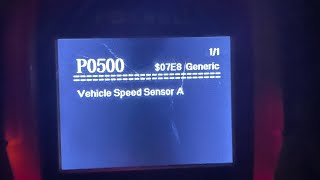
- P0500 — P0500 refers to 'Vehicle Speed Sensor A Malfunction'. Since the Output Speed Sensor's data is used to determine vehicle speed, a fault in the OSS (P0720) will often trigger a P0500 code as well. 🎬 Watch: Diagnosing and fixing the P0500 vehicle speed sensor code
- P0793 — This code refers to the 'Intermediate Shaft Speed Sensor'. While a different sensor, its wiring is often routed near the OSS, and a problem affecting one (like rodent damage) could affect the other.
Platform-Specific Known Issues
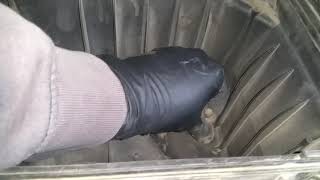
- Access on 2nd Gen (2004-2010): On the popular 2nd generation Sienna, the output speed sensor is located on top of the transmission, toward the driver's side. To access it, the entire air filter housing assembly must be removed. Some owners also remove the battery and battery tray for easier access 🎬 Watch: This 2005 Sienna speed sensor replacement walkthrough and more room to work.
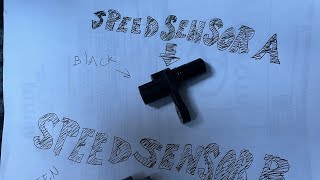
- Sensor Identification: The transmission has both an input and an output speed sensor, which often look identical and are located near each other. P0720 refers specifically to the output sensor. It is crucial to correctly identify which sensor is which before replacement. Repair manuals or forum diagrams can help distinguish them based on their specific location on the transaxle case. On some models, the input sensor has a smaller magnetic prong than the output sensor.
Mechanic-Grade Diagnostic Values
- Output Speed Sensor internal resistance — expected: 560 - 680 Ω (cold). Failure: A reading of 0 Ω (short) or infinite Ω (open circuit) indicates a failed sensor.
- Sensor reference voltage at the connector — expected: 5V ± 0.5V. Failure: No voltage or significantly lower voltage points to a wiring or ECM issue.
- Ground circuit resistance at the connector — expected: < 0.1 Ω. Failure: High resistance indicates a poor ground connection, which can cause erratic signals.
- Live data from scan tool (vehicle stopped) — expected: 0 rpm. Failure: Any reading other than zero indicates a sensor or wiring fault.
- Live data from scan tool (cruising at approx. 37 mph / 60 km/h) — expected: ~2800 rpm. Failure: A reading that is erratic, zero, or does not correspond to vehicle speed indicates a fault.
- Continuity test from sensor connector to ECM connector — expected: Below 1 Ω. Failure: Resistance of 10 kΩ or higher indicates an open circuit in the harness.
Scan Tool Commands That Help
- Toyota Techstream: Live Data / Data List — This is the primary function used to diagnose P0720. The technician monitors the 'Output Speed Sensor' or 'Transmission Revolution Sensor (NOUT)' parameter while driving to see if the signal is smooth, erratic, or absent, directly testing the sensor's real-world operation.
Wiring & Ground Locations
- ECM Connector C68 (example) — The ECM is typically located in the engine compartment, often on the left rear side.. The wires from the output speed sensor (often labeled NOTO and NOTB) terminate at specific pins on the ECM connector (e.g., pins 125 and 101 on some models). Testing for continuity and shorts between the sensor connector and these specific ECM pins is the definitive way to rule out a wiring harness problem.
- Sensor Connector (C46 example) — On the transmission housing, under the air filter box assembly.. This is the primary point for testing the sensor's internal resistance and checking for power and ground from the harness. Corrosion or damage here is a common cause of the fault.
Real Owner Repair Stories
- YouTube video on a Ford, but demonstrating a universally applicable issue (Ford Truck (demonstrates a common failure mode)) — Check engine light with P0720, speedometer not working, slow and sluggish upshifts.
❌ Tried (didn't work) Initial assumption was a bad sensor.
✅ What actually fixed it The wiring harness leading to the sensor had been chewed through by a rodent. The fix required lowering the transmission slightly to access the damaged wires, which were then soldered, heat-shrunk, and taped up to restore the connection. - YouTube video on a 2003 Toyota Sienna (2003 Toyota Sienna) — Check Engine Light with code P0500 (often triggered by the same fault as P0720).
✅ What actually fixed it The owner replaced the vehicle speed sensor (output speed sensor) located on top of the transmission. Access required removing the battery and airbox. After replacement, the problem was fixed.
OEM Part Supersession History
89413-24010, 89413-33020, 89411-33010→89413-08020— Part consolidation and design updates by Toyota.
Heads up: While these part numbers are often listed as interchangeable for the application, it is always critical to verify the correct part number with the vehicle's VIN before purchasing to avoid errors.
Model Year Variations Within This Range
- 2012: On the 2012 Sienna equipped with the 2.7L 4-cylinder engine, the output speed sensor is located *inside* the transmission. Access requires removing the transmission pan and the valve body, making it a significantly more complex and labor-intensive repair than on the V6 models where the sensor is external.
- 2001-2003 (Gen 1) vs 2004-2015 (Gen 2/3): The first generation uses a 4-speed (U140E) while later models use 5-speed (U151E) and 6-speed automatics. While the P0720 code's meaning is the same, the exact sensor part number and its precise location on the transmission case can differ slightly. For example, 89413-24010 is common for 2001-2003, while 89413-08020 is common for 2004-2010.
Diagnostic Flowchart
Other Known Issues on This Vehicle
Issues unrelated to this code that are worth knowing about as an owner of this generation:
- Power Sliding Door Failure 🔴 High — Extremely common across all generations (2001-2015). The cable frays or snaps, or the motor fails, rendering the power function inoperable. (Ref: Multiple TSBs issued, including T-SB-0085-09 for 2004-2010 models and T-SB-0141-18 for 2011-2018 models, detailing cable replacement procedures. A recall was also issued for 2011-2016 models for doors opening while driving.)
- Rupturing VVT-i Oil Line (2GR-FE V6) 🔴 High — Common on 2007-2010 models with the 3.5L 2GR-FE engine. A rubber section of the oil line can burst, leading to rapid oil loss and catastrophic engine failure if not shut down immediately. (Ref: Toyota issued a Limited Service Campaign (LSC 90K) to replace the rubber hose with an all-metal line (Part No. 15772-31030). Many vehicles may still have the original faulty line.)
- Cracked or Melting Dashboard 🟠 Medium — Very common on 2nd generation (2004-2010) models due to heat and UV exposure. The dash develops a web of cracks or becomes sticky to the touch. (Ref: Toyota acknowledged this with a Warranty Enhancement Program (ZE6), which extended the warranty for dashboard replacement, though this program has since expired for most vehicles.)
- Engine Oil Sludge (1MZ-FE V6) 🔴 High — A known issue on the 1st generation (2001-2003) 3.0L 1MZ-FE engine, attributed to the crankcase ventilation system design. Can lead to blocked oil passages and engine failure if not addressed with frequent oil changes. (Ref: In the past, Toyota offered warranty extensions and repair coverage for sludge-related engine damage on these models.)
- Spare Tire Carrier Cable Corrosion 🟠 Medium — Common in regions using road salt. The cable holding the spare tire under the vehicle corrodes and can break, causing the spare tire to fall off. (Ref: Toyota issued a recall in 2014 for affected Siennas to replace the carrier assembly.)
Used vs. New Parts: Buying Guide for This Vehicle
When a used part is the smart pick: For this specific repair, a used part is generally not recommended. The output speed sensor is a relatively inexpensive electronic component that fails due to age and heat cycles. A used sensor from a junkyard has an unknown amount of remaining life and carries a high risk of premature failure, forcing you to do the labor twice.
Donor-vehicle mileage cap: roughly under 15000 miles for the part to have meaningful remaining life.
What to inspect on the donor part:
- If considering used, only pull from a very low-mileage, late-model year wreck.
- Ensure the connector pins are clean, straight, and free of any corrosion.
- Visually inspect the plastic housing for any cracks or signs of heat damage.
OEM-only on this vehicle (don't cheap out):
- While not strictly 'OEM-only', using a Genuine Toyota part or a known OE supplier like Denso, Aisin, or NTK is highly recommended for electronic sensors to ensure accurate readings and longevity.
Aftermarket brands forum-validated for this vehicle:
- NGK/NTK
- Denso
- Aisin
- Standard Motor Products (SMP)
Brands owners have reported issues with on this vehicle:
- Unbranded, 'white-box' sensors from online marketplaces should be avoided due to a high rate of out-of-box failures and incorrect signal outputs, which can cause persistent shifting problems even after replacement.
Real Owner Stories
Aggregated from forums and TSBs cited above. Mileages and costs reflect what owners reported in those sources.
2004 Toyota Sienna
Symptoms: The vehicle experienced harsh shifting and triggered the P0720 code.
What fixed it: Replacement of the output speed sensor (part #89413-08020) located under the air box.
Source hint: SiennaChat.com: 'P0720 Output speed sensor'
2004 Toyota Sienna
Symptoms: Owner diagnosed a P0720 Output Speed Sensor Circuit code and observed shifting problems.
What fixed it: Replacing the sensor after testing its resistance confirmed it was faulty.
Source hint: Toyotanation.com: '2004 Sienna P0720 Output Speed Sensor Circuit'
Related OBD-II Codes
Frequently Asked Questions
Where is the output speed sensor located on my 2004-2010 Sienna?
My 2004 Sienna has harsh shifting and a P0720 code; what is the specific replacement part number?
How can I tell the difference between the input and output speed sensors on my transmission?
What resistance value should I look for when testing the Sienna's speed sensor with a multimeter?
Is the P0720 issue common to other Toyota vehicles that share the Sienna's platform?
Could my Sienna's P0720 code be caused by something other than the sensor itself?
Helpful Videos
We Have This Part in Stock




The information in this article is provided for general reference and educational purposes only. Vehicle specifications, procedures, and part compatibility can vary by production date, trim level, and region. Always consult your vehicle's factory service manual and verify part numbers before purchasing or performing repairs. Safety-critical components such as airbags, seat belts, and braking systems should be installed by a qualified professional.
- Toyota Sienna:
- 🧭 Diagnostic Flowchart
- 🎬 Helpful Videos
- 🛍️ Shop This Part
- What's Unique About the 2001-2015 Toyota Sienna
- Symptoms You May Notice
- Most Likely Causes
- Rare But Worth Checking
- Diagnosis Steps
- Parts You'll Likely Need
- Related Codes That Often Appear With This One
- Platform-Specific Known Issues
- Mechanic-Grade Diagnostic Values
- Scan Tool Commands That Help
- Wiring & Ground Locations
- Real Owner Repair Stories
- OEM Part Supersession History
- Model Year Variations Within This Range
- Other Known Issues on This Vehicle
- Used vs. New Parts: Buying Guide for This Vehicle
- Real Owner Stories
- 2004 Toyota Sienna
- 2004 Toyota Sienna
- Related OBD-II Codes
- Frequently Asked Questions
- 🎟️ Get 5% Off