

P0722 on 2011-2013 Ford Expedition: Output Speed Sensor Failure Causes and Fixes
On 2011-2013 Ford Expeditions, P0722 is almost always caused by a failed Output Speed Sensor (OSS) which is part of the internal transmission molded lead frame. This is a known issue covered by Ford's extended warranty program 19N01. The fix is to replace the entire lead frame assembly, a job best left to professionals that involves dropping the transmission pan and valve body.
- P0722 on a 2011-2013 Expedition is a very specific and well-documented problem.
- The cause is almost certainly a failure of the internal transmission molded lead frame, which contains the Output Speed Sensor.
- Do not drive the vehicle, as it can unexpectedly downshift to first gear, creating a major safety hazard.
- This is not a simple sensor replacement; it is an advanced repair that requires dropping the transmission pan and valve body.
- Check with a Ford dealer for any remaining warranty coverage under program 19N01, even though it has likely expired.
What's Unique About the 2011-2013 Ford EXPEDITION
The 2011-2013 Expedition uses the 6R80 automatic transmission, which is based on the ZF 6HP26 design. In this transmission, the Output Speed Sensor (OSS) is not a simple, externally accessible part. Instead, it is integrated into a large internal component called the molded lead frame (or conductor plate). This lead frame, which also houses the Turbine Speed Sensor (TSS) and Transmission Range (TR) sensor, is a known, widespread failure point due to heat and vibration causing cracks in the internal circuits. Ford acknowledged this with multiple Technical Service Bulletins (TSBs) and an extended warranty program (19N01) specifically for this issue. Therefore, a P0722 code on this vehicle points almost directly to a failure of this internal assembly, rather than a simple external sensor or wiring problem.
Diagnostic Flowchart
Tap your situation to follow the diagnostic path that matches what you're seeing on this vehicle.
Symptoms You May Notice
- Sudden, harsh downshifts, sometimes into first gear while at speed.
- Illuminated Malfunction Indicator Light (MIL) or Check Engine Light.
- Illuminated wrench light in the instrument cluster.
- Erratic or delayed gear shifting.
- Speedometer reads zero or behaves erratically while driving.
- Odometer displays dashes ("_ _ _ _") instead of numbers.
- Transmission may start off in a higher gear (e.g., 3rd or 5th) from a stop.
- Cruise control becomes inoperative.
- Symptoms may be intermittent and temporarily clear after restarting the engine.
- Replacing only the valve body without the lead frame.
- Replacing the entire transmission when only the lead frame is faulty. One owner was quoted $4,300 for a rebuild but fixed it for under $400 by replacing the lead frame himself.
- Assuming it is an external, easily-replaced speed sensor. On this vehicle, the sensor is internal to the lead frame.
- Blaming the PCM before thoroughly investigating the lead frame and wiring.
Most Likely Causes
- Failed Molded Lead Frame Assembly 🔴 High Probability → Shop Transmission Valve Body The Output Speed Sensor (OSS) is integrated into the lead frame, which is a known high-failure part in the 6R80 transmission. Internal solder joints for the OSS are known to crack from heat and vibration. Ford acknowledged this with TSBs and an extended warranty program (19N01).
How to confirm: Scan the PCM for DTCs P0722, P0720, or P0731. The presence of these codes, combined with the symptoms, is a strong indicator. Ford's own program 19N01 and related TSBs use these specific codes to authorize the replacement.
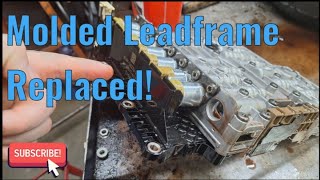
Typical fix: Replace the entire molded lead frame assembly inside the transmission. This involves dropping the transmission pan and valve body. It is also best practice to replace the transmission bulkhead connector sleeve at the same time, as the old seals can leak.
Est. part cost: $150-$350 - Damaged Wiring or Connectors ⚪ Low Probability While less common than lead frame failure, the external transmission bulkhead connector or its sleeve can become damaged, corroded, or leak fluid, interrupting the signal. The plastic sleeve's O-rings are a known leak point.
How to confirm: Visually inspect the main transmission electrical connector and harness for damage, corrosion, or fluid intrusion. If the connector is full of transmission fluid, the internal bulkhead sleeve has failed and needs replacement. 🎬 See this DIY tutorial for fixing common 6R80 transmission issues. A continuity test from the transmission connector to the PCM can also be performed.
Typical fix: Repair the damaged section of the wiring harness or replace the bulkhead connector sleeve and seals. This is often done preventatively during a lead frame replacement.
Est. part cost: $20-$100 - Powertrain Control Module (PCM) Fault ⚪ Low Probability → Shop Engine Control Module (ECM) While some TSBs involved a PCM software update as an initial step, it is rarely the root cause of a P0722 with these symptoms. For 2011+ models, the Transmission Control Module (TCM) is integrated into the PCM, but it is more likely the PCM is correctly reporting the 'no signal' fault from the failed lead frame.
How to confirm: This should be the last resort after the lead frame and wiring have been confirmed to be good. Requires advanced diagnostics by a professional.
Typical fix: Reprogram or replace the PCM. This requires specialized equipment like the Ford IDS.
Est. part cost: $500-$1200
Diagnosis Steps
- Use an OBD-II scanner to confirm the presence of P0722 and check for other related codes like P0720 and P0731. The presence of these codes together is a very strong sign of lead frame failure.
- Check your vehicle's VIN with a Ford dealer or online to see if it was covered under Customer Satisfaction Program 19N01. Even though the program has expired for all 2011-2013 vehicles, its existence confirms the likely problem.
- Visually inspect the external transmission wiring harness and the main bulkhead connector for any signs of damage, corrosion, or fluid intrusion. A fluid leak here points to a failed bulkhead connector sleeve.
- For advanced diagnosis, use a multimeter to check for continuity on the OSS circuit between the transmission vehicle harness connector and the PCM connector. A resistance of less than 5 ohms is expected.
- Given the extremely high probability, the next step is to plan for the replacement of the molded lead frame assembly. This is an internal component.
- The repair involves draining the transmission fluid, removing the transmission pan, and then removing the valve body assembly to access and replace the lead frame.
- During the repair, it is highly recommended to also replace the transmission bulkhead connector sleeve to prevent future leaks, as the original O-rings are prone to failure.
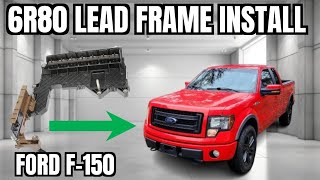
- After replacing the lead frame and sleeve, install a new pan gasket and filter, refill with the correct type of transmission fluid (Mercon LV), clear the trouble codes, and perform a transmission adaptive learning procedure. 🎬 Watch: Easy steps for a successful lead frame installation.
Parts You'll Likely Need
- Transmission Molded Lead Frame Assembly
(OEM #AL3Z-7G276-D)— This is the component that houses the failing Output Speed Sensor. It is the definitive fix for this code on this vehicle. The 'D' revision replaces older 'A' and 'B' versions.
Trusted brands: Motorcraft, Dorman (926-149)
OEM price range: $200-$350
Aftermarket price range: $150-$250 - Transmission Fluid (Mercon LV)
(OEM #XT-10-QLVC)— The transmission must be drained to perform the repair. You will need approximately 9-10 quarts for a drain and refill.
Trusted brands: Motorcraft
OEM price range: $100-$150
Aftermarket price range: $80-$120 - Transmission Pan Gasket and Filter — The pan must be removed for the repair, and the gasket should always be replaced. It is best practice to replace the filter at the same time.
Trusted brands: Motorcraft, Wix, ATP
OEM price range: $40-$70
Aftermarket price range: $25-$50 - Transmission Bulkhead Connector Sleeve
(OEM #6L2Z-7G276-AA)— This sleeve seals the wiring harness connection to the transmission. The original O-rings are a common leak point, and it's best practice to replace it when the valve body is removed to prevent future leaks or connection issues.
Trusted brands: Motorcraft
OEM price range: $20-$40
Aftermarket price range: $15-$30
Related Codes That Often Appear With This One
- P0720 — P0720 is 'Output Speed Sensor Circuit Malfunction'. P0720 and P0722 often appear together as they both relate to the same sensor circuit. Ford's TSBs and recall information group them together as primary indicators of lead frame failure.
- P0731 — P0731 is 'Gear 1 Incorrect Ratio'. The PCM sets this code when it commands first gear but the speed sensor data doesn't match the expected engine RPM and gear ratio, a direct consequence of the OSS failure. This is also listed in TSB 19N01 as a qualifying code for lead frame replacement.
- P1500 — This code is also mentioned in Ford's TSB 19N01 alongside P0722 as a potential code related to the lead frame failure.
Technical Service Bulletins (TSBs) & Recalls
- 19N01-S3: This is a supplement to the Customer Satisfaction Program that confirms the extended warranty (10 years/150,000 miles) for the molded lead frame. It explicitly links DTCs P0720, P0722, P0731, and/or P1500 to the failure and authorizes replacement. It also notes that the refund offer for prior repairs expired in 2019.
- TSB 13-6-8: This bulletin addresses symptoms including the transmission starting in 5th gear, a non-functional speedometer reading zero, and the odometer displaying dashes. It notes that codes P0720 and P0722 may be present and instructs technicians to replace the molded lead frame on the main control assembly for vehicles built before April 8, 2013.
Platform-Specific Known Issues
- Ford issued Customer Satisfaction Program 19N01 which extended the warranty for the molded lead frame to 10 years or 150,000 miles due to the high failure rate of the integrated OSS. While this program has expired for all 2011-2013 vehicles, its existence is a confirmation of the widespread nature of this specific problem.
Mechanic-Grade Diagnostic Values
- Continuity of OSS Circuit — expected: Less than 5 ohms. Failure: Resistance greater than 5 ohms indicates an open in the circuit.
- Live Data OSS RPM vs. Actual Speed — expected: OSS RPM on a scan tool should be near 0 when stopped in gear and should increase smoothly and proportionally with vehicle speed.. Failure: If the OSS reading jumps erratically, drops to zero intermittently while moving, or does not change with vehicle speed, the sensor signal is lost.
Scan Tool Commands That Help
- Ford IDS (Integrated Diagnostic System) or equivalent professional scan tool: Reset Transmission Adaptive Memory / TCM Keep-Alive Memory (KAM) Reset — This function must be performed after replacing the lead frame or valve body. It clears the old, learned shift adaptations, allowing the transmission to relearn shift points and pressures with the new components. Failure to do so can result in continued poor shifting performance.
- Ford IDS (Integrated Diagnostic System) or equivalent professional scan tool: Transmission Adaptive Learning Drive Cycle — After resetting the adaptive memory, a specific drive cycle is required for the transmission to fully adapt. This typically involves a series of light, medium, and heavy throttle upshifts, as well as engaging all gears from a stop.
Wiring & Ground Locations
- C1616 — The main 16-pin electrical connector on the outside of the 6R80 transmission case.. This is the primary connection point for all internal transmission electronics, including the OSS. Pin 15 (Brown/Green wire) is the specific circuit for the OSS signal going to the PCM. A visual inspection here for fluid intrusion or damage is a key diagnostic step.
- C1381T — A connector at the Powertrain Control Module (PCM).. This is the destination for the OSS signal. Pin 14 of this connector receives the signal from Pin 15 of the transmission connector (C1616). Checking continuity between these two points is the definitive way to test the wiring harness integrity.
Real Owner Repair Stories
- Ford F150 Forum user SHIFT_Lock (2014 F-150 (same 6R80 transmission and issue as 2011-2013 Expedition)) — Weird or no shifting, P0722 code present.
❌ Tried (didn't work) The user's mechanic initially quoted $1200, stating the valve body and lead frame had to be replaced together.
✅ What actually fixed it The user replaced only the lead frame assembly themselves. The total cost for the new lead frame, fluid, filter, gasket, and related seals was approximately $400-$500. The repair took a few hours.
OEM Part Supersession History
AL3Z-7G276-A, AL3Z-7G276-B→AL3Z-7G276-D— The 'D' revision is the updated part from Ford, intended to resolve the known failure points of the earlier versions. The last letter in a Ford part number typically indicates the revision level.
Heads up: While older 'A' or 'B' stock may still be sold, it is critical to use the latest 'D' revision for this repair to ensure longevity and prevent a repeat failure.
Model Year Variations Within This Range
- 2011-2013: For the 2011 model year and later, Ford integrated the Transmission Control Module (TCM) with the main Powertrain Control Module (PCM). This is different from 2009-2010 models where the TCM was part of the valve body assembly (called a Mechatronic unit) inside the transmission. This means for 2011+ vehicles, the lead frame is a separate, less expensive part than the earlier complete Mechatronic assembly.
- 2011-onward: For the 2011 model year, the 6R80 transmission was revised with a new one-way clutch to improve 1-2 shift feel. This change required modifications to the transmission case, valve body, and the molded lead frame itself, as well as different control strategies from the PCM.
Helpful Videos
We Have This Part in Stock




The information in this article is provided for general reference and educational purposes only. Vehicle specifications, procedures, and part compatibility can vary by production date, trim level, and region. Always consult your vehicle's factory service manual and verify part numbers before purchasing or performing repairs. Safety-critical components such as airbags, seat belts, and braking systems should be installed by a qualified professional.
- Ford EXPEDITION:
- 🧭 Diagnostic Flowchart
- 🎬 Helpful Videos
- 🛍️ Shop This Part
- What's Unique About the 2011-2013 Ford EXPEDITION
- Symptoms You May Notice
- Most Likely Causes
- Diagnosis Steps
- Parts You'll Likely Need
- Related Codes That Often Appear With This One
- Technical Service Bulletins (TSBs) & Recalls
- Platform-Specific Known Issues
- Mechanic-Grade Diagnostic Values
- Scan Tool Commands That Help
- Wiring & Ground Locations
- Real Owner Repair Stories
- OEM Part Supersession History
- Model Year Variations Within This Range
- 🎟️ Get 5% Off