

P0722 on 2011-2019 Ford Explorer: Output Speed Sensor Failure Causes and Fixes
On a 2011-2019 Ford Explorer, code P0722 is most often caused by a failed Output Speed Sensor (OSS) located on the transmission's internal molded lead frame. This is a well-documented, high-failure part on the 6F50/6F55 transmission. The repair requires removing the transmission pan and valve body to replace the lead frame assembly. Expect a shop cost of $600-$1,500 for this repair. Driving is not recommended due to the risk of sudden, dangerous downshifts.
- P0722 on a 2011-2019 Explorer means the transmission's Output Speed Sensor has no signal.
- The most likely cause is a failure of the internal molded lead frame, which houses the sensor.
- This is not a simple external sensor swap; it requires removing the transmission pan and valve body.
- A major safety concern is the potential for the transmission to suddenly downshift to first gear at speed.
- When performing the repair, it is wise to also replace the bulkhead connector sleeve and other small seals.
What's Unique About the 2011-2019 Ford Explorer
The 2011-2019 Ford Explorer (fifth generation) uses the 6F50 or 6F55 automatic transmission. A very common and well-documented issue with these transmissions is the failure of the molded lead frame. Unlike older vehicles where the speed sensor is an easily accessible external part, on these Explorers, the Output Speed Sensor (OSS) is integrated directly into this internal lead frame assembly. This makes the repair significantly more involved, as the transmission pan and valve body must be removed for access. Ford has acknowledged this issue through extended warranty programs on similar vehicles with related transmissions (like the 6R80), highlighting the systemic nature of this part's failure.
Symptoms You May Notice
- Check Engine Light and/or wrench light is on
- Harsh, erratic, or delayed gear shifting
- Transmission gets stuck in one gear (limp mode)
- Speedometer reads 0 MPH or behaves erratically
- Odometer displays dashes instead of numbers
- Sudden, unintended downshift to first gear, potentially at highway speeds
- Cruise control does not work
- Reduced fuel economy 🎬 See: How to fix a P0722 code and restore shifting
- Replacing only an external speed sensor, without realizing the primary OSS is internal to the lead frame on 2011+ models.
- Replacing the PCM without thoroughly testing the wiring and the internal lead frame first.
- Assuming a full transmission rebuild is needed when only the lead frame has failed. 🎬 Watch: Compare your lead frame replacement options before buying parts
Most Likely Causes
- Failed Molded Lead Frame 🔴 High Probability → Shop Transmission Valve Body The internal lead frame, which contains the OSS, Turbine Speed Sensor (TSS), and transmission range sensor, is a known high-failure item on the 6F and 6R series transmissions. The internal circuitry and sensor connections are prone to breaking down from heat and vibration. Ford has issued extended warranty programs (like 19N01 for the 6R80) for this specific part due to high failure rates causing the exact symptoms of P0722.
How to confirm: A diagnostic scan tool will show code P0722, often accompanied by P0720. Ford's own diagnostic procedure for Customer Satisfaction Program 19N01 uses the presence of DTCs P0720, P0722, and/or P0731 as the primary confirmation to authorize lead frame replacement. Diagnosis is confirmed by testing the sensor circuit at the transmission's external connector and finding no signal, pointing to an internal transmission fault.
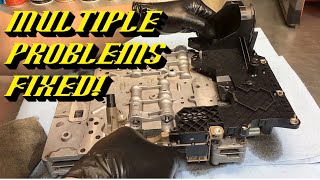
Typical fix: Replace the entire molded lead frame assembly inside the transmission. This requires draining the fluid, removing the transmission pan, and removing the main control (valve body) to access the lead frame. 🎬 Watch: Step-by-step lead frame replacement walkthrough It is also highly recommended to replace the transmission bulkhead connector sleeve and the pump pass-through seal at the same time, as these are common leak points.
Est. part cost: $150-$350 - Damaged Wiring or Connector 🟡 Medium Probability
How to confirm: Visually inspect the external transmission wiring harness for any signs of damage, melting, or corrosion at the main connector. A common issue can be the harness getting pinched between the bellhousing and the engine block during previous repairs. Use a multimeter to check for continuity and proper voltage at the connector pins leading to the transmission.
Typical fix: Repair or replace the damaged section of the wiring harness or clean/replace the corroded connector.
Est. part cost: $20-$200 - Low or Contaminated Transmission Fluid ⚪ Low Probability → Shop Transmission Assembly
How to confirm: Check the transmission fluid level and condition. If the fluid is very low, dark, or has a burnt smell, it can indicate internal problems that may affect sensor operation by causing restricted hydraulic passages. In some cases, as noted in NHTSA ODI #11721793, metal shavings may be found in the transmission drain filler plug when P0722 is present.
Typical fix: Perform a transmission fluid and filter change. If the fluid is severely contaminated, a transmission flush may be necessary. This is often a temporary fix if an underlying mechanical issue caused the fluid contamination.
Est. part cost: $100-$250
Rare But Worth Checking
- Faulty Powertrain Control Module (PCM): → Shop Engine Control Module (ECM) A PCM failure is rare, but possible. NHTSA ODI #11578725 describes a case where a technician attempted to reprogram the PCM and output shaft speed sensor as a preliminary step when DTCs P0720 and P0722 appeared.
- Internal Transmission Mechanical Failure: → Shop Transmission Assembly Severe internal damage can create metal debris that interferes with the magnetic speed sensor or cause other electrical issues. This would typically be accompanied by other symptoms like loud noises or severe slipping.
Diagnosis Steps
- Use an OBD-II scanner to confirm P0722 is the active code. Note any other pending or stored codes, especially P0720 and P0731. As seen in NHTSA ODI #11506508, P0722 may also appear alongside communication codes like U0401 or misfire codes like P0316.
- Check the level and condition of the automatic transmission fluid. Burnt or dark fluid can indicate a more serious internal issue.
- Visually inspect the main transmission wiring harness and connector. Look for any signs of melting, chafing, or corrosion on the pins.
- Using a professional scan tool, monitor the live data for the Output Speed Sensor (OSS) PID while driving. If it reads 0 or is erratic while the vehicle is moving, the sensor or its circuit is faulty.
- Using a multimeter and a wiring diagram, test for the correct reference voltage and ground at the transmission connector. An oscilloscope can also be used to check for a square wave signal from the sensor while the wheels are turning.
- If external wiring is intact and there is no signal from the OSS, the issue is almost certainly internal to the transmission, with the molded lead frame being the primary suspect.
- At this point, the transmission pan must be dropped for further diagnosis, which typically involves replacing the lead frame.
Parts You'll Likely Need
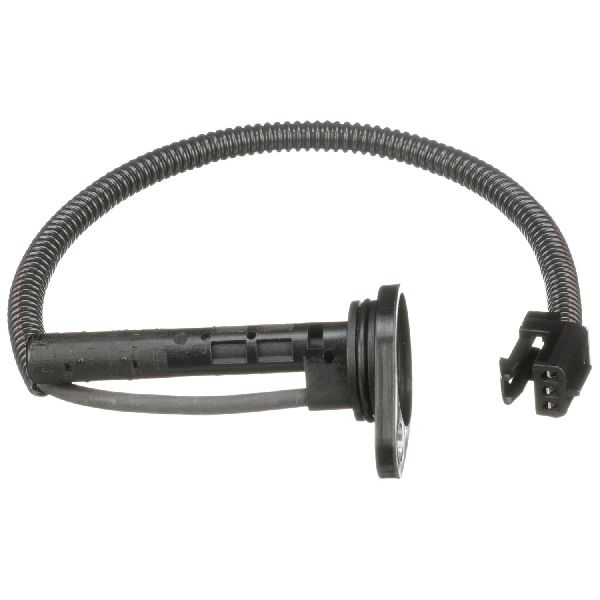
- Automatic Transmission Molded Lead Frame
(OEM #AL3Z-7G276-D)— This assembly contains the Output Shaft Speed (OSS) sensor and is the most common failure point for code P0722 on this vehicle. Ford's parts catalog confusingly calls this part a 'Connector'.
Trusted brands: Motorcraft, Dorman
OEM price range: $200-$350
Aftermarket price range: $150-$250 - Automatic Transmission Fluid
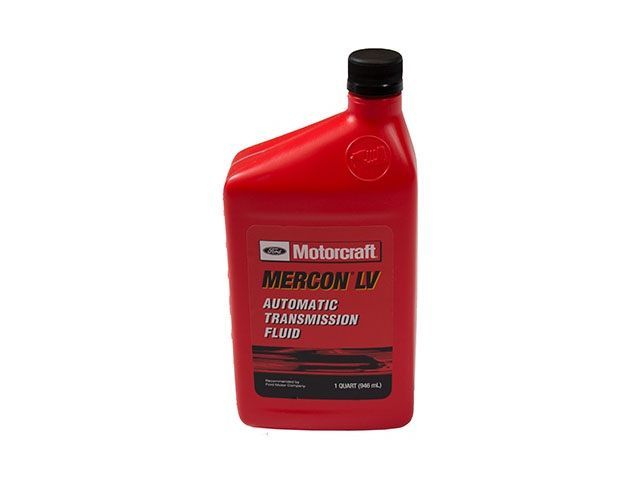
(OEM #Motorcraft MERCON LV)— The transmission fluid must be drained to access the lead frame and should be replaced with new fluid during the repair. Approximately 9-10 quarts are needed.
Trusted brands: Motorcraft
OEM price range: $80-$150
Aftermarket price range: $60-$120 - Transmission Pan Gasket — The gasket should be replaced whenever the transmission pan is removed to ensure a proper seal.
Trusted brands: Motorcraft, Fel-Pro
OEM price range: $25-$50
Aftermarket price range: $15-$30 - Transmission Bulkhead Connector Sleeve — This is a common leak point and should be replaced as a preventative measure while the valve body is removed. It's an inexpensive part that can save a future repair.
Trusted brands: Motorcraft
OEM price range: $15-$30
Aftermarket price range: $10-$20
Related Codes That Often Appear With This One
- P0720 — P0720 indicates a generic circuit malfunction for the Output Speed Sensor, while P0722 specifically indicates no signal is being received. They often appear together pointing to the same root cause, the failed lead frame.
- P0731 — This code indicates 'Gear 1 Incorrect Ratio'. The PCM may set this code when it commands first gear but cannot verify it via the OSS signal, often pointing back to the lead frame failure. Ford includes this DTC in its diagnostic criteria for lead frame replacement.
Technical Service Bulletins (TSBs) & Recalls
- TSB 13-6-8: While not for the Explorer specifically, it addresses identical symptoms (stuck in gear, no speedometer, P0720/P0722) on the related 6R80 transmission and directs replacement of the molded lead frame.
Platform-Specific Known Issues
- Ford issued Customer Satisfaction Program 19N01, which extended the warranty on the molded lead frame for some 2011-2013 F-150s and 2012-2013 Expeditions with the 6R80 transmission, which is mechanically similar to the 6F50/55. This program covered replacement if codes P0720, P0722, or P0731 were present, highlighting the known issue with this component family. While this specific program may not cover all Explorers, it demonstrates the widespread nature of the lead frame problem.
- TSB 13-6-8 was issued for other Ford models with the related 6R80 transmission for symptoms including starting in 5th gear, speedometer at zero, and codes P0720/P0722, instructing dealers to replace the molded lead frame.
Mechanic-Grade Diagnostic Values
- Resistance of the OSS sensor circuit within the molded lead frame (solenoid body). — expected: Less than 5 ohms. Failure: A resistance reading greater than 5 ohms indicates an internal fault in the lead frame assembly, requiring replacement.
- OSS Signal Waveform (using an oscilloscope) — expected: A regular square wave, typically 2-5V in amplitude, with frequency increasing with vehicle speed.. Failure: A complete absence of a waveform confirms a dead sensor or a complete break in the power, ground, or signal circuit.
Scan Tool Commands That Help
- Ford IDS (Integrated Diagnostic System) or equivalent professional scan tool: Live Data Monitoring of PID: OSS_SRC — This is the most crucial diagnostic step. While driving, monitor the Output Shaft Speed (OSS) PID. If the vehicle is moving but the PID reads 0 RPM or is erratic, it directly confirms a lack of signal from the sensor or its circuit, strongly pointing to the lead frame.
Wiring & Ground Locations
- Transmission Bulkhead Connector — The main external electrical connector on the transmission case where the vehicle harness attaches.. This is the primary point for external testing. A common failure point is the connector sleeve seal (originally orange, later updated to black), which can leak fluid and cause corrosion on the pins, interrupting the OSS signal.
- PCM Connector C175T — The main 50-pin connector at the Powertrain Control Module (PCM).. For the 6F55 transmission, the OSS signal wire (typically Gray-Violet) is on Pin 16. Testing for continuity between this pin and the corresponding pin at the transmission bulkhead connector can rule out a wiring harness break.
- Main Chassis Ground — A primary ground connection point is typically located to the right of the battery, near the engine compartment fuse box.. While less common for this specific code, a poor main ground can cause a variety of unpredictable electronic issues. Ensuring this connection is clean and tight is a fundamental step in any electrical diagnosis.
Real Owner Repair Stories
- Ford F150 Forum (similar 6R80 transmission) (2012 F-150 FX4 3.5L EcoBoost with 6R80 transmission) — Sudden transmission issues, likely including limp mode and warning lights.
❌ Tried (didn't work) Dealer misdiagnosed the issue and quoted a 6-month wait for a part that wasn't correct for the model year.
✅ What actually fixed it The owner self-installed a Dorman-branded molded lead frame, along with a new filter and fluid. The Dorman unit performed identically to OEM and resolved all symptoms. Total cost was under $750, compared to a dealer quote of over $3,000. - NHTSA ODI #11716692 — An owner reported having no 1st or 2nd gear until the vehicle was shut off and restarted. A dealer diagnosed the issue as a "P0722, pinpoint OSS sensor failure" and successfully repaired it with a new lead frame.
- NHTSA ODI #11306291 — A driver experienced a sudden downshift into 1st gear while driving, which caused the speedometer to read 0 and the odometer to display dashes. A technician subsequently retrieved code P0722.
OEM Part Supersession History
AL3Z-7G276-A→AL3Z-7G276-D— Revision and improvement of the part to address high failure rates. The 'D' revision is the most current and recommended replacement.
Heads up: While the parts may be physically interchangeable, always install the latest revision ('D') to get the most durable version. Some vendors may still sell old 'A' stock.
Model Year Variations Within This Range
- 2011-2019: Explorers with the standard naturally aspirated engine typically received the 6F50 transmission, while models with the EcoBoost engine or tow package were equipped with the more robust 6F55. The 6F55 was designed to handle higher torque and features beefier internal components, like a wider ring gear, but both use the same failure-prone molded lead frame design.
Diagnostic Flowchart
Other Known Issues on This Vehicle
Issues unrelated to this code that are worth knowing about as an owner of this generation:
- Internal Water Pump Failure (3.5L & 3.7L V6) 🔴 High — Commonly occurs around 100,000 miles. The timing-chain-driven design means failure can lead to coolant mixing with engine oil, causing catastrophic engine damage. Repair costs are very high ($2,000-$3,000+).
- Power Steering Rack Failure 🔴 High — A significant number of complaints involve the electronic power steering rack failing, leading to a loss of power assist. This is a costly repair, often exceeding $1,000. (Ref: Multiple recalls were issued for steering-related issues on early models.)
- Exhaust Fumes in Cabin 🟠 Medium — A well-documented issue where cracks in the exhaust manifold or sealing issues could allow carbon monoxide to enter the passenger cabin, particularly under hard acceleration. (Ref: Ford addressed this with service actions, but complaints persist.)
- MyFord Touch / SYNC System Glitches 🟡 Low — Early models in this generation were known for buggy infotainment systems that would freeze, reboot, or become unresponsive. Software updates from the dealer often improved performance. (Ref: Various software update TSBs were released.)
- PTU (Power Transfer Unit) Fluid Overheating 🟠 Medium — On AWD models, the PTU fluid can overheat due to a lack of cooling and a small fluid capacity. Ford claimed it was a 'lifetime' fluid, but lack of service can lead to PTU failure. Regular fluid changes every 30,000 miles are recommended by owners.
- A-Pillar Trim Detachment/Rattle 🟡 Low — The exterior trim pieces on the A-pillars are known to become loose, rattle, or even fly off at highway speeds. This was subject to a recall. (Ref: Recall exists for this issue.)
Used vs. New Parts: Buying Guide for This Vehicle
When a used part is the smart pick: Never. The molded lead frame is a high-failure electronic component. A used part from a salvage yard has an unknown history and a high probability of either being faulty already or failing shortly after installation. The significant labor cost to access this internal part makes installing a used one a very poor risk.
What to inspect on the donor part:
- Not applicable, do not buy this part used.
OEM-only on this vehicle (don't cheap out):
- Molded Lead Frame (strongly recommended)
Aftermarket brands forum-validated for this vehicle:
- Dorman: While OEM (Motorcraft) is the safest choice, numerous owner accounts on forums report successful, long-term repairs using the Dorman replacement lead frame, especially when OEM parts faced supply shortages.
Brands owners have reported issues with on this vehicle:
- Unbranded, low-cost units from online marketplaces should be avoided. The quality control on these parts is often non-existent, and the risk of premature failure is very high.
Real Owner Stories
Aggregated from forums and TSBs cited above. Mileages and costs reflect what owners reported in those sources.
2012 Ford Explorer
Symptoms: Owners on explorerforum.com reported the P0722 code and confirmed that replacing the lead frame resolved the issue.
What fixed it: Replacement of the molded lead frame.
Source hint: explorerforum.com: Numerous threads discuss the P0722 code, with owners confirming that repl
2013 Ford Explorer (6R80/6F50 family)
Symptoms: Starting in 5th gear, speedometer at zero, and codes P0720/P0722.
What fixed it: Replace the molded lead frame.
Source hint: TSB 13-6-8
Documented NHTSA Reports
NHTSA ODI #11506508
Symptoms: The owner reported a "wrench" display on the dashboard and retrieved codes U0401, P0316, and P0722. A dealer indicated the issue was likely the molded lead frame.
NHTSA ODI #11721793
Symptoms: The speedometer failed to operate as intended, and the vehicle was diagnosed with DTC P0722. Metal shavings were discovered in the transmission drain filler plug during inspection.
Related OBD-II Codes
Frequently Asked Questions
Does Customer Satisfaction Program 19N01 apply to my 2011-2019 Ford Explorer?
My Explorer's speedometer dropped to 0 MPH and the odometer shows dashes. Is this related to P0722?
Can a P0722 code cause my Explorer to suddenly downshift to first gear at high speeds?
What is the recommended fix if my Explorer has P0722 and P0720 codes?
Is there a TSB for these transmission symptoms on Ford vehicles?
Could my Explorer's P0722 code be caused by the internal water pump issue?
Helpful Videos
We Have This Part in Stock





The information in this article is provided for general reference and educational purposes only. Vehicle specifications, procedures, and part compatibility can vary by production date, trim level, and region. Always consult your vehicle's factory service manual and verify part numbers before purchasing or performing repairs. Safety-critical components such as airbags, seat belts, and braking systems should be installed by a qualified professional.
- Ford Explorer:
- 🧭 Diagnostic Flowchart
- 🎬 Helpful Videos
- 🛍️ Shop This Part
- What's Unique About the 2011-2019 Ford Explorer
- Symptoms You May Notice
- Most Likely Causes
- Rare But Worth Checking
- Diagnosis Steps
- Parts You'll Likely Need
- Related Codes That Often Appear With This One
- Technical Service Bulletins (TSBs) & Recalls
- Platform-Specific Known Issues
- Mechanic-Grade Diagnostic Values
- Scan Tool Commands That Help
- Wiring & Ground Locations
- Real Owner Repair Stories
- OEM Part Supersession History
- Model Year Variations Within This Range
- Other Known Issues on This Vehicle
- Used vs. New Parts: Buying Guide for This Vehicle
- Real Owner Stories
- 2012 Ford Explorer
- 2013 Ford Explorer (6R80/6F50 family)
- Documented NHTSA Reports
- NHTSA ODI #11506508
- NHTSA ODI #11721793
- Related OBD-II Codes
- Frequently Asked Questions
- 🎟️ Get 5% Off