

P0722 on 2012-2017 Hyundai Accent: Output Speed Sensor Failure Causes and Fixes
On a 2012-2017 Accent with the A6GF1 6-speed automatic, P0722 is almost always caused by a failed internal transmission wire harness that contains the input and output speed sensors. This is a well-documented, common failure addressed by Hyundai TSBs. The repair is complex, requiring removal of the transmission oil pan and valve body, with shop costs typically ranging from $600 to $1,000.
- P0722 on a 2012-2017 Accent means the transmission will go into 'limp mode' (stuck in 3rd gear).
- The cause is almost certainly a failed wire harness located inside the transmission, a known issue confirmed by Hyundai TSBs.
- Do not replace the entire transmission; the fix is to replace the internal harness and speed sensors.
- This is a labor-intensive repair (3-5 hours) that requires removing the transmission valve body and should be performed by a professional.
- The key parts needed are the internal harness (PN 46307-3B650), the sensor assembly (PN 42620-26010), and a new oil pan gasket.
What's Unique About the 2012-2017 Hyundai Accent
For the 2012-2017 Hyundai Accent (RB generation) with the 6-speed A6GF1 automatic transmission, this code points to a very specific and well-documented issue. Unlike many other vehicles where the speed sensor is an easily accessible external part, the failure on this Accent is typically an internal wire harness assembly located inside the transmission. This harness, which integrates both the input and output speed sensors, is known to degrade from constant exposure to heat and transmission fluid. Hyundai has issued multiple Technical Service Bulletins (TSBs), including 14-AT-013 and its successor 16-AT-003, that instruct technicians to replace this internal harness rather than misdiagnosing a costlier transmission failure. This makes the diagnosis straightforward but the repair significantly more labor-intensive than a simple external sensor swap.
Symptoms You May Notice
- Check Engine Light is on
- Transmission is stuck in one gear (fail-safe or "limp mode"), typically 3rd gear
- Harsh or erratic shifting, or a 'bang' when shifting from Park to Drive
- Poor or very sluggish acceleration from a stop
- Speedometer may work intermittently or not at all, though it often works normally as it may use ABS wheel speed sensors instead
- Flashing 'D' (Drive) indicator on the instrument cluster
- Replacing the entire transmission. Hyundai TSBs specifically advise against this, as the problem is almost always the much cheaper internal harness or sensors. A Reddit user with a 2016 Elantra reported getting a P0722 code even after a full transmission swap, indicating the problem was likely wiring or the PCM, not the transmission itself.
Most Likely Causes
- Failed Internal Transmission Wire Harness 🔴 High Probability → Shop Transmission Assembly This is a known, widespread failure point for this generation's A6GF1 transmission, as documented in Hyundai TSBs 14-AT-013, 16-AT-003, and 20-AT-011H. The harness, which includes the input and output speed sensors, degrades over time from heat and fluid exposure inside the transmission, causing cracked insulation and broken internal connections.
How to confirm: A professional technician will use a scan tool to confirm the absence of an output speed signal while the vehicle is in motion. If external wiring is intact, the internal harness is the confirmed cause per the TSBs.
Typical fix: Replace the internal transmission wire harness. This requires draining the transmission fluid, removing the oil pan, and removing the valve body to access the harness.
Est. part cost: $150-$200 - Failed Input/Output Speed Sensor Assembly 🟡 Medium Probability The sensors are part of the internal harness assembly and are exposed to the same harsh conditions. The TSB lists a separate part number for the sensor itself, but it is almost always replaced with the harness.
How to confirm: This is diagnosed along with the harness. Since replacing the harness is labor-intensive, it is standard practice to replace the sensors at the same time to prevent repeat repairs.
Typical fix: Replace the input/output speed sensor assembly while replacing the internal harness.
Est. part cost: $30-$70 - Damaged External Wiring or Connector ⚪ Low Probability While less common than the internal failure, external wiring can be damaged by road debris, corrosion, or rodents.
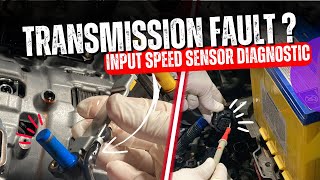
How to confirm: Visually inspect the wiring harness leading from the transmission case to the PCM for any signs of damage, corrosion, or loose connections. A YouTuber with a 2008 Elantra (different model but similar diagnostic principle) found a broken wire at the sensor connector was the cause of his P0722 code. 🎬 See how to diagnose a broken sensor connector wire Use a multimeter to check for continuity and shorts.
Typical fix: Repair the damaged section of wire or replace the connector pigtail.
Est. part cost: $10-$50
Rare But Worth Checking
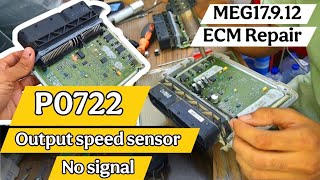
- Faulty Powertrain Control Module (PCM/ECM): → Shop Engine Control Module (ECM) This is very uncommon. In one documented case on a Hyundai Accent, a technician found that leaking capacitors inside the engine computer caused incorrect voltage (1.3V instead of ~11V) to the sensor, triggering the code even after the sensor and harness were replaced. Repairing the ECU board fixed the issue. 🎬 Watch this step-by-step ECM repair for code P0722 This should only be considered after all other causes are ruled out.
Diagnosis Steps
- Connect an OBD-II scanner and confirm the presence of code P0722. Note any other transmission-related codes like P0721 or P0717.
- Use the scanner's live data function to monitor the Transmission Output Speed Sensor reading while driving slowly. A reading of 0 RPM while the vehicle is moving confirms the 'No Signal' condition.
- Perform a thorough visual inspection of the external transmission wiring harness and connectors for any obvious damage, corrosion, or signs of rodent damage.
- If external wiring appears okay, the issue is almost certainly internal to the transmission, as per Hyundai TSBs 14-AT-013 and 16-AT-003.
- The next step, recommended for a professional, is to drain the transmission fluid, remove the transmission oil pan, and then remove the valve body.
- Replace the internal transmission wire harness and the input/output speed sensor assembly. It is critical to replace both as a set.
- Reinstall the valve body, oil pan with a new gasket, and refill with approximately 5-6 quarts of Hyundai-specified automatic transmission fluid (SP-IV / SPH-IV ATF).
- Clear the trouble codes and perform a test drive to ensure the transmission shifts correctly and the Check Engine Light does not return.
Parts You'll Likely Need
- Internal Transmission Wire Harness
(OEM #46307-3B650)— This is the primary failure point for P0722 on this vehicle, as identified by multiple Hyundai TSBs. It supersedes older part numbers 46307-3B610 and 46307-3B620.
Trusted brands: Hyundai (Genuine OE)
OEM price range: $150-$200
Aftermarket price range: $100-$150 - Input/Output Speed Sensor Assembly
(OEM #42620-26010)— This sensor assembly is attached to the internal harness and is typically replaced at the same time to ensure a complete repair, as per TSB 14-AT-013.
Trusted brands: Hyundai (Genuine OE), Standard Motor Products, NGK
OEM price range: $50-$70
Aftermarket price range: $25-$50 - Transmission Oil Pan Gasket
(OEM #45282-26100)— The oil pan must be removed to access the internal components, and the gasket must be replaced upon reassembly to prevent leaks.
Trusted brands: Hyundai (Genuine OE)
OEM price range: $15-$25
Aftermarket price range: $10-$20 - Hyundai SP-IV Automatic Transmission Fluid
(OEM #00232-19045)— The correct fluid type is required when refilling the transmission after the repair. Approximately 5-6 quarts are needed.
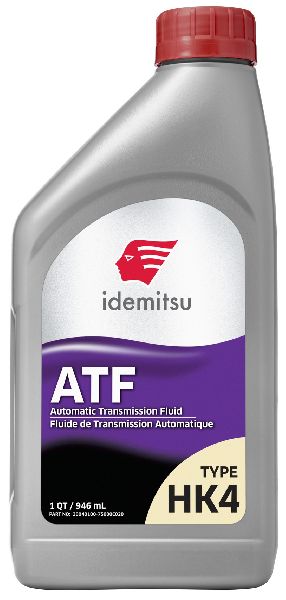
Trusted brands: Hyundai (Genuine OE), Idemitsu TLS-LV, Valvoline MaxLife Multi-Vehicle ATF
OEM price range: $15-$20 per quart
Aftermarket price range: $8-$12 per quart
Related Codes That Often Appear With This One
- P0721 — This code for 'Output Speed Sensor Circuit Range/Performance' is caused by the same failing internal harness and is listed in the same TSBs.
- P0717 — This code for 'Input/Turbine Speed Sensor 'A' Circuit No Signal' is also caused by the same internal harness failure, as the harness contains both input and output sensors.
Technical Service Bulletins (TSBs) & Recalls
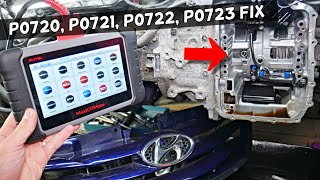
- TSB 14-AT-013: The original bulletin that identifies the internal harness and sensors as the cause for P0717, P0721, and P0722, and provides part numbers and repair procedures for the 2012+ Accent (RB). 🎬 Watch a walkthrough of this Hyundai speed sensor fix
- TSB 16-AT-003: Supersedes 14-AT-013, updating information and confirming the issue persists in later models.
- TSB 20-AT-011H: A later TSB that also points to the internal harness as the primary cause for these codes on the 2012-2017 Accent.
Platform-Specific Known Issues
- The 6-speed automatic transmission (A6GF1) used in the 2012-2017 Accent is known for the internal wire harness failing, causing codes P0717, P0721, and P0722. This is a much more common issue on this platform than external wiring or PCM faults.
- Owner forums are filled with identical stories: car suddenly enters limp mode (stuck in 3rd gear), throws P0722, and the fix is always the internal harness replacement, with dealer quotes ranging from $600 to over $1000.
Mechanic-Grade Diagnostic Values
- Output Speed Sensor (Hall Effect Type) Voltage - HIGH state — expected: 1.18V - 1.68V (corresponding to 11.8 - 16.8mA). Failure: No voltage or voltage outside this range.
- Output Speed Sensor (Hall Effect Type) Voltage - LOW state — expected: 0.59V - 0.84V (corresponding to 5.9 - 8.4mA). Failure: No voltage or voltage outside this range.
- Valve Body Harness Bolt Torque — expected: 6-7 lb-ft (0.9-1.0 kgf.m). Failure: N/A - This is a reassembly specification.
- Valve Body to Case Bolt Torque — expected: 9-11 lb-ft (1.3-1.5 kgf.m). Failure: N/A - This is a reassembly specification.
Scan Tool Commands That Help
- Hyundai GDS (Global Diagnostic System): Current Data (Input Speed & Output Speed Sensors) — This is the primary live data screen to use during a test drive to confirm if the output speed sensor is reading 0 RPM while the vehicle is moving, which is the main symptom of P0722.
- Hyundai GDS (Global Diagnostic System): Resetting Auto Transmission Adaptive Values — After replacing the internal harness and/or sensors, this function should be used to clear the TCM's learned shift patterns. This prevents harsh or erratic shifting after the repair as the TCM adapts to the new components.
Wiring & Ground Locations
- ECM Pins (for MEG17.9.12 ECU) — At the Engine Control Module connector.. In a rare case of PCM failure, a technician identified the specific pins for the output speed sensor circuit: Pin 60 (Ground), Pin 59 (5V reference), and Pin 50 (12V). A fault in the PCM was causing Pin 50's circuit to only supply 1.3V instead of the required ~11-12V, which was the root cause of the P0722 code.
Real Owner Repair Stories
- YouTube channel 'Car hospital' (Hyundai Accent (year not specified, but with MEG17.9.12 ECU)) — P0722 - Output Speed Sensor Circuit No Signal.
❌ Tried (didn't work) Replacing the output speed sensor.
✅ What actually fixed it The technician diagnosed incorrect voltage on the sensor's wiring. Tracing it back to the ECM, they discovered leaking capacitors had damaged the board. Repairing the ECM restored the correct voltage (~11.7V) to the sensor circuit and cleared the code. - NHTSA ODI #11696914 (Hyundai Elantra) — An owner reported having to use manual 1st and 2nd gears while reverse worked fine. Although no dash lights were present, an auto parts store scan revealed error code P0722, leading the owner to attempt replacing the input/output speed sensor.
- NHTSA ODI #11427357 (Hyundai Elantra) — A driver reported that the car would not go into drive at all before the check engine light appeared with code P0722.
OEM Part Supersession History
46307-3B610, 46307-3B620→46307-3B650— Updated design or material to improve durability and prevent the common heat/fluid degradation failure.
Heads up: The newer 46307-3B650 part is backward compatible and is the correct replacement for the older numbers.
Model Year Variations Within This Range
- 2012-2017: The A6GF1 transmission in this range uses a 'Generation 1' valve body with 8 solenoids. Newer Hyundai models (post-2017) may use a 'Generation 2' valve body with 7 solenoids. While the internal harness is the common failure for P0722 in this range, it's a critical distinction if sourcing a complete valve body or transmission.
Diagnostic Flowchart
Other Known Issues on This Vehicle
Issues unrelated to this code that are worth knowing about as an owner of this generation:
- Degrading Flexible Steering Coupler 🟠 Medium — Very common, typically appears after 50,000 miles. Causes a distinct clunking or clicking noise in the steering wheel when turning. (Ref: No recall for Accent, but a well-known issue across the Hyundai/Kia lineup. The part (56315-2K000-FFF) is inexpensive, but labor can be a few hundred dollars.)
- GDI Engine Intake Valve Carbon Buildup 🟠 Medium — Common to all Gasoline Direct Injection (GDI) engines, including the 1.6L in the Accent. Becomes noticeable after 60,000-100,000 miles, causing rough idle, hesitation, and reduced power. (Ref: No TSB/recall. Requires preventative measures like using quality fuel/oil and periodic intake cleaning services (e.g., walnut blasting) for removal.)
- Ignition Coil Failure 🟡 Low — Frequently reported cause for misfires (P0300 series codes) and rough running, especially between 30k-60k miles.
- Wiring Harness Chafing 🔴 High — A known issue where the engine wiring harness can rub against brackets near the master cylinder, causing shorts that can lead to blown fuses, misfires, or a no-start condition.
- Failing Rear Shock Absorbers 🟡 Low — Owners report premature failure of rear shocks, leading to clunking noises over bumps and cupped tire wear.
Used vs. New Parts: Buying Guide for This Vehicle
When a used part is the smart pick: A used part is generally NOT recommended for this repair. The primary failure part, the internal wire harness, fails due to heat and age. A used harness from a junkyard vehicle will have similar age and heat exposure and is likely to fail soon, if it hasn't already. The labor to replace it is significant, so using a new OEM part is the only reliable choice.
Donor-vehicle mileage cap: roughly under 30000 miles for the part to have meaningful remaining life.
What to inspect on the donor part:
- If forced to use a salvaged part, source it from the newest, lowest-mileage vehicle possible.
- Inspect the plastic connector housings for any signs of brittleness or cracking.
- Check the wire insulation for flexibility; if it feels hard or stiff, it has been heat-cycled excessively and should be avoided.
OEM-only on this vehicle (don't cheap out):
- Internal Transmission Wire Harness (P/N: 46307-3B650)
Aftermarket brands forum-validated for this vehicle:
- For the speed sensor itself (if replaced separately), Standard Motor Products and NGK/NTK are generally considered reliable alternatives to OEM.
Brands owners have reported issues with on this vehicle:
- Unbranded, no-name harnesses from online marketplaces should be avoided. The quality of the wiring, insulation, and pins is critical, and failure of a cheap harness will require repeating a very labor-intensive job.
Real Owner Stories
Aggregated from forums and TSBs cited above. Mileages and costs reflect what owners reported in those sources.
2013 Hyundai Accent
Symptoms: The car experienced transmission problems and entered limp mode, throwing code P0722 along with other codes.
What fixed it: Replacement of the internal transmission components as discussed in owner threads regarding sensor and harness failures.
Source hint: Hyundai-Forums.com thread titled 'Accent transmission problem or sensor problem?'
2012-2017 Hyundai Accent
Symptoms: Car suddenly enters limp mode (stuck in 3rd gear) and throws P0722.
What fixed it: Internal harness replacement.
Cost: $600-$1000
Source hint: Go-Parts.com Blog: P0720 on 2009-2022 Hyundai Accent
2016 Hyundai Elantra (A6GF1 Transmission)
Symptoms: Getting a P0722 code; owner replaced the entire transmission but the code persisted, suggesting the fault could also lie in external wiring or the computer.
What fixed it: Diagnostic focus shifted to external wiring or PCM after internal mechanical replacement failed to clear the code.
Source hint: Reddit r/MechanicAdvice: Replaced Transmission, Still Getting Speed Sensor Code – What Next?
Hyundai Accent
Symptoms: An owner reported a diagnostic invoice noting a failed transmission range switch and failed transmission pulse generators, with code P0722 for the output speed sensor (PG-B) showing an open or short circuit. The transmission fluid condition was also noted as poor.
Source hint: NHTSA ODI #10143151
Related OBD-II Codes
Frequently Asked Questions
Which Hyundai Technical Service Bulletins (TSBs) address the P0722 code for the 2012-2017 Accent?
Why is my 2012-2017 Accent stuck in 3rd gear when the P0722 code appears?
What is the specific part number for the internal harness that usually fails on this model?
Can I just replace the output speed sensor itself to fix P0722?
How much should I expect to pay a dealer to fix this issue on my Accent?
Does the P0722 code always mean my speedometer will stop working?
Helpful Videos
We Have This Part in Stock


The information in this article is provided for general reference and educational purposes only. Vehicle specifications, procedures, and part compatibility can vary by production date, trim level, and region. Always consult your vehicle's factory service manual and verify part numbers before purchasing or performing repairs. Safety-critical components such as airbags, seat belts, and braking systems should be installed by a qualified professional.
- Hyundai Accent:
- 🧭 Diagnostic Flowchart
- 🎬 Helpful Videos
- 🛍️ Shop This Part
- What's Unique About the 2012-2017 Hyundai Accent
- Symptoms You May Notice
- Most Likely Causes
- Rare But Worth Checking
- Diagnosis Steps
- Parts You'll Likely Need
- Related Codes That Often Appear With This One
- Technical Service Bulletins (TSBs) & Recalls
- Platform-Specific Known Issues
- Mechanic-Grade Diagnostic Values
- Scan Tool Commands That Help
- Wiring & Ground Locations
- Real Owner Repair Stories
- OEM Part Supersession History
- Model Year Variations Within This Range
- Other Known Issues on This Vehicle
- Used vs. New Parts: Buying Guide for This Vehicle
- Real Owner Stories
- 2013 Hyundai Accent
- 2012-2017 Hyundai Accent
- 2016 Hyundai Elantra (A6GF1 Transmission)
- Hyundai Accent
- Related OBD-II Codes
- Frequently Asked Questions
- 🎟️ Get 5% Off