

P0722 on 2013-2018 Hyundai Santa Fe: Output Speed Sensor Failure Causes and Fixes
On a 2013-2018 Santa Fe, P0722 is almost always a failed internal transmission speed sensor or wiring harness. The transmission will be stuck in 3rd gear (limp mode), causing poor acceleration. The fix requires removing the transmission oil pan and valve body to access the parts, making it a job for a professional or experienced DIYer. Expect a shop cost of $450-$950. Hyundai issued a TSB (16-AT-003) advising against full transmission replacement for this code.
- P0722 on a 2013-2018 Santa Fe will put the vehicle in 'limp mode' (stuck in 3rd gear).
- The cause is almost certainly a failed speed sensor or wiring harness located *inside* the transmission.
- Do NOT let a shop replace the entire transmission. A specific Hyundai TSB (16-AT-003) details the correct, less expensive repair.
- This is not a simple DIY fix. The repair requires removing the transmission valve body, which should be done by a qualified mechanic.
- When getting the repair done, it is wise to replace both the sensor assembly and the internal wiring harness at the same time.
What's Unique About the 2013-2018 Hyundai Santa Fe
On the 6-speed automatic transmission (A6MF/A6LF family) used in this generation of Santa Fe, the input and output speed sensors are part of an assembly located inside the transmission, mounted to the valve body. This makes replacement much more complex than on vehicles with externally mounted sensors. Hyundai is aware of this issue and released a Technical Service Bulletin (TSB 16-AT-003) that specifically instructs technicians not to replace the entire transmission for this code, but to instead replace the internal sensor and/or wiring harness. This internal placement is a common design choice for this family of Hyundai/Kia transmissions.
Generation note: The 2013-2018 year range covers the entire third generation (DM) of the Hyundai Santa Fe. This includes both the 5-seat 'Santa Fe Sport' (chassis code AN) and the 7-seat long-wheelbase 'Santa Fe' or 'Santa Fe XL' (chassis code NC). The relevant Technical Service Bulletin (16-AT-003) applies to both versions equipped with the 6-speed automatic transmission.
Symptoms You May Notice
- Check Engine Light is on
- Transmission is stuck in 3rd gear (fail-safe or 'limp' mode)
- Very poor acceleration from a complete stop
- Harsh or erratic shifting before failing completely
- Speedometer may work intermittently or not at all
- Flashing 'D' (Drive) indicator on the instrument cluster
- Poor fuel economy
- Replacing the entire transmission. Hyundai explicitly advises against this in TSB 16-AT-003, as the cause is almost always a much cheaper internal sensor or harness.
- Replacing only the speed sensor when the internal harness is also faulty. Due to the significant labor involved in accessing these parts, it is highly recommended to replace both simultaneously.
Most Likely Causes
- Failed Internal Transmission Wiring Harness 🔴 High Probability → Shop Transmission Assembly This part (OEM P/N: 46307-3B650) is located inside the transmission, exposed to constant heat and fluid, which can degrade the wiring insulation over time. It is a known failure point addressed by Hyundai's TSB 16-AT-003.
How to confirm: After confirming no external wiring issues, the transmission pan and valve body must be removed. The harness can then be visually inspected for brittle or damaged wires and tested for continuity with a multimeter.
Typical fix: Replace the internal wiring harness. This is often done at the same time as replacing the speed sensor assembly as a preventative measure.
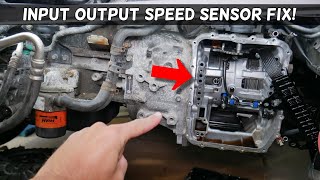
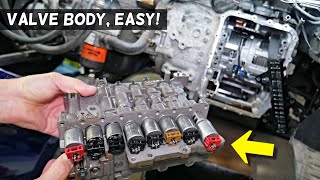
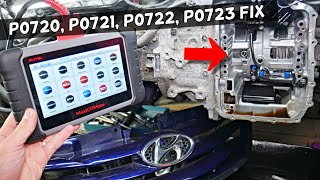
Est. part cost: $80-$140 - Failed Input/Output Speed Sensor Assembly 🔴 High Probability Like the harness, the sensor assembly is internal and subject to a harsh environment. The official Hyundai repair procedure advises checking and replacing this part for code P0722. 🎬 Watch: How to fix transmission codes P0720 through P0723 The assembly contains both input and output sensors, and a failure in one can trigger codes for either or both. 🎬 Watch: How to locate and replace the speed sensor assembly
How to confirm: Using a scan tool, check for a signal from the output speed sensor in the live data stream while driving. A reading of 0 RPM while the vehicle is moving confirms the failure. The sensor itself can be tested with a multimeter for resistance after being removed from the valve body.
Typical fix: Replace the input/output speed sensor assembly. This part is located on the valve body inside the transmission. The OEM part number is often cited as 42621-3B100 or similar variants depending on the specific transmission build.
Est. part cost: $25-$180 - Damaged External Wiring or Connector ⚪ Low Probability
How to confirm: Visually inspect the main transmission wiring harness and the main connector on the outside of the transmission case for corrosion, pushed-out pins, or physical damage from road debris.
Typical fix: Repair the damaged section of the harness or clean/replace the connector.
Est. part cost: $10-$50
Rare But Worth Checking
- Faulty Transmission Control Module (TCM) or Powertrain Control Module (PCM): → Shop Engine Control Module (ECM) This is rare. The TSB advises only considering this if the code returns after replacing both the internal sensor and harness. A faulty module may fail to process an otherwise good signal from the sensor.
- Contaminated or Low Transmission Fluid: → Shop Transmission Assembly While not a direct cause of an electrical 'no signal' fault, very old or contaminated fluid can contain metallic debris that sticks to the magnetic tip of the speed sensor, interfering with its ability to generate a signal. This is less common but worth considering if the fluid is in poor condition. A manufacturer report (NHTSA ODI #10143151) for a similar Hyundai powertrain noted that a P0722 code was found alongside poor transmission fluid level and condition.
Diagnosis Steps
- Connect a scan tool and confirm P0722 is present. Note any other transmission codes like P0717 or P0721.
- Use the scan tool's live data function to monitor 'Input Speed Sensor' and 'Output Speed Sensor' while driving the vehicle (if possible). A reading of 0 RPM from the output sensor while the vehicle is moving confirms the lack of signal.
- Visually inspect the main external transmission wiring harness and the large round connector on the outside of the transmission case for any obvious damage, corrosion, or loose pins.
- If external wiring is okay, proceed with the internal repair. Drain the transmission fluid into a clean container.
- Remove the transmission oil pan. If it is a steel pan, the sealant will need to be carefully cut. If plastic, it will have a reusable gasket.
- Remove the transmission valve body assembly following the manufacturer's procedure. This involves disconnecting several connectors and removing a specific sequence of bolts.
- With the valve body removed, you can now access the sensor assembly and internal harness.
- Inspect and test the internal harness (Part No. 46307-3B650) for continuity and signs of degradation.
- Inspect and test the input/output speed sensor assembly.
- Replace the faulty component(s). It is highly recommended to replace both the sensor assembly and the internal harness at the same time, as recommended by Hyundai's TSB.
- Reinstall the valve body, torquing bolts to specification (typically 8-11 lb.ft).
- Reinstall the oil pan. Use a new gasket for plastic pans or the specified sealant (e.g., Permatex Ultra Gray) for steel pans.
- Refill the transmission with the correct fluid (Hyundai/Kia SP-IV). The A6MF1 transmission has a total capacity of about 7.1 liters, but a drain and fill will typically require 4.5-5 liters.
- Clear the trouble codes and perform a test drive to confirm the repair.
Parts You'll Likely Need
- Internal Transmission Wiring Harness
(OEM #46307-3B650)— This is one of the two primary failure points identified in Hyundai's TSB for this code. It connects the valve body solenoids and sensors to the main external connector. This part number supersedes 46307-3B610 and 46307-3B620.
Trusted brands: Hyundai (Genuine)
OEM price range: $85-$140
Aftermarket price range: $60-$90 - Input/Output Speed Sensor Assembly
(OEM #42620-26010 / 42621-3B100 (Verify by VIN))— This sensor assembly, which contains both the input and output speed sensors, is the other primary failure point. It is located on the valve body inside the transmission.
Trusted brands: Hyundai (Genuine), NGK, Wells, Dorman
OEM price range: $150-$210
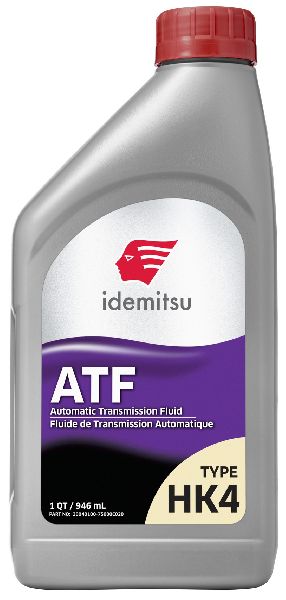
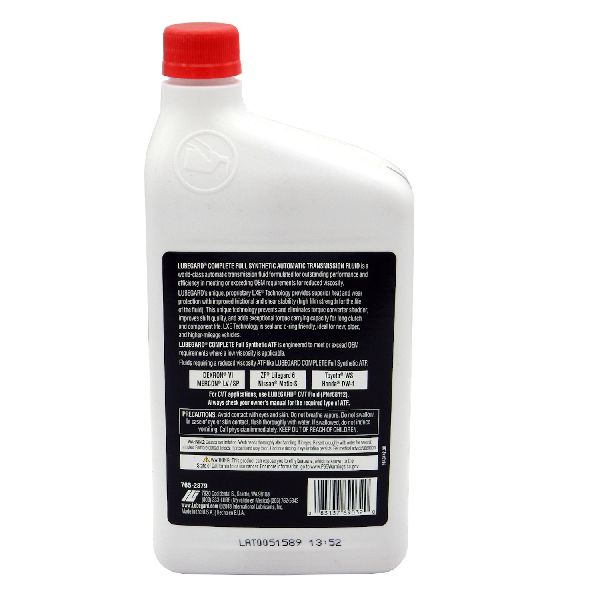
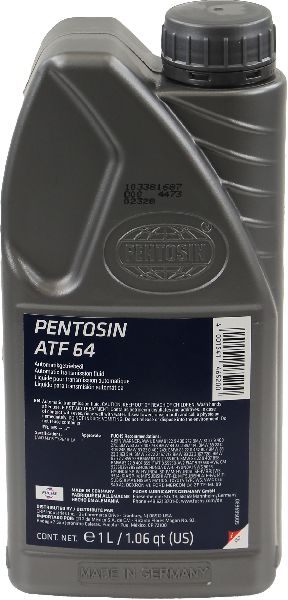
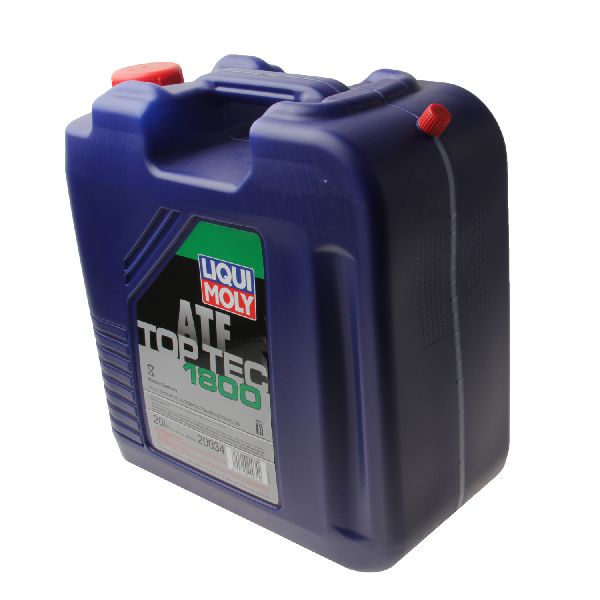
Aftermarket price range: $25-$180 - Automatic Transmission Fluid (SPH-IV)
(OEM #00232-19045)— The transmission fluid must be drained to perform the repair and must be refilled with the correct type of fluid. Approximately 5 quarts are needed for a pan drop.
Trusted brands: Hyundai/Kia (Genuine), Idemitsu TLS-LV, ENEOS Model H, Valvoline MaxLife Multi-Vehicle ATF
OEM price range: $15-$25 per quart
Aftermarket price range: $10-$18 per quart - Transmission Oil Pan Gasket
(OEM #45285-3B700 (for plastic pan))— A new gasket is required for plastic oil pans. For steel pans, a specific sealant like Permatex Ultra Gray or Hyundai Ultra Gray Gasket is used instead.
Related Codes That Often Appear With This One
- P0717 — This code is for 'Input Speed Sensor Circuit No Signal'. Since the input and output sensors are part of the same physical assembly and use the same wiring harness, they often fail together or are flagged by the same harness issue.
- P0721 — This code is for 'Output Speed Sensor Circuit Range/Performance'. It can be set due to an intermittent failure of the same sensor or wiring that causes P0722, representing a signal that is erratic rather than completely absent.
Technical Service Bulletins (TSBs) & Recalls
- TSB 16-AT-003 (supersedes 14-AT-013): Addresses codes P0717, P0721, and P0722. It explicitly states not to replace the transmission and provides the procedure for replacing the internal input/output speed sensor and/or the valve body wiring harness.
Platform-Specific Known Issues
- The primary issue for this platform is the internal location of the speed sensors and their wiring harness within the A6MF/A6LF transmission. This makes the repair significantly more labor-intensive and costly than for vehicles with external sensors.
- A YouTube video by 'Auto Repair Guys' demonstrates the repair on a similar Hyundai 6-speed transmission, showing the location of the sensors on the valve body after removing the oil pan, confirming the complexity of the job.
Mechanic-Grade Diagnostic Values
- Output Speed Sensor (OSS) Wiring Harness Continuity — expected: Below 1 Ω. Failure: A reading higher than 1 Ω indicates excessive resistance or an open circuit in the wiring between the sensor connector and the TCM.
- Output Speed Sensor (OSS) Wiring Short-to-Ground Test — expected: 10 kΩ or higher (ideally OL - Open Loop). Failure: A low resistance reading indicates a short circuit to ground on the signal wire.
- Output Speed Sensor (OSS) Air Gap — expected: 0.010 - 0.075 inches. Failure: An incorrect air gap can cause a weak or non-existent signal, though this is not adjustable and would indicate incorrect parts or a damaged tone ring.
- Sensor Input Voltage — expected: 9 Volts. Failure: Significantly lower or no voltage at the sensor indicates a problem with the power supply from the TCM/PCM.
Scan Tool Commands That Help
- Hyundai GDS (or advanced aftermarket scanner): Resetting Auto Transmission Adaptive Values / Init Of TCU Learning — This function must be performed after replacing the valve body, internal harness, speed sensors, or the entire transmission. It erases the old learned shift pressure and timing values, allowing the TCM to relearn with the new components for optimal shift quality.
Wiring & Ground Locations
- TCM Connector (A19) — The Transmission Control Module (TCM) is typically located under the battery tray in the engine bay, mounted to the transaxle case.. This is the destination for the sensor signal. Pin 18 is the signal positive (+) and Pin 7 is the signal negative (-) for the Output Speed Sensor. Testing for continuity and shorts between these pins and the sensor connector can isolate a wiring fault.
- Main Transmission Ground — Typically located on the chassis frame rail directly underneath the battery and battery tray.. A corroded or loose main ground for the transmission or TCM can cause a host of electrical issues, including erratic or missing sensor signals, leading to a P0722 code. This is a common failure point due to its exposure to the elements and potential battery acid leaks.
Real Owner Repair Stories
- Reddit user on r/Elantra (2016 Hyundai Elantra (uses a similar A6-family transmission)) — Car would not accelerate when put in Drive, throwing P0722 code.
❌ Tried (didn't work) Replaced the input/output speed sensor three times., Replaced the entire transmission with a used unit (26k miles).
✅ What actually fixed it The code persisted even after replacing the transmission. The likely cause, pointed out by other users, was a fault in the wiring harness between the sensor and the control module, which had not been tested prior to the expensive transmission replacement. - NHTSA ODI #11696914: An owner of a similar Hyundai model reported that while reverse worked fine, the car required using manual 1st and 2nd gears to move forward. An auto parts store scan revealed code P0722, though no dashboard lights had initially appeared.
- NHTSA ODI #11427357: Another owner experienced a situation where the vehicle would not go into drive at all. After the check engine light came on, a scan confirmed code P0722.
When the Usual Fixes Don't Work
- In one documented case involving a similar Hyundai powertrain, a persistent P0722 code was not caused by the common sensor or internal harness failure. After replacing those parts, the fault remained. The root cause was traced to leaking capacitors on the main circuit board of the Engine Control Module (ECM). The leaking electrolyte caused a voltage drop on the sensor's signal circuit, which the ECM interpreted as 'No Signal'. The fix was a board-level repair of the ECM, not another transmission part.
OEM Part Supersession History
46307-3B610, 46307-3B620→46307-3B650— Improved materials and construction to better withstand the high-temperature, fluid-filled environment inside the transmission.
Heads up: The newer part number is a direct replacement for the older versions and should always be used.
Model Year Variations Within This Range
- 2013-2018: The A6MF/A6LF transmission family was used throughout this generation. The primary variation relevant to this repair is the transmission oil pan material. Some vehicles may have a steel pan that requires RTV sealant (e.g., Hyundai Ultra Gray), while others have a plastic pan that uses a specific reusable gasket (P/N: 45285-3B700). It is critical to identify the pan type before starting the repair to have the correct sealing materials on hand.
Diagnostic Flowchart
Other Known Issues on This Vehicle
Issues unrelated to this code that are worth knowing about as an owner of this generation:
- Theta II Engine Failure 🔴 High — Widespread across multiple model years, particularly with the 2.0L Turbo and 2.4L GDI engines. Can occur at various mileages, often starting with a knocking noise. (Ref: Multiple recalls (e.g., NHTSA 17V-226) and a major class-action lawsuit settlement have been issued, extending the engine warranty for original and subsequent owners.)
- MDPS Steering Coupler Degradation 🟠 Medium — Extremely common. Owners typically notice a distinct clicking or clunking noise from the steering column when turning the wheel at low speeds. (Ref: Hyundai issued TSB 17-ST-001 for this issue and extended the warranty on the part (P/N 56315-2K000-FFF) for many models.)
- Peeling White Paint 🟡 Low — Common on vehicles with factory white or pearl white paint finishes. Paint can bubble and peel off in large sheets, often on the hood and roof. (Ref: Hyundai extended the paint warranty to 10 years/unlimited miles for this specific issue on affected models.)
- Secondary Hood Latch Corrosion 🔴 High — Common enough to trigger a safety recall. The cable can corrode and prevent the secondary latch from engaging, creating a risk of the hood flying open while driving if the primary latch fails. (Ref: NHTSA Recall 17V-226.)
- ABS Module Electrical Short 🔴 High — Affects a wide range of Hyundai models. The ABS module can leak brake fluid internally, causing an electrical short that can lead to an engine compartment fire, even when the vehicle is parked. (Ref: NHTSA Recall 20V-520.)
- Front Axle Shaft Fracture (FWD 2.4L) 🔴 High — Specific to 2013 Santa Fe Sport FWD models with the 2.4L engine. A manufacturing defect could cause the right front axle shaft to fracture, resulting in a loss of motive power. (Ref: NHTSA Recall 13V-354.)
Used vs. New Parts: Buying Guide for This Vehicle
When a used part is the smart pick: For this specific repair, using used parts is generally not recommended. The primary failure points (internal harness, sensors) are wear items that degrade with heat and time. A used part from a junkyard will have unknown remaining life and carries a high risk of premature failure, forcing you to repeat the significant labor involved.
Donor-vehicle mileage cap: roughly under 40000 miles for the part to have meaningful remaining life.
What to inspect on the donor part:
- If considering a used sensor assembly, verify it comes from a vehicle with a documented low mileage (under 40k miles).
- Never use a used internal wiring harness. The plastic and insulation become brittle with every heat cycle.
- Inspect the sensor's magnetic tip for heavy metallic contamination, which could indicate the donor transmission had internal mechanical problems.
OEM-only on this vehicle (don't cheap out):
- Internal Transmission Wiring Harness (46307-3B650): Given the high labor cost to access this part, the reliability of a Genuine Hyundai part is worth the extra cost over aftermarket alternatives.
Aftermarket brands forum-validated for this vehicle:
- For the speed sensor assembly, brands like NGK, Wells, and Dorman are generally considered reliable alternatives to OEM if sourced from a reputable supplier.
Brands owners have reported issues with on this vehicle:
- Avoid unbranded, no-name parts from online marketplaces. The quality control is non-existent, and a failed sensor can leave you stranded and require repeating the entire, labor-intensive repair.
Real Owner Stories
Aggregated from forums and TSBs cited above. Mileages and costs reflect what owners reported in those sources.
2011 Hyundai Sonata (A6MF Transmission)
Symptoms: The owner reported the vehicle was throwing code P0722. The dealer provided a quote for an internal repair rather than a full transmission replacement.
What fixed it: Replacing the internal harness (46307-3B650) and the sensors as per the dealer's recommendation and TSB guidance.
Source hint: hyundai-forums.com
Hyundai 6-speed Automatic (A6MF/A6LF)
Symptoms: The vehicle exhibited codes P0720, P0721, P0722, and P0723. Visual inspection showed the sensors were located internally on the valve body.
What fixed it: Disassembling the transmission to replace the input and output speed sensors located on the valve body.
Source hint: YouTube - 'HYUNDAI CODE P0720 P0721 P0722 P0723 FIX ELANTRA SONATA SANTA FE TUCSON ACCENT VELOSTER'
Related OBD-II Codes
Frequently Asked Questions
Does Hyundai TSB 16-AT-003 apply to my 2013-2018 Santa Fe for code P0722?
What specific part numbers are needed to fix the P0722 code on my Santa Fe?
Why is my Santa Fe stuck in 3rd gear and showing a flashing 'D' indicator?
Can I replace the P0722 speed sensor on the outside of the transmission?
What type of transmission fluid should I use when refilling after the sensor repair?
Is the P0722 code related to the Theta II engine recalls on the Santa Fe?
Helpful Videos
We Have This Part in Stock


The information in this article is provided for general reference and educational purposes only. Vehicle specifications, procedures, and part compatibility can vary by production date, trim level, and region. Always consult your vehicle's factory service manual and verify part numbers before purchasing or performing repairs. Safety-critical components such as airbags, seat belts, and braking systems should be installed by a qualified professional.
- Hyundai Santa Fe:
- 🧭 Diagnostic Flowchart
- 🎬 Helpful Videos
- 🛍️ Shop This Part
- What's Unique About the 2013-2018 Hyundai Santa Fe
- Symptoms You May Notice
- Most Likely Causes
- Rare But Worth Checking
- Diagnosis Steps
- Parts You'll Likely Need
- Related Codes That Often Appear With This One
- Technical Service Bulletins (TSBs) & Recalls
- Platform-Specific Known Issues
- Mechanic-Grade Diagnostic Values
- Scan Tool Commands That Help
- Wiring & Ground Locations
- Real Owner Repair Stories
- When the Usual Fixes Don't Work
- OEM Part Supersession History
- Model Year Variations Within This Range
- Other Known Issues on This Vehicle
- Used vs. New Parts: Buying Guide for This Vehicle
- Real Owner Stories
- 2011 Hyundai Sonata (A6MF Transmission)
- Hyundai 6-speed Automatic (A6MF/A6LF)
- Related OBD-II Codes
- Frequently Asked Questions
- 🎟️ Get 5% Off