

P0730 on 2012-2018 Ford Focus: Incorrect Gear Ratio and DPS6 Transmission Problems
On a 2012-2018 Ford Focus, P0730 almost always points to a serious issue with the infamous PowerShift (DPS6) dual-clutch automatic transmission. The most likely causes are a failing Transmission Control Module (TCM) or a worn/contaminated clutch assembly. This is a complex and expensive repair, often costing $1,000-$3,500+. Many owners report the issue recurring even after repairs.
- P0730 on a 2012-2018 Focus is a very serious code that almost certainly indicates a problem with the PowerShift (DPS6) automatic transmission.
- The two most likely culprits are a failed Transmission Control Module (TCM) or a worn/contaminated clutch assembly.
- Before paying for any repairs, check with a Ford dealer to see if your vehicle is still covered under the extended warranty programs for the TCM (14M02) or clutch (14M01).
- This is not a DIY repair. It requires specialized tools, software, and knowledge of the DPS6 transmission's unique failure modes.
- Do not continue to drive the vehicle. Doing so can lead to a complete loss of power and potentially more expensive damage.
What's Unique About the 2012-2018 Ford Focus
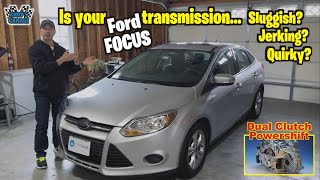
The 2012-2018 Ford Focus with an automatic transmission uses the Getrag/Ford DPS6 (also known as 6DCT250), a dry-clutch dual-clutch automated manual. Unlike a traditional automatic with a torque converter, it has two separate dry clutches (one for odd gears, one for even) that are supposed to provide fast, efficient shifts. However, this design proved notoriously unreliable, leading to widespread issues with shuddering, hesitation, and outright failure. The problems were so prevalent that they resulted in class-action lawsuits and multiple warranty extension programs from Ford. Internal Ford documents revealed the company was aware of the issues before the cars even went on sale. Therefore, a P0730 code on this car is rarely a simple fix and is almost always tied to the fundamental design flaws of the DPS6 transmission.
Symptoms You May Notice
- Check Engine Light is on
- Transmission warning light illuminated ('Transmission Fault Service Now')
- Severe shuddering or vibration on light acceleration.
- Harsh, jerky, or delayed shifts.
- Hesitation when accelerating from a stop.
- Transmission slipping out of gear or seemingly shifting into neutral while driving.
- Vehicle enters 'limp mode,' limiting gear selection.
- Car refuses to move from a stop, then engages harshly.
- Engine revs up with no corresponding increase in speed.
- Replacing only the transmission fluid. While low or dirty fluid can cause P0730 in traditional automatics, on the DPS6 Focus it is almost always a symptom of a larger mechanical or electronic failure, like leaking seals.
- Blaming the clutch when the TCM is the root cause, or vice-versa. Dealerships have been known to quote expensive clutch replacements when the issue was a warrantied TCM, and owners have replaced TCMs only to find the shudder from a worn clutch remains.
Most Likely Causes
- Failing Transmission Control Module (TCM) 🔴 High Probability → Shop Transmission Assembly The TCM on the DPS6 is known for internal failures, including bad solder joints and processor faults, due to heat and vibration. Ford extended the warranty on this part to 10 years/150,000 miles under program 14M02 because the failure rate was so high. TSB 16-0129 also addresses intermittent loss of engagement due to the TCM.
How to confirm: Diagnosis requires a high-level scan tool to check for specific TCM-related fault codes (like P0606, P0902, U0100) and to monitor live data. A dealer or specialized shop must perform this. Owners report dealerships can be reluctant to replace the TCM under warranty unless specific codes are present, even with clear symptoms.
Typical fix: Replacement of the TCM, followed by programming it to the vehicle and performing a clutch adaptive learn procedure using Ford's proprietary software (IDS).
Est. part cost: $500-$900 for a genuine Ford part. Aftermarket options are not recommended. - Worn or Contaminated Clutch Assembly 🔴 High Probability The input shaft seals on the DPS6 transmission were prone to leaking fluid onto the dry clutches. This contamination causes severe shudder and slippage. The clutch forks and release bearings are also common wear items. The design is fundamentally flawed and even replacement clutches can fail again.
How to confirm: A technician can perform a clutch shudder test as outlined in TSB 16-0109. Visual inspection during transmission removal will confirm fluid contamination or excessive wear. This was addressed in TSB 16-0109 and warranty extension 14M01.
Typical fix: Replacement of the entire dual-clutch and fork assembly. This is a major, labor-intensive repair. Using a quality LUK RepSet kit is highly recommended over cheaper alternatives, which are known to fail quickly. A successful repair must be followed by the adaptive learning procedure.
Est. part cost: $700-$1200. Real-world repair quotes from owners range from $1800 to over $3500 including labor. - Faulty Clutch Actuator Motors 🟡 Medium Probability The transmission uses two electric motors to move the shift forks and engage the clutches. These motors can fail due to internal wear or electrical issues, leading to an inability to select gears properly.
How to confirm: Specific diagnostic trouble codes, such as P090C (Clutch Actuator 'B' Circuit Low) or P0902, will point to a fault in an actuator circuit. A technician can sometimes swap the upper and lower actuators to see if the fault code follows the part, confirming the failure.
Typical fix: Replacement of the faulty actuator motor. This is a relatively less expensive repair compared to the TCM or clutch.
Est. part cost: $100-$200
Rare But Worth Checking
- Damaged Wiring or Poor Grounds: The main chassis ground connections near the battery and on the transmission itself are a known weak point. Ford often painted the chassis and then attached the ground lugs, leading to poor electrical contact. Cleaning the paint from under the ground points to create a bare-metal connection is a well-documented fix in owner forums for various electrical gremlins. A bad ground can cause communication errors (like U-codes) and mimic TCM failure.
- Internal Mechanical Failure: While less common than TCM or clutch failure, other internal components like bearings, shift forks, or gears can fail, causing a P0730 code. This usually results in a complete transmission replacement or rebuild.
Diagnosis Steps
- Scan for all diagnostic trouble codes in the TCM and PCM. Note any codes that accompany P0730, especially TCM-specific or communication codes.
- Check the vehicle's VIN against Ford's recall and customer satisfaction program database for open warranty extensions like 14M01 (Clutch) and 14M02 (TCM).
- Inspect the main chassis ground points for the TCM near the battery and on the transmission housing. Check for corrosion, looseness, or paint under the contacts.
- Using a professional scan tool, monitor live data from the input and output speed sensors to look for discrepancies.
- If shudder is the primary complaint, a technician should perform the clutch shudder test as outlined in TSB 16-0109.
- If TCM or actuator codes are present, follow the specific diagnostic procedures for those components. This may involve testing circuits or swapping actuators to isolate the fault.
- If diagnostics point to an internal failure, the transmission will need to be removed for inspection of the clutch assembly and input shaft seals.
Parts You'll Likely Need
- Transmission Control Module (TCM)
(OEM #AE8Z-7Z369-F (supersedes AE8Z-7Z369-B, -D, -E))— This is the brain of the transmission and the most common failure point on the DPS6, responsible for a host of shifting problems. Ford issued warranty extension 14M02 for this part. Upgraded versions feature more robust soldered connections to prevent failures seen in the original design.
Trusted brands: Motorcraft (Ford OEM)
OEM price range: $500-$900
Aftermarket price range: N/A - Aftermarket/rebuilt units are not recommended. - Dual Clutch and Fork Assembly Kit
(OEM #F1FZ-7B546-B)— The second most common failure. Leaking input shaft seals contaminate the dry clutches, causing shudder and slip. The kit replaces the clutches, forks, and bearings.
Trusted brands: Motorcraft, LUK (often considered the OEM supplier and recommended by independent technicians)
OEM price range: $800-$1000
Aftermarket price range: $650-$800 (for LUK RepSet)
Related Codes That Often Appear With This One
- P07A3 — Indicates a friction element or clutch is stuck on.
- P0902 — Indicates a problem with the clutch actuator 'B' circuit, often related to a failing TCM or actuator motor.
- P287A — Indicates clutch 'B' is stuck engaged, a common symptom of a failing clutch pack or actuator.
- U0100 — Indicates Lost Communication with ECM/PCM. This often points towards a failing TCM or a bad ground connection.
Technical Service Bulletins (TSBs) & Recalls
- TSB 16-0109: Outlines the official diagnostic procedure for excessive clutch shudder, which may involve replacing the clutch assembly due to contaminated or worn parts.
- TSB 16-0129: Addresses intermittent loss of transmission engagement, no-start, or loss of power, often pointing to a faulty TCM. It details the procedure for replacing the TCM and reprogramming.
- Bulletin #16-0057: While specifically for stripped chassis vehicles with TorqShift transmissions, this bulletin confirms that a MIL with DTC P0730 can be triggered by internal transmission issues.
- Bulletin #TSB160057: A manufacturer service bulletin noting that vehicles may exhibit a Malfunction Indicator Lamp (MIL) with diagnostic trouble codes P0730, P0751, and/or P2700.
Platform-Specific Known Issues
- Class-Action Lawsuits: Ford has faced numerous class-action lawsuits regarding the DPS6 transmission, leading to settlements that included vehicle buybacks and cash payments for owners.
- Customer Satisfaction Program 14M01: Ford extended the warranty on the clutch assembly and input shaft seals to 7 years or 100,000 miles for shudder and leak issues.
- Customer Satisfaction Program 14M02: Ford extended the warranty on the
Mechanic-Grade Diagnostic Values
- TCM Live Data PIDs: Input Shaft Speed Sensor A (ISSA) and B (ISSB) at idle in Park. — expected: 0 RPM. Failure: If either ISSA or ISSB shows RPMs (e.g., 800 RPM), it indicates the corresponding clutch (A or B) is dragging or not fully disengaging.
- TCM Power Supply Voltage at Connector C1750 — expected: Greater than 10 volts. Failure: Voltage below 10 volts indicates a problem in the power supply circuit to the TCM, which can cause various fault codes.
- TCM Ground Circuit Resistance — expected: Less than 5 ohms. Failure: Resistance greater than 5 ohms between the TCM connector ground pins and a known good chassis ground points to a bad ground, a very common issue.
- Clutch Motor Hall-Effect Sensor Supply Voltage — expected: Greater than 4.5 volts. Failure: Low voltage at the clutch motor connector (C1633) suggests a wiring or TCM internal fault.
Scan Tool Commands That Help
- Ford IDS (or FORScan): TCM Adaptive Learning / Clutch Touch Point Learn — This procedure MUST be performed after replacing the TCM, clutch assembly, or clutch actuators. It allows the TCM to learn the engagement points of the new components. Failure to perform this step will result in harsh shifting, shudder, and other driveability issues.
- Ford IDS (or FORScan): Transmission Adaptive Learning-Shift Drum Adaptive Learning — Used to resolve certain shifting-related DTCs like P072B (Stuck In Reverse). This function relearns the positions of the gear selector drums.
- Ford IDS (or FORScan): Live Data Monitoring (PIDs: ISSA, ISSB, Clutch Slip A, Clutch Slip B) — Crucial for diagnosing a dragging clutch. By monitoring input shaft speeds with the engine running in Park, a technician can determine if a clutch is failing to disengage, which is a key step before removing the transmission.
Wiring & Ground Locations
- G104 — On the driver's side strut tower area, under the hood. This is the main chassis ground point for the battery negative cable.. Ford painted the chassis before attaching the ground lug, leading to a poor connection that relies only on the bolt threads. This weak ground causes erratic behavior from the TCM, mimicking internal failure. Cleaning the paint to create a bare-metal connection is a common and effective fix for many electrical issues, including transmission faults.
- TCM Connectors C1750A / C1750B — On the Transmission Control Module (TCM) itself, which is mounted on the side of the transmission case.. These are the main connectors for all power, ground, and communication signals to the TCM. Pinpoint tests for voltage and resistance are performed here to confirm the health of the TCM's circuits before condemning the module.
- Engine Wiring Harness Chafe Point — A section of the main engine wiring harness can rub against a sharp edge of the intake manifold.. This rubbing can cut into wires, causing shorts that can trigger various codes, including communication errors (U-codes) or sensor faults that can be related to P0730. Ford issued TSB 15-0036 for this issue.
- Input/Output Speed Sensor Connectors — The two input speed sensors (A and B) are on the side of the transmission, visible after removing the battery tray. The output speed sensor (OSS) is on the bottom of the transmission near the right-hand axle.. The P0730 code is calculated from the readings of these sensors. The wiring pigtails to these sensors are known to chafe and break, causing incorrect signals and triggering the code. Inspecting these wires is a critical step.
Real Owner Repair Stories
- Reddit user, r/FordFocus (2013 Ford Focus SE Hatchback) — Sudden loss of power, 'Engine Fault - Repair Now' message, rough idle, car would not accelerate more than a tiny bit.
❌ Tried (didn't work) Replacing the accelerator pedal position sensor., Replacing the throttle body., Replacing the spark plugs.
✅ What actually fixed it The owner discovered TSB 15-0036, which describes the engine wiring harness rubbing against the intake manifold. Upon inspection, they found a gash in their harness that had cut into the wires, causing a short. The fix was to repair the damaged wires in the harness. - YouTube video by 'Ford Focus DCT Ground Mod' (2015 Ford Focus with DPS6) — Herky-jerky shifting, hesitation, general poor driveability characteristic of the DPS6 transmission.
❌ Tried (didn't work) Accepting it as a design flaw.
✅ What actually fixed it The owner performed the 'ground mod.' This involved unbolting the main chassis ground strap (G104) on the driver's side strut tower, sanding the paint off the chassis underneath the connector to expose bare metal, and re-securing the ground strap. This provided a much more stable ground for the car's electronics, including the TCM, which significantly smoothed out the transmission's operation.
Model Year Variations Within This Range
- 2011-2015 Fiesta, 2012-2016 Focus: TSB 16-0109, which addresses clutch shudder and leaking input shaft seals, has slightly different labor hour allowances for the Focus (5.7 hrs) versus the Fiesta (5.1 hrs) for the full clutch and seal replacement job, reflecting minor differences in the repair procedure.
Diagnostic Flowchart
Other Known Issues on This Vehicle
Issues unrelated to this code that are worth knowing about as an owner of this generation:
- Canister Purge Valve Failure 🟠 Medium — Very common across 2012-2018 models. Can cause stalling at idle, rough running, and difficulty starting after refueling. (Ref: NHTSA Recalls 18V735000 and 19V515000.)
- Power Steering Assist Failure 🔴 High — Common on earlier models (esp. 2012-2014), but can occur on all years. Can result in a sudden and complete loss of power steering while driving. (Ref: Subject of numerous NHTSA complaints.)
- Cracked Coolant Reservoir 🟡 Low — The plastic coolant expansion tank is known to develop hairline cracks, leading to slow coolant leaks.
- Worn Passenger Side Engine Mount 🟠 Medium — The hydraulic passenger-side engine mount frequently fails, causing excessive engine vibration to be felt in the cabin, especially at idle. (Ref: A very common wear item reported by owners.)
- Door Latch Failures 🟠 Medium — Failures can cause 'door ajar' warnings to stay on or, more seriously, doors that may not latch securely. (Ref: Subject of multiple recalls.)
Used vs. New Parts: Buying Guide for This Vehicle
When a used part is the smart pick: For this specific vehicle and code, used parts are generally a poor choice for the primary failure components. However, a used clutch actuator motor from a verified low-mileage donor vehicle could be a viable option if diagnostics confirm it is the sole point of failure.
Donor-vehicle mileage cap: roughly under 50000 miles for the part to have meaningful remaining life.
What to inspect on the donor part:
- Verify the donor vehicle's mileage.
- Check for any signs of external damage or corrosion on the part.
- If possible, confirm the donor vehicle did not have transmission-related fault codes.
OEM-only on this vehicle (don't cheap out):
- Transmission Control Module (TCM): Used TCMs will have the same design flaws as the original and are likely near the end of their life. Remanufactured units from reputable sources (like Dorman) or new OEM parts are the only reliable options.
- Clutch and Fork Assembly: This is a wear item with a flawed design. Installing a used clutch is guaranteeing a repeat failure in the near future. Always use a new, quality kit (OEM or LUK).
Aftermarket brands forum-validated for this vehicle:
- LUK: For the clutch assembly, LUK is widely considered to be the original equipment manufacturer and is highly recommended by independent technicians.
Brands owners have reported issues with on this vehicle:
- No-name/unbranded clutch kits from online marketplaces are known to fail very quickly.
Real Owner Stories
Aggregated from forums and TSBs cited above. Mileages and costs reflect what owners reported in those sources.
2012-2018 Ford Focus
Symptoms: Grinding noise, followed by the car refusing to move from a stop and then jerking hard into gear, accompanied by Check Engine and Transmission warning lights.
What fixed it: The owner reported the P0730 code (incorrect gear ratio) and symptoms consistent with DPS6 transmission failure.
Source hint: Reddit r/FordFocus - 'I got p0730 code which reads incorrect gear ratio'
2012-2018 Ford Focus
Symptoms: Severe shuddering and transmission issues requiring a full clutch assembly replacement.
What fixed it: Replacement of the entire dual-clutch and fork assembly.
Cost: $1800-$3500
Source hint: Reddit r/FordFocus - 'Cost for clutch assembly replacement?'
2012-2018 Ford Focus
Symptoms: Electrical issues that mimic TCM failure.
What fixed it: Removing the ground straps, grinding the paint away to bare metal on the chassis near the battery and transmission housing, and reattaching the straps.
Source hint: Reddit r/FordFocus - 'Focus TCM Fix: Ground Strap Modification'
2012-2018 Ford Focus
Symptoms: Intermittent loss of engagement and TCM-related fault codes.
What fixed it: Replacement of the TCM followed by programming and a clutch adaptive learn procedure using Ford's proprietary software (IDS).
Source hint: TSB 16-0129
Related OBD-II Codes
Frequently Asked Questions
Is my 2012-2018 Ford Focus covered under a warranty extension for the TCM failure causing P0730?
Does TSB 16-0109 apply if my Focus is shuddering during acceleration?
Can I get my clutch replaced for free under a Ford program?
What should I do if my dealership refuses to replace the TCM under warranty because they don't see specific codes?
Is there a specific TSB for the 'Transmission Fault Service Now' message and loss of power?
Should I use an aftermarket clutch or TCM for my Ford Focus repair?
Helpful Videos

We Have This Part in Stock



The information in this article is provided for general reference and educational purposes only. Vehicle specifications, procedures, and part compatibility can vary by production date, trim level, and region. Always consult your vehicle's factory service manual and verify part numbers before purchasing or performing repairs. Safety-critical components such as airbags, seat belts, and braking systems should be installed by a qualified professional.
- Ford Focus:
- 🧭 Diagnostic Flowchart
- 🎬 Helpful Videos
- 🛍️ Shop This Part
- What's Unique About the 2012-2018 Ford Focus
- Symptoms You May Notice
- Most Likely Causes
- Rare But Worth Checking
- Diagnosis Steps
- Parts You'll Likely Need
- Related Codes That Often Appear With This One
- Technical Service Bulletins (TSBs) & Recalls
- Platform-Specific Known Issues
- Mechanic-Grade Diagnostic Values
- Scan Tool Commands That Help
- Wiring & Ground Locations
- Real Owner Repair Stories
- Model Year Variations Within This Range
- Other Known Issues on This Vehicle
- Used vs. New Parts: Buying Guide for This Vehicle
- Real Owner Stories
- 2012-2018 Ford Focus
- 2012-2018 Ford Focus
- 2012-2018 Ford Focus
- 2012-2018 Ford Focus
- Related OBD-II Codes
- Frequently Asked Questions
- 🎟️ Get 5% Off