

P0731 on 2019-2023 Ford Ranger: Incorrect 1st Gear Ratio Causes and Fixes
P0731 on a 2019-2023 Ford Ranger indicates the 10-speed 10R80 transmission is slipping in first gear. This is often caused by internal issues like a faulty main valve body or a failing CDF clutch drum, which are known problems for this transmission. A simple fluid check is the first step, but repair often requires professional service and may involve following procedures outlined in Ford Technical Service Bulletins (TSBs) like TSB 24-2046.
- P0731 on a 2019-2023 Ranger indicates a serious internal transmission problem, most often related to the main valve body or CDF clutch drum.
- This is a known issue with the 10R80 transmission, and Ford has issued service bulletins (like TSB 23-2123) to address it.
- While checking the transmission fluid is a good first step, a resolution for this code typically requires professional service and may involve a valve body overhaul or transmission rebuild.
- Do not continue to drive the vehicle extensively, as this can turn a repairable issue into a complete transmission failure.
- Ensure any repairs use the latest updated parts from Ford to prevent a recurrence of the problem.
What's Unique About the 2019-2023 Ford RANGER
The 2019-2023 Ranger uses the Ford-GM co-developed 10R80 10-speed automatic transmission, which is known for specific mechanical and hydraulic issues. Unlike generic causes, problems on this platform often point to a faulty main control valve body due to sticking valves or a design issue with the 'CDF' clutch drum bushing that allows it to walk out of position, causing a significant hydraulic leak. Ford has issued multiple Technical Service Bulletins (TSBs), such as TSB 23-2123 and the superseding TSB 24-2046, that address harsh shifting, delayed engagement, and various ratio codes (including P0731) by recommending a valve body overhaul or, in more severe cases, replacement of the CDF clutch drum.
Diagnostic Flowchart
Tap your situation to follow the diagnostic path that matches what you're seeing on this vehicle.
Symptoms You May Notice
- Check Engine Light or Transmission Warning Light is on.
- Delayed or harsh engagement when shifting into Drive or Reverse.
- Sluggish, hesitant, or no acceleration from a stop.
- Engine RPMs rise without a corresponding increase in speed (slipping).
- Transmission gets stuck in a higher gear ('limp mode').
- Whining, grinding, or clunking noises from the transmission.
- Noticeable hesitation or a 'flare' in RPMs between shifts, particularly the 3-4 or 3-5 shift.
- Replacing only the speed sensors when the issue is mechanical slip.
- Assuming it's a simple fluid issue without checking for known mechanical faults like the valve body or CDF drum, which are covered by TSBs.
- Replacing the entire transmission when only a valve body overhaul or CDF drum replacement is needed.
- Clearing codes and performing a software update without addressing the underlying mechanical cause (sticking valves or CDF drum sleeve).
Most Likely Causes
- Main Control Valve Body Failure 🔴 High Probability → Shop Transmission Valve Body The 10R80 transmission is known for having issues with sticking valves or internal leaks in the valve body, causing pressure loss and incorrect gear engagement. TSB 24-2046 directly lists sticking valves in the main control valve body as a primary cause for a host of DTCs including P0731. The fix often involves a complete overhaul or replacement of the unit.
How to confirm: A technician can perform a pressure test and use a diagnostic scan tool (like Ford's IDS) to monitor solenoid commands versus actual gear engagement. The definitive diagnosis is made by following the procedure in TSB 24-2046, which may lead to a valve body overhaul.
Typical fix: Overhaul or replacement of the main control valve body. This involves removing the transmission pan to access and replace the unit, followed by a mandatory adaptive learning drive cycle.
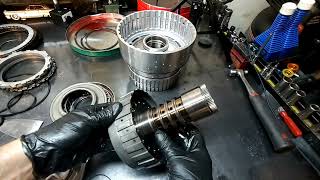
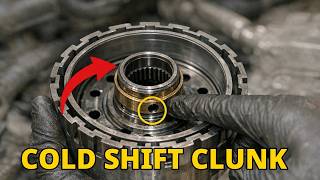
Est. part cost: $700-$1300 for an OEM part. - CDF Clutch Drum Failure 🔴 High Probability → Shop Transmission Clutch Pressure Plate Early versions of the 10R80 had a bushing in the CDF (Clutch F) drum that could slide out of place ('walk out'), uncovering oil passages and causing a major hydraulic pressure loss. This leads to slipping, harsh shifts, and various gear ratio codes. Ford later released an updated part with a machined lip 🎬 Watch: How the updated CDF drum fixes harsh shifting issues. to prevent the bushing from moving.
How to confirm: This is a major internal failure requiring transmission disassembly to inspect the CDF drum and its bushing. TSB 24-2046 provides a diagnostic path that can lead to identifying this failure. Visual inspection during a teardown will show the out-of-place bushing.
Typical fix: The transmission must be removed and completely disassembled to replace the CDF drum with the updated part (OEM Part # JL3Z-7H351-B). This is a very labor-intensive job, often done as part of a full transmission rebuild.
Est. part cost: $300-$600 for the part, but labor is extensive. - Low or Contaminated Transmission Fluid 🟡 Medium Probability → Shop Transmission Assembly While not specific to the Ranger, low fluid is a universal cause of transmission issues. The 10R80 is extremely sensitive to fluid level and condition, requiring only Mercon ULV fluid. Low fluid starves the system of hydraulic pressure needed to engage clutches. However, on this platform, low fluid is often a symptom of another problem (like a leak) rather than the root cause.
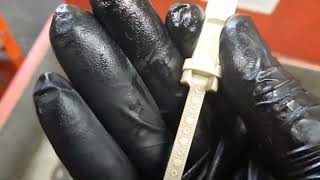
How to confirm: Check the transmission fluid level and condition according to the manufacturer's procedure. The 10R80 does not have a traditional dipstick, so this must be done from under the vehicle at a specific temperature. 🎬 See how to correctly check and add 10R80 transmission fluid. The fluid should be clean and red, not dark brown, burnt-smelling, or full of metallic particles.
Typical fix: Top off the fluid to the correct level or perform a transmission fluid and filter change. Use only Ford-specified Motorcraft Mercon ULV fluid. If the problem persists, a more serious mechanical issue is likely present.
Est. part cost: $150-$300 - Faulty Shift Solenoid ⚪ Low Probability → Shop Transmission Valve Body A solenoid responsible for engaging first gear can fail electrically or mechanically. While possible, it's less common than the systemic valve body or CDF drum issues on this specific transmission. Often, solenoid codes appear as a result of the valve body or CDF drum issue, not as the root cause.
How to confirm: A diagnostic scan tool can often detect a specific solenoid circuit fault. A technician can also test the solenoid's resistance and function, but this is usually done during a valve body inspection.
Typical fix: Replace the faulty solenoid. This requires dropping the transmission pan and valve body. Solenoids are typically replaced as a set during a valve body overhaul.
Est. part cost: $50-$150 per solenoid, or included with a valve body assembly.
Rare But Worth Checking
- Faulty Input/Output Speed Sensor: A failing speed sensor can send incorrect data to the TCM, causing it to miscalculate the gear ratio. This will usually be accompanied by other speed sensor-specific fault codes.
- Damaged Wiring or Connectors: Corrosion or damage to the wiring harness leading to the transmission can interrupt signals between the TCM and the transmission's sensors or solenoids. This is a possible but uncommon cause.
- Faulty Transmission Control Module (TCM): → Shop Transmission Assembly In rare cases, the TCM itself can fail, leading to incorrect commands or calculations. This is usually diagnosed after all other mechanical and electrical possibilities have been ruled out.
Diagnosis Steps
- Check and verify the transmission fluid level and condition. Ensure the correct Motorcraft Mercon ULV fluid is used.
- Use a professional scan tool (Ford IDS preferred) to check for any other pending or active transmission-related DTCs. Note all codes, as they are critical for diagnosis per Ford TSBs.
- Review live data from the input speed sensor, output speed sensor, and commanded vs. actual gear PIDs to confirm the slip in 1st gear.
- Consult Ford Technical Service Bulletins. Specifically, TSB 24-2046 provides a detailed diagnostic procedure for these symptoms and codes.
- Follow the TSB diagnostic tree, which may involve a valve body overhaul. During this process, a technician inspects for sticking valves.
- If the TSB procedure points towards it, or if the valve body overhaul does not resolve the issue, a full transmission teardown is required to inspect and replace the CDF clutch drum 🎬 Watch: A detailed look at internal CDF drum failure. with the updated part.
Parts You'll Likely Need
- Main Control Valve Body
(OEM #JL3Z-7A100-D (supercedes earlier versions))— This is a primary failure point on the 10R80 transmission causing pressure loss and shift problems, as acknowledged in Ford TSBs 23-2123 and 24-2046.
Trusted brands: Motorcraft
OEM price range: $700-$1300
Aftermarket price range: $500-$900 (Remanufactured) - CDF Clutch Drum
(OEM #JL3Z-7H351-B (Updated part))— A known design flaw in earlier 10R80s can cause this drum's bushing to fail, leading to pressure loss and slipping. Replacement requires a full transmission rebuild and is a permanent fix for the bushing walking out.
Trusted brands: Motorcraft
OEM price range: $300-$600 - Transmission Fluid and Filter Kit
(OEM #Motorcraft MERCON ULV Automatic Transmission Fluid (XT-12-QULV))— Any internal transmission service requires draining the fluid. The 10R80 is highly sensitive to fluid type and cleanliness. A fluid and filter change is the first step in diagnosis and required for any repair.
Trusted brands: Motorcraft
OEM price range: $150-$300
Related Codes That Often Appear With This One
- P0729, P0732, P0733, P0734, P0735 — These are incorrect gear ratio codes for other gears. When multiple appear, it points to a systemic issue like low fluid, a failing valve body, or major internal failure.
- P0751, P0756, P0761, etc. — These are shift solenoid performance codes. They are explicitly listed alongside ratio codes in Ford's TSBs for the 10R80, pointing directly to a failing valve body or CDF drum issue.
Technical Service Bulletins (TSBs) & Recalls
- TSB 25-2134: Mentions P0731 among a list of DTCs related to transmission issues.
- TSB 25-2024: Also lists P0731 with other transmission codes for shift quality concerns.
- TSB 23-2123: Supersedes a previous TSB and details a procedure to overhaul the main control valve body to fix harsh shifts and ratio codes like P0731 on 2019-2023 Rangers.
- TSB 24-2046: Addresses harsh/delayed shifts due to issues with the solenoid strategy, sticking valves in the main control valve body, and movement of the CDF clutch cylinder sleeve.
Platform-Specific Known Issues
- TSB 24-2046: This is the most current and relevant TSB, superseding TSB 23-2123. It directly addresses P0731 among many other codes for harsh/delayed shifts. It identifies the cause as sticking valves in the main control body OR axial movement of the CDF clutch cylinder sleeve. The procedure guides technicians on how to diagnose and fix the specific issue.
- TSB 23-2123: This earlier TSB also addressed harsh shifts and the same list of DTCs, but primarily focused on overhauling the main control valve body after a potential software update and adaptive learning cycle failed to fix the issue.
- Forum Consensus on Ranger5G.com and F150Forum.com: Owners on these forums frequently discuss the 10R80's harsh shifting and eventual failure leading to codes like P0731. Many threads corroborate that the dealer fix involves either the valve body replacement or a full CDF drum replacement under TSBs, with some owners unfortunately needing multiple visits.
Mechanic-Grade Diagnostic Values
- Shift Solenoid Resistance — expected: 5.0 - 5.4 Ohms at 68°F (20°C). Failure: Readings outside this range indicate a faulty solenoid coil.
- Torque Converter Clutch (TCC) Solenoid Current — expected: Proportional; low pressure at low current (50 mA), high pressure at high current (850 mA).. Failure: Pressure that doesn't change smoothly with current, or is incorrect for a given current, indicates a worn or sticking solenoid.
- Line Pressure Control (LPC) Solenoid Current — expected: Inversely proportional; full pressure at low current (50 mA), low pressure at high current (850 mA).. Failure: Pressure that doesn't respond correctly to current changes points to a faulty LPC solenoid.
Scan Tool Commands That Help
- FORScan / Ford IDS: Clear Transmission Adaptive Tables / Reset KAM — This function must be performed after replacing the valve body, the entire transmission, or performing a fluid change. It erases the learned shift strategies, which is the first step before performing the mandatory adaptive learning drive cycle.
- FORScan / Ford IDS: Solenoid Body Strategy Programming — When a new main control valve body is installed, its unique 13-digit solenoid strategy number must be programmed into the TCM. Failure to do so will result in poor shifting as the TCM will be using incorrect data for the new solenoids.
- Ford IDS / Professional Scan Tool: Live Data Monitoring (PIDs) — To diagnose P0731, a technician must monitor the PIDs for Input Shaft Speed (TSS), Output Shaft Speed (OSS), and Commanded Gear. A slip is confirmed when the commanded gear is 1st, but the ratio between the TSS and OSS does not match the 1st gear ratio.
Wiring & Ground Locations
- C175T — This is a large multi-pin connector at the Powertrain Control Module (PCM), often located on the firewall.. This connector contains the pins for the Turbine Shaft Speed (TSS) sensor, Output Shaft Speed (OSS) sensor, and various shift solenoids. A technician can back-probe pins here to test for correct voltage, resistance, and signal from these critical transmission components without having to access the transmission directly.
- G104 / G103 — On Ford Rangers, these are common ground points located in the engine compartment on the left (driver's) side, near the front.. A poor PCM or sensor ground can cause erratic signals and incorrect readings, potentially leading to false transmission codes. Verifying that these grounds are clean and tight is a crucial step in diagnosing any electronic fault code.
Real Owner Repair Stories
- Ford F150 Forum user (2018 Ford F-150 (shares 10R80 transmission)) — Harsh shifting and transmission fault codes.
❌ Tried (didn't work) Initial diagnosis and attempts to reprogram the solenoid strategy failed, returning a 'Solenoid Not Found' error from Ford's servers.
✅ What actually fixed it The user installed a new main control valve body. The final fix required successfully programming the new solenoid strategy into the PCM/TCM to resolve the error codes and shifting issues.
OEM Part Supersession History
JL3Z-7A100-B→JL3Z-7A100-D— Supersession for updated parts or revisions to the main control valve body assembly.
Heads up: JL3Z-7A100-D is the direct replacement for -B. When replacing, the new solenoid body strategy ID must be programmed into the TCM.
Model Year Variations Within This Range
- 2019 - Mid-2022: Vehicles built on or before August 15, 2022, were more prone to the CDF clutch drum bushing 'walking out'. Later models, particularly 2023 and newer, are more likely to have the updated CDF drum from the factory, which has a machined lip to prevent the bushing from migrating.
Helpful Videos

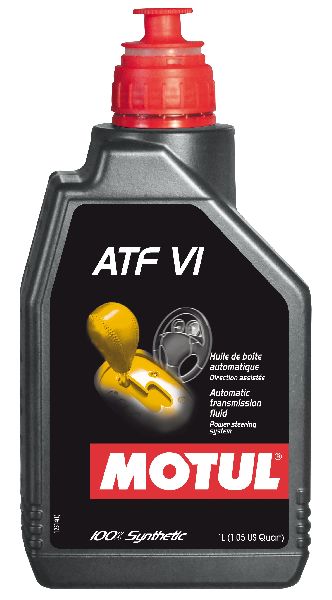
We Have This Part in Stock


The information in this article is provided for general reference and educational purposes only. Vehicle specifications, procedures, and part compatibility can vary by production date, trim level, and region. Always consult your vehicle's factory service manual and verify part numbers before purchasing or performing repairs. Safety-critical components such as airbags, seat belts, and braking systems should be installed by a qualified professional.
- Ford RANGER:
- 🧭 Diagnostic Flowchart
- 🎬 Helpful Videos
- 🛍️ Shop This Part
- What's Unique About the 2019-2023 Ford RANGER
- Symptoms You May Notice
- Most Likely Causes
- Rare But Worth Checking
- Diagnosis Steps
- Parts You'll Likely Need
- Related Codes That Often Appear With This One
- Technical Service Bulletins (TSBs) & Recalls
- Platform-Specific Known Issues
- Mechanic-Grade Diagnostic Values
- Scan Tool Commands That Help
- Wiring & Ground Locations
- Real Owner Repair Stories
- OEM Part Supersession History
- Model Year Variations Within This Range
- 🎟️ Get 5% Off