

P0731 on 2019-2023 Lincoln Navigator: Gear 1 Incorrect Ratio Causes and Fixes
P0731 on a 2019-2023 Lincoln Navigator most often indicates an internal transmission problem related to the CDF clutch assembly, a known issue with the 10R80 transmission. A bushing in the CDF clutch drum can 'walk' out of place, causing a hydraulic leak and harsh/failed shifts. The fix requires transmission removal to install an updated drum (Part No. JL3Z-7H351-B). This is a complex, expensive repair and not a typical DIY job.
- P0731 on a 2019-2023 Navigator indicates a slipping condition in first gear.
- The most probable cause is a known internal transmission defect related to the CDF clutch drum, as documented in manufacturer TSBs.
- This is not a simple fix; professional diagnosis involving hydraulic pressure testing is required, and the repair involves removing the transmission.
- Always use the specified Motorcraft MERCON ULV transmission fluid for this 10-speed transmission.
- Do not ignore this code, as continued driving can lead to more severe and costly internal transmission damage.
What's Unique About the 2019-2023 Lincoln NAVIGATOR
The 2019-2023 Lincoln Navigator uses the Ford 10R80 10-speed automatic transmission, co-developed with GM. This specific transmission is known to have a design flaw with a component called the CDF clutch drum. Multiple Technical Service Bulletins (TSBs) point to a sleeve/bushing within this drum migrating or 'walking' out of its intended position. This movement partially blocks hydraulic fluid passages that actuate the C, D, and F clutch packs. The restriction leads to delayed and harsh clutch engagement, causing the slip that triggers the P0731 code. This makes the issue a specific, well-documented mechanical fault rather than a generic 'transmission slipping' problem.
Diagnostic Flowchart
Tap your situation to follow the diagnostic path that matches what you're seeing on this vehicle.
Symptoms You May Notice
- Check Engine Light is on
- Powertrain Malfunction (Wrench) light may be illuminated
- Harsh or delayed shifting, especially into first gear
- A loud clunk or bang when shifting, particularly from Park to Drive or during the first few shifts when cold
- Vehicle hesitates or has poor acceleration from a stop
- Transmission may feel like it's slipping
- Vehicle may enter "limp mode," getting stuck in a higher gear and displaying a message about reduced power
- Replacing only the transmission speed sensors without checking for internal hydraulic leaks. If the underlying cause is the CDF clutch drum, new sensors will not fix the problem.
- Performing a transmission fluid flush without addressing the root mechanical cause. While fresh fluid might temporarily improve symptoms, it will not fix the bushing migration in the CDF drum.
Most Likely Causes
- Faulty CDF Clutch Cylinder/Drum 🔴 High Probability → Shop Automatic Transmission Coast Clutch Hub As documented in multiple Ford/Lincoln TSBs (including TSB 24-2254), the bushing in the CDF clutch cylinder can move axially, causing internal hydraulic leaks. This is a widely recognized design flaw in the 10R80 transmission. Ford has released an updated part with a machined lip to prevent the bushing from walking out.
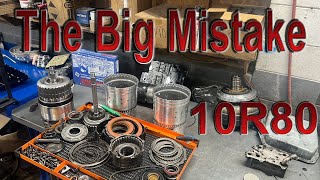
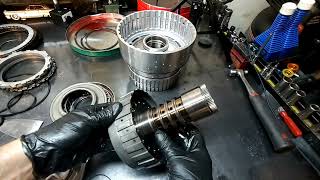
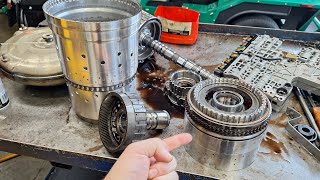
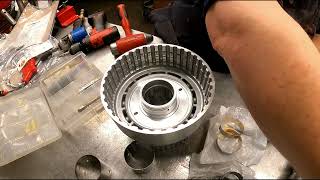
How to confirm: A technician will perform hydraulic pressure tests as outlined in service manuals. A significant pressure drop in the affected circuits confirms an internal leak. Visually, a transmission teardown is the only way to see the migrated bushing. 🎬 See a teardown showing exactly how the bushing fails internally.
Typical fix: The transmission must be removed and disassembled to replace the faulty CDF clutch cylinder assembly with the updated part (OEM Part No. JL3Z-7H351-B). Some TSBs also recommend replacing the main valve body at the same time.
Est. part cost: $150-$400 - Low or Contaminated Transmission Fluid 🟡 Medium Probability → Shop Transmission Assembly While not a design flaw, the 10R80 is very sensitive to fluid level and condition. Low fluid can cause pressure loss, leading to slipping and incorrect ratio codes.
How to confirm: Check the transmission fluid level and condition. The 10R80 transmission does not have a traditional dipstick, so this must be done by a technician from underneath the vehicle with the engine running and transmission at a specific temperature. Fluid should be clean, red, and at the proper level. Burnt-smelling or dark fluid indicates a problem.
Typical fix: Perform a transmission fluid drain and fill, or a full fluid exchange, using only the correct Motorcraft MERCON ULV fluid (Part No. XT-12-QULV) and replace the filter.
Est. part cost: $150-$300 - Main Control Valve Body or Solenoid Failure ⚪ Low Probability → Shop Transmission Valve Body Sticking valves or failing solenoids within the valve body can cause erratic pressure and shifting issues that mimic the CDF drum failure. It is a known, but less common, point of failure compared to the CDF drum.
How to confirm: A diagnostic scan tool can command individual solenoids to check for response. The valve body can be removed and inspected for sticking valves or contamination. Often, it is replaced as a diagnostic step if fluid is clean and the CDF drum is suspected but not yet confirmed.
Typical fix: Replace the main control valve body assembly (OEM Part No. JL3Z-7A100-B).
Est. part cost: $500-$1200
Rare But Worth Checking
- Faulty Transmission Speed Sensor: → Shop Transmission Assembly While less common, a failing input or output speed sensor can send incorrect data to the TCM, causing it to miscalculate the gear ratio and set a P0731 code. This is often accompanied by other speed sensor-specific codes.
- Powertrain Control Module (PCM/TCM) Software Issue: Outdated software can sometimes cause shifting irregularities. Checking for available PCM/TCM updates is a standard early diagnostic step and the least intrusive action to take first.
Diagnosis Steps
- Verify the transmission fluid level and condition using the correct procedure for the 10R80 (no dipstick). Ensure it is full and not burnt or contaminated.
- Use a professional scan tool to check for any other transmission-related trouble codes and review live data for input/output speed sensor correlation.
- Check for available PCM/TCM software updates with a Ford-specific scan tool. This is the least invasive first step.
- Check for applicable Technical Service Bulletins (TSBs) for the vehicle's VIN. Specifically, look for TSBs related to the 10R80 transmission and harsh shifting, such as TSB 24-2254 or TSB 23-2061.
- If a TSB related to the CDF clutch drum exists, follow the prescribed diagnostic procedure, which typically involves performing specific hydraulic pressure tests to check for internal leakage.
- If pressure tests indicate a leak, the transmission must be removed for inspection and replacement of the CDF clutch cylinder with the updated part.
- If pressure tests are inconclusive, further diagnosis of the main control valve body, solenoids, and internal wiring may be necessary.
Parts You'll Likely Need
- CDF Clutch Cylinder Hub Assembly
(OEM #JL3Z-7H351-B)— This is the updated OEM part that corrects the original design flaw where a bushing could 'walk' out of place. It supersedes older part numbers 🎬 Watch: A detailed walkthrough of the CDF drum repair process. like HL3Z-7H351-A and JL3Z-7H351-A.
Trusted brands: Ford (Motorcraft)
OEM price range: $150-$250 - Automatic Transmission Fluid (Mercon ULV)
(OEM #XT-12-QULV)— Required for any transmission service. The 10R80 uses this specific ultra-low viscosity fluid. Using the wrong fluid can cause damage.
Trusted brands: Motorcraft
OEM price range: $15-$25 per quart
Aftermarket price range: $10-$20 per quart - Main Control Valve Body Assembly
(OEM #JL3Z-7A100-B)— Often replaced as part of the CDF drum repair procedure outlined in some TSBs, or if it is diagnosed as the primary fault.
Trusted brands: Ford (Motorcraft)
OEM price range: $600-$900 - Transmission Filter Kit — Should be replaced any time the transmission pan is removed for service.
Trusted brands: Motorcraft
OEM price range: $50-$80
Aftermarket price range: $30-$60
Related Codes That Often Appear With This One
- P0732, P0733, P0734, etc. — These codes indicate incorrect gear ratios for other gears (2nd, 3rd, 4th). When seen with P0731, it strongly suggests a widespread internal hydraulic or mechanical issue, such as the CDF clutch problem which affects multiple clutch packs.
- P0729 — This code for 'Gear 6 Incorrect Ratio' is also listed in the same TSBs related to the CDF clutch failure, indicating a common root cause.
- P2700-P2708 — These codes relate to transmission friction element apply time and are also listed in the TSBs for the CDF clutch issue, pointing to a clutch engagement problem caused by the hydraulic leak.
Technical Service Bulletins (TSBs) & Recalls
- TSB 24-2254: Mentions DTC P0731 and points to axial movement of the CDF clutch cylinder as a potential cause for shifting issues on 2022 models.
- TSB 23-2061: Supersedes earlier TSBs and provides updated diagnostic and repair procedures for harsh shifting issues related to the CDF clutch drum in 10R80 transmissions.
- TSB 25-2023: Lists P0731 among many other codes related to transmission issues in 2019 models.
- TSB 26-2046: Lists P0731 among many other codes related to transmission issues in 2022 models.
Platform-Specific Known Issues
- Multiple TSBs, including #TSB 24-2254, have been issued for the 10R80 transmission used in the 2019-2023 Navigator. These bulletins address harsh or delayed shifts and a list of trouble codes including P0731. The primary cause identified is "axial movement of the CDF clutch cylinder sleeve causing hydraulic circuit leaks."
- The CDF drum failure is so common that the aftermarket has developed solutions and the repair is considered 'gravy' work by some transmission technicians due to its frequency.
Mechanic-Grade Diagnostic Values
- Line Pressure Control (LPC) Solenoid Current — expected: Low or no current (approx. 50 mA) results in full line pressure.. Failure: High current (approx. 850 mA) results in very low pressure. The control current should not go to zero when commanded off.
- Torque Converter Clutch (TCC) Solenoid Current — expected: High current (approx. 850 mA) results in high pressure (apply).. Failure: Low or no current (approx. 50 mA) results in very low pressure (release).
- Shift Solenoid (A-F) Operation — expected: These are directly proportional; maximum current equals maximum pressure.. Failure: Zero current results in zero pressure. An open power circuit to the solenoids will prevent all clutches from engaging.
Scan Tool Commands That Help
- FORScan or Ford IDS: Clear Transmission Adaptive Tables — This service function is used to reset all learned shift, clutch fill, and pressure data. It is a critical first step before performing the adaptive learning drive cycle after a fluid change, software update, or major component replacement.
- FORScan or Ford IDS: Adaptive Learning Drive Cycle — This is not a direct command, but a mandatory procedure to be performed after clearing the adaptive tables. It involves a specific sequence of light-throttle accelerations, stops, and gear selections (N, R, D) to allow the TCM to relearn clutch fill times and pressures for smooth shifting. Failure to perform this can result in continued poor shift quality even after a successful repair.
- FORScan: Halt/Resume Transmission Adaptive Learning — This function can be used to temporarily disable the transmission's learning process. Some users do this to maintain a consistent shift feel, but it is generally not recommended as it prevents the transmission from adapting to wear over time.
Wiring & Ground Locations
- Transmission Bulkhead Connector — The main electrical connector on the exterior of the transmission case where the vehicle's wiring harness connects to the internal transmission components (lead frame, solenoids, sensors).. This is the primary interface for all electronic commands and sensor feedback. A poor connection, corrosion, or damaged pins at this connector can interrupt signals from the speed sensors or commands to the shift solenoids, potentially causing incorrect ratio codes. A full wiring diagram is needed for pin-specific testing.
- Line Pressure Test Port — This is a threaded port on the transmission case, typically an M10 x 1.00 thread. Access requires removing the transmission fluid cooler.. This port is essential for performing a line pressure test to confirm or rule out an internal hydraulic leak, which is the main symptom of CDF drum failure. Using an incorrect thread pitch (like NPT) will damage the case.
Real Owner Repair Stories
- Reddit user in r/f150 (2018 Ford F-150 EcoBoost, 145k miles) — Crazy shift problems, including floating between gears and then slamming into another. Reported the transmission trying to shift into 1st gear at 80 mph.
❌ Tried (didn't work) Transmission relearn procedure, Valve body replacement
✅ What actually fixed it The user found a TSB that led them to diagnose the CDF drum. The final fix was replacing the faulty CDF drum, which had a failed Teflon ring seal due to the known bushing migration issue.
OEM Part Supersession History
HL3Z-7H351-A→JL3Z-7H351-A— Initial revision of the part.
Heads up: Superseded by newer versions due to the bushing migration issue.JL3Z-7H351-A→JL3Z-7H351-B— The final revision, JL3Z-7H351-B, incorporates a machined lip on the inner half of the drum. This lip acts as a physical stop, preventing the inner sleeve/bushing from walking out of position and causing the hydraulic leak.
Heads up: JL3Z-7H351-B is the definitive fix and should be used in all repairs for this issue.
Model Year Variations Within This Range
- 2017 - Mid-2022: Vehicles built on or before August 15, 2022, are more likely to have the original CDF clutch drum design that is prone to the bushing migration failure. TSB 22-2428 notes that vehicles built after this date may have the revised part from the factory. Another source suggests the change was implemented in the fall of 2022 or for vehicles built after December 23, 2022.
Helpful Videos
We Have This Part in Stock


The information in this article is provided for general reference and educational purposes only. Vehicle specifications, procedures, and part compatibility can vary by production date, trim level, and region. Always consult your vehicle's factory service manual and verify part numbers before purchasing or performing repairs. Safety-critical components such as airbags, seat belts, and braking systems should be installed by a qualified professional.
- Lincoln NAVIGATOR:
- 🧭 Diagnostic Flowchart
- 🎬 Helpful Videos
- 🛍️ Shop This Part
- What's Unique About the 2019-2023 Lincoln NAVIGATOR
- Symptoms You May Notice
- Most Likely Causes
- Rare But Worth Checking
- Diagnosis Steps
- Parts You'll Likely Need
- Related Codes That Often Appear With This One
- Technical Service Bulletins (TSBs) & Recalls
- Platform-Specific Known Issues
- Mechanic-Grade Diagnostic Values
- Scan Tool Commands That Help
- Wiring & Ground Locations
- Real Owner Repair Stories
- OEM Part Supersession History
- Model Year Variations Within This Range
- 🎟️ Get 5% Off