

P0732 on 2001-2005 Chevrolet Silverado: Gear 2 Incorrect Ratio Causes and Fixes
P0732 on a 2001-2005 Silverado indicates the transmission is slipping in 2nd gear. The most common fixes are addressing low or dirty transmission fluid or replacing a faulty shift solenoid (Part No. 24230298) inside the transmission pan. These initial fixes can cost between $50 and $200.
- P0732 on your Silverado means the transmission is slipping in second gear and should be addressed immediately to avoid severe damage.
- Always start diagnosis by checking the transmission fluid level and condition; this is the simplest and most common fix.
- A faulty 1-2 shift solenoid is a very common and relatively inexpensive cause for this code on the 4L60E/4L65E transmission.
- If the transmission fluid is dark, smells burnt, or contains significant metal debris, a full transmission rebuild or replacement is likely necessary.
- Do not ignore this code. Driving with a slipping transmission will quickly lead to a much more expensive failure.
What's Unique About the 2001-2005 Chevrolet SILVERADO
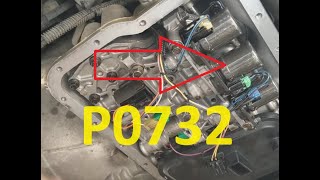
The 2001-2005 Silverado primarily uses the 4L60E or heavy-duty 4L65E automatic transmission. This code is very common on these units. While the cause can be as simple as low fluid, these transmissions are well-known for issues with the 1-2 and 2-3 shift solenoids failing. These solenoids (both are identical part number 24230298) are relatively inexpensive and located inside the transmission pan, making them a common point of failure that can be addressed without a full transmission removal.
Diagnostic Flowchart
Tap your situation to follow the diagnostic path that matches what you're seeing on this vehicle.
Symptoms You May Notice
- Check Engine Light is on
- Transmission slipping, especially in 2nd gear
- Harsh, delayed, or failed shifts into 2nd gear
- Engine RPMs flare up during the 1-2 shift without a corresponding increase in speed
- Vehicle skips 2nd gear entirely, shifting from 1st to 3rd
- Vehicle enters 'limp mode' (may be stuck in 3rd gear)
- Poor acceleration
- Decreased fuel economy
- Replacing the entire transmission when only a simple, inexpensive shift solenoid was faulty.
- Replacing speed sensors when the root cause was low or contaminated transmission fluid.
- Assuming an internal failure before checking for electrical issues, such as a blown fuse for the transmission solenoids as mentioned in TSB 01-07-30-002E.
Most Likely Causes
- Low or Dirty Transmission Fluid 🔴 High Probability → Shop Transmission Assembly Transmission fluid can be consumed by leaks over time or become contaminated, losing its hydraulic properties. Insufficient fluid reduces hydraulic pressure, preventing proper clutch engagement. It's the most common and fundamental issue for any transmission problem.
How to confirm: Check the transmission fluid dipstick for level and color. The fluid should be bright red and not smell burnt. If it's low, dark brown/black, or contains metal particles, it indicates a problem.
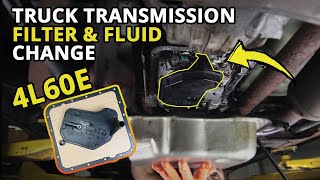
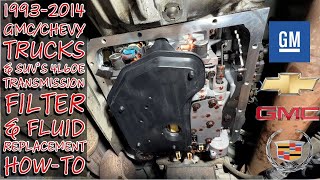
Typical fix: Top off the fluid if low. If the fluid is dirty or burnt, perform a transmission fluid and filter change. 🎬 Watch: Step-by-step guide to changing your transmission fluid and filter.
Est. part cost: $40-$100 - Failed Shift Solenoid 🔴 High Probability → Shop Transmission Valve Body The 4L60E/4L65E transmissions are known for shift solenoid failures. The solenoid is an electronic part that can wear out or fail electrically over time. The 1-2 (A) and 2-3 (B) solenoids are identical and a failure of either can cause shifting issues.
How to confirm: A professional scan tool can command the solenoid to activate. It can also be tested with a multimeter for proper resistance (typically 20-30 ohms) or by applying power from a 9V battery to listen for a 'click' after removing the transmission pan.
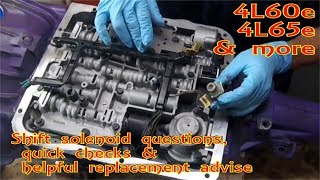
Typical fix: Drop the transmission pan, remove the old solenoid from the valve body, and install a new one. It is highly recommended to replace both the 1-2 and 2-3 shift solenoids (ACDelco 24230298) at the same time since they are the same part and subject to the same wear. 🎬 See how to replace the 1-2 and 2-3 shift solenoids.
Est. part cost: $30-$80 - Worn 2-4 Band or Internal Clutch Failure 🟡 Medium Probability High mileage, heavy towing, or aggressive driving can cause the internal friction materials, like the 2-4 band used for second gear, to wear out or break, leading to slippage. A broken band will result in a complete inability to engage 2nd gear.
How to confirm: This is often a diagnosis of exclusion. If fluid and solenoids are good, but the slip persists, internal wear is likely. A transmission pressure test can confirm low pressure in the 2nd gear circuit. Finding significant metal shavings or black clutch material in the pan is a definitive sign. In some cases, a broken band can be seen through the servo bore after removing the servo cover 🎬 Watch: Diagnosing a broken 2-4 band and internal failure symptoms. on the side of the transmission.
Typical fix: This requires a complete transmission rebuild or replacement.
Est. part cost: $1500-$3500 - Faulty Valve Body ⚪ Low Probability → Shop Transmission Valve Body Debris from dirty fluid or normal wear can clog the small passages in the valve body or cause valves to stick in their bores, preventing proper hydraulic pressure from reaching the 2nd gear clutches.
How to confirm: After dropping the pan, the valve body can be inspected for stuck valves or scoring. This is typically done by a transmission specialist. A common failure point in 4L60E valve bodies is wear in the TCC regulator valve bore, which can cause related issues and the code P1870.
Typical fix: The valve body can sometimes be cleaned and serviced with oversized valves or reamed bores. Often, it is replaced as a unit or with a remanufactured one.
Est. part cost: $200-$500
Rare But Worth Checking
- Faulty Input or Output Speed Sensor: While less common for this specific code, a failing sensor can send incorrect data to the TCM, causing it to miscalculate the gear ratio and falsely trigger the code. This usually sets other sensor-specific codes as well, such as P0722.
- Wiring Harness Issues: Damaged wires or corroded connectors between the TCM and the transmission can interrupt signals to and from the solenoids and sensors. TSB 01-07-30-002E points to a loss of voltage at the main transmission fuse (often due to a faulty ignition switch or bad aftermarket wiring) as a cause for being stuck in gear.
Diagnosis Steps
- Check the transmission fluid level and condition. This is the first and most important step.
- Use an OBD-II scanner to check for any other related trouble codes, such as those for specific solenoids (P0751, P0756) or sensors.
- Check fuses. Verify that the fuse supplying power to the transmission solenoids has power. A blown fuse can cause the transmission to default to 2nd or 3rd gear.
- With an advanced scan tool, monitor live data for input and output speed sensor readings to see if they are rational and consistent.
- If fluid is full and clean, the next logical step is to suspect a shift solenoid. Drop the transmission pan to access and test the 1-2 and 2-3 shift solenoids. Test resistance (should be 20-30 ohms) and listen for a click when applying 9V power.
- While the pan is off, inspect for excessive metal shavings or black clutch material. A small amount of fine grey material is normal, but large flakes, chunks, or a silvery sheen in the fluid indicate a serious internal failure.
- If solenoids test good and there is no major debris, the issue may be in the valve body or require a professional pressure test to diagnose internal hydraulic leaks or a worn/broken 2-4 band.
Parts You'll Likely Need
- Transmission Filter and Gasket Kit
(OEM #24208576 (ACDelco, Deep Pan))— Required whenever performing a fluid change or dropping the pan to access internal components like solenoids.
Trusted brands: ACDelco, ATP, Wix
OEM price range: $30-$50
Aftermarket price range: $15-$30 - 1-2 & 2-3 Shift Solenoid (Solenoid A & B)
(OEM #24230298)— This is one of the most common electrical failure points inside the 4L60E/4L65E transmission that directly causes the P0732 code. The 1-2 and 2-3 solenoids are identical and should be replaced as a pair.
Trusted brands: ACDelco, Bosch, Rostra
OEM price range: $25-$40
Aftermarket price range: $15-$30 - Automatic Transmission Fluid
(OEM #10-9395 (ACDelco DEXRON-VI))— Required for any service. These transmissions originally used DEXRON-III, but the modern recommended fluid is DEXRON-VI, which is fully backward-compatible and offers superior performance.
Trusted brands: ACDelco, Valvoline, Castrol
OEM price range: $8-$12 per quart
Aftermarket price range: $6-$10 per quart
Related Codes That Often Appear With This One
- P0731 — Incorrect Ratio in 1st Gear. If seen with P0732, it may point to a shared component like a solenoid or a more systemic issue like low fluid pressure.
- P0751 — Shift Solenoid 'A' Performance/Stuck Off. This code directly points to a problem with the 1-2 shift solenoid, a primary cause of P0732.
- P0756 — Shift Solenoid 'B' Performance/Stuck Off. This points to the 2-3 shift solenoid, which can also be involved in 2nd gear operation.
- P0894 — Transmission Component Slipping. This is a more general slipping code that often accompanies specific gear ratio codes like P0732.
- P1870 — Transmission Component Slipping. On 4L60E transmissions, this code often points to a worn TCC valve bore in the valve body, which can cause a variety of shifting issues.
Technical Service Bulletins (TSBs) & Recalls
- PIP4379K: Notes that codes including P0732 can be associated with conditions like no drive/reverse engagement, delayed shifts, or range inhibit, and advises technicians to follow standard service information for diagnosis.
- 01-07-30-002E: Addresses conditions where the transmission is stuck in second or third gear and may set codes like P0753 or P0758. It identifies the cause as a potential loss of voltage to the transmission solenoid power supply circuit, advising technicians to check the fuse and related wiring from the ignition switch before replacing internal parts.
Platform-Specific Known Issues
- The provided NHTSA Technical Service Bulletin (TSB) #PIP4379K lists P0732 among many other codes related to various shifting and engagement problems, indicating a known range of potential issues within the transmission that GM has acknowledged.
- TSB #01-07-30-002E is highly relevant, noting that a loss of voltage to the transmission solenoid power supply circuit (e.g., a blown fuse often labeled TRANS or IGN 0) can cause the 4L60E/4L65E to default to third gear and set multiple codes. This is a critical electrical check before assuming mechanical failure.
Mechanic-Grade Diagnostic Values
- 1-2 (A) & 2-3 (B) Shift Solenoid Resistance — expected: 20 to 30 Ohms (some sources say 20-40 Ohms). A more specific, healthy range is often cited as 21-25 Ohms.. Failure: A reading outside the 20-30 Ohm range, or an open/short circuit, indicates a failed solenoid.
- Transmission Line Pressure at Idle (Park/Neutral/Drive) — expected: 55-65 PSI.. Failure: Significantly lower pressure indicates a potential issue with the pump, filter, or a major internal leak.
- Transmission Line Pressure at Stall Speed or WOT — expected: Stock: 170-190 PSI. Performance builds can be higher, around 225-240 PSI.. Failure: Failure to build adequate pressure under load points to a weak pump, clogged filter, or significant internal hydraulic leaks.
- Pressure Control (EPC) Solenoid Resistance — expected: 3.5 to 8.0 Ohms.. Failure: Readings outside this range suggest a faulty EPC solenoid, which can cause widespread pressure and shifting problems.
Scan Tool Commands That Help
- Tech 2 / GDS2 (or equivalent professional scanner): Solenoid Control / Output Component Control — This bidirectional function allows a technician to command each shift solenoid on and off while the vehicle is stationary to verify electrical circuit integrity and listen for the solenoid's 'click' without dropping the pan. It's a critical step to differentiate between an electrical fault (solenoid, wiring) and a mechanical/hydraulic fault.
- Tech 2 / GDS2: PC Solenoid Amp Control — Used during a line pressure test, this function allows the technician to manually control the amperage sent to the Pressure Control (PC) solenoid and compare the resulting line pressure to a diagnostic chart. This directly tests the PC solenoid's ability to regulate pressure correctly.
Wiring & Ground Locations
- Engine-to-Firewall Ground Straps — Located at the rear of the engine, connecting the cylinder head(s) or engine block to the vehicle's firewall. There is typically one on the driver's side and one on the passenger's side.. These straps provide the primary ground path for the transmission solenoids and sensors. A corroded, loose, or broken strap can cause erratic solenoid behavior, voltage spikes, and incorrect sensor readings, leading to shifting problems and codes like P0732.
- PCM / Engine Block Grounds — A critical ground for the Powertrain Control Module (PCM) is located on top of the engine block, often near the front. Another major engine block ground is on the driver's side, towards the back, connecting the block to the battery negative cable.. A poor PCM ground can cause a multitude of incorrect sensor readings and commands, including those that control the transmission. A bad engine block ground can affect the entire electrical system, including the starter and transmission.
- Frame Grounds — The main battery negative cable connects to the frame near the radiator support. There are also body mount grounds near the B-pillar.. The entire vehicle body and frame are used as a ground plane. Corrosion at these main connection points can create resistance and cause widespread, difficult-to-diagnose electrical issues, including transmission problems.
- Transmission Case Connector (C2) — The main round electrical connector on the passenger side of the 4L60E transmission case.. This is the single point of connection for all internal electronics. Pin E is the 12V+ power feed for the shift solenoids. Pin A is the ground-side control for the 1-2 Shift Solenoid, and Pin B is for the 2-3 Shift Solenoid. Testing for voltage and continuity at these pins can diagnose external wiring issues.
Real Owner Repair Stories
- LS1Tech Forum User (2003 Chevrolet Tahoe 5.3L with 4L60E) — Initially, a slight 'miss' feel at the top of 2nd gear. Later, it would not shift into 2nd at all, skipping from 1st to 3rd gear. Eventually lost 4th gear and got a 'Trans Hot' message.
❌ Tried (didn't work) Clearing codes (problem returned)., Driving gently (problem worsened over time).
✅ What actually fixed it The user performed a transmission rebuild. The ultimate cause was determined to be a worn 2-4 band and failing 3-4 clutches, which are common wear items in high-mileage 4L60E transmissions. The initial symptom of skipping 2nd gear was a direct result of the worn 2-4 band.
OEM Part Supersession History
DEXRON-III→DEXRON-VI (e.g., ACDelco 10-9395)— DEXRON-VI was introduced in 2006 as a fluid with significantly improved shear stability, oxidation resistance, and friction durability.
Heads up: DEXRON-VI is fully backward-compatible and is the recommended service fluid for all GM automatic transmissions that originally specified DEXRON-III. Using DEXRON-III in a transmission that specifies DEXRON-VI is not recommended.10478131→24230298— Part number consolidation and potential minor updates by the manufacturer, ACDelco/GM.
Heads up: Part number 24230298 is the correct and current OEM part for the 1-2 and 2-3 shift solenoids for the entire 1993+ 4L60E/4L65E family. The parts are physically and functionally interchangeable.
Model Year Variations Within This Range
- 2005 (late production): Some late-2005 model year trucks began to be equipped with a 4L60E/4L65E that included an Input Speed Sensor (ISS). A transmission from a 2001-2004 truck (without ISS) will not function correctly in a 2005 truck that requires it, as the TCM will be looking for a sensor that isn't there. However, a later transmission with an ISS will generally work in an older truck, as the unused sensor is simply ignored by the older PCM.
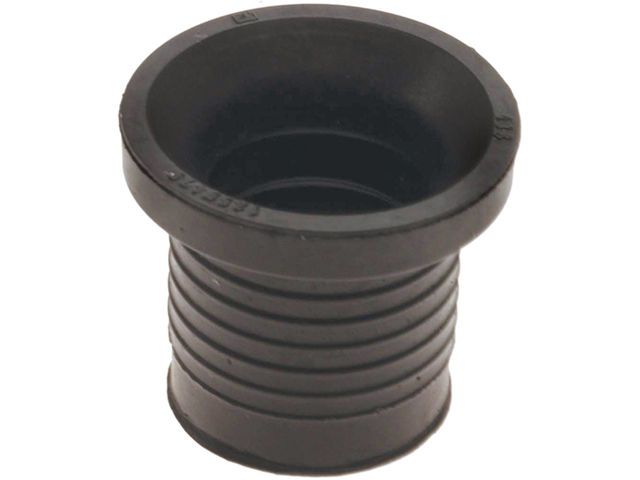
- 2004 (late production): Starting in late 2004, the front pump O-ring was replaced with a press-in metal-clad seal. This means that rebuild kits are often split between pre-2004 and 2004+ models. A 2004 truck could have either design depending on its build date.
Helpful Videos


We Have This Part in Stock

The information in this article is provided for general reference and educational purposes only. Vehicle specifications, procedures, and part compatibility can vary by production date, trim level, and region. Always consult your vehicle's factory service manual and verify part numbers before purchasing or performing repairs. Safety-critical components such as airbags, seat belts, and braking systems should be installed by a qualified professional.
- Chevrolet SILVERADO:
- 🧭 Diagnostic Flowchart
- 🎬 Helpful Videos
- 🛍️ Shop This Part
- What's Unique About the 2001-2005 Chevrolet SILVERADO
- Symptoms You May Notice
- Most Likely Causes
- Rare But Worth Checking
- Diagnosis Steps
- Parts You'll Likely Need
- Related Codes That Often Appear With This One
- Technical Service Bulletins (TSBs) & Recalls
- Platform-Specific Known Issues
- Mechanic-Grade Diagnostic Values
- Scan Tool Commands That Help
- Wiring & Ground Locations
- Real Owner Repair Stories
- OEM Part Supersession History
- Model Year Variations Within This Range
- 🎟️ Get 5% Off