

P0732 on 2020-2023 Ford Explorer: Gear 2 Incorrect Ratio Causes and Fixes
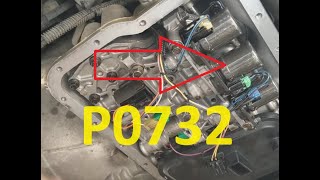
On a 2020-2023 Ford Explorer, P0732 almost always indicates a serious internal transmission problem, not low fluid. The most common cause is a failure within the 'CDF' clutch drum assembly in the 10-speed (10R60/10R80) transmission, a known issue covered by multiple Ford TSBs. This is not a DIY fix and often requires a major transmission repair, CDF drum replacement with an updated part, or a valve body replacement by a professional.
- P0732 on a 2020-2023 Explorer indicates a serious internal transmission problem, not just a sensor or fluid issue.
- The most likely cause is a well-documented failure of the CDF clutch drum assembly, a known weak point in the Ford 10-speed transmission.
- This is not a DIY repair. The vehicle should be taken to a qualified transmission shop or dealership for diagnosis.
- Repair will be costly, likely involving either a new valve body, a new CDF drum (which requires transmission removal), or a complete transmission replacement.
- When speaking to a mechanic, be sure to mention the known TSBs related to the CDF clutch drum and valve body for this transmission.
What's Unique About the 2020-2023 Ford EXPLORER
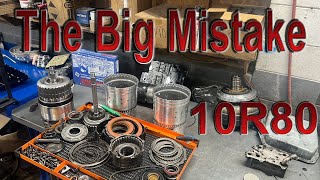
The 2020-2023 Explorer uses Ford's 10-speed automatic transmission, either the 10R60 (for 2.3L EcoBoost) or the 10R80 (for 3.0L EcoBoost & 3.3L). This transmission family is known for a specific design flaw documented in numerous Technical Service Bulletins (TSBs). TSB 24-2254 explicitly states that a bushing inside the C-D-F clutch drum can 'walk' or move axially out of place. This movement uncovers hydraulic passages, causing a critical loss of fluid pressure to the clutch packs. This lack of pressure prevents the clutches from engaging properly, leading to slipping and the resulting gear ratio codes like P0732. 🎬 Watch: Understanding gear ratio codes and how to fix them. Ford has since released an updated CDF drum with a machined lip to prevent the bushing from moving.
Diagnostic Flowchart
Tap your situation to follow the diagnostic path that matches what you're seeing on this vehicle.
Symptoms You May Notice
- Check Engine Light or illuminated wrench light on the dashboard
- Harsh, delayed, or jerky shifting, especially into second gear
- Transmission slipping, where the engine RPMs increase but the vehicle doesn't accelerate as it should.
- Vehicle entering 'limp mode' (stuck in one gear)
- A feeling of being rear-ended when the transmission shifts.
- Delayed engagement when shifting from Park to Drive or Reverse
- Loud clunking or grinding sounds during shifting.
- Sudden, unpredictable loss of power when accelerating from a stop.
- Replacing only the shift solenoids. While a solenoid can fail, the issue is more often a mechanical failure in the CDF drum or a sticking valve in the valve body that the solenoid cannot overcome.
- Assuming a simple fluid change will fix the problem. If the code is due to the common CDF drum failure, adding new fluid will not resolve the mechanical slip and the problem will return immediately.
- Blaming the issue on driving habits. While the 10-speed transmission has an adaptive learning strategy, no amount of relearning can fix the hydraulic leak caused by the failed CDF drum bushing.
Most Likely Causes
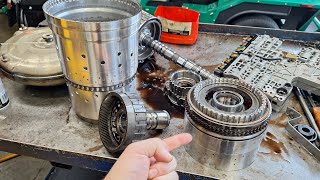
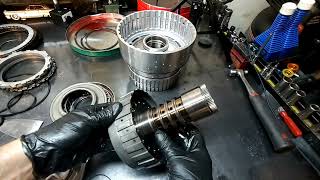
- Internal Failure of the CDF Clutch Drum Assembly 🔴 High Probability → Shop Transmission Assembly As documented in multiple Ford TSBs (like TSB 24-2254), a bushing within the CDF clutch drum is prone to 'walking' or moving out of its intended position. This uncovers oil passages, causing a significant loss of hydraulic pressure to the clutches, leading to slipping. This is a well-known mechanical design flaw in the 10R60/10R80 transmission family.
How to confirm: This requires transmission disassembly to physically inspect the CDF drum and its internal bushing. A technician will first drop the transmission pan and almost certainly find excessive clutch material (a gray, metallic sludge) and other debris, which confirms a major internal failure. An air pressure test performed on the transmission with the valve body removed can also audibly reveal the leak at the CDF clutch pack.
Typical fix: Replacement of the CDF clutch drum with an updated part that has a machined lip to prevent the bushing from moving. This is a complete transmission teardown job. In some cases, if damage is extensive, a full transmission replacement is recommended.
Est. part cost: $300-$700 for the drum assembly; $4000-$8000 for a remanufactured transmission. - Main Control Valve Body Failure 🟡 Medium Probability → Shop Transmission Valve Body The valve body directs hydraulic fluid to engage the correct clutches. TSB 22-2102 notes that sticking valves within the main control can cause this group of codes. Debris from an early-stage CDF drum failure can also contaminate the valve body, causing its solenoids and valves to fail.
How to confirm: A technician can use a Ford diagnostic tool (FDRS) to run a 'PCM - Transmission Accelerated Main Control Break In' routine. TSB 22-2102 advises this may resolve the issue. If the issue persists, or if a technician finds sticking valves during a valve body overhaul, replacement is necessary.
Typical fix: Replacement of the main control valve body assembly and reprogramming the TCM. This is less labor-intensive than a full transmission rebuild but still a major repair.
Est. part cost: $800-$1500 - Low or Contaminated Transmission Fluid ⚪ Low Probability → Shop Transmission Assembly This is almost always a symptom of the CDF drum failure, not the root cause. The slipping clutches quickly disintegrate, contaminating the fluid with metallic particles. These vehicles do not have a traditional dipstick, so checking the fluid is a service procedure that involves raising the vehicle and opening a check plug.
How to confirm: Check the transmission fluid level and condition via the check plug on the side of the transmission case. The fluid will likely appear very dark, burnt, and full of gray, metallic particles, indicating severe internal wear.
Typical fix: A fluid and filter change will NOT fix the mechanical problem. It is a required step during the replacement of the CDF drum or valve body, but it will not resolve the slip on its own.
Est. part cost: $150-$400 for a fluid and filter service.
Rare But Worth Checking
- Powertrain Control Module (PCM) Software Issue: In some cases, particularly for general harsh shifting without specific gear ratio codes, Ford has issued TSBs (like 22-2428) that recommend a PCM/TCM software update as a first step before mechanical repairs. However, for a persistent P0732, a mechanical fault is far more likely.
- Failed Input/Output Speed Sensor: A faulty speed sensor can provide incorrect data to the TCM, leading to a gear ratio code. However, this would typically set a specific sensor-related code (e.g., P0722) in addition to the P0732.
Diagnosis Steps
- Verify the transmission fluid level and condition. This must be done on a lift with the vehicle at operating temperature. Note any burnt smell or visible metallic debris, which strongly suggests internal failure.
- Use a professional OBD-II scanner (preferably Ford's FDRS) to check for any other pending or active trouble codes related to the transmission.
- Check for any available Technical Service Bulletins (TSBs) for your vehicle's VIN. TSB 24-2254 is the most critical starting point for this code.
- Follow the diagnostic path outlined in the TSBs. For example, TSB 22-2102 suggests a 'PCM - Transmission Accelerated Main Control Break In' routine for low-mileage vehicles.
- Drop the transmission pan to inspect for metal shavings or excessive gray clutch material. The presence of significant debris confirms a significant internal failure and makes a teardown necessary.
- If the pan is clean and TSBs suggest it, a valve body replacement may be attempted first.
- If debris is present, the transmission must be removed for inspection and replacement of the CDF clutch drum assembly.
Parts You'll Likely Need
- CDF Clutch Drum Assembly (Updated)
(OEM #JL3Z-7H351-B)— This is the most common point of failure in the 10R60/10R80 transmission leading to this code. The updated Ford part is designed with a lip to prevent the internal bushing from walking out of place.
Trusted brands: Motorcraft
OEM price range: $350-$600
Aftermarket price range: $300-$500 - Main Control Valve Body
(OEM #L1MZ-7A100-F (confirm with VIN))— The second most likely cause, responsible for directing hydraulic pressure. Sticking valves or internal leaks can cause shifting and ratio errors, as noted in TSB 22-2102.
Trusted brands: Motorcraft
OEM price range: $900-$1500
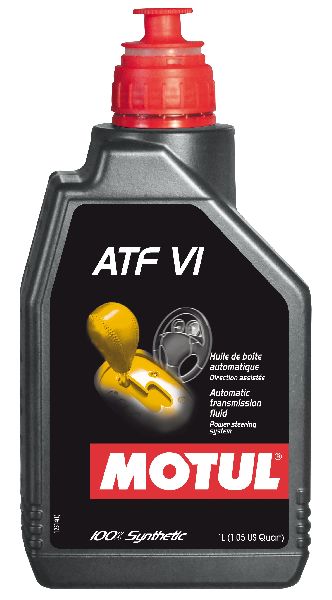
Aftermarket price range: $700-$1200 - Automatic Transmission Fluid (Mercon ULV)
(OEM #Motorcraft XT-12-QULV)— Required for any transmission service. The 10-speed transmission requires this specific Ultra-Low Viscosity (ULV) fluid. Using any other fluid can cause damage.
Related Codes That Often Appear With This One
- P0731 — Incorrect Ratio in 1st Gear. Often set alongside P0732 due to the same underlying hydraulic pressure loss from the CDF drum or valve body issue.
- P0733, P0734, P0735, P0736 — Incorrect Ratio in other gears. The TSBs provided list a wide range of incorrect gear ratio codes that can be caused by the same CDF clutch or valve body problems.
- P2700-P2705 — Transmission Friction Element Apply Time Range/Performance. These codes point directly to clutch pack engagement issues, which is the direct result of the CDF drum or valve body failure.
Technical Service Bulletins (TSBs) & Recalls
- TSB 26-2046
- TSB 25-2302
- TSB 24-2254
- TSB 22-2102
- TSB 21-2434
Platform-Specific Known Issues
- TSB 24-2254 explicitly states that P0732 (and many other codes) may be due to 'axial movement of the CDF clutch cylinder' in the 10-speed transmission, causing hydraulic leaks.
- TSB 20-2403 (superseded but relevant) details a specific diagnostic path: for vehicles under 5,000 miles, attempt a 'break-in' procedure; for vehicles over 5,000 miles, replace the main control valve body if symptoms persist.
- Owner forums are filled with reports of 2020+ Explorers experiencing catastrophic transmission failures at relatively low mileage (e.g., 25k-60k miles), often requiring full transmission replacements costing over $5,000.
- The issue is not isolated to the Explorer; it is a widespread problem across many Ford and Lincoln models using the 10R-series transmissions, including the F-150, Mustang, and Expedition.
Mechanic-Grade Diagnostic Values
- Shift Solenoid (A-F) Resistance — expected: 5.0 - 5.4 Ohms at 68°F (20°C). Failure: Resistance outside of this range indicates a faulty solenoid coil.
- Transmission Fluid Temperature (TFT) Sensor Resistance — expected: 37k - 16k Ohms at 69°F-104°F. Failure: Resistance values that do not correlate with the transmission fluid temperature suggest a faulty sensor.
- Line Pressure Control (LPC) Solenoid Current — expected: Inversely proportional; high pressure at low current (~50 mA), low pressure at high current (~850 mA).. Failure: Pressure readings that do not correspond to the commanded current indicate a sticking valve or faulty solenoid.
- Torque Converter Clutch (TCC) Solenoid Current — expected: Directly proportional; low pressure at low current (~50 mA), high pressure at high current (~850 mA).. Failure: Pressure readings that do not correspond to the commanded current indicate a sticking valve or faulty solenoid.
Scan Tool Commands That Help
- Ford Diagnosis and Repair System (FDRS): PCM - Transmission Accelerated Main Control Break In — As per TSB 22-2102, this routine should be performed to attempt to free sticking valves in the main control valve body before resorting to replacement, especially on lower mileage vehicles.
- Ford Diagnosis and Repair System (FDRS): Clear KAM (Keep Alive Memory) and Shift Tables — This is a standard procedure after any transmission repair or software update to reset the adaptive learning strategy, forcing the TCM to relearn the transmission's characteristics.
Wiring & Ground Locations
- Line Pressure Test Port — There is an M10 x 1.00 threaded port on the transmission case for testing line pressure. One user on a Mustang forum identified a pressure testing port on the back of the transmission, up and to the left of the driveshaft.. Connecting a pressure gauge here allows a technician to verify if the hydraulic pressure is within specification. Low line pressure would confirm a hydraulic leak, which is the root cause of the slip that triggers P0732.
- Engine to Firewall Ground Strap — Typically located on the back of the driver's side cylinder head, connecting to the firewall.. A loose or corroded main ground strap can cause a wide range of electrical issues for the powertrain control systems, potentially affecting TCM operation, though it is not a primary cause for P0732.
Real Owner Repair Stories
- Reddit user in r/f150 (Early 2022 Ford F-150 SuperCrew 5.0 4x4 with 23k miles (pre-CDF drum revision)) — Erratic shifting, transmission not shifting at times.
❌ Tried (didn't work) Reprogramming the TCM, clearing KAM and shift tables.
✅ What actually fixed it The technician performed a pressure test which passed, then removed and disassembled the main control (valve body). They found a couple of valves sticking in their bores, overhauled the main control, reassembled, and performed an adaptive road test. This resolved the erratic shifting.
OEM Part Supersession History
HL3Z-7H351-A, JL3Z-7H351-A→JL3Z-7H351-B— The updated part (JL3Z-7H351-B) is the revised CDF clutch drum assembly. It adds a machined lip to prevent the internal sleeve/bushing from moving axially, which was the cause of the hydraulic leak in the original design.L1MZ-7A100-B→L1MZ-7A100-F— L1MZ-7A100-F is the updated main control valve body assembly. The reasons for supersession are not explicitly stated but are typically to address issues like sticking valves or to improve durability.
Model Year Variations Within This Range
- 2020 - Early 2023: Vehicles built on or before December 23, 2022, are more likely to have the original, faulty CDF clutch drum design. Vehicles built after this date likely have the revised part from the factory, making the valve body a more probable cause if P0732 appears.
Helpful Videos

We Have This Part in Stock


The information in this article is provided for general reference and educational purposes only. Vehicle specifications, procedures, and part compatibility can vary by production date, trim level, and region. Always consult your vehicle's factory service manual and verify part numbers before purchasing or performing repairs. Safety-critical components such as airbags, seat belts, and braking systems should be installed by a qualified professional.
- Ford EXPLORER:
- 🧭 Diagnostic Flowchart
- 🎬 Helpful Videos
- 🛍️ Shop This Part
- What's Unique About the 2020-2023 Ford EXPLORER
- Symptoms You May Notice
- Most Likely Causes
- Rare But Worth Checking
- Diagnosis Steps
- Parts You'll Likely Need
- Related Codes That Often Appear With This One
- Technical Service Bulletins (TSBs) & Recalls
- Platform-Specific Known Issues
- Mechanic-Grade Diagnostic Values
- Scan Tool Commands That Help
- Wiring & Ground Locations
- Real Owner Repair Stories
- OEM Part Supersession History
- Model Year Variations Within This Range
- 🎟️ Get 5% Off