

P0732 Ford F-150 (2017-2023): Gear 2 Incorrect Ratio Causes and Fixes
On 2017-2023 F-150s with the 10R80 transmission, P0732 almost always points to a significant internal issue, most commonly a failed CDF clutch drum bushing. This is a widely documented design flaw where a bushing 'walks' out of place, causing a hydraulic leak. This is not a simple fix and typically requires a transmission rebuild or replacement with an updated drum, costing between $4,000 and $7,000.
- P0732 on a 2017-2023 F-150 is a serious code that almost certainly indicates an internal transmission problem.
- The most likely cause is a known design flaw in the 10R80 transmission's CDF clutch drum, which requires extensive repair.
- Do not continue to drive the vehicle. This is not a code to ignore, as it can lead to complete transmission failure.
- A simple fluid change or software update will not fix this code. The repair will be mechanical and expensive, often requiring a transmission rebuild or replacement.
- Reference Ford TSBs like TSB 24-2254 when speaking with a repair shop, as it directly addresses the cause of this code.
What's Unique About the 2017-2023 Ford F-150

The 2017-2023 Ford F-150 predominantly uses the 10-speed 10R80 automatic transmission, co-developed with GM. While technologically advanced, this transmission has a widely documented design flaw related to the C-D-F (Clutch D-F) clutch drum. A specific bushing inside this drum is prone to premature wear and can 'walk' (migrate axially) out of its bore. This movement uncovers hydraulic passages, causing a critical loss of pressure to the clutch packs responsible for engaging gears. This pressure loss leads to slipping, harsh shifts, and eventually, gear ratio error codes like P0732. Ford has issued multiple Technical Service Bulletins (TSBs) like TSB 24-2254 and redesigned the CDF drum with a retention lip to prevent this 'bushing walkout', but it remains a common and expensive failure point.
Diagnostic Flowchart

Tap your situation to follow the diagnostic path that matches what you're seeing on this vehicle.
Generation note: This issue affects both the 13th generation (2017-2020) and 14th generation (2021-2023) Ford F-150, as both widely use the 10R80 automatic transmission where this fault is common. TSBs cover vehicles across these generations.
Symptoms You May Notice

- Check Engine Light or illuminated wrench light on the dashboard.
- Harsh, jerky, or delayed shifting, especially into 2nd, 3rd, or 4th gear.
- Transmission slipping, where the engine RPMs flare up without a corresponding increase in speed.
- Vehicle hesitates or feels like it has no power when accelerating from a stop.
- Loud clunking or banging noises during shifts.
- Transmission gets stuck in one gear (limp mode) or refuses to downshift when coming to a stop.
- A whining noise during shifts in lower gears.
- Replacing only the input or output speed sensors. While these sensors report the problem, they are rarely the cause of it. The mismatch they detect is real, caused by mechanical or hydraulic slippage inside the transmission.
- Simply clearing the code and performing a software update or adaptive learn reset. While TSBs sometimes recommend software updates for shift quality issues, a P0732 code indicates a mechanical or hydraulic slip that software cannot fix. This will not resolve the underlying issue.
Most Likely Causes

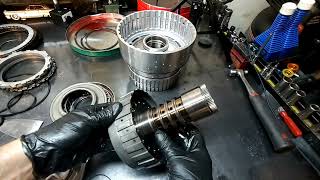
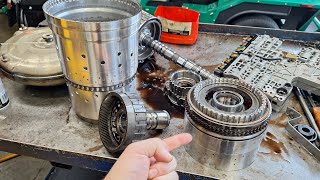
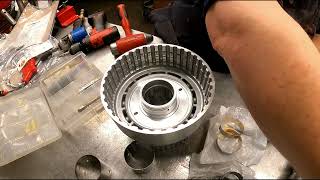
- Worn/Failed CDF Clutch Drum Bushing 🔴 High Probability → Shop Transmission Clutch Pressure Plate This is a well-documented design flaw in the 10R80 transmission. The original bushing can move or 'walk' out of its bore, uncovering hydraulic passages and causing a pressure leak to the C, D, and F clutch packs. Ford TSB #TSB 24-2254 directly links this axial movement to a host of gear ratio codes 🎬 Watch: See how the CDF drum fails and causes these codes., including P0732.
How to confirm: A technician will need to perform a specialized hydraulic pressure test using a VCMM and pressure transducers, as outlined in Ford TSBs. A more direct, mechanic-level test involves removing the valve body and using a blow gun with a rubber tip to apply compressed air to the C-clutch port; if it doesn't make a thud or hold pressure, the clutch circuit has failed, likely due to the drum.
Typical fix: The transmission must be removed and disassembled. The damaged CDF clutch drum must be replaced with an updated part that has a redesigned, staked, or lipped bushing to prevent it from walking out. Most shops recommend a full rebuild or replacement with a remanufactured unit at this point due to potential contamination.
Est. part cost: $150-$400 for the updated drum assembly, but this is a small fraction of the total repair cost which is dominated by labor. - Faulty Valve Body or Solenoids 🟡 Medium Probability → Shop Transmission Valve Body The complex valve body is the hydraulic brain of the transmission. Debris from a failing CDF drum can contaminate the valve body, clogging passages or causing solenoids to stick. In some cases, the separator plate between the valve body halves can have issues, or its impregnated filters can come loose, causing valves to stick.
How to confirm: A technician can use a high-level scan tool like Ford's IDS to command individual solenoids and monitor pressure responses. The valve body can also be removed and inspected for debris, loose filters, or worn components.
Typical fix: Replacement of the entire main control valve body assembly. In some cases, a single shift solenoid can be replaced, but for P0732, this is less likely to be the sole root cause. Often, the valve body is replaced along with the CDF drum.
Est. part cost: $700-$1200 - Low or Degraded Transmission Fluid ⚪ Low Probability → Shop Transmission Assembly While not a design flaw, the 10R80 is very sensitive to fluid level and condition. The required Motorcraft MERCON ULV fluid is a very thin, specific type. Low fluid can cause pressure loss and slipping. However, if the code is already present, the fluid is almost never the root cause, but rather a symptom of a leak or a failed attempt at a simple fix. Burnt, dark fluid is a confirmation of internal failure.
How to confirm: Checking the transmission fluid level and condition. On these trucks, this is not a simple dipstick check and must be done by a technician with the vehicle at a specific temperature.
Typical fix: Perform a fluid and filter change using the correct OEM fluid. This is highly unlikely to resolve a P0732 code and should be considered a basic maintenance step, not a repair for this specific fault.
Est. part cost: $150-$300 for fluid and filter.
Rare But Worth Checking
- Cracked Clutch F Piston:
Diagnosis Steps
- Verify the code with a professional OBD-II scanner.
- Check for any related Technical Service Bulletins (TSBs) for the vehicle's VIN. TSB 24-2254 is the most critical starting point.
- Have a qualified technician check the transmission fluid level and condition. Dark, burnt fluid or fluid with excessive metal shavings indicates significant internal wear.
- Perform a complete scan of the TCM for any other related transmission codes to see if multiple gear ratios are affected.
- Follow the diagnostic procedure outlined in Ford's TSB 24-2254, which involves advanced hydraulic pressure testing of the CDF clutch circuit using specialized tools.
- If pressure tests indicate a leak, the transmission must be removed for inspection.
- Once disassembled, visually inspect the CDF drum for a migrated or 'walked' bushing. Also inspect the associated clutch pistons for cracks and seals for damage.
Parts You'll Likely Need
- CDF Clutch Cylinder / Drum Assembly
(OEM #JL3Z-7H351-B)— This is the updated component that contains the redesigned bushing with a lip or stake to prevent it from walking out. It is the core of the repair. This part supersedes older versions like HL3Z-7H351-A and JL3Z-7H351-A.
Trusted brands: Motorcraft
OEM price range: $150-$300 - Transmission Rebuild Kit — If the transmission is being fully rebuilt, a master kit including all gaskets, seals, O-rings, and clutch pistons will be needed to ensure a lasting repair.
Trusted brands: Motorcraft, SunCoast
OEM price range: $800-$1500
Aftermarket price range: $500-$1000 - Main Control Valve Body Assembly — Often replaced due to contamination from the failing CDF drum or if solenoids are determined to be faulty. It's a common point of failure and often replaced as part of a major transmission repair.
Trusted brands: Motorcraft
OEM price range: $700-$1200
Aftermarket price range: $600-$900
Related Codes That Often Appear With This One
- P076F — Incorrect Gear Ratio for 7th gear. This code is often seen with P0732, as mentioned in NHTSA complaint ODI #11592755, indicating multiple clutch circuits may be affected by the same root cause (like the CDF drum failure).
- P0729, P0731, P0733, P0734, P0735, P0736 — These are incorrect gear ratio codes for other gears (6th, 1st, 3rd, 4th, 5th, Reverse). The provided TSBs list P0732 as part of a large family of codes that can be triggered by the same internal hydraulic leak.
Technical Service Bulletins (TSBs) & Recalls
- TSB 24-2254: Explicitly mentions axial movement of the CDF clutch cylinder sleeve causing hydraulic leaks and a long list of DTCs including P0732. Recommends hydraulic testing and replacement of the CDF drum.
- TSB 23-2123 (Supersedes 22-2139): Addresses harsh/delayed shifts and various DTCs by overhauling the main control valve body and performing an adaptive learning drive cycle.
- TSB 21-2357: An earlier TSB also pointing to valve body overhaul and software strategies for a similar list of codes and symptoms.
Platform-Specific Known Issues
- The primary issue is the premature failure of the CDF clutch drum bushing in the 10R80 transmission, as acknowledged in multiple Ford TSBs (e.g., TSB 24-2254). This is not a matter of 'if' but 'when' for many vehicles, causing hydraulic leaks that trigger codes like P0732.
- Owner complaints and class-action lawsuits allege these transmission issues, including harsh shifting, hesitation, and sudden loss of power, constitute a safety defect. One owner on Reddit described the danger: 'Imagine needing to clear an intersection while turning left across oncoming traffic. Or trying to merge into traffic and not being able to with cars bearing down on you.'
- The repair is labor-intensive, requiring complete removal and teardown of the transmission, making it an expensive fix even though the primary causal part (the updated drum) is relatively inexpensive.
Mechanic-Grade Diagnostic Values
- Shift Solenoid (A-F) Resistance — expected: 5.0 - 5.4 Ohms at 20°C (68°F). Failure: Readings outside this range indicate a faulty solenoid coil.
- Transmission Fluid Temperature (TFT) Sensor Resistance — expected: Varies with temperature: 100k-37k Ω at 32-68°F (0-20°C); 37k-16k Ω at 69-104°F (21-40°C); 16k-5k Ω at 105-158°F (41-70°C).. Failure: Resistance that is infinite (open circuit) or near-zero (short circuit), or values that do not correspond to the fluid temperature.
Scan Tool Commands That Help
- Ford IDS (Integrated Diagnostic Software): Transmission Characterization/Solenoid IDN — This is a mandatory procedure after replacing the main control valve body or any solenoids. The technician must enter the 13-digit solenoid strategy number from the new part to ensure the TCM uses the correct performance data.
- Ford IDS / FORScan: Clear Transmission Adaptive Tables — This function should be performed after any transmission repair, especially valve body or internal component replacement. It erases the TCM's learned shift adjustments, forcing it to relearn shift patterns with the new components. Failing to do this can result in continued poor shift quality.
- FORScan: Halt Transmission Adaptive Learning — Some owners and tuners use this function to disable the transmission's ability to learn and adjust shift pressures over time. This can result in more consistent shift behavior but may also mask underlying issues. It is generally used by advanced users attempting to resolve persistent erratic shifting complaints.
Wiring & Ground Locations
- C177 (Internal Transmission Connector) — The main electrical connector on the transmission case that connects the external harness to the internal components like the valve body and sensors.. This is the primary point for checking electrical integrity from the TCM to the transmission. The ATSG provides a terminal chart for this connector, allowing a technician to test specific circuits, such as the Shift Solenoid F control (Blue/Gray wire) or the TFT sensor signal (Brown/Yellow wire), without disassembling the transmission.
- G100 / G102 — Typically located on the right or left side of the engine compartment, bolted to the frame or engine block. (Note: Specific location from diagrams for older F-150s).. These are major powertrain grounds. A loose or corroded ground at these locations can cause erratic behavior in the PCM/TCM, potentially leading to incorrect calculations, faulty solenoid commands, and a variety of transmission-related codes, including P0732.
Real Owner Repair Stories
- Reddit user Shoplizard88 (2018 Ford F-150 with 48,000 miles) — Transmission got stuck in 7th gear, wouldn't downshift at a stop, then would bog and clunk into first. Threw code P076F (Gear 7 Incorrect Ratio).
❌ Tried (didn't work) Initial diagnosis at the dealer.
✅ What actually fixed it The transmission was declared 'done' by the dealer. The final fix was a complete rebuild using the redesigned CDF drum. The owner was quoted ~$4,000 for the rebuild or ~$7,000 for a new transmission from the dealer. - Reddit user Commercial_Method_28 (2017 Ford F-150) — Wrench light with codes P0732, P0734, and P076F.
❌ Tried (didn't work) A user in the thread with similar symptoms on a 2018 Mustang replaced the valve body and updated software, but the slipping persisted.
✅ What actually fixed it The original poster, a technician, identified the cause as the CDF clutch cylinder bushing having walked out of place, causing a major hydraulic leak. The fix is to replace the CDF drum with the updated part.
OEM Part Supersession History
HL3Z-7H351-A, JL3Z-7H351-A→JL3Z-7H351-B— The original CDF clutch drum designs allowed an internal bushing to 'walk' out of its bore, uncovering hydraulic ports and causing pressure loss. The updated JL3Z-7H351-B part features a machined lip that acts as a positive stop, preventing the bushing from migrating.
Model Year Variations Within This Range
- 2017-2020: The CDF drum bushing failure is most commonly associated with the earlier years of the 10R80 production, particularly 2017-2018 models. While later years can still fail, the initial design was most susceptible.
- 2020+: Ford began using different separator plates in the valve body. According to Sonnax, new OE valve bodies should come with a light brown separator plate. If a 'new' unit has the older yellow plate, it may be a rebuilt or used core. A 2020 owner also reported a dealer repair included new separator plates and a software re-flash that dramatically improved shifting, suggesting running changes were made.
Helpful Videos
We Have This Part in Stock


The information in this article is provided for general reference and educational purposes only. Vehicle specifications, procedures, and part compatibility can vary by production date, trim level, and region. Always consult your vehicle's factory service manual and verify part numbers before purchasing or performing repairs. Safety-critical components such as airbags, seat belts, and braking systems should be installed by a qualified professional.
- Ford F-150:
- 🧭 Diagnostic Flowchart
- 🎬 Helpful Videos
- 🛍️ Shop This Part
- What's Unique About the 2017-2023 Ford F-150
- Symptoms You May Notice
- Most Likely Causes
- Rare But Worth Checking
- Diagnosis Steps
- Parts You'll Likely Need
- Related Codes That Often Appear With This One
- Technical Service Bulletins (TSBs) & Recalls
- Platform-Specific Known Issues
- Mechanic-Grade Diagnostic Values
- Scan Tool Commands That Help
- Wiring & Ground Locations
- Real Owner Repair Stories
- OEM Part Supersession History
- Model Year Variations Within This Range
- 🎟️ Get 5% Off