

P0732 on 2018-2023 Ford Mustang: Gear 2 Incorrect Ratio Causes and Fixes
On a 2018-2023 Ford Mustang with the 10R80 automatic transmission, code P0732 almost always indicates a serious internal transmission failure, specifically a faulty CDF clutch drum. A bushing inside the drum walks out of position, causing a hydraulic pressure leak. This is a well-documented design flaw, not a simple DIY fix, and often requires transmission removal and overhaul or replacement, costing several thousand dollars.
- P0732 on a 2018-2023 Mustang is not a minor issue; it strongly indicates a significant internal transmission problem.
- The most probable cause is a well-known design flaw in the 10R80 transmission's CDF clutch drum.
- Do not attempt to fix this by simply changing the fluid or replacing shift solenoids; diagnosis by a professional is crucial.
- The correct repair involves removing the transmission and replacing the faulty CDF drum with an updated OEM part (JL3Z-7H351-B).
- This is a costly repair, often totaling between $2,500 and $7,000, and is not suitable for a DIY mechanic.
What's Unique About the 2018-2023 Ford MUSTANG
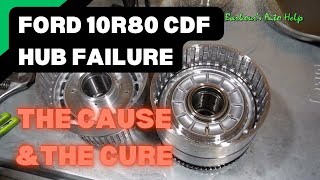
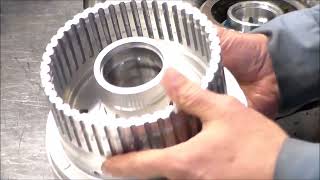
The 2018-2023 Ford Mustang uses the 10-speed 10R80 automatic transmission, which is known to have a specific, widespread mechanical flaw. This flaw involves the C-D-F (clutch C, D, and F) clutch drum assembly. A bushing inside this drum can move or 'walk' out of its bore, uncovering hydraulic ports and causing a catastrophic loss of hydraulic pressure to the clutch packs. This design issue is so common that Ford has issued multiple Technical Service Bulletins (TSBs) and released a redesigned part (JL3Z-7H351-B) that adds a physical lip to hold the bushing in place. 🎬 Watch: A deep dive into the CDF hub failure and fix. Therefore, unlike in many other vehicles where P0732 might be caused by low fluid or a bad sensor, on this specific Mustang, it very strongly points to this particular internal failure.
Diagnostic Flowchart
Tap your situation to follow the diagnostic path that matches what you're seeing on this vehicle.
Symptoms You May Notice
- Check Engine Light is on
- Wrench light illuminated on the dash
- Harsh, jerky, or delayed shifts, particularly into or out of second gear
- Transmission slipping, where engine RPMs flare up without an increase in speed
- Loud thud or bang when accelerating or between shifts
- Vehicle entering 'limp mode' (limited engine power and available gears)
- Failure to engage Drive or Reverse, or a long delay before engagement; may feel like the car is in neutral
- Increased fuel consumption
- Replacing only the shift solenoids or the valve body. While a solenoid can fail, the symptoms of P0732 on this platform are overwhelmingly caused by the mechanical failure of the CDF drum. A new valve body or solenoid will not fix the hydraulic leak from the drum, leading to a repeat failure.
- Performing only a software update or adaptive learning reset. While these procedures are often recommended for general shift quality complaints, they cannot correct a major internal hydraulic leak.
Most Likely Causes
- Internal CDF Clutch Drum Failure 🔴 High Probability → Shop Transmission Clutch Pressure Plate This is a well-documented weak point in the Ford 10R80 transmission. A bushing in the CDF clutch cylinder can move or 'walk' out of its bore, uncovering hydraulic ports and causing a pressure leak that prevents clutches from engaging properly. Ford has acknowledged this with multiple TSBs (e.g., TSB 24-2254) and has released an updated part (JL3Z-7H351-B) with a lip to correct the design flaw.
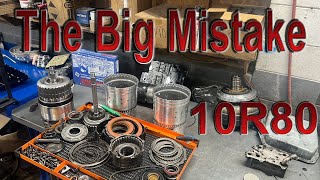
How to confirm: A technician will perform a hydraulic pressure test on the transmission circuits using specialized equipment as outlined in TSB 24-2254. If the test fails for the affected clutches (showing a significant leak), the transmission must be removed and disassembled to physically inspect the CDF drum. 🎬 See this teardown video showing the internal bushing failure.
Typical fix: The transmission must be removed and disassembled. The original CDF clutch drum assembly is replaced with the updated, redesigned part (JL3Z-7H351-B). This is a major repair that includes replacing numerous seals and gaskets during reassembly.
Est. part cost: $200-$500 for the drum assembly and related seals/gaskets. - Low or Contaminated Transmission Fluid ⚪ Low Probability → Shop Transmission Assembly While less likely to be the root cause than the CDF drum, low fluid can cause pressure issues leading to slipping and incorrect ratio codes. These transmissions do not have a traditional dipstick, making fluid level checks difficult and often overlooked. Many owners on forums have reported their transmissions were low on fluid from the factory.
How to confirm: The vehicle must be lifted perfectly level, brought to a specific operating temperature (typically 206-215°F), and the fluid level checked via the check/fill plug on the side of the transmission case. The fluid condition (color, smell) should also be inspected for signs of burning or contamination.
Typical fix: Top-off the fluid to the correct level or perform a complete fluid and filter change if the fluid is dirty or burnt. Use only the specified Motorcraft MERCON ULV (Ultra Low Viscosity) fluid.
Est. part cost: $150-$250 for fluid and a new filter pan. - Main Control Valve Body Failure ⚪ Low Probability → Shop Transmission Valve Body The valve body can suffer from sticking solenoids or internal warping, causing erratic pressure control. While this is a known 10R80 issue, it's less specific to the P0732 code than the CDF drum failure. In some cases, a failing CDF drum can send debris through the transmission, damaging the valve body.
How to confirm: Diagnosis requires a professional scan tool to command individual solenoids and monitor pressures. In some cases, the valve body must be removed for inspection or replacement. Some owners have had the valve body replaced only to have the CDF drum fail shortly after.
Typical fix: Replacement of the entire main control valve body assembly. This is often done in conjunction with a CDF drum replacement.
Est. part cost: $800-$1500
Rare But Worth Checking
- Faulty Transmission Speed Sensor: → Shop Transmission Assembly An input or output speed sensor could fail, but this would typically set a specific sensor-related trouble code (like P0722) in addition to or instead of P0732.
- TCM/PCM Software Issue: Outdated software can cause harsh shifting, but it is unlikely to cause a gear ratio code without an underlying mechanical or hydraulic failure. Ford has issued TSBs that involve reprogramming the TCM, but often as a complementary step to a mechanical repair like a valve body or CDF drum replacement.
Diagnosis Steps
- Verify the code with a professional OBD-II scanner that can read transmission-specific codes.
- Check for any Technical Service Bulletins (TSBs) related to the VIN. TSB 24-2254 is particularly relevant for diagnosing the CDF drum failure. 🎬 Watch: An expert explanation of the harsh shifting TSB.
- Check the transmission fluid level and condition. This is a critical first step and must be done with the vehicle level and at the correct operating temperature (206-215°F).
- Check for TCM/PCM software updates. Ensure the transmission is running on the latest calibration, though this is unlikely to be the sole fix.
- Use an advanced scan tool to monitor transmission input and output speed sensors in real-time to look for erratic readings.
- Perform a full transmission hydraulic pressure test as detailed in TSB 24-2254 to identify internal leaks. This is the key step in confirming the CDF drum failure.
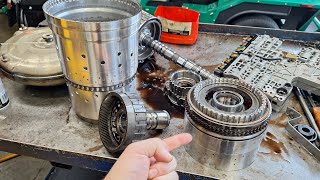
- If pressure tests fail or are inconclusive, the final step is transmission removal and disassembly for internal inspection and replacement of the CDF clutch drum assembly.
Parts You'll Likely Need
- CDF Clutch Drum Hub Assembly (Updated Design)
(OEM #JL3Z-7H351-B)— This is the component that contains the design flaw causing the hydraulic leak. The updated part has a revised bushing design with a lip to prevent it from moving. This part supersedes previous versions HL3Z-7H351-A and JL3Z-7H351-A.
Trusted brands: Motorcraft (Ford OEM)
OEM price range: $140-$470
Aftermarket price range: N/A - Transmission Overhaul Gasket and Seal Kit — Required for reassembling the transmission after replacing the CDF drum. All seals, gaskets, and single-use bolts should be replaced during the overhaul.
Trusted brands: Motorcraft
OEM price range: $300-$500
Aftermarket price range: $200-$400 - Motorcraft MERCON ULV Automatic Transmission Fluid
(OEM #XT-12-QULV)— The transmission must be refilled with approximately 9-13 quarts of this specific fluid after the repair. Using any other fluid type can cause damage.
Trusted brands: Motorcraft
OEM price range: $15-$25 per quart
Aftermarket price range: N/A
Related Codes That Often Appear With This One
- P0731, P0733, P0734, P0735, P0736, P076F — These are incorrect gear ratio codes for other gears. A failing CDF drum can affect multiple clutch packs (C, D, and F) and cause ratio errors in several gears, not just second.
- P0751, P0756, P0761, etc. — These are performance codes for specific shift solenoids (A, B, C, etc.). The hydraulic leak from the CDF drum can prevent the clutches from engaging properly, which the TCM may misinterpret as a solenoid performance problem.
Technical Service Bulletins (TSBs) & Recalls
- TSB 24-2254: Supersedes previous TSBs and addresses harsh/delayed shifts and a list of DTCs including P0732. It explicitly blames "axial movement of the CDF clutch cylinder (7H351) sleeve causing hydraulic circuit leaks" and provides a detailed diagnostic procedure involving a pressure test.
- TSB 23-2123: An earlier, now superseded bulletin that also addressed harsh shifting and recommended overhauling the main control valve body and/or performing an adaptive learning drive cycle.
Platform-Specific Known Issues
- A known design flaw in the 10R80 transmission's CDF clutch cylinder sleeve allows it to 'walk' or move axially, uncovering oil passages and causing hydraulic circuit leaks. This is the primary cause for P0732 and a wide range of other shifting complaints.
- Ford has issued multiple TSBs (e.g., TSB 24-2254) that directly address this failure mode and provide diagnostic procedures for confirming the hydraulic leak before transmission removal.
- The issue is the subject of class-action lawsuits alleging Ford was aware of the defect but did not issue a recall.
Mechanic-Grade Diagnostic Values
- Shift Solenoid Resistance — expected: 5.0 - 5.4 ohms at 68°F (20°C). Failure: A reading outside this range indicates a faulty solenoid coil.
- Transmission Fluid Temperature (TFT) Sensor Resistance — expected: Approx. 1.5k to 0.8k ohms. Failure: Resistance should correspond to a temperature range of 231°F to 266°F (111°C to 130°C). An open or shorted reading indicates a failed sensor.
- Gear Ratio for 2nd Gear — expected: 2.985:1. Failure: The TCM sets P0732 when the calculated ratio of input speed to output speed significantly deviates from this value, indicating slippage.
Scan Tool Commands That Help
- Ford IDS (Integrated Diagnostic System): Transmission Strategy Download / Transmission Characterization — This function is required after replacing the main control valve body or the entire transmission. It downloads the 13-digit solenoid body strategy data to the TCM to ensure proper hydraulic control. Failure to perform this can result in DTC P163E and poor shifting.
- Ford IDS or equivalent professional scanner: Clear Transmission Adaptive Tables — This should be performed after any major transmission repair, such as replacing the CDF drum or valve body. It resets the learned shift adaptations, allowing the TCM to relearn clutch fill times and pressures with the new components.
- Ford IDS or equivalent professional scanner: Adaptive Learning Drive Cycle — After clearing the adaptive tables, a specific drive cycle must be performed. This involves a series of light-throttle accelerations through all gears and gentle braking to allow the TCM to relearn and fine-tune shift points and quality.
Wiring & Ground Locations
- G201 — Located on the passenger side kick panel, near the Powertrain Control Module (PCM).. This is a primary ground point for the PCM. A poor connection here could cause erratic behavior from the PCM/TCM, although it is an unlikely cause for a specific gear ratio code compared to the known mechanical faults.
- C175T — This is the main 52-pin electrical connector for the transmission harness at the Powertrain Control Module (PCM).. This connector carries the signals for the Turbine Speed Sensor (TSS) on pin 16, the Output Shaft Speed (OSS) sensor on pin 25, and the Transmission Fluid Temperature (TFT) sensor on pin 19, all of which are critical for the TCM to calculate gear ratios and detect faults like P0732.
Real Owner Repair Stories
- Reddit user in /r/f150 (2018 Ford F-150 with 148,000 miles) — Wrench light came on, throwing code P0732. Truck would not engage 2nd gear and would 'float' before clunking into another gear, creating a safety issue when pulling into traffic.
❌ Tried (didn't work) The user did not report trying other fixes first; they went to a dealer for diagnosis.
✅ What actually fixed it The user's final update stated the issue was diagnosed as a faulty solenoid in the valve body, and the valve body was being replaced. However, another user in the same thread with a similar issue at only 48k miles reported their dealer was rebuilding the transmission with the redesigned CDF drum for ~$4,000, which is the more common and permanent fix for these symptoms.
OEM Part Supersession History
HL3Z-7H351-A→JL3Z-7H351-A, then JL3Z-7H351-B— The original design allowed an internal sleeve/bushing to 'walk' out of position, causing a hydraulic leak. The final version, JL3Z-7H351-B, incorporates a machined lip to physically prevent the sleeve from moving.
Model Year Variations Within This Range
- 2018-2022 (built before Aug 16, 2022): Vehicles built before August 16, 2022, were equipped from the factory with the earlier design of the CDF clutch drum, which is prone to the sleeve-walking failure. Vehicles built after this date should have the updated part from the factory, making this specific failure much less likely.
Helpful Videos

We Have This Part in Stock


The information in this article is provided for general reference and educational purposes only. Vehicle specifications, procedures, and part compatibility can vary by production date, trim level, and region. Always consult your vehicle's factory service manual and verify part numbers before purchasing or performing repairs. Safety-critical components such as airbags, seat belts, and braking systems should be installed by a qualified professional.
- Ford MUSTANG:
- 🧭 Diagnostic Flowchart
- 🎬 Helpful Videos
- 🛍️ Shop This Part
- What's Unique About the 2018-2023 Ford MUSTANG
- Symptoms You May Notice
- Most Likely Causes
- Rare But Worth Checking
- Diagnosis Steps
- Parts You'll Likely Need
- Related Codes That Often Appear With This One
- Technical Service Bulletins (TSBs) & Recalls
- Platform-Specific Known Issues
- Mechanic-Grade Diagnostic Values
- Scan Tool Commands That Help
- Wiring & Ground Locations
- Real Owner Repair Stories
- OEM Part Supersession History
- Model Year Variations Within This Range
- 🎟️ Get 5% Off