

P0733 on 2002-2003 Chevrolet Silverado 1500 HD: Gear 3 Incorrect Ratio Causes & Fixes
On a 2002-2003 Silverado 1500 HD with the 4L80-E transmission, code P0733 means the transmission is slipping in third gear. The most common causes are low or dirty DEXRON-VI transmission fluid and a failing 2-3 shift solenoid ('B' solenoid). A fluid and filter service may fix it for under $200, while a solenoid replacement is a more involved, but still common, repair. If those fail, a worn direct clutch pack is the likely internal cause.
- P0733 indicates the transmission is slipping in 3rd gear.
- Always start your diagnosis by checking the transmission fluid level and condition; this is the easiest and most common fix.
- If a fluid and filter change doesn't solve the problem, a faulty 2-3 shift solenoid is the next most likely culprit.
- Finding significant metal debris in the transmission pan is a sign of serious internal mechanical failure, likely requiring a transmission rebuild.
- Do not continue to drive with this code, as you risk turning a moderate repair (like a solenoid) into a catastrophic and expensive transmission failure.
What's Unique About the 2002-2003 Chevrolet SILVERADO 1500 HD
The 2002-2003 Silverado 1500 HD is equipped with a heavy-duty automatic transmission, the 4L80-E, designed for towing and hauling. While robust, this transmission's common failure points directly relate to the P0733 code. Issues often stem from fluid breakdown under heavy use or failure of the direct clutch pack responsible for 3rd gear engagement. Forum discussions among transmission builders confirm the direct clutches are a known wear item because they are subjected to very high rotational speed differences in lower gears, leading to wear over time, especially in heavy-duty applications.
Diagnostic Flowchart
Tap your situation to follow the diagnostic path that matches what you're seeing on this vehicle.
Symptoms You May Notice
- Check Engine Light is on
- Transmission slipping during or after shifting into 3rd gear
- Engine RPMs flare up without an increase in speed
- Harsh or delayed shifting into 3rd gear
- Vehicle enters "limp mode" (stuck in one gear, often 2nd)
- Reduced fuel economy
- A feeling of losing power during acceleration in 3rd gear
- Replacing input or output speed sensors. While a sensor failure can cause shifting issues, it is more likely to be accompanied by a specific sensor trouble code (like P0717 or P0722). P0733 is almost always a hydraulic or mechanical issue being correctly reported by the sensors.
- Assuming the entire transmission must be replaced without first checking the fluid level/condition or testing the shift solenoids, which are much cheaper and more common fixes.
Most Likely Causes
- Low or Dirty Transmission Fluid 🔴 High Probability → Shop Transmission Assembly These heavy-duty trucks are often used for towing and hauling, which accelerates the breakdown of transmission fluid. The original DEXRON-III fluid is now superseded by DEXRON-VI, which offers better thermal stability, but leaks can still develop over time, leading to low fluid levels.
How to confirm: Check the transmission fluid level with the engine running and the transmission warm. The fluid should be bright red and clear, not brown, black, or smell burnt. Burnt-smelling, dark fluid is a strong indicator of internal clutch wear.
Typical fix: Perform a transmission fluid and filter change using DEXRON-VI fluid. If the fluid is very low, the source of the leak must be found and repaired.
Est. part cost: $70-$150 for fluid and filter kit - Faulty 2-3 Shift Solenoid ('B' Solenoid) 🟡 Medium Probability → Shop Transmission Valve Body Solenoids are electro-mechanical valves that cycle thousands of times. They can wear out or become clogged with debris from old fluid, causing them to stick or respond slowly, preventing proper hydraulic pressure for the 3rd gear shift.
How to confirm: A professional can use a scan tool to command the solenoid on and off to check its response. The solenoid's electrical circuit can also be tested for proper resistance (typically 20-40 ohms). Since the 'A' and 'B' solenoids in the 4L80-E are identical, a diagnostic trick is to swap them and see if the problem moves to the 1-2 shift, triggering a different code.
Typical fix: Drop the transmission pan and valve body to replace the faulty shift solenoid. It is highly recommended to replace both the 1-2 ('A') and 2-3 ('B') solenoids at the same time as they are identical parts with similar wear patterns.
Est. part cost: $40-$80 per solenoid, or $70-$120 for a kit with both - Worn 3rd Gear (Direct) Clutch Pack ⚪ Low Probability On the 4L80-E transmission, the direct clutch pack is responsible for 3rd gear. High mileage and heavy use, especially towing, wear out the friction material on these clutches, causing them to slip. This is a well-documented failure point, as the direct clutches must endure significant speed differentials when not engaged.
How to confirm: This is a diagnosis of exclusion. If the fluid and solenoids are confirmed to be good, but the slip persists, internal mechanical failure is likely. Inspecting the transmission pan for excessive clutch material (looks like black sludge) or metal shavings is a strong indicator.
Typical fix: This requires a complete transmission rebuild or replacement to access and replace the worn clutch pack and associated seals. Many rebuild kits offer upgraded direct clutch components to improve durability.
Est. part cost: $1800-$4000+
Rare But Worth Checking
- Valve Body Issues: → Shop Transmission Valve Body The valve body contains a maze of channels and valves. Chronic wear in the valve bores can cause pressure loss to the 3rd gear clutch pack. Debris can also cause valves to stick. Aftermarket solutions, like Sonnax remanufactured valve bodies, specifically address these wear points to prevent issues like 2-3 neutral conditions and solenoid performance codes.
- Failing Transmission Control Module (TCM): → Shop Transmission Assembly While rare, the TCM can fail internally or have software glitches. This should only be considered after all mechanical and electrical possibilities, including wiring harness checks, have been exhausted.
- Damaged Transmission Wiring Harness: → Shop Transmission Assembly The main circular connector on the passenger side of the transmission case can become corroded, or pins can back out. This can interrupt the signal to the 2-3 shift solenoid, causing a P0733 code even if the solenoid itself is good.
Diagnosis Steps
- Check the transmission fluid level and condition with the engine running and at operating temperature. Ensure the correct fluid (DEXRON-VI) is being used.
- Scan the TCM for any other active or pending trouble codes to see if other solenoids or gear ratios are affected.
- If fluid is low, top it off, clear the code, and test drive. If fluid is dark or burnt, perform a fluid and filter change.
- Inspect the old fluid and pan magnet for excessive metal shavings or clutch material, which would indicate severe internal wear.
- Inspect the main transmission case electrical connector for corrosion, moisture, or backed-out pins.
- Use a bi-directional scan tool to command the 2-3 shift solenoid on and off to verify its mechanical operation.
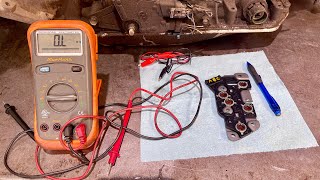
- Test the shift solenoid circuit for proper voltage and resistance (should be 20-40 ohms). 🎬 Watch: How to test your solenoids, sensors, and pressure switches. Consider swapping the 'A' and 'B' solenoids to see if the fault follows the solenoid.
- If solenoids and wiring are good, perform a transmission line pressure test to check for hydraulic issues in the 3rd gear circuit.
- If all other tests pass, the issue is likely an internal mechanical failure, such as a worn direct clutch pack, requiring transmission removal and teardown.
Parts You'll Likely Need
- Transmission Fluid and Filter Kit — This is the first step and most common fix. The 4L80-E requires DEXRON-VI fluid for modern service fills.
Trusted brands: ACDelco, Valvoline, FRAM
OEM price range: $100-$160
Aftermarket price range: $70-$120 - Shift Solenoid Kit (A & B)
(OEM #A: 24230288, B: 24230289)— The 2-3 Shift Solenoid ('B') specifically controls the hydraulic circuit for third gear. The 1-2 ('A') and 2-3 ('B') solenoids are identical and have similar service lives, so it is best practice to replace them as a pair.
Trusted brands: ACDelco, Bosch, Rostra
OEM price range: $60-$90 per solenoid
Aftermarket price range: $70-$120 for a pair
Related Codes That Often Appear With This One
- P0894 — This code for 'Transmission Component Slipping' is a general code that often accompanies a specific gear ratio error like P0733, confirming the TCM's slip detection.
- P0756 — This code for 'Shift Solenoid 'B' Performance or Stuck Off' points directly to the solenoid responsible for the 2-3 shift, which is a primary cause of P0733.
- P0731, P0732, P0734 — The presence of incorrect ratio codes for other gears suggests a widespread problem like low fluid, a clogged filter, or a failing transmission pump, rather than a single component failure.
Technical Service Bulletins (TSBs) & Recalls
- PIP4379M: Mentions P0733 in a list of codes related to delayed or no gear engagement, or a range inhibit condition.
Platform-Specific Known Issues
- A Technical Service Bulletin (TSB #PIP4379M) from GM notes that P0733 can appear with a wide range of other transmission codes related to delayed or no gear engagement. The bulletin advises that this condition can be caused by something as simple as a low fluid level, especially during cold starts or after a recent fluid service where the pump may have lost its prime. It instructs technicians to check the fluid level meticulously before suspecting major component failure.
Mechanic-Grade Diagnostic Values
- Shift Solenoid 'A' (1-2) or 'B' (2-3) Resistance — expected: 20 - 40 Ohms. Failure: A reading outside this range (open circuit or short) indicates a failed solenoid coil.
- Pressure Control (EPC) Solenoid Resistance — expected: 3.5 - 5.5 Ohms. Failure: A reading outside this range indicates a faulty EPC solenoid.
- Line Pressure at Hot Idle (In Park or Drive) — expected: 40 - 75 PSI. Failure: Significantly lower pressure indicates a weak pump, internal leak, or faulty EPC solenoid.
- Line Pressure at WOT Stall (In Drive) — expected: 160 - 180 PSI. Failure: Failure to reach this pressure under load points to a pump, EPC, or major internal hydraulic leak.
Scan Tool Commands That Help
- GM Tech2 / GDS2: Solenoid Output Test — To command the 2-3 shift solenoid ('B') on and off while listening for an audible 'click' from the transmission pan. A lack of a click indicates a mechanically stuck or electrically failed solenoid, helping confirm the diagnosis before dropping the pan.
- GM Tech2 / GDS2: Transmission Data Live View — To monitor 'Commanded Gear' vs. 'Current Gear' and the on/off status of Solenoid B during a test drive. This confirms the TCM is commanding the shift and allows the technician to see the slip occur in real-time data.
Wiring & Ground Locations
- Transmission Case Connector (C2) — Large, round, multi-pin connector on the passenger side of the 4L80-E transmission case.. This is the primary test point for all transmission electronics without dropping the pan. For P0733, a technician would test the resistance of the 2-3 shift solenoid between Pin E (+12V feed) and Pin B (Solenoid 'B' ground control from TCM).
- PCM/Engine Grounds (e.g., G103, G104) — Typically located on the engine block, cylinder heads, or on the frame near the battery.. A poor ground for the Powertrain Control Module (PCM) can cause erratic behavior, including incorrect solenoid operation and false sensor readings. While not a direct cause, checking that main engine and PCM grounds are clean and tight is a critical step in any electronic diagnosis.
"I Checked Everything" — The Actual Cause
- For this transmission code, the equivalent of a 'smoke test clean' scenario is when both the transmission fluid service and shift solenoid replacement fail to resolve the P0733 code. In these cases, the slip is almost always caused by an internal hydraulic leak that standard tests cannot pinpoint. The root cause is often a cracked direct clutch drum or worn sealing surfaces inside the drum, which requires a full transmission teardown to identify and repair.
When the Usual Fixes Don't Work
- In a significant number of cases for the 4L80-E, replacing the 2-3 shift solenoid and changing the fluid does not fix a persistent P0733 code. This outcome strongly points to a mechanical failure within the direct clutch circuit. The most common underlying cause is wear on the direct clutch friction plates. However, if a rebuild was recently performed and the code returns, the cause is often more subtle, such as a hairline crack in the direct clutch drum, worn sealing rings on the center support, or a damaged bonded piston seal, all of which lead to a loss of hydraulic pressure needed to clamp the clutch pack.
OEM Part Supersession History
Varies (Pre-1994 designs)→24230289 (Solenoid B) / 24230288 (Solenoid A)— A major design change occurred around 1994. Earlier solenoids required a periodic 'cleaning pulse' from the TCM, while later designs did not. The 2002-2003 Silverado HD uses the later, more reliable design.
Heads up: The 'A' (1-2) and 'B' (2-3) shift solenoids are physically and electrically identical for this model year and can be interchanged for diagnostic purposes. Ensure any replacement is specified for 1994+ 4L80-E transmissions.
Model Year Variations Within This Range
- 2002-2003: There are no significant internal or electrical differences in the 4L80-E transmission between the 2002 and 2003 model years for the Silverado 1500 HD that would alter the diagnosis or repair of a P0733 code. Both years fall well within the 'late' model 4L80-E production run with the updated electronics and internal components.
Helpful Videos

We Have This Part in Stock

The information in this article is provided for general reference and educational purposes only. Vehicle specifications, procedures, and part compatibility can vary by production date, trim level, and region. Always consult your vehicle's factory service manual and verify part numbers before purchasing or performing repairs. Safety-critical components such as airbags, seat belts, and braking systems should be installed by a qualified professional.
- Chevrolet SILVERADO 1500 HD:
- 🧭 Diagnostic Flowchart
- 🎬 Helpful Videos
- 🛍️ Shop This Part
- What's Unique About the 2002-2003 Chevrolet SILVERADO 1500 HD
- Symptoms You May Notice
- Most Likely Causes
- Rare But Worth Checking
- Diagnosis Steps
- Parts You'll Likely Need
- Related Codes That Often Appear With This One
- Technical Service Bulletins (TSBs) & Recalls
- Platform-Specific Known Issues
- Mechanic-Grade Diagnostic Values
- Scan Tool Commands That Help
- Wiring & Ground Locations
- "I Checked Everything" — The Actual Cause
- When the Usual Fixes Don't Work
- OEM Part Supersession History
- Model Year Variations Within This Range
- 🎟️ Get 5% Off