

P0733 on 2020-2023 Ford Explorer: Gear 3 Incorrect Ratio Causes and Fixes
On a 2020-2023 Ford Explorer, P0733 is almost always caused by an internal failure of the CDF clutch assembly in the 10R60/10R80 transmission. This is a known issue documented in multiple Ford Technical Service Bulletins. The sleeve within the CDF clutch cylinder 'walks' out of its bore, causing a hydraulic leak that leads to slipping in third gear. The fix requires extensive transmission repair or replacement and is not a DIY job, with costs potentially reaching several thousand dollars.
- P0733 on a 2020-2023 Explorer is a serious code that strongly points to a known internal transmission defect.
- The most likely cause is a failed CDF clutch cylinder, as documented by Ford in multiple Technical Service Bulletins.
- This is not a DIY-friendly repair. It requires transmission removal and specialized service, and will be costly.
- Do not ignore this code. Continued driving can lead to more severe and expensive transmission damage.
- When seeking repairs, reference TSB 24-2254 with your mechanic or dealership, as it outlines the specific known issue.
What's Unique About the 2020-2023 Ford EXPLORER
The 2020-2023 Ford Explorer uses a 10-speed automatic transmission (10R60 or 10R80) which is known to have specific vulnerabilities. Unlike generic causes that apply to any vehicle, this generation of Explorer is prone to a specific internal mechanical failure. Ford has issued multiple Technical Service Bulletins (TSBs) pointing to a faulty CDF clutch cylinder. The sleeve inside this cylinder can move axially ('walk') out of its bore, uncovering fluid passages and causing a significant hydraulic leak. This leak prevents the clutch pack for third gear from engaging properly, causing the slip that triggers P0733. This makes it far less likely that the cause is a simple sensor or fluid issue and highly probable that it's a significant internal transmission problem requiring disassembly.
Diagnostic Flowchart
Tap your situation to follow the diagnostic path that matches what you're seeing on this vehicle.
Symptoms You May Notice
- Harsh, delayed, or erratic shifting, particularly a 'flare' or high RPM slip when shifting into 3rd or 4th gear.
- Check Engine Light or illuminated Malfunction Indicator Lamp (MIL).
- Transmission slipping, where engine RPMs increase without a corresponding increase in vehicle speed, especially in 3rd gear.
- Vehicle entering "limp mode," where the transmission is locked in a single gear to prevent damage.
- A feeling of shuddering or jerking during acceleration or shifting.
- Loud clunking noise when the transmission attempts to shift.
- Replacing input or output speed sensors. While these sensors provide the data to detect the slip, they are rarely the cause of the problem itself. The problem is the physical slip, not the sensor detecting it.
- Assuming a simple fluid change will fix the issue. If the code is caused by the known CDF clutch failure, a fluid change will not resolve the underlying mechanical problem and is a waste of money.
- Replacing the valve body when the CDF clutch is the actual cause. While valve body issues exist, the TSBs for P0733 point directly to the CDF clutch as the primary component to test first.
Most Likely Causes
- Faulty CDF (Clutch D/F) Clutch Cylinder 🔴 High Probability → Shop Automatic Transmission Coast Clutch Hub Ford has identified this as a primary failure point in the 10R80 transmission. TSB 24-2254 explicitly states that axial movement of the CDF clutch cylinder sleeve causes hydraulic leaks, leading to numerous gear ratio and shift codes, including P0733. This is a well-documented design flaw, with updated parts created to resolve the issue.
How to confirm: A technician must perform a specialized hydraulic circuit leakage test on the CDF clutch circuit as outlined in the TSB. This requires removing the valve body to access the transmission's internal ports. A video demonstration shows audible air leakage from the F clutch port when this failure is present. Ford has also introduced a more accurate "Transmission Clutch Circuit Leak Test" using a pressure vacuum transducer (PVT) with the FDRS scan tool to reduce false positives from the older air check method.
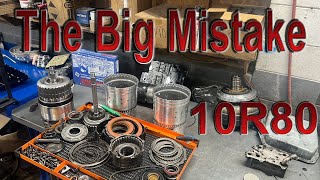
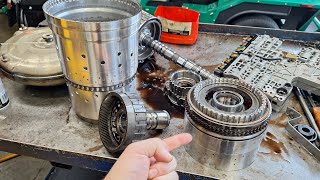
Typical fix: Replacement of the CDF clutch cylinder assembly with the updated part (which has a machined lip to prevent the sleeve from moving 🎬 Watch: See the updated CDF hub design and the fix) and any related damaged components. This is an internal transmission repair that requires removing the transmission from the vehicle and partial disassembly. 🎬 Watch: A full teardown showing the internal bushing failure
Est. part cost: $200-$500 - Low or Dirty Transmission Fluid ⚪ Low Probability → Shop Transmission Assembly While possible on any automatic transmission, it's an unlikely root cause on this platform given the prevalence of the CDF clutch TSB. However, low fluid can cause hydraulic pressure loss and slipping. Dirty fluid is often a symptom of the internal failure (clutch material), not the cause.
How to confirm: Check the transmission fluid level and condition according to the manufacturer's procedure. On the 10R80, this is done from underneath the vehicle at a specific operating temperature, as there is no traditional dipstick.
Typical fix: Perform a transmission fluid drain-and-fill or a full fluid exchange with the correct Motorcraft MERCON ULV fluid. This will not fix the issue if the CDF clutch has failed.
Est. part cost: $150-$300 - Valve Body Failure or Sticking Solenoids ⚪ Low Probability → Shop Transmission Valve Body The 10-speed transmissions have also been known to have valve body issues, and some TSBs address sticking valves. However, for the specific group of codes that includes P0733, the CDF clutch issue is the more common culprit identified by Ford's latest bulletins. A valve body issue is more likely if shifting is erratic across all gears, not just concentrated around one.
How to confirm: A diagnostic scan tool with bidirectional control can command solenoids on and off to test their function. A technician may also perform pressure tests on specific clutch circuits or inspect the valve body for sticking valves upon removal.
Typical fix: Overhaul or replacement of the main control valve body assembly.
Est. part cost: $800-$1500
Rare But Worth Checking
- Faulty Transmission Control Module (TCM): → Shop Transmission Assembly While rare, a software glitch or internal failure in the TCM can cause incorrect gear ratio calculations. This should only be considered after all mechanical and hydraulic issues have been ruled out.
- Damaged Wiring or Connectors: Corrosion or damage to the wiring for the transmission speed sensors or solenoids can cause erratic signals, leading to this code. This is an unlikely cause unless the vehicle has flood damage or known rodent issues.
- Failed One-Way Clutch (Sprag): A failed one-way clutch, or sprag, can cause a lack of engagement in certain gears, leading to ratio codes. A tell-tale sign can be the ability to move in manually selected 1st or 2nd gear but not in Drive. This is a major internal failure requiring a full rebuild.
Diagnosis Steps
- Verify the code with a professional OBD-II scanner that can read transmission-specific data.
- Check for any applicable Technical Service Bulletins (TSBs) for your vehicle's VIN. TSB 24-2254 is the most critical 🎬 Watch: Expert breakdown of common 10-speed transmission problems bulletin for this issue.
- Check the transmission fluid level and condition. Note that dark or burnt-smelling fluid is a strong indicator of internal clutch wear.
- Scan for other related transmission codes to see if a pattern exists that matches the TSBs (e.g., multiple gear ratio codes like P0731, P0732, etc.).
- If symptoms and codes align with TSB 24-2254, the vehicle must be taken to a qualified technician. The procedure requires removing the transmission pan and valve body.
- The technician will then perform an air pressure test on the CDF clutch circuit ports as detailed in the TSB. A leak detected during this test confirms the CDF clutch cylinder has failed. Alternatively, a newer, more accurate test using a Pressure Vacuum Transducer (PVT) may be performed via the Ford diagnostic software (FDRS).
- If the air test passes, diagnosis would then proceed to the valve body or other internal clutch packs, but this is less likely.
Parts You'll Likely Need
- CDF Clutch Cylinder Assembly (Upgraded)
(OEM #HL3Z-7G199-A)— This is the most common point of failure for this code on this vehicle, as identified by Ford in multiple TSBs. The replacement part is an updated design to prevent repeat failure.
Trusted brands: Motorcraft
OEM price range: $250-$400 - Transmission Gasket and Seal Kit — Required for any internal transmission repair to ensure all components are sealed correctly upon reassembly.
Trusted brands: Motorcraft
OEM price range: $150-$300
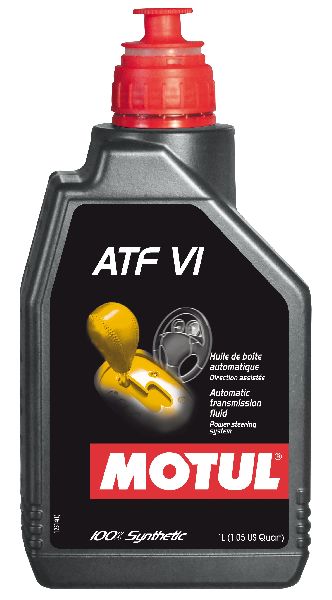
Aftermarket price range: $100-$200 - Motorcraft MERCON ULV Automatic Transmission Fluid
(OEM #XT-12-QULV)— The transmission must be refilled with this specific fluid after the repair. Using any other fluid type can cause damage.
Trusted brands: Motorcraft
OEM price range: $15-$25 per quart
Related Codes That Often Appear With This One
- P0731, P0732, P0734, P0735 — These are incorrect gear ratio codes for other gears. They often appear with P0733 because the underlying hydraulic leak in the CDF clutch assembly can affect multiple gear circuits. The TSBs list a large group of codes that are all traced back to this single component failure.
- P2700-P2708 — These codes relate to transmission clutch apply time and performance. They are also listed in the same TSBs as P0733 and point to the same internal hydraulic leak/clutch issue.
Technical Service Bulletins (TSBs) & Recalls
- TSB 24-2254: The most current and relevant TSB. It explicitly names P0733 and a host of other codes as being caused by axial movement of the CDF clutch cylinder sleeve. It provides the diagnostic procedure to confirm the leak.
- TSB 23-2250: A broader TSB that also lists P0733. It covers multiple potential causes including software, valve body issues, and the CDF clutch cylinder, applying to a wide range of Ford/Lincoln vehicles with 10-speed transmissions.
- Superseded TSBs (22-2102, 21-2434, etc.): Earlier versions of the bulletins that documented the same pattern of failures. Their existence shows this has been a persistent problem that Ford has been addressing for several years.
Platform-Specific Known Issues
- A widespread and well-documented issue with the 10R80 transmission involves the CDF clutch cylinder sleeve moving out of position, causing internal hydraulic leaks. This is documented in Ford TSB 24-2254 and its predecessors. The failure is so common that transmission shops refer to the part as the 'trash can' and immediately suspect it when P0733 and related codes appear.
Mechanic-Grade Diagnostic Values
- CDF Clutch Circuit Air Test — expected: A solid 'clunk' sound as the clutch applies, with no audible continuous air leakage.. Failure: A continuous hissing or leaking sound indicates the CDF clutch cylinder sleeve has shifted and is leaking pressure.
Scan Tool Commands That Help
- Ford IDS/FDRS: Transmission Clutch Circuit Leak Test — This is the updated, official Ford procedure to accurately diagnose internal hydraulic leaks in the A-F clutch circuits using a Pressure Vacuum Transducer (PVT). It is more reliable than the older manual air check method for confirming a failed CDF clutch drum.
- Ford IDS/FDRS: Transmission Characterization/Solenoid IDN — This function is required after replacing the valve body/solenoid assembly. It writes the new 13-digit solenoid body strategy number to the TCM to ensure correct shift pressures and timing.
- FORScan: TCM Adaptive Tables Reset — After a transmission repair, this function clears the learned shift adaptations. The subsequent drive cycle allows the TCM to relearn the new components' characteristics, which is critical for proper shift quality.
Wiring & Ground Locations
- C175T — Main 52-pin harness connector at the Powertrain Control Module (PCM).. This connector carries the wiring for critical transmission components, including the Transmission Range (TR) sensor, Transmission Fluid Temperature (TFT) sensor, and various shift and pressure control solenoids. A fault here could theoretically cause shifting issues, though it's far less common than the mechanical CDF clutch failure for P0733. For example, Pin 19 (BN-YE wire) is for the TFT sensor, and Pin 16 (GY-OG wire) is for the Turbine Shaft Speed (TSS) sensor.
Real Owner Repair Stories
- Monster Transmission (2020 Ford F-150, 60,000 miles) — Long delays shifting into reverse, unpredictable flare between 4th and 5th gear.
✅ What actually fixed it A transmission teardown confirmed the CDF drum sleeve had separated. The fix was a full rebuild including a revised/upgraded CDF drum, an upgraded valve body, and new fluid.
OEM Part Supersession History
HL3Z-7H351-A, JL3Z-7H351-A→JL3Z-7H351-B— The original CDF clutch drum (cylinder) was prone to the internal sleeve walking out of its bore. The updated part, JL3Z-7H351-B, has a machined lip on the inner half of the drum to physically prevent the sleeve from moving, providing a permanent fix.N/A→Sonnax 129910-01K (Aftermarket Kit)— As an alternative to replacing the entire drum, Sonnax offers a 'CDF Drum Saver Kit'. This kit provides a new sleeve with an improved press fit, a locking set screw to prevent rotation, and a physical step to prevent it from shifting rearward. This can be used to repair an existing drum.
Heads up: This is an aftermarket repair kit, not a direct OEM part replacement. It requires special tools (Sonnax 129910-TK) for installation.
Model Year Variations Within This Range
- 2020-2022 (built on or before 08/15/2022): Vehicles built on or before August 15, 2022, are equipped with the original CDF clutch cylinder design that is prone to sleeve failure as outlined in TSB 24-2254. Vehicles built after this date likely have the updated component from the factory, making this specific failure less probable.
Helpful Videos

We Have This Part in Stock


The information in this article is provided for general reference and educational purposes only. Vehicle specifications, procedures, and part compatibility can vary by production date, trim level, and region. Always consult your vehicle's factory service manual and verify part numbers before purchasing or performing repairs. Safety-critical components such as airbags, seat belts, and braking systems should be installed by a qualified professional.
- Ford EXPLORER:
- 🧭 Diagnostic Flowchart
- 🎬 Helpful Videos
- 🛍️ Shop This Part
- What's Unique About the 2020-2023 Ford EXPLORER
- Symptoms You May Notice
- Most Likely Causes
- Rare But Worth Checking
- Diagnosis Steps
- Parts You'll Likely Need
- Related Codes That Often Appear With This One
- Technical Service Bulletins (TSBs) & Recalls
- Platform-Specific Known Issues
- Mechanic-Grade Diagnostic Values
- Scan Tool Commands That Help
- Wiring & Ground Locations
- Real Owner Repair Stories
- OEM Part Supersession History
- Model Year Variations Within This Range
- 🎟️ Get 5% Off