

P0733 on 2018-2023 Ford Mustang: Gear 3 Incorrect Ratio Causes and Fixes
On a 2018-2023 Ford Mustang, code P0733 is most often caused by a known internal failure in the 10R80 transmission related to the CDF clutch drum. This is a complex and expensive repair that requires transmission removal and disassembly, and should be handled by a professional. Ford has acknowledged this issue through multiple Technical Service Bulletins and has released a revised part.
- P0733 on a 2018-2023 Mustang almost always indicates a serious internal transmission problem, not a simple sensor or fluid issue.
- The root cause is a well-documented design flaw in the 10R80 transmission's CDF clutch drum, as outlined in Ford TSB 24-2254.
- Do not continue to drive the vehicle. Driving with a slipping transmission can cause catastrophic damage, turning a costly repair into a full transmission replacement.
- This is not a DIY repair. It requires specialized tools and knowledge for transmission removal and overhaul.
- Ensure the repair shop uses the updated/redesigned CDF clutch drum to permanently fix the issue.
What's Unique About the 2018-2023 Ford MUSTANG
The 2018-2023 Mustang uses the 10-speed 10R80 automatic transmission, which is known for a specific, widespread design flaw. Ford has issued multiple Technical Service Bulletins (TSBs), including TSB 24-2254, which directly link P0733 and a host of other transmission codes to a fault in the 'CDF' clutch drum assembly. A bushing within this drum can move out of place ("walk"), blocking hydraulic fluid passages and causing a significant internal hydraulic leak. This leak prevents the C, D, or F clutches from engaging properly, leading to severe slippage and gear ratio errors, particularly affecting gears 3, 4, and 5. This is not a simple fluid or sensor issue; it's a well-documented mechanical/hydraulic failure point that has led to class-action lawsuits.
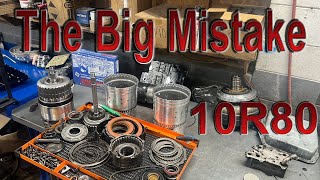
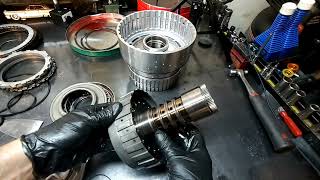
🎬 Watch: A deep dive into the 10R80 CDF drum design flawDiagnostic Flowchart
Tap your situation to follow the diagnostic path that matches what you're seeing on this vehicle.
Symptoms You May Notice
- Check Engine Light is on.
- Harsh, delayed, or jerky shifting, especially into or out of 3rd gear.
- Transmission slipping, where engine RPMs flare up without an increase in vehicle speed, often between the 3-4 shift.
- Sluggish acceleration or a feeling of power loss.
- Vehicle may enter "limp mode," locking the transmission in a single gear to prevent further damage.
- Flashing O/D (Overdrive) light or a transmission-specific warning on the dash (often a yellow wrench icon).
- A long pause or hesitation when shifting from Park to Drive.
- Shuddering or lugging when accelerating in higher gears, as the transmission struggles to downshift correctly.
- Replacing only the input or output speed sensors. While these sensors report the problem, they are rarely the cause of a gear ratio code. A sensor fault would typically set its own specific code (e.g., P0722).
- Performing only a fluid flush. If the CDF drum has failed, a fluid flush will not solve the mechanical or hydraulic issue and may even worsen symptoms by circulating debris.
- Replacing only the valve body. While debris from the failing drum can damage the valve body, replacing it alone without addressing the root cause (the CDF drum) will not provide a permanent fix.
Most Likely Causes
- Internal Failure of the CDF Clutch Drum Assembly 🔴 High Probability → Shop Transmission Assembly This is a widely documented failure on the 10R80 transmission. Per TSB 24-2254, a sleeve within the CDF clutch cylinder can move axially, blocking hydraulic ports and causing a major hydraulic leak that prevents clutches from engaging properly. This design flaw was addressed in later production models and with a revised part. The issue is so common it has resulted in multiple class-action lawsuits against Ford.
How to confirm: A professional technician will need to perform a hydraulic pressure test on the transmission circuits as outlined in TSB 24-2254. Dropping the transmission pan and finding excessive gray, metallic sludge or glitter is also a strong indicator of this internal failure. A technician may also use a scan tool to monitor transmission slip data.
Typical fix: The transmission must be removed and disassembled to replace the faulty CDF clutch drum with a revised part (Ford P/N JL3Z-7H351-B). The revised drum features a lip on the bushing to prevent it from walking out of place. Due to the high likelihood of collateral damage from debris, a full transmission rebuild or replacement with a remanufactured unit is often necessary.
Est. part cost: $150-$470 for the revised CDF drum assembly. - Low or Contaminated Transmission Fluid ⚪ Low Probability → Shop Transmission Assembly While less likely to be the root cause given the known TSBs, low fluid can cause a lack of hydraulic pressure, leading to slipping. Contaminated fluid (often full of clutch material from the failing CDF drum) will confirm an internal mechanical failure but is not the cause itself.
How to confirm: Check the transmission fluid level and condition via the service plug. The fluid should be at the correct level and bright red (Ford Mercon ULV). Dark, burnt-smelling fluid, or fluid with visible metal particles, indicates a serious internal problem.
Typical fix: Perform a transmission fluid and filter change using only the specified Ford Mercon ULV fluid. This is highly unlikely to fix a P0733 code if the CDF drum has failed and is generally not recommended as a first step.
Est. part cost: $150-$300 for fluid and filter. - Faulty Valve Body or Shift Solenoids ⚪ Low Probability → Shop Transmission Valve Body The 10R80 valve body can also be a source of problems, including sticking solenoids or cross-leaks in the valve body itself, which can cause shifting issues. However, these symptoms are often secondary to or misdiagnosed for the CDF drum failure. Debris from the failing drum can contaminate the valve body and cause solenoids to fail.
How to confirm: Requires an advanced scan tool to command individual solenoids and monitor their operation and hydraulic pressures. This is a job for a transmission specialist. Often, a valve body issue is only discovered during the rebuild process for the CDF drum.
Typical fix: Replacement of the specific faulty solenoid or the entire valve body assembly. This is often done in conjunction with the CDF drum replacement.
Est. part cost: $400-$1200 for a valve body assembly.
Diagnosis Steps
- Verify the code with a quality OBD-II scanner. Note all other present codes.
- Check the transmission fluid level and condition. Ensure it is full and clean. The correct fluid is Ford Mercon ULV. Dark, burnt, or metallic fluid is a strong sign of internal failure.
- Review Ford Technical Service Bulletins (TSBs), specifically TSB 24-2254, which directly addresses this code and supersedes previous versions.
- Take the vehicle to a qualified transmission shop or Ford dealership. Inform them of the TSB related to the CDF clutch drum failure.
- The shop will likely drop the transmission pan to inspect for excessive metal debris, a key sign of CDF drum failure.
- Advanced diagnosis involves performing hydraulic pressure tests on the transmission circuits to confirm an internal leak, as specified in TSB 24-2254.
- A technician may also perform a KAM (Keep Alive Memory) reset to see if the issue is software-related, though this is unlikely to fix a mechanical failure.
Parts You'll Likely Need
- CDF Clutch Drum Assembly (Revised)
(OEM #JL3Z-7H351-B)— This is the component identified by Ford in TSB 24-2254 as the primary cause of the failure. The original design allows a bushing to walk out, causing a hydraulic leak. The revised part has a lip to prevent this. This part number supersedes HL3Z-7H351-A and JL3Z-7H351-A.
Trusted brands: Motorcraft
OEM price range: $150-$470
Aftermarket price range: $250-$450 - Transmission Overhaul/Rebuild Kit — Required to replace all necessary seals, gaskets, and clutches during the transmission disassembly and reassembly. Debris from the failed drum often contaminates other clutches, necessitating a full rebuild.
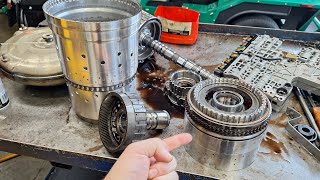
Trusted brands: Motorcraft, SunCoast, McLeod 🎬 Watch: How to build a more reliable 10R80 transmission
OEM price range: $500-$1000
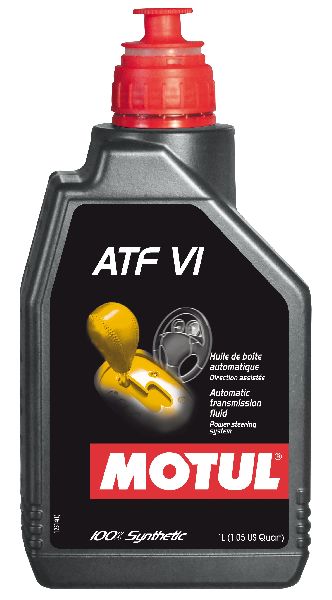
Aftermarket price range: $400-$1200 - Transmission Fluid (Mercon ULV)
(OEM #XT-12-QULV)— The transmission must be refilled with the correct specification fluid after the repair. The 10R80 specifically requires Mercon ULV.
Trusted brands: Motorcraft
OEM price range: $15-$25 per quart
Aftermarket price range: $10-$20 per quart
Related Codes That Often Appear With This One
- P0732 — Stands for 'Gear 2 Incorrect Ratio'. The CDF drum issue affects multiple clutch packs, and it's common for several gear ratio codes to appear together as the internal failure progresses.
- P0734, P0735 — Incorrect ratio codes for 4th and 5th gear. The CDF drum is responsible for clutches C, D, and F, which are involved in gears 3, 4, and 5, making these codes common companions to P0733.
- P0751, P0756, P0761, etc. — These are codes for shift solenoid performance ('A', 'B', 'C', etc.). TSB 24-2254 lists a large group of solenoid and gear ratio codes that are all traced back to the same CDF clutch cylinder failure.
Technical Service Bulletins (TSBs) & Recalls
- TSB 24-2254: The most current TSB, superseding previous versions. It addresses harsh/delayed shifts and a long list of DTCs including P0733, identifying the cause as axial movement of the CDF clutch cylinder sleeve causing hydraulic leaks. It outlines a specific hydraulic test procedure to confirm the failure.
- TSB 23-2250 / 23-2176: Earlier versions of the bulletin that were superseded by TSB 24-2254. They described the same fundamental problem.
Platform-Specific Known Issues
- A primary issue for the 10R80 transmission in 2018-2023 Mustangs is the failure of the CDF clutch drum due to a bushing walking out of place, causing hydraulic leaks. This is officially acknowledged by Ford in multiple TSBs and affects vehicles built on or before August 15, 2022.
Mechanic-Grade Diagnostic Values
- Shift Solenoid Resistance — expected: 5.0 - 5.4 Ohms at 68°F (20°C). Failure: A resistance reading outside of this range indicates a faulty solenoid coil.
Scan Tool Commands That Help
- Ford IDS, FORScan, or equivalent professional scanner: Clear Transmission Adaptive Tables / Reset KAM — This function should be used after a transmission repair, such as replacing the valve body or CDF drum, to erase the learned shift parameters. It forces the TCM to start a new learning process with the new components. Note: This will not fix a mechanical fault.
- Ford IDS, FORScan, or equivalent professional scanner: Adaptive Learning Drive Cycle — This is a mandatory, multi-step driving procedure that must be performed immediately after clearing the adaptive tables. It involves a specific sequence of light accelerations through gears 1-10, gentle braking to a stop, and shifting between N, R, and D to allow the TCM to properly relearn clutch fill times and shift pressures. Failing to perform this cycle is a common reason for continued poor shift quality after a repair.
- FORScan: Halt Transmission Adaptive Learning — This is an advanced/unofficial function used by some owners to prevent the TCM from adjusting shift parameters over time. Some users feel the adaptive strategy creates undesirable shift quality and prefer to disable it, though this is not a manufacturer-recommended procedure.
Wiring & Ground Locations
- C175T (Main Transmission Case Connector) — The main 26-pin electrical connector on the passenger side of the 10R80 transmission case.. This connector carries all signals for speed sensors and solenoid controls. For P0733, a technician would test pins for the Turbine Speed Sensor (TSS, Pin 1), Input Shaft Speed sensors (ISS1/ISS2, Pins 2/3), and Output Shaft Speed sensor (OSS, Pin 4) to rule out a sensor or wiring issue before condemning the transmission internally.
Real Owner Repair Stories
- Synthesized from multiple owner reports on Mustang6G.com and Reddit's r/f150. (2018-2021 Ford Mustang GT or F-150 with 10R80 Transmission) — Check engine light with codes P0733 and often P0732. Harsh, clunky shifting at low speeds, especially in gears 2-4. A noticeable flare or slip when shifting between 3rd and 4th gear.
❌ Tried (didn't work) Performing a transmission fluid flush/change, which sometimes made symptoms temporarily better before they returned., Resetting the transmission adaptive learning tables without a mechanical repair., Being told by a dealer that the harsh shifting is 'normal operation' for the 10R80.
✅ What actually fixed it The definitive fix was taking the vehicle to a competent dealer or independent transmission shop that was aware of Ford's TSBs. The transmission was removed and disassembled to replace the original CDF clutch drum with the updated part (JL3Z-7H351-B) that has the anti-walk bushing. In most cases, this required a partial or full transmission rebuild due to contamination from clutch material.
OEM Part Supersession History
HL3Z-7H351-A→JL3Z-7H351-A, then JL3Z-7H351-B— The original design allowed an internal bushing/sleeve to 'walk' out of position, blocking hydraulic fluid passages to the C, D, and F clutches. The final revised part, JL3Z-7H351-B, incorporates a machined lip that physically prevents the bushing from moving.
Model Year Variations Within This Range
- 2018 - mid-2022: Vehicles built on or before August 15, 2022, were equipped with the original CDF clutch drum design that is prone to the bushing walking out, as outlined in TSB 24-2254. Vehicles built after this date are expected to have the revised part from the factory, making them significantly less likely to experience this specific failure.
Helpful Videos
We Have This Part in Stock


The information in this article is provided for general reference and educational purposes only. Vehicle specifications, procedures, and part compatibility can vary by production date, trim level, and region. Always consult your vehicle's factory service manual and verify part numbers before purchasing or performing repairs. Safety-critical components such as airbags, seat belts, and braking systems should be installed by a qualified professional.
- Ford MUSTANG:
- 🧭 Diagnostic Flowchart
- 🎬 Helpful Videos
- 🛍️ Shop This Part
- What's Unique About the 2018-2023 Ford MUSTANG
- Symptoms You May Notice
- Most Likely Causes
- Diagnosis Steps
- Parts You'll Likely Need
- Related Codes That Often Appear With This One
- Technical Service Bulletins (TSBs) & Recalls
- Platform-Specific Known Issues
- Mechanic-Grade Diagnostic Values
- Scan Tool Commands That Help
- Wiring & Ground Locations
- Real Owner Repair Stories
- OEM Part Supersession History
- Model Year Variations Within This Range
- 🎟️ Get 5% Off