

P0734 on 2018-2023 Ford Expedition: Gear 4 Incorrect Ratio Causes and Fixes
On a 2018-2023 Ford Expedition, code P0734 is almost always a sign of an internal issue with the 10R80 10-speed transmission, often related to the valve body or CDF drum. This is a complex repair requiring professional service, potentially costing several thousand dollars. Ford has issued TSB 24-2046 which directly addresses this code and points to these specific components as the cause.
- P0734 on a 2018-2023 Expedition is a serious code that points to an internal problem with the 10R80 transmission.
- The most likely causes are a faulty main control valve body or a failed CDF clutch drum, both of which are known issues addressed by Ford TSBs.
- Do not ignore this code. While the vehicle may be drivable, continuing to use it can lead to complete transmission failure.
- This is not a DIY-friendly repair. Diagnosis and repair require a professional technician with experience in modern Ford transmissions.
- Ensure any repair shop checks for relevant TSBs, as Ford has provided specific repair procedures for these known issues.
What's Unique About the 2018-2023 Ford EXPEDITION
The 2018-2023 Ford Expedition uses the 10R80 10-speed automatic transmission, which is known for a range of issues including harsh shifting, hunting for gears, and internal component failures. Code P0734 on this platform is frequently linked to specific known failure points within this transmission, such as a faulty main control valve body or issues with the CDF (Clutch F) clutch drum, as outlined in Ford's own Technical Service Bulletins. These issues are so prevalent that class-action lawsuits have been filed regarding the 10R80 transmission's performance and reliability.
Diagnostic Flowchart
Tap your situation to follow the diagnostic path that matches what you're seeing on this vehicle.
Symptoms You May Notice
- Check Engine Light is on
- Harsh, jerky, or delayed shifts, particularly involving 4th gear.
- Transmission slipping (engine RPMs increase but vehicle speed does not), especially during the 3-4 shift.
- Vehicle fails to shift into 4th gear, getting stuck in 3rd.
- Loud clunking or unusual noises from the transmission during shifts.
- Reduced fuel economy due to inefficient gear operation.
- Vehicle lurching or hesitating between gears.
- In severe cases, the transmission may enter a "limp mode," limiting available gears and vehicle speed.
- Replacing only a single shift solenoid when the entire valve body is the root cause of the problem due to sticking valves or cross-leaks.
- Assuming the issue is a simple fluid change when significant metal debris in the pan indicates a deeper mechanical failure (like the CDF drum) that has already occurred.
- Performing a transmission software update or adaptive learning reset and expecting it to fix a mechanical or hydraulic fault. This is often a first step but rarely the final solution for P0734.
Most Likely Causes
- Sticking Valves in Main Control Valve Body 🔴 High Probability → Shop Transmission Valve Body The 10R80 transmission is known for issues with its complex hydromechanical valve body, where valves can stick due to design or contamination, leading to pressure losses and erratic shifting. Ford TSBs directly cite sticking valves as a primary cause for P0734 and other related codes.
How to confirm: A technician will use a high-level scan tool to monitor transmission solenoid commands and pressures. If diagnostics point to a hydraulic/valve issue and fluid is okay, the valve body is the prime suspect. A technician may also find that a specific solenoid actuator is physically hanging up inside the valve body upon disassembly.
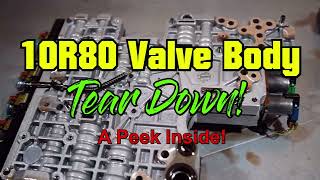
Typical fix: Replacement of the main control valve body assembly. After replacement, the TCM must be reprogrammed with the new 13-digit solenoid body strategy 🎬 Watch: A detailed look inside the 10R80 valve body assembly., and an adaptive learning drive cycle must be performed.
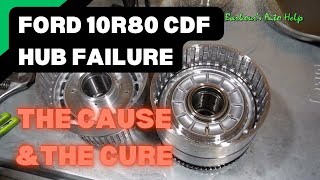
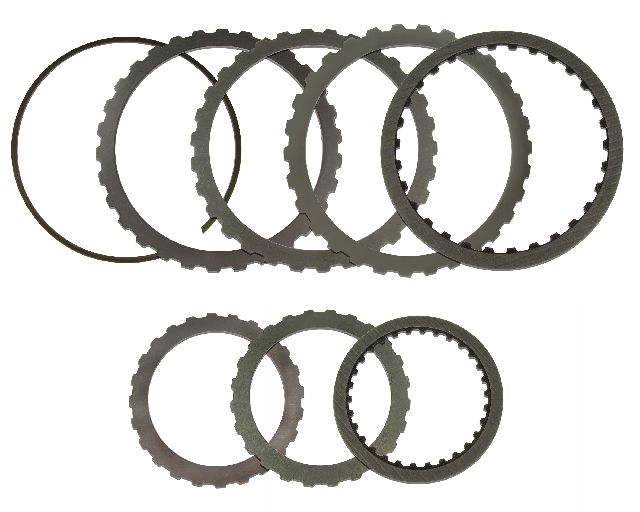
Est. part cost: $700-$1500 - CDF Clutch Cylinder Sleeve Movement 🔴 High Probability → Shop Automatic Transmission Coast Clutch Hub Early versions of the 10R80 (generally pre-August 2022 models) had a design flaw where a bushing/sleeve in the CDF (Clutch F) drum could walk or move out of position, causing a seal to fail and resulting in a significant hydraulic pressure loss. This is a well-documented failure point addressed by multiple Ford TSBs. Vehicles built after August 16, 2022, should have a revised part from the factory.
How to confirm: This requires a partial transmission teardown to physically inspect the CDF drum. A technician may first air-check the clutch pack through the valve body opening with a blow gun to detect a large leak, pointing to this failure.
Typical fix: The transmission must be partially disassembled to replace the CDF drum with an updated part. Aftermarket kits are also available that install a locking set screw to prevent the sleeve from moving.
Est. part cost: $200-$400 for the drum, plus extensive labor 🎬 Watch: See why the CDF hub fails and how to fix it.
- Low or Contaminated Transmission Fluid 🟡 Medium Probability → Shop Transmission Assembly While not unique to this vehicle, the complexity of the 10R80 makes it very sensitive to fluid level and condition. Insufficient fluid reduces hydraulic pressure needed for clutch engagement. Contaminated fluid can cause valves in the valve body to stick.
How to confirm: Check the transmission fluid level and condition. Note: The 10R80 does not have a traditional dipstick, requiring a specific lift and temperature procedure (96°C – 101°C / 206°F – 215°F) to check the fluid from a plug on the transmission pan. 🎬 Watch: How to properly check and fill 10R80 transmission fluid. The fluid should be bright red (Motorcraft ULV is clear/honey-colored when new) and not smell burnt. Metal shavings are a sign of severe internal wear.
Typical fix: If low, top off with the correct fluid (Motorcraft MERCON ULV). If dirty or burnt, perform a fluid and filter change. If the fluid is very contaminated with metal, it indicates a severe internal failure has already occurred and a simple fluid change will not fix the issue.
Est. part cost: $100-$300 for fluid and filter
Rare But Worth Checking
- Faulty Transmission Speed Sensor: → Shop Transmission Assembly While possible, it's less common than the mechanical or hydraulic issues on the 10R80. The TCM uses input and output speed sensors to calculate gear ratios. A faulty sensor could send incorrect data, triggering the code. This is often accompanied by other sensor-specific codes (e.g., P0720 for an output speed sensor fault).
- Transmission Control Module (TCM) Failure: → Shop Transmission Assembly A software glitch or internal hardware failure in the TCM can cause a false P0734 code, but this is rare. It should only be considered after all other mechanical and hydraulic possibilities have been exhausted. Sometimes a TCM software reflash is the first step prescribed by a dealer to rule out software issues.
- Missing Transmission Roll Pin: → Shop Transmission Assembly A specific recall (18S09) was issued for some 2018 Expeditions where a roll pin may not have been installed in the transmission, which could cause a loss of the 'Park' function. While not directly causing a P0734, it highlights early production issues with the 10R80.
Diagnosis Steps
- Verify the code with a professional OBD-II scanner that can read transmission-specific data.
- Check for any Technical Service Bulletins (TSBs) related to the vehicle's VIN. TSBs like 23-2250 are highly relevant for this code on this vehicle.
- Check the transmission fluid level and condition following the specific OEM procedure (requires a lift and temperature monitoring between 206°F - 215°F). Note any burnt smell or metal particles.
- Use a scan tool to monitor live data, observing commanded gear vs. actual gear, input/output speed sensor readings, and solenoid performance data.
- Follow the diagnostic procedure outlined in the relevant TSB, which may involve reprogramming the PCM/TCM and performing an adaptive learning drive cycle.
- If codes return, the TSB points toward inspecting and likely replacing the main control valve body.
- If the valve body is not the issue or if the vehicle was built before August 2022, the TSB directs inspection and replacement of the CDF clutch cylinder, which requires partial transmission disassembly.
Parts You'll Likely Need
- Main Control Valve Body Assembly
(OEM #JL1Z-7A100-A, JL1Z-7A100-B, HL3Z-7A100-B)— This is a primary failure point on the 10R80 transmission, responsible for many shifting issues and gear ratio codes. TSBs point directly to sticking valves in this component.
Trusted brands: Motorcraft
OEM price range: $700-$1500
Aftermarket price range: $500-$1000 - CDF Clutch Drum/Hub
(OEM #HL3Z-7A360-D (part of the assembly))— A known weak point in earlier 10R80 models where a sleeve moves out of position, causing a pressure loss and shifting faults. The updated part is intended to prevent this movement.
Trusted brands: Motorcraft
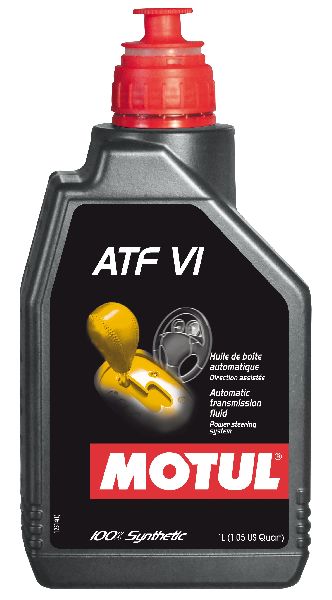
OEM price range: $200-$400 - Automatic Transmission Fluid
(OEM #XT-12-QULV (Motorcraft MERCON ULV))— Any service will require replacing the fluid. The 10R80 is extremely sensitive to fluid type and quality. Only the specified fluid should be used.
Related Codes That Often Appear With This One
- P0729, P0731, P0732, P0733, P0735, P0736 — These are all incorrect gear ratio codes for other gears. Seeing them together with P0734 strongly points to a systemic transmission problem like a failing valve body, low fluid, or major internal failure, rather than an issue isolated to just one gear. The NHTSA TSB provided in the prompt lists all these codes together.
- P0751, P0756, P0761, etc. — These are shift solenoid performance codes. They often appear alongside gear ratio codes because a stuck or malfunctioning solenoid is preventing the proper gear from being engaged, leading to the ratio error detected by the TCM. The NHTSA TSB provided in the prompt lists these codes together as part of the same underlying issue.
Technical Service Bulletins (TSBs) & Recalls
- TSB 24-2046: Supersedes 23-2350. Addresses harsh/delayed shifts and a long list of DTCs including P0734. Points to sticking valves in the main control body or axial movement of the CDF clutch cylinder sleeve as the primary causes.
- TSB 22-2428: An earlier TSB mentioned by a Ford technician on Reddit, also pointing to the CDF clutch housing issue as a root cause for widespread 10R80 problems.
Platform-Specific Known Issues
- The 10R80 transmission in 2018-2023 Expeditions is subject to multiple Technical Service Bulletins (TSBs) for harsh/delayed shifts and engagement issues. TSB 24-2046 specifically lists P0734 and points to the valve body and CDF clutch cylinder sleeve as likely causes.
- Owner forums and Reddit threads are filled with complaints about the 10R80's reliability, with many owners experiencing the exact symptoms associated with P0734, often leading to costly valve body or transmission replacements.
- A class-action lawsuit has been filed against Ford concerning the 10R80 transmission used in Expeditions and other models, alleging the transmissions are defective and can shift harshly, lunge, and hesitate.
Mechanic-Grade Diagnostic Values
- Shift Solenoid Resistance — expected: 5.0 - 5.4 Ohms at 68°F (20°C). Failure: A reading outside this range indicates a faulty solenoid coil.
- Transmission Fluid Temperature for Level Check — expected: 96°C – 101°C (206°F – 215°F). Failure: Checking the fluid at the wrong temperature will result in an inaccurate level reading, which can lead to misdiagnosis.
Hidden / Shadow Codes Worth Checking
- P163E: Transmission Control Module (TCM) Programming Error (see via This code may appear after replacing the main control valve body and can be read by a Ford-specific scan tool like IDS or FORScan. It indicates a software incompatibility, often caused by incorrectly entering the 12-digit solenoid body ID instead of only the 13-digit solenoid strategy during programming.)
Scan Tool Commands That Help
- Ford IDS, FORScan, or equivalent professional scanner: Clear Transmission Adaptive Tables / Reset KAM — This must be performed after any major transmission repair, fluid change, or valve body replacement. It erases the learned shift patterns, which is the first step before performing the mandatory adaptive learning drive cycle. Failing to do this can cause continued erratic shifting.
- Ford IDS or equivalent professional scanner: PCM – Transmission Strategy Download — This is required when a new main control valve body or a complete transmission is installed. The tech must input the 13-digit solenoid strategy number from the new part's tag into the TCM/PCM. Failure to program the new strategy will result in poor shifting and can damage the new valve body.
- FORScan: Halt Transmission Adaptive Learning — Some users attempt to use this function to disable the transmission's learning process, which they blame for developing poor shift quality over time. However, this is not a Ford-approved procedure and is debated on forums, with many stating it's not possible or advisable.
Wiring & Ground Locations
- Main Transmission Case Connector — The main electrical connector on the side of the 10R80 transmission case.. This connector houses the pins for all internal transmission components, including the shift solenoids and speed sensors. A visual inspection for corrosion or damage is a key diagnostic step. Pin 26 (BN-WH wire) is the ground control for Shift Solenoid D, which is involved in the 4th gear shift.
- Underhood Fuse Box - Fuse F24 (2019 Model) — In the fuse box located in the engine compartment.. This fuse provides power to the Transmission Control Module (TCM). While a blown fuse is unlikely to cause only a P0734, checking for power supply issues to the TCM is a fundamental part of electrical diagnosis.
Real Owner Repair Stories
- Reddit user in r/FordTransmissionTech (Early 2018 Ford Mustang (uses same 10R80 transmission)) — Slipping in 3rd, 4th, and 5th gears, occurring 80% of the time under 50-70% acceleration. A whine noise was present during shifts in gears 1-4.
❌ Tried (didn't work) Replacement of the main control valve body assembly., Updating the solenoid strategy and clearing adaptive tables., Updating the PCM firmware at a Ford dealership.
✅ What actually fixed it The user was advised by a transmission technician that after a valve body replacement fails to fix the issue, the next logical step is to suspect the CDF clutch cylinder failure, as the symptoms (especially a 3-4 slip) are a perfect match for that known issue. The recommended confirmation was to air-check the C-clutch port for leaks. - Ford Expedition Forum user (2019 Expedition Max Platinum with 59k miles) — Rough shifting between 4-5 and sometimes 5-6.
❌ Tried (didn't work) The dealership replaced the CDF drum under warranty.
✅ What actually fixed it The rough shifting continued immediately after the CDF drum replacement. The dealer advised that the transmission's adaptive learning needs several hundred miles (or a couple tanks of fuel) to relearn clutch apply pressures and shift timing. The issue is not considered resolved until this relearning period is complete. If it persists, an aftermarket tune is suggested by other forum members.
OEM Part Supersession History
Various early 10R80 Valve Bodies→HL3Z-7A100-B, JL1Z-7A100-B, etc.— Ford has released multiple revisions of the valve body to address shifting concerns and improve reliability.
Heads up: It is critical to use the correct valve body for the specific vehicle application (e.g., with/without start/stop). Using the wrong part can cause functionality issues. After installation, the new 13-digit solenoid strategy MUST be programmed into the TCM.
Model Year Variations Within This Range
- 2018 - Mid-2022: Vehicles built before August 16, 2022, are prone to the CDF clutch drum sleeve shifting, which is a primary cause of gear ratio and shifting codes. Vehicles built after this date should have an updated CDF drum from the factory that prevents the sleeve from moving.
- 2021+: Some 2021 and later Ford valve bodies eliminated the TCC gain control valve, which was a feature in earlier models. While aftermarket controllers can work with either version, it is important to use the correct OEM valve body for the vehicle's original configuration.
Helpful Videos
We Have This Part in Stock


The information in this article is provided for general reference and educational purposes only. Vehicle specifications, procedures, and part compatibility can vary by production date, trim level, and region. Always consult your vehicle's factory service manual and verify part numbers before purchasing or performing repairs. Safety-critical components such as airbags, seat belts, and braking systems should be installed by a qualified professional.
- Ford EXPEDITION:
- 🧭 Diagnostic Flowchart
- 🎬 Helpful Videos
- 🛍️ Shop This Part
- What's Unique About the 2018-2023 Ford EXPEDITION
- Symptoms You May Notice
- Most Likely Causes
- Rare But Worth Checking
- Diagnosis Steps
- Parts You'll Likely Need
- Related Codes That Often Appear With This One
- Technical Service Bulletins (TSBs) & Recalls
- Platform-Specific Known Issues
- Mechanic-Grade Diagnostic Values
- Hidden / Shadow Codes Worth Checking
- Scan Tool Commands That Help
- Wiring & Ground Locations
- Real Owner Repair Stories
- OEM Part Supersession History
- Model Year Variations Within This Range
- 🎟️ Get 5% Off