

P0734 on 2017-2023 Ford F-150: Gear 4 Incorrect Ratio Causes and Fixes
On a 2017-2023 Ford F-150 with the 10R80 transmission, code P0734 almost always indicates a serious internal transmission problem, not a simple sensor fix. The most common culprit is a failure of the CDF clutch drum assembly due to a design flaw. This is a major repair that often results in a full transmission replacement or rebuild with updated parts.
- P0734 on a 2017-2023 F-150 is a serious code that signals a significant internal transmission problem.
- The most likely cause is a well-known failure of the CDF clutch drum inside the 10R80 10-speed transmission.
- Do not ignore this code. Continued driving will lead to further, more expensive damage and a potential breakdown.
- A simple fluid change or sensor replacement will not fix this issue. The repair requires transmission removal and either a rebuild or a full replacement.
- When seeking repairs, ask the shop about their experience with the 10R80 CDF drum issue and if they use updated parts.
What's Unique About the 2017-2023 Ford F-150
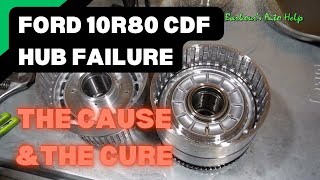
The 2017-2023 F-150 primarily uses the Ford 10-speed 10R80 automatic transmission. This specific transmission is known to have a high failure rate of an internal component called the CDF (Clutch D/F) drum. A bushing/sleeve inside this drum can "walk out" or move axially, uncovering hydraulic ports and causing a critical loss of pressure to multiple clutch packs. This design flaw is so prevalent that it's the number one suspect for P0734 and other gear ratio codes on this platform. The issue was significant enough for Ford to release multiple updated part designs for the CDF drum and for aftermarket companies like Sonnax to develop reinforcement kits.
🎬 Watch: A deep dive into the CDF hub failure and cure.Diagnostic Flowchart
Tap your situation to follow the diagnostic path that matches what you're seeing on this vehicle.
Generation note: This range covers the end of the 13th generation (2017-2020) and the beginning of the 14th generation (2021-2023) of the F-150. Both generations widely use the 10R80 10-speed automatic transmission, which is the primary subject of this P0734 issue. Ford reportedly began using an updated CDF drum in transmissions built on or after August 16, 2022, as referenced in TSB 23-2250. Vehicles built before this date are more susceptible.
Symptoms You May Notice
- Check Engine Light or wrench light is on
- Transmission slipping, especially when trying to shift into 4th gear
- Harsh or delayed shifting between gears, particularly when cold.
- Sudden, harsh downshifts or slamming into gear from a stop.
- Engine RPMs flare up without an increase in vehicle speed
- Vehicle enters "limp mode," limiting available gears.
- Failure to shift into or out of 4th gear.
- A feeling of the transmission shifting into neutral between gears.
- Replacing only the transmission speed sensors. While sensors can fail, they are not the common cause for this code on this specific transmission and would likely set their own specific codes (like P0720).
- Performing a transmission fluid flush. If the code is caused by a mechanical failure like the CDF drum, a flush is a waste of money as the transmission will need to be disassembled anyway. Many forum users and TSBs warn against this as a 'fix'.
Most Likely Causes
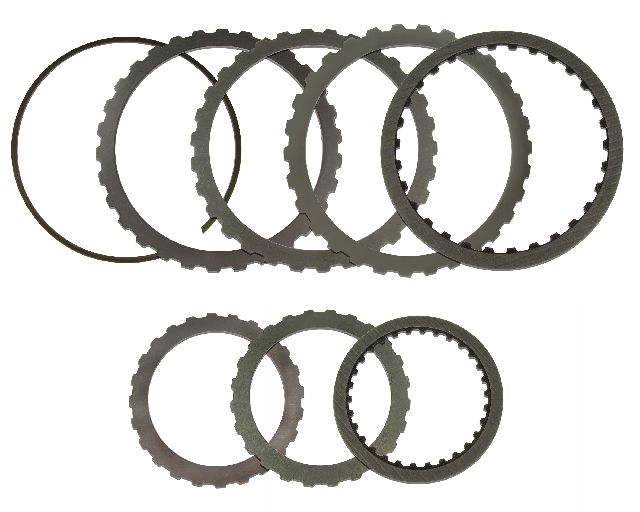
- Internal CDF Clutch Drum Failure 🔴 High Probability → Shop Transmission Clutch Pressure Plate The 10R80 transmission has a well-documented design flaw where a bushing in the CDF drum assembly can walk out of position, damaging a seal and causing a major hydraulic leak that affects multiple clutch circuits. This is a very common failure point, acknowledged in Ford TSBs like 23-2050.
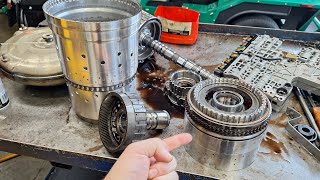
How to confirm: Diagnosis requires a transmission teardown to physically inspect the CDF drum for a migrated sleeve 🎬 See a full 10R80 teardown showing the bushing failure. and damaged seal. When the pan is dropped, the fluid will often be dark and contain clutch material, and sometimes the displaced bushing itself can be found in the pan. A technician may also air-test the clutch pack through the valve body to check for leaks; a significant leak in the C or D clutch circuits points to CDF drum failure.
Typical fix: The transmission must be removed and disassembled. The fix involves replacing the faulty CDF drum with an updated OEM version (part # JL3Z-7H351-B is a redesigned part) or installing an aftermarket reinforcement kit like the Sonnax CDF Drum Saver Kit (part # 129910-01K). Due to the complexity and labor involved, many shops recommend a complete transmission rebuild or replacement with a remanufactured unit that includes the updated parts.
Est. part cost: $200-$500 for an updated drum, $4000-$8000+ for a remanufactured transmission. - Main Valve Body Failure 🟡 Medium Probability → Shop Transmission Valve Body Sticking valves or internal cross-leaks within the valve body can prevent proper hydraulic pressure from reaching the clutch packs. Ford has issued TSBs (like 23-2050) that address overhauling the valve body for shift quality issues and various DTCs, including P0734. Often, this issue occurs alongside the CDF drum failure.
How to confirm: A technician with an advanced scan tool can monitor solenoid commands and pressures. A physical inspection of the valve body for stuck valves or debris is the definitive test. Specialized tools can also be used to check for leaks.
Typical fix: The valve body can be removed, cleaned, and overhauled with updated components, or replaced as an assembly. Ford's TSB procedure involves overhauling the main control. This is often done as part of a larger transmission repair.
Est. part cost: $500-$1500 for the valve body assembly (e.g., OEM part HL3Z-7A100-B). - Low or Contaminated Transmission Fluid ⚪ Low Probability → Shop Transmission Assembly This is almost always a *symptom* of the CDF drum failure, not the root cause. The internal leak caused by the drum failure quickly contaminates the fluid with clutch material. While a separate leak can cause low fluid, it's less common. The correct fluid is Motorcraft MERCON ULV.
How to confirm: Check the transmission fluid level and condition from under the vehicle (no dipstick). The fluid level check must be done at operating temperature (around 206°F - 215°F). Fluid should be bright red and clear. Dark, burnt-smelling fluid with metallic or clutch material is a definitive sign of severe internal damage.
Typical fix: If the fluid is simply low due to an external leak, fix the leak and refill with Motorcraft Mercon ULV (Part # XT-12-QULV). If the fluid is contaminated, a fluid change will not fix the underlying mechanical problem and the transmission must be disassembled.
Est. part cost: $150-$300 for a fluid and filter service.
Rare But Worth Checking
- Faulty Shift Solenoid: → Shop Transmission Valve Body While a solenoid can fail, it is much less common than the CDF drum or valve body issues on the 10R80. A solenoid failure will typically be accompanied by a specific solenoid performance code (e.g., P0751, P2707), though these codes are also listed as potential companions to the CDF drum failure in TSBs.
- Transmission Control Module (TCM) Software: → Shop Transmission Assembly Outdated software can cause harsh shifting, but it is extremely unlikely to be the sole cause of a P0734 gear ratio code without an underlying mechanical issue. TSBs often recommend a PCM/TCM reflash as part of a larger repair procedure after mechanical parts (like the valve body) are replaced.
Diagnosis Steps
- Verify the code with a quality OBD-II scanner. Note any other transmission-related codes.
- Check for any Technical Service Bulletins (TSBs). TSB 23-2050 is highly relevant and lists P0734 as a primary code for CDF drum and valve body issues.
- Check the transmission fluid level and condition. This must be done with the vehicle at operating temperature (206°F - 215°F) and on a level surface. Note any burnt smell or metallic/clutch debris, which strongly indicates internal failure.
- Use an advanced scan tool to monitor transmission data PIDs (Parameter IDs), such as commanded gear vs. actual gear, line pressure, and solenoid performance.
- Drop the transmission pan and inspect for debris. Finding a loose metal sleeve (from the CDF drum) or excessive clutch material in the pan confirms a major mechanical failure.
- With the pan off, remove the valve body. This allows for visual inspection and air pressure testing of the clutch pack circuits. A significant air leak in the C or D clutch circuits when air is applied confirms the CDF drum has failed.
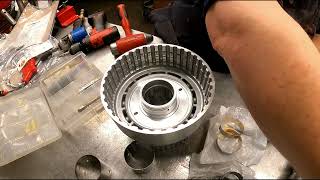
- If air tests confirm a leak, the transmission must be removed from the vehicle and completely disassembled for inspection and repair of the CDF drum and any collateral damage. 🎬 Watch this quick overview of the CDF drum replacement process.
Parts You'll Likely Need
- Complete Transmission Assembly (Remanufactured)
(OEM #e.g., JL3Z-7000-B (Varies by specific model))— Due to the complexity of the 10R80 and the prevalence of the CDF drum failure, a full replacement with a warrantied remanufactured unit containing updated parts is the most common and often most reliable long-term repair. - CDF Clutch Drum Hub Assembly
(OEM #JL3Z-7H351-B)— This is the updated OEM part designed to fix the bushing 'walk-out' issue. It supersedes older part numbers HL3Z-7H351-A and JL3Z-7H351-A. This is required if a full rebuild is being performed instead of a replacement. - Main Valve Body Assembly
(OEM #e.g., HL3Z-7A100-B)— Often replaced or overhauled during the transmission rebuild, as sticking valves can contribute to or be a result of the primary failure. Debris from the failing clutches can damage the valve body. - Sonnax CDF Drum Saver Kit
(OEM #129910-01K)— A popular aftermarket alternative to replacing the entire drum. It installs a new, more robust sleeve with a locking mechanism to prevent it from walking out. This is for shops that specialize in rebuilding the original transmission. - Motorcraft MERCON ULV Automatic Transmission Fluid
(OEM #XT-12-QULV)— This is the only specified fluid for the 10R80 transmission. A full fluid replacement is required for any internal transmission repair.
Related Codes That Often Appear With This One
- P07F7 — This code means 'Unable to Engage Gear 7' or 'Gear 10 Incorrect Ratio' in some documents. Like P0734, it indicates a gear ratio error and is often triggered by the same internal hydraulic leaks caused by CDF drum failure. Owner complaints frequently list P0734 and P07F7 together. [ODI #11714853, ODI #11638866, ODI #11683808]
- P0732 — This code is for 'Gear 2 Incorrect Ratio'. The CDF drum failure affects multiple clutch packs, and it's common to see ratio errors for other gears logged at the same time. TSB 23-2050 lists this code as part of the group related to the CDF drum and valve body issues.
- P0735 — This code is for 'Gear 5 Incorrect Ratio'. Like the other gear ratio codes, it points to widespread hydraulic pressure loss and is often seen with P0734 for the same underlying reasons.
- P0729 — This code is for 'Gear 6 Incorrect Ratio'. It is another common companion code listed in Ford's TSBs addressing the 10R80's internal failures.
Technical Service Bulletins (TSBs) & Recalls
- TSB 23-2250: Supersedes previous TSBs, identifies axial movement of the CDF clutch cylinder sleeve as a cause for hydraulic leaks and numerous DTCs including P0734. Notes that trucks built after 8/16/2022 should have updated parts.
- TSB 22-2428: A comprehensive TSB covering harsh/delayed shifts and a long list of DTCs (including P0734) on most 10R80-equipped vehicles. It attributes the cause to TCM software, valve body issues, AND the CDF clutch sleeve movement.
- TSB 23-2123: Focuses on harsh shifts and many of the same DTCs as 22-2428. The prescribed fix is to overhaul the main control valve body and perform an adaptive learning drive cycle.
Platform-Specific Known Issues
- Multiple NHTSA owner complaints for 2017-2020 F-150s cite P0734, often paired with P07F7, leading to a diagnosis of complete transmission failure requiring replacement. [ODI #11714853, ODI #11638866, ODI #11626827]
- One owner complaint specifically notes the diagnosis for P0734 was a failed 'CDF Drum'. [ODI #11715241]
- Ford has issued multiple Technical Service Bulletins (TSBs) for the 10R80 transmission addressing harsh shifts and gear ratio DTCs, including P0734. TSB 22-2428 and others point to issues with the main control valve body and axial movement of the CDF clutch cylinder sleeve as root causes.
Mechanic-Grade Diagnostic Values
- Shift Solenoid (A-F) Resistance — expected: 5.0 - 5.4 Ohms at 68°F (20°C). Failure: Readings outside this range indicate a faulty solenoid coil.
- Transmission Fluid Temperature (TFT) Sensor Resistance — expected: 37k-16k Ohms at 69-104°F (21-40°C); 2.7k-1.5k Ohms at 195-230°F (91-110°C). Failure: Resistance that does not correlate with the fluid temperature can cause incorrect line pressure calculations and shift problems.
Hidden / Shadow Codes Worth Checking
- P0734-00: The '-00' suffix is a Failure Type Code (FTC) used by Ford, indicating a general component failure without more specific sub-fault information. It confirms the gear ratio error is the primary fault detected for this circuit. (see via This is often visible on higher-end scan tools and is explicitly mentioned in NHTSA owner complaints, suggesting it's readable by more than just dealer-level tools. [ODI #11689469, ODI #11683808])
Scan Tool Commands That Help
- Ford IDS (Integrated Diagnostic System) or equivalent (FORScan): Transmission Characterization / Solenoid IDN — This function is mandatory after replacing the valve body or a complete transmission. It writes the 13-digit solenoid body strategy number to the TCM to ensure correct hydraulic pressures and shift timing. Failure to perform this can cause harsh shifts or DTCs.
- Ford IDS or equivalent: Clear Adaptive Tables — This should be performed after any transmission repair, including valve body or CDF drum replacement. It resets the transmission's learned shift patterns, forcing it to relearn based on the new components.
- Advanced Scan Tool: Clutch Pressure Air Test (Manual) — This is not a scan tool command but a manual test performed with the valve body removed. A technician uses a blow gun with a rubber tip to apply compressed air to the clutch circuit ports on the transmission case. A hissing sound (air leak) from the C or D clutch circuit strongly confirms a failed CDF drum seal.
Wiring & Ground Locations
- C1575 — The main transmission vehicle harness connector on the outside of the transmission case.. All electronic signals for solenoids and sensors pass through this connector. While not a common failure point for P0734, any corrosion or pushed-out pins here could cause a variety of transmission codes and erratic behavior.
- Transmission Case Ground — A ground strap connecting the transmission bellhousing to the vehicle's chassis/frame.. A poor ground connection can cause electrical noise and erratic behavior from sensors and solenoids, although it is an unlikely root cause for a specific gear ratio code like P0734.
Real Owner Repair Stories
- Reddit user in r/FordTransmissionTech (2017 Ford F-150 with 10R80) — Codes P0732, P0734, P076F. At cold start, a long slip when shifting from 3rd to 5th gear. A whine noise during shifts in gears 1-4.
❌ Tried (didn't work) Replaced the main valve body assembly., Updated the solenoid strategy in the TCM., Cleared adaptive tables., Updated the PCM firmware.
✅ What actually fixed it The user was advised by a Ford technician in the thread that the symptoms and failed attempts pointed directly to the classic CDF clutch cylinder bushing misalignment. The final fix is the physical removal and rebuild/replacement of the transmission to address the failed CDF drum.
OEM Part Supersession History
HL3Z-7H351-A, JL3Z-7H351-A→JL3Z-7H351-B— The original CDF drum designs allowed an internal bushing/sleeve to 'walk out' of position. The updated JL3Z-7H351-B part features a revised design with a lip that physically prevents the bushing from migrating and causing the hydraulic leak.
Model Year Variations Within This Range
- 2017 - Mid-2022: Vehicles built on or before August 15, 2022, were originally equipped with the older, failure-prone CDF drum design. Vehicles built after this date are more likely to have the updated drum from the factory, reducing the probability of this specific failure.
- 2017-2020 vs 2021+: Early software calibrations (2017-2020) were often more aggressive in their shift strategies to maximize fuel economy, which could contribute to harsh shifting complaints. Later models (2021+) often have more refined software from the factory.
Helpful Videos
We Have This Part in Stock


The information in this article is provided for general reference and educational purposes only. Vehicle specifications, procedures, and part compatibility can vary by production date, trim level, and region. Always consult your vehicle's factory service manual and verify part numbers before purchasing or performing repairs. Safety-critical components such as airbags, seat belts, and braking systems should be installed by a qualified professional.
- Ford F-150:
- 🧭 Diagnostic Flowchart
- 🎬 Helpful Videos
- 🛍️ Shop This Part
- What's Unique About the 2017-2023 Ford F-150
- Symptoms You May Notice
- Most Likely Causes
- Rare But Worth Checking
- Diagnosis Steps
- Parts You'll Likely Need
- Related Codes That Often Appear With This One
- Technical Service Bulletins (TSBs) & Recalls
- Platform-Specific Known Issues
- Mechanic-Grade Diagnostic Values
- Hidden / Shadow Codes Worth Checking
- Scan Tool Commands That Help
- Wiring & Ground Locations
- Real Owner Repair Stories
- OEM Part Supersession History
- Model Year Variations Within This Range
- 🎟️ Get 5% Off