

P0734 on 2020-2023 Lincoln Aviator: Gear 4 Incorrect Ratio Causes and Fixes
On a 2020-2023 Lincoln Aviator, code P0734 almost always indicates a known internal transmission problem, specifically with the 'CDF drum' assembly. This is not a simple fix and requires professional diagnosis and repair, often involving transmission disassembly. The updated OEM part to fix this is JL3Z-7H351-B.
- P0734 on a 2020-2023 Aviator is a serious code that points to a probable internal transmission issue, not a simple sensor or fluid problem.
- The most likely cause is a well-documented failure of the CDF drum bushing, a known weakness in this 10-speed transmission.
- Manufacturer TSBs exist for this exact problem, guiding technicians on diagnosis and repair.
- This is not a DIY-friendly repair. It requires transmission removal and disassembly by a qualified professional.
- Do not ignore this code. Driving with a slipping transmission can lead to complete failure and a much more costly replacement.
What's Unique About the 2020-2023 Lincoln AVIATOR
The 2020-2023 Aviator uses a 10-speed automatic transmission (10R60) which is known for a specific mechanical weakness. Multiple Technical Service Bulletins (TSBs) from Ford/Lincoln address symptoms like harsh or delayed shifts associated with this code. The root cause is often a design flaw in an internal component called the CDF clutch drum, where a bushing can 'walk' (move) out of place, blocking hydraulic passages and causing a loss of hydraulic pressure and slippage. This makes P0734 on an Aviator much more specific than a generic transmission code on another vehicle.
Diagnostic Flowchart
Tap your situation to follow the diagnostic path that matches what you're seeing on this vehicle.
Symptoms You May Notice
- Harsh or delayed shifting, particularly into or out of 4th gear. [TSB 21-2434, TSB 22-2102].
- Illuminated Malfunction Indicator Lamp (Check Engine Light).
- Transmission slipping, where engine RPMs increase without a corresponding increase in vehicle speed.
- Vehicle may enter a 'limp mode,' limiting available gears and vehicle speed.
- Reduced fuel economy.
- Slamming into gear after a period of hesitation or 'floating' between gears.
- Replacing only the transmission speed sensors. While a sensor can fail, it's not the common cause for this code on this platform, which is dominated by the CDF drum issue.
- Assuming a simple transmission fluid change will fix the problem. If the CDF drum has failed, new fluid will not repair the internal hydraulic leak.
- Replacing the valve body without inspecting the CDF drum. Debris from a failing drum can contaminate a new valve body, leading to a repeat failure.
Most Likely Causes
- Internal Transmission Failure (CDF Drum Bushing) 🔴 High Probability → Shop Transmission Assembly The 10R60/10R80 family of transmissions has a well-documented issue where a bushing in the CDF clutch drum can 'walk' out of its bore, blocking hydraulic passages and causing a seal failure. This leads to pressure loss and slippage, triggering gear ratio codes. The updated part has a machined lip to prevent this movement.
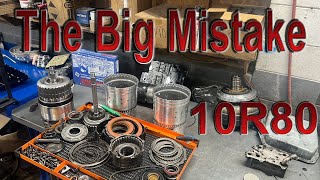
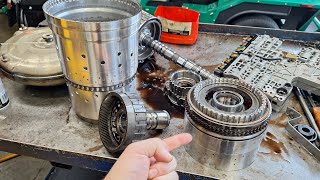
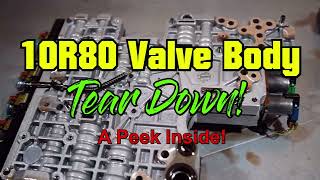
How to confirm: A technician can follow diagnostic procedures outlined in Ford's TSBs, which may include a specialized hydraulic pressure test to confirm leakage in the CDF drum circuit before disassembly. Visual inspection during a transmission teardown provides definitive proof, where the migrated bushing will be clearly visible. 🎬 See this teardown showing exactly how the CDF drum fails.
Typical fix: The transmission must be removed and partially disassembled to replace the faulty CDF drum with an updated part (OEM Part #JL3Z-7H351-B). This is a major repair.
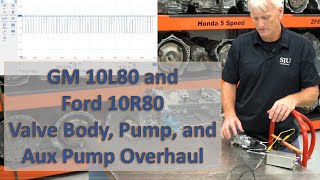
Est. part cost: $150-$250 for the drum itself, but this is part of a larger rebuild. - Faulty Main Control Valve Body 🟡 Medium Probability → Shop Transmission Valve Body The valve body is the complex hydraulic control center of the transmission. Debris from initial wear or a failing CDF drum can cause solenoids to stick or passages to become blocked. TSBs often direct technicians to service the valve body first.
How to confirm: A technician will inspect the valve body for scoring, debris, and test the individual shift solenoids for correct electrical resistance and operation. TSBs 21-2434 and 22-2102 specifically call for a 'PCM - Transmission Accelerated Main Control Break In' routine to be run, which attempts to clear sticking valves before recommending an overhaul.
Typical fix: Cleaning the valve body and passages or replacing the entire main control valve body assembly. In many cases, this is done in conjunction with the CDF drum replacement.
Est. part cost: $700-$1500 - Low or Contaminated Transmission Fluid ⚪ Low Probability → Shop Transmission Assembly
How to confirm: Check the transmission fluid level and condition. The Aviator does not have a traditional dipstick, so this must be be done by a technician via a fill plug on the transmission case. The fluid should be red and clear (Motorcraft MERCON ULV), not brown, black, or smelling burnt.
Typical fix: If low, top off the fluid and inspect for leaks. If the fluid is dirty or burnt, a fluid and filter change is necessary, but this is unlikely to fix the code if an internal mechanical issue like the CDF drum failure is present.
Est. part cost: $150-$400 for a fluid and filter service.
Rare But Worth Checking
- TCM Software or Calibration Error:
Diagnosis Steps
- Verify the code with a professional OBD-II scanner.
- Check for any applicable Technical Service Bulletins (TSBs) for the vehicle's VIN. TSB 22-2428 is a key bulletin that supersedes several others and addresses this issue directly. 🎬 Watch: A breakdown of the harsh shifting TSB and software fixes.
- Have a technician check the transmission fluid level and condition. This is a sealed transmission and requires a specific procedure.
- Follow the diagnostic steps in the relevant TSB, which typically starts with software-based routines like reprogramming the PCM/TCM and performing a 'Transmission Accelerated Main Control Break In' routine.
- Perform the adaptive learning drive cycle as specified in the TSB.
- If symptoms and codes persist, advanced diagnostics such as a transmission pressure test may be performed to isolate the hydraulic leak.
- If tests point to an internal failure, the transmission will need to be removed for inspection and repair, focusing on the CDF drum (replacing with updated part JL3Z-7H351-B) and the main control valve body.
Parts You'll Likely Need
- Transmission CDF Drum Assembly (Updated)
(OEM #JL3Z-7H351-B)— This is the most common point of failure in the 10R60/10R80 transmission leading to gear ratio codes. The original design is prone to a bushing failure, and this updated part is required for a permanent fix.
Trusted brands: Motorcraft
OEM price range: $150-$250
Aftermarket price range: $120-$200 - Transmission Main Control Valve Body Assembly — This is the hydraulic brain of the transmission. It can be damaged by debris from the failing CDF drum or have its own internal failures. It is often serviced or replaced as part of the repair process per TSBs.
Trusted brands: Motorcraft
OEM price range: $1000-$1500
Aftermarket price range: $700-$1200 - Transmission Fluid and Filter Kit
(OEM #FL3Z-7A098-B (Filter))— Required for any internal transmission service. The correct fluid (Motorcraft MERCON ULV, part # XT-12-QULV) is critical for the proper operation of this transmission.
Trusted brands: Motorcraft
OEM price range: $150-$250
Aftermarket price range: $100-$200
Related Codes That Often Appear With This One
- P0729 — Incorrect 6th Gear Ratio. These codes often appear together as they all point to a common underlying problem within the transmission, such as the CDF drum failure or valve body issue. [TSB 25-2302, TSB 21-2434].
- P0731, P0732, P0733, P0735 — Incorrect Gear Ratio for gears 1, 2, 3, and 5. A cluster of gear ratio codes strongly suggests a systemic failure affecting multiple clutch packs, not an isolated solenoid problem. [TSB 25-2302, TSB 22-2102].
- P2700-P2705 — These codes relate to Transmission Friction Element Apply Time Range/Performance. They indicate that a specific clutch is taking too long to engage, which is a direct symptom of a hydraulic leak caused by issues like the CDF drum failure. [TSB 21-2434].
Technical Service Bulletins (TSBs) & Recalls
- TSB 25-2302: Addresses various gear ratio and clutch apply time codes, including P0734, on 2020-2023 Aviators.
- TSB 21-2434: Notes harsh/delayed shifts and a list of DTCs including P0734, pointing to sticking valves in the main control valve body as a possible cause.
- TSB 22-2102: Similar to the above TSB, covering ha
Platform-Specific Known Issues
- TSB 22-2428 is a comprehensive bulletin that supersedes previous ones (like 21-2434 and 22-2102) and directly mentions that harsh shifts and various DTCs including P0734 may be due to 'axial movement of the CDF clutch cylinder sleeve'. This confirms the manufacturer is aware of the specific mechanical flaw.
- The repair procedure outlined in the TSBs is multi-layered. It starts with software updates and diagnostic routines before authorizing mechanical repairs like overhauling the valve body or replacing the CDF drum, indicating a complex diagnostic tree.
Mechanic-Grade Diagnostic Values
- Transmission Fluid Temperature for Level Check — expected: 190°F - 205°F (88°C - 96°C). Failure: Checking the fluid level when the transmission is too cold or too hot will result in an inaccurate reading, potentially masking a low fluid condition or leading to an incorrect fill level.
- Shift Solenoid (A-F) Operation — expected: Directly proportional linear force solenoids. Zero current equals zero pressure; maximum current equals maximum pressure.. Failure: These are mechanical solenoids that actuate valves; they do not pass fluid. Failure is typically sticking or a failure to respond to current, rather than a simple resistance failure.
- Line Pressure Control (LPC) Solenoid Current — expected: Inversely proportional operation. Low or no current (~50 mA) results in full line pressure. High current (~850 mA) results in very low pressure.. Failure: Incorrect pressure readings relative to the commanded current can indicate a failing LPC solenoid or a leak in the hydraulic circuit it controls.
Scan Tool Commands That Help
- Ford Diagnostic & Repair System (FDRS): PCM/TCM - Transmission Accelerated Main Control Break In — This routine is a primary diagnostic step outlined in TSBs for harsh or delayed shifts. It is run multiple times (typically 3) to attempt to clear sticking valves in the main control valve body before authorizing a more invasive mechanical repair.
- Ford Diagnostic & Repair System (FDRS) or FORScan: Program Solenoid Strategy — This is a mandatory procedure after replacing the main control valve body or the entire transmission assembly. The 13-digit solenoid strategy number, etched on the valve body, must be programmed into the TCM/PCM to ensure proper shift calibration and operation.
- Ford Diagnostic & Repair System (FDRS): Perform Adaptive Learning Drive Cycle — This must be performed after any software update, valve body service, or internal transmission repair. It allows the TCM to relearn clutch apply pressures and shift timing, which is critical for resolving shift quality complaints.
Wiring & Ground Locations
- Fuse F47 (Passenger Compartment Fuse Panel) — Located in the fuse panel inside the passenger compartment.. This 10A fuse provides power to the Transmission Control Module (TCM). A loss of power here would cause a complete loss of transmission control and likely generate multiple communication codes in addition to P0734.
- Fuse F60 (Passenger Compartment Fuse Panel) — Located in the fuse panel inside the passenger compartment.. This 5A fuse provides 'keep alive power' to the Powertrain Control Module (PCM), which is essential for retaining adaptive learning memory. Intermittent power loss could contribute to erratic shifting behavior.
- Transmission Main Electrical Connector — On the exterior of the transmission case, connecting the main vehicle harness to the internal transmission components (valve body, sensors).. This is the primary interface for all electronic commands and sensor feedback. Corrosion or a loose connection here can cause a wide range of transmission codes, including incorrect ratio faults. A full pinout can be found in the official factory wiring diagrams.
Real Owner Repair Stories
- Reddit user in r/f150 (Early generation 10R80 (specific year not mentioned, but context implies pre-2021)) — Harsh shifting.
❌ Tried (didn't work) A TSB-directed replacement of 'a couple valve body plates' did not fix the issue.
✅ What actually fixed it The final repair required replacing the CDF cylinder (drum), a support, a rebuild kit, and various frictions/plates. The user noted this was a 'gravy 17-hour job under warranty'. - Reddit user in r/f150 (Ford F-150, failure at 85,000 miles.) — Rough shifting, leading to transmission failure.
❌ Tried (didn't work) Not specified, but the user was out of warranty.
✅ What actually fixed it The CDF drum was replaced. The user noted that because the updated part exists, it's an admission of fault by Ford, and they were able to get Ford to pay for 50% of the repair cost despite being out of warranty.
"I Checked Everything" — The Actual Cause
- A common diagnostic pattern for this issue is not a failed smoke test, but a failed software fix. Per TSBs, the first step is often to run the 'Transmission Accelerated Main Control Break In' routine to clear sticking valves. When this procedure and subsequent adaptive learning drive cycles fail to resolve the P0734 code and harsh shifting, it strongly indicates the root cause is not software or a temporarily stuck valve, but the mechanical failure of the CDF drum's internal sleeve, requiring a teardown.
OEM Part Supersession History
HL3Z-7H351-A, JL3Z-7H351-A→JL3Z-7H351-B— The original CDF drum design allowed an internal sleeve/bushing to 'walk' or move axially. This movement would unseat a seal, causing a significant hydraulic pressure leak in the clutch circuit, leading to slipping and gear ratio codes. The updated JL3Z-7H351-B part has a machined lip on the drum that physically prevents the sleeve from moving, providing a permanent solution to the problem.
Model Year Variations Within This Range
- 2020-2022: TSB 22-2428, which details the CDF drum issue, applies to 10R60 transmissions (used in the Aviator) built on or before December 23, 2022. Vehicles built after this date may have the updated components from the factory.
- 2020 vs 2021+: The transmission control software and shift strategies were updated for the 2021+ model years. Earlier models were more prone to aggressive gear-skipping strategies for fuel economy, while later calibrations tend to provide more consistent, sequential shifts. This can change the 'feel' of the transmission but does not prevent the underlying mechanical CDF drum issue from occurring.
Helpful Videos

We Have This Part in Stock


The information in this article is provided for general reference and educational purposes only. Vehicle specifications, procedures, and part compatibility can vary by production date, trim level, and region. Always consult your vehicle's factory service manual and verify part numbers before purchasing or performing repairs. Safety-critical components such as airbags, seat belts, and braking systems should be installed by a qualified professional.
- Lincoln AVIATOR:
- 🧭 Diagnostic Flowchart
- 🎬 Helpful Videos
- 🛍️ Shop This Part
- What's Unique About the 2020-2023 Lincoln AVIATOR
- Symptoms You May Notice
- Most Likely Causes
- Rare But Worth Checking
- Diagnosis Steps
- Parts You'll Likely Need
- Related Codes That Often Appear With This One
- Technical Service Bulletins (TSBs) & Recalls
- Platform-Specific Known Issues
- Mechanic-Grade Diagnostic Values
- Scan Tool Commands That Help
- Wiring & Ground Locations
- Real Owner Repair Stories
- "I Checked Everything" — The Actual Cause
- OEM Part Supersession History
- Model Year Variations Within This Range
- 🎟️ Get 5% Off