

P0734 on 2024 Ram 3500: Gear 4 Incorrect Ratio Causes & Fixes
On a 2024 Ram 3500, code P0734 typically points to low or dirty transmission fluid, a failing shift solenoid, or an improperly installed transmission filter after a service. Start by checking the transmission fluid level and condition. A fluid and filter service may resolve the issue, but if not, professional diagnosis of the valve body or internal components is likely needed, with specific failure points differing between the 68RFE and Aisin transmissions.
- P0734 means your transmission is slipping in 4th gear.
- The first and most important diagnostic step is to check the transmission fluid level and condition. Do not proceed with expensive repairs without verifying this first.
- If you recently had a transmission service performed, a poorly installed filter seal is a likely culprit.
- Due to the complexity and high cost of potential repairs, professional diagnosis with a proper scan tool is strongly recommended.
- Ignoring this code can lead to severe transmission damage and leave you stranded.
What's Unique About the 2024-2024 Ram 3500
The 2024 Ram 3500 can be equipped with one of two main automatic transmissions: the Chrysler-built 68RFE or the heavy-duty Aisin AS69RC, typically paired with high-output Cummins engines. While both can set a P0734 code, the underlying causes may differ. The 68RFE is known to be more susceptible to issues under high power, particularly with the overdrive clutch pack which is engaged in 4th gear. The Aisin AS69RC is a more robust, commercial-grade unit, but its TCM is notoriously locked down, making it difficult to tune and sometimes leading to harsh or clunky shifts from the factory. Diagnosis must consider which transmission is in the truck, as parts and common failure points are not interchangeable.
Diagnostic Flowchart
Tap your situation to follow the diagnostic path that matches what you're seeing on this vehicle.
Symptoms You May Notice
- Check Engine Light is on.
- Inability to shift into 4th gear, or a significant delay in the shift.
- Transmission slipping, where engine RPMs increase without a corresponding increase in vehicle speed.
- Harsh or jerky shifting into or out of 4th gear.
- Vehicle enters 'limp mode,' limiting speed and power, sometimes after the 3-4 shift attempt.
- Decreased fuel economy due to being stuck in lower gears.
- Engine revs much higher than usual for a given speed.
- Replacing the input and output speed sensors immediately. While these sensors provide the data, they are not usually the root cause unless a specific sensor code is also present.
- Assuming an internal failure without checking hydraulic pressure. Low line pressure from a bad filter seal, faulty pump, or stuck regulator valve can cause slipping that mimics a burnt-out clutch.
Most Likely Causes
- Low or Dirty Transmission Fluid / Improper Filter Installation 🔴 High Probability → Shop Transmission Assembly Improper fluid level or degraded fluid quality affects hydraulic pressure, which is critical for clutch engagement. A very common issue on the 68RFE after a transmission service is an improperly seated sump filter O-ring, which causes the pump to suck air, leading to aeration and a loss of line pressure.
How to confirm: Check the transmission fluid level and condition using the dipstick (if equipped) or service plug. The fluid should be at the correct level, red in color, and not smell burnt. If the issue occurred immediately after a fluid change, inspect the pan filter seal to ensure it is flush against the pump body.
Typical fix: Perform a transmission fluid and filter change using the correct Mopar-specified fluid (ATF+4 for 68RFE, Mopar ASRC for Aisin). If the pan filter seal was the cause, it must be correctly re-installed. 🎬 Watch: Step-by-step guide to a RAM transmission fluid and filter change. If the fluid is very dark or contains metal debris, internal damage is likely.
Est. part cost: $100-$250 - Failed Shift Solenoid or Solenoid Pack 🟡 Medium Probability → Shop Transmission Valve Body
How to confirm: A professional technician can use a high-end scan tool to command the 4th gear solenoid (part of the Overdrive clutch circuit on a 68RFE) and monitor its operation. The valve body must be accessed to test the solenoid's resistance or replace it.
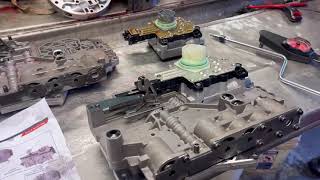
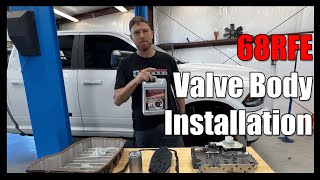
Typical fix: Replace the individual shift solenoid or the entire solenoid/TRS assembly (often called the valve body solenoid pack). 🎬 See how to replace the valve body and solenoid pack. On the 68RFE, this is a common repair.
Est. part cost: $250-$600 - Valve Body Malfunction 🟡 Medium Probability → Shop Transmission Valve Body Debris from normal wear can clog small passages in the valve body, or a valve (like the main regulator valve) can stick, preventing correct hydraulic pressure from being routed to the 4th gear clutch pack. Aftermarket shift kits and valve body upgrades are common for both the 68RFE and Aisin to address these weaknesses.
How to confirm: Requires removal and inspection of the valve body, often performed by a transmission specialist. Pressure testing specific ports can also help diagnose the issue.
Typical fix: The valve body may be cleaned and serviced with upgraded components (like a Sonnax kit) or completely replaced if warped or damaged.
Est. part cost: $500-$1500 - Worn or Damaged Internal Clutch Pack ⚪ Low Probability On the 68RFE, the Underdrive (UD) and Overdrive (OD) clutch packs are applied for 4th gear. The UD clutch is a known weak point and can fail under high torque. The OD clutch pack is also a notorious failure point, often resulting from hydraulic issues. On the Aisin, internal failures are less common but can still occur with heavy use.
How to confirm: This is typically diagnosed after all external and hydraulic causes are ruled out. Finding significant clutch material in the transmission pan is a strong indicator. A full transmission teardown is required for confirmation.
Typical fix: The transmission must be removed from the vehicle and completely rebuilt or replaced.
Est. part cost: $2000-$7000+
Rare But Worth Checking
- Faulty Input or Output Speed Sensor: While possible, a failing speed sensor will usually set its own specific trouble code (e.g., P0716, P0721) in addition to or instead of P0734. The diagnostic logic often checks for these codes first.
- Faulty Powertrain/Transmission Control Module (PCM/TCM): → Shop Transmission Assembly This is extremely rare and should only be considered after all other mechanical, hydraulic, and wiring issues have been definitively ruled out. A service manual procedure may suggest replacing the PCM if the code sets while the vehicle is in Park or Neutral.
- Damaged Wiring Harness: Corrosion, chafing, or loose pins in the transmission wiring harness can cause intermittent signals from sensors or to solenoids, leading to ratio errors. This can mimic a component failure.
Diagnosis Steps
- Check the transmission fluid level and condition. Ensure it is full and does not smell burnt. If the service was recent, suspect an improperly installed pan filter seal.
- Use a professional scan tool to check for any other transmission-related DTCs. Address any solenoid, pressure switch, or sensor-specific codes first.
- Review the freeze-frame data to see the conditions under which the code was set (vehicle speed, engine RPM, line pressure vs. desired line pressure, etc.).
- Perform a road test while monitoring transmission input and output speed sensor data with a scan tool to observe the slip when shifting into 4th gear.
- If fluid level is correct, perform a transmission fluid and filter change. Inspect the pan for excessive metal shavings or clutch material. This is a critical step.
- If the problem persists, perform a line pressure test to check for adequate hydraulic pressure from the pump. Compare actual pressure to desired pressure from the scan tool data.
- If pressures are good, the next step is to inspect the valve body and solenoids. This requires removing the transmission oil pan. A technician can air-check clutch packs through the valve body passages to check for leaks.
- If the valve body and solenoids are confirmed to be working, the issue is likely internal to the transmission (e.g., worn clutches, leaking seals in the UD/OD circuit), requiring a rebuild or replacement.
Parts You'll Likely Need
- Transmission Fluid and Filter Kit
(OEM #68RFE Filter Kit: 68019688AA; Aisin Filter: 68224232AA)— The most common and first step in troubleshooting is to correct low or dirty fluid. An improperly installed filter seal after a service is also a known cause, especially on the 68RFE.
Trusted brands: Mopar
OEM price range: $100-$200
Aftermarket price range: $70-$150 - Transmission Solenoid Pack
(OEM #68RFE Solenoid Block: 68437849AB (or later revision))— The solenoid pack controls the hydraulic flow for shifting. A faulty solenoid can fail to direct pressure to the 4th gear clutch pack, causing a ratio error. It is a common failure point on the 68RFE.
Trusted brands: Mopar, Sonnax
OEM price range: $500-$700
Aftermarket price range: $300-$600
Related Codes That Often Appear With This One
- P0700 — This is a generic transmission fault code that indicates the TCM has stored a specific fault, such as P0734. It's an informational code that tells you to check the TCM for more details.
- P0731, P0732, P0733, P0735 — These are incorrect gear ratio codes for other gears. If multiple gear ratio codes are present, it often points to a widespread issue like low fluid pressure, a failing torque converter, or a major internal failure.
- P0841 — This code relates to the transmission fluid pressure sensor. It can appear with P0734 if the underlying cause is a hydraulic pressure problem affecting multiple systems. [Bulletin #21-012-25 REV. E]
- P0871 — This code indicates an issue with the Overdrive pressure switch rationality on a 68RFE. Since the OD clutch is used for 4th gear, a hydraulic leak in this circuit can cause both P0871 and P0734.
Technical Service Bulletins (TSBs) & Recalls
- 21-012-25 REV. E: Lists P0734-00 as one of several incorrect gear ratio DTCs that may be addressed by a TCM software update on certain vehicles. This TSB often involves multiple codes appearing together.
Platform-Specific Known Issues
- For trucks with the 68RFE transmission, issues can arise after a fluid service if the sump filter's O-ring seal is not installed correctly, causing it to suck air and lose hydraulic pressure.
- A Reddit user with a 2024 Ram 3500 reported getting P0734 immediately after a transmission service where an aftermarket deep pan was installed, highlighting the sensitivity to correct fluid level and component installation.
- On 68RFE transmissions, the overdrive accumulator piston plate is a known failure point. The bolts can back out or break, causing the plate to bend and the accumulator piston to fail, resulting in a loss of 4th, 5th, and 6th gears.
Mechanic-Grade Diagnostic Values
- 68RFE Shift Solenoid Resistance (UD, OD, 2C, 4C, MS, LR/TCC) — expected: ~1.3 Ohms at room temperature.. Failure: An open circuit (infinite resistance) or a reading significantly outside the expected value indicates a failed solenoid coil.
- 68RFE Pressure Control Solenoid Resistance — expected: ~4.9 Ohms at room temperature.. Failure: A reading significantly different from 4.9 Ohms suggests a faulty pressure control solenoid.
- Aisin AS69RC PWM Solenoid Resistance (Yellow or Black connector) — expected: 4-6 Ohms.. Failure: Readings outside this range indicate a faulty solenoid.
- Aisin AS69RC On/Off Solenoid Resistance (Green connector) — expected: 11-21 Ohms.. Failure: Readings outside this range indicate a faulty solenoid.
- 68RFE Input/Output Speed Sensor Resistance — expected: ~535 Ohms at room temperature.. Failure: A significant deviation or open circuit points to a failed sensor.
- Scan Tool: Desired Line Pressure vs. Actual Line Pressure (68RFE) — expected: Readings should be nearly identical under all conditions. For example, ~60 PSI in Drive at a stop, and ~120 PSI during a 3rd gear cruise.. Failure: If actual line pressure is consistently more than 10 PSI below desired line pressure, it indicates a hydraulic leak, failing pump, or sticking regulator valve.
Hidden / Shadow Codes Worth Checking
- P1794 - Speed Sensor Ground Error: This DTC can set if the common ground circuit for the input and output speed sensors is lost. The TCM sees pulses from the input sensor on both circuits, resulting in an apparent 1:2 speed ratio when stopped in neutral, which is nonsensical. (see via Standard OBD-II scan tool. It's not hidden, but its relationship to a P0734 cause (faulty ground) is a mechanic-grade insight.)
Scan Tool Commands That Help
- wiTECH or equivalent professional scan tool: 68RFE Transmission Verification Test — This is a guided diagnostic procedure used after initial checks or repairs to verify the transmission is operating correctly and to see if codes return under specific test conditions.
- wiTECH or equivalent professional scan tool: Induce Limp-in Mode — Done by physically disconnecting the main transmission solenoid harness connector. This forces the transmission into a hydraulic limp mode (4th gear). A test drive in this state helps determine if the fault is electronic or a major mechanical/hydraulic failure.
- wiTECH or equivalent professional scan tool: Quick Learn / Adaptive Learn Reset — This procedure should be performed after replacing the valve body, solenoid pack, or rebuilding the transmission. It resets the Clutch Volume Index (CVI) values, allowing the TCM to relearn clutch apply rates for smooth shifts.
Wiring & Ground Locations
- Transmission Solenoid/TRS Assembly Connector — On the left side of the 68RFE transmission case.. This is the main electrical interface for all solenoids. Checking for corrosion, pushed pins, or damage here is a critical step. Pin 10 is the main power feed, and Pin 7 is the control for the Overdrive solenoid, which is used for 4th gear.
- PCM Connector C175T — At the Powertrain Control Module (PCM).. This connector contains the pins for the speed sensors. Pin 16 is for the Turbine/Transmission Shaft Speed (TSS) sensor, and Pin 25 is for the Output Shaft Speed (OSS) sensor. Testing for continuity and voltage at these pins can diagnose wiring issues between the sensors and the PCM.
- Shared Speed Sensor Ground Circuit — Integrated into the powertrain wiring harness.. A fault in the common ground wire for the input and output speed sensors can cause erratic readings and may set a P1794 DTC alongside the P0734, pointing towards a wiring issue rather than a component failure.
Real Owner Repair Stories
- Turbo Diesel Register forum user 'x74611c3' (2007 Ram 2500 with 68RFE) — Immediately after a DIY transmission fluid and filter change, the truck threw P0700 and P0734. It would lose all power upon shifting to 4th gear and go into limp mode.
❌ Tried (didn't work) Replacing both the input and output speed sensors.
✅ What actually fixed it The user was advised to re-check their work. The final fix was dropping the pan again and discovering the flat sump filter's O-ring was not seated correctly, causing the pump to suck air and lose hydraulic pressure. - RamForum.com user 'Hemi-4-me' (2011 Ram 1500 with 545RFE (similar hydraulic principles)) — After installing a high-stall torque converter and a Transgo shift kit, the truck threw P0734 and P0735 upon hitting 4th gear and went into limp mode.
❌ Tried (didn't work) Complete transmission teardown (all internal clutches and parts looked brand new)., Swapping the old torque converter back in., Swapping the old valve body channel plate back in., Double-checking wiring.
✅ What actually fixed it The issue was an incorrect installation of the Transgo reprogramming kit in the valve body. The plugs and seals from the kit were installed backward or in the incorrect locations. - YouTube user 'DIYTechnician' (2010 Dodge Ram 1500) — Intermittent P0734 and P0735 codes, causing the truck to get stuck in 4th gear. The check engine light would sometimes go away after 100 miles and then return.
❌ Tried (didn't work) Replacing the input and output speed sensors., Replacing the transmission solenoid pack.
✅ What actually fixed it After spending around $600 on parts that didn't fix it, and consulting with a transmission shop that mentioned seeing it before, the owner replaced the Powertrain Control Module (PCM/ECM). This finally resolved the issue.
"I Checked Everything" — The Actual Cause
- A common scenario is when P0734 appears immediately after a transmission service. All components may test fine, but the actual cause is an improperly seated sump filter O-ring on the 68RFE. The seal gets installed on the filter neck instead of being seated flush in the pump body first, which allows air to be drawn into the hydraulic system, causing pressure loss and slipping.
- In modified transmissions, if a valve body shift kit (like a Transgo kit) is installed, P0734 can occur if the small plugs and seals from the kit are put into the wrong bores or oriented incorrectly. The transmission hard parts will be perfect, but the hydraulic circuit modifications are faulty, causing cross-leaks or pressure loss.
OEM Part Supersession History
515490 (68RFE Spin-on Filter)→515489— The updated 515489 part features the improved OE Anti-Drain Back Valve design.
Heads up: Using filters without a properly functioning anti-drain back valve can lead to torque converter drain-back, causing delayed engagement and potential for setting ratio codes on startup.68RFE 'Black Connector' Solenoid Pack→68RFE 'White Connector' or 'Grey Connector' Solenoid Pack (e.g., 68437849AB)— Updated designs for improved reliability and compatibility.
Heads up: Sonnax recommends the 'white connector' solenoid pack as it is considered universal for 45RFE/545RFE/68RFE valve bodies. If installing an older 'black connector' pack on some valve bodies, a striker plate may need to be transferred from the original unit.
Model Year Variations Within This Range
- 2024: While the 2024 model year is new, the 68RFE has a history of internal changes. For example, the TCC limit valve in the pump was improved post-2012, and valve body repair kits are often specific to year ranges (e.g., early vs. late). Technicians should always verify part numbers and repair kits against the specific VIN, as mid-cycle updates to address known issues are common.
Helpful Videos
We Have This Part in Stock


The information in this article is provided for general reference and educational purposes only. Vehicle specifications, procedures, and part compatibility can vary by production date, trim level, and region. Always consult your vehicle's factory service manual and verify part numbers before purchasing or performing repairs. Safety-critical components such as airbags, seat belts, and braking systems should be installed by a qualified professional.
- Ram 3500:
- 🧭 Diagnostic Flowchart
- 🎬 Helpful Videos
- 🛍️ Shop This Part
- What's Unique About the 2024-2024 Ram 3500
- Symptoms You May Notice
- Most Likely Causes
- Rare But Worth Checking
- Diagnosis Steps
- Parts You'll Likely Need
- Related Codes That Often Appear With This One
- Technical Service Bulletins (TSBs) & Recalls
- Platform-Specific Known Issues
- Mechanic-Grade Diagnostic Values
- Hidden / Shadow Codes Worth Checking
- Scan Tool Commands That Help
- Wiring & Ground Locations
- Real Owner Repair Stories
- "I Checked Everything" — The Actual Cause
- OEM Part Supersession History
- Model Year Variations Within This Range
- 🎟️ Get 5% Off