

P0735 on 2020-2023 Ford TRANSIT: Gear 5 Incorrect Ratio Causes and Fixes
This code indicates a slip in 5th gear in the 10-speed (10R80) automatic transmission. The most common causes are low or dirty transmission fluid, a faulty valve body, or internal transmission failure, particularly with the CDF drum. A professional diagnosis is required, as repairs can range from a fluid service to a full transmission rebuild.
- P0735 on a 2020-2023 Transit indicates a potentially serious problem with the 10-speed automatic transmission, specifically that 5th gear is slipping.
- Do not ignore this code. Driving with it can lead to catastrophic transmission failure and a much higher repair bill.
- The first diagnostic step should always be a professional check of the transmission fluid level and condition.
- Be aware of Ford's Technical Service Bulletins (TSBs), as the fix could be a software update or a known issue with the valve body.
- This is not a DIY-friendly repair. Seek a qualified transmission specialist for diagnosis.
What's Unique About the 2020-2023 Ford TRANSIT
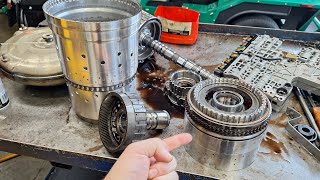
The 2020-2023 Ford Transit uses the 10R80 10-speed automatic transmission, which is known for specific mechanical and hydraulic weak points. A primary point of failure is the CDF drum, where a bushing can slide out of place, causing a loss of hydraulic pressure and erratic shifting. Another known issue is the aluminum outer shell (or 'trash can') developing grooves where the clutches ride, causing them to bind. Ford has issued multiple Technical Service Bulletins (TSBs) for this transmission that cover a wide array of shifting issues and gear ratio codes, including P0735. These bulletins often point toward control module software updates or, more commonly, issues with the main control valve body, indicating that the problem is frequently more complex than a simple sensor failure.
Diagnostic Flowchart
Tap your situation to follow the diagnostic path that matches what you're seeing on this vehicle.
Symptoms You May Notice
- Check Engine Light is on
- Transmission slipping, shuddering, or flaring, especially when shifting to or driving in 5th gear
- Harsh, clunking, or delayed shifting
- Inability to shift into 5th gear
- Engine RPMs flare up without an increase in vehicle speed
- Reduced acceleration and poor fuel economy
- Vehicle enters 'limp mode' (stuck in one gear)
- Delayed engagement when shifting from Park to Drive
- Replacing input or output speed sensors without proper diagnosis. While a sensor can fail, it's less common than fluid, valve body, or internal mechanical issues for this specific code. Often, other codes for the sensor circuit itself would be present.
- Assuming an immediate need for a transmission rebuild without first checking fluid, TSBs for software updates, and testing the valve body and solenoids.
- Mistaking an engine performance issue, like a misfire, for a transmission slip. The TCM can misinterpret the resulting crankshaft speed fluctuations as a gear ratio error.
Most Likely Causes
- Low or Contaminated Transmission Fluid 🔴 High Probability → Shop Transmission Assembly The 10R80 transmission is sensitive to fluid level and condition. A low level starves the pump of fluid, reducing hydraulic pressure needed to engage clutches. Contamination from internal wear (clutch material, metal shavings) can clog the filter and valve body passages.
How to confirm: A technician must check the fluid level and condition. This requires lifting the vehicle, bringing the transmission to a specific operating temperature (206°F - 215°F or 96°C - 101°C), and opening a check plug. Dark, burnt-smelling fluid, or fluid with a glittery appearance (metal shavings), indicates a serious internal problem.
Typical fix: Perform a transmission fluid drain-and-fill or flush with the correct Motorcraft MERCON ULV fluid. If significant debris is found, a simple fluid change will not fix the underlying mechanical issue.
Est. part cost: $150-$300 - Faulty Main Control Valve Body or Solenoids 🟡 Medium Probability → Shop Transmission Valve Body Ford has issued TSB 20-2226 specifically for the 2020 Transit, citing sticking valves in the main control valve body as a cause for harsh engagement and DTCs P0772/P2704, which are related issues. Fine metallic contamination from normal wear can cause valves and solenoids to stick, leading to pressure loss and shift errors.
How to confirm: A technician uses a high-end scan tool to command individual solenoids and monitor transmission line pressure. Inspecting the valve body requires removing the transmission pan. Often, replacement is the only definitive way to rule it out if other causes are not found.
Typical fix: Replacement of the faulty solenoid or the entire main control valve body assembly. Aftermarket performance valve bodies are also available for related platforms like the F-150, which aim to correct factory pressure issues.
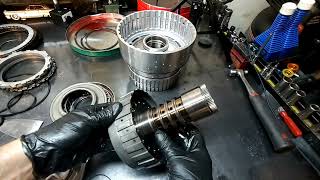
Est. part cost: $600-$1500 - Internal Transmission Mechanical Failure 🟡 Medium Probability → Shop Transmission Assembly The 10R80 has a well-documented design flaw with the C-D-F drum. A bushing can walk out of its bore, uncovering fluid passages and causing a pressure loss that leads to slipping and burnt clutches. Ford has since released an updated drum with a machined lip to prevent this. Worn clutch packs 🎬 Watch: A close-up look at the failed CDF drum bushing. for 5th gear (the 'E' clutch) are a direct cause of slipping.
How to confirm: The presence of excessive metal debris in the transmission pan is a strong indicator of internal failure. A definitive diagnosis requires transmission removal and teardown to inspect the CDF drum, clutch packs, and outer shell.
Typical fix: A complete transmission rebuild using updated parts (like the revised CDF drum and hardened outer shell) or full replacement of the transmission assembly.
Est. part cost: $2500-$7000 - Powertrain/Transmission Control Module (PCM/TCM) Software Issue ⚪ Low Probability → Shop Transmission Assembly Ford TSBs #TSB 26-2046 and #TSB 21-2377 explicitly mention that this code, among many others, may be set due to PCM software. An update can resolve incorrect diagnostic logic or improve shifting strategies. However, software is less likely to be the root cause if significant slipping is felt.
How to confirm: A Ford dealer or qualified shop can check the current software calibration against the latest available version using the Ford Diagnostic and Repair System (FDRS).
Typical fix: Reprogramming the PCM/TCM to the latest software version. After reprogramming, an adaptive learning drive cycle must be performed.
Est. part cost: $0-$250
Rare But Worth Checking
- Engine Misfire: In a documented case on a 10R80-equipped F-150, a severe engine misfire from fouled spark plugs was misinterpreted by the TCM as a transmission slip specifically in 5th gear, setting codes P0735 and P2704. The transmission was mechanically sound, and replacing the spark plugs fixed the 'slip'. This highlights the importance of checking for engine-related codes first.
- Damaged Wiring Harness: Damage to the wiring between the TCM and the transmission's sensors or solenoids can cause incorrect signals, leading to this code. This could include corrosion at connectors or chafing of the harness.
Diagnosis Steps
- Verify the code with a professional OBD-II scanner capable of reading transmission data.
- Check for any engine-related trouble codes. Address any misfire or engine sensor codes first.
- Check for any available Technical Service Bulletins (TSBs) related to the transmission. The provided TSBs 26-2046, 21-2377, and 20-2226 are highly relevant.
- Perform a thorough check of the transmission fluid level and condition. This must be done by a qualified technician due to the lack of a dipstick and specific temperature requirements.
- Inspect the transmission wiring harness and connectors for any visible damage, corrosion, or loose connections.
- Use a scan tool to monitor live data, including input/output speed sensor readings, commanded vs. actual gear, solenoid commands, and transmission fluid temperature.
- If suspected, have a dealer or qualified shop check and update the PCM/TCM software to the latest calibration.
- Perform a hydraulic pressure test to check for adequate line pressure.
- If other tests are inconclusive, drop the transmission pan to inspect for metal debris and to access the valve body and solenoids for testing or replacement. The presence of significant metal indicates a mandatory teardown.
Parts You'll Likely Need
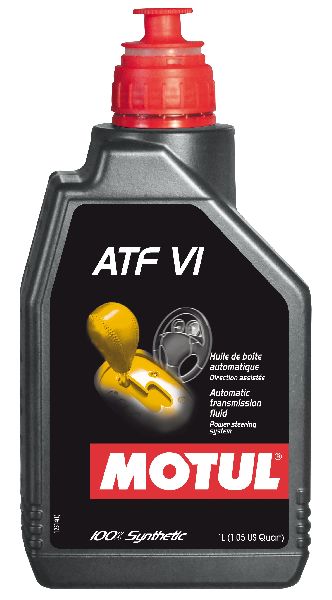
- Automatic Transmission Fluid
(OEM #XT-12-QULV)— Low or contaminated fluid is a primary cause of shifting problems and incorrect gear ratio codes. Only Motorcraft MERCON ULV should be used.
Trusted brands: Motorcraft
OEM price range: $20-$30 per quart
Aftermarket price range: $15-$25 per quart - Main Control Valve Body
(OEM #L1MZ-7A100-F (replaces L1MZ-7A100-B))— Sticking valves or failed solenoids within the valve body are a known issue on the 10R80, leading to pressure loss and incorrect gear ratios. Replacement often requires programming the new solenoid strategy to the TCM.
Trusted brands: Ford
OEM price range: $600-$1500
Aftermarket price range: $400-$1000 - CDF Drum (Clutch Hub Drum Assembly)
(OEM #JL3Z-7H351-B)— The original CDF drum is prone to a bushing failure that causes a major hydraulic leak, leading to multiple gear ratio codes including P0735. An updated part from Ford corrects this design flaw.
Trusted brands: Ford
OEM price range: $150-$250
Aftermarket price range: N/A
Related Codes That Often Appear With This One
- P0729, P0731, P0732, P0733, P0734, P0736 — These are all incorrect gear ratio codes for other gears (6th, 1st, 2nd, 3rd, 4th, and Reverse, respectively). Seeing them together with P0735 strongly suggests a systemic issue like low fluid, a faulty valve body, a failed CDF drum, or a failing torque converter rather than a problem isolated to a single gear's clutch pack. Both TSB 26-2046 and TSB 21-2377 list these codes together.
- P2704 — This code stands for 'Friction Element 'E' Apply Time Range/Performance'. The 'E' clutch is involved in the 4-5 shift. Seeing P2704 with P0735 points directly to a problem with the 'E' clutch system, be it a hydraulic leak (like from the CDF drum), a sticking solenoid in the valve body, or a worn-out clutch pack.
Technical Service Bulletins (TSBs) & Recalls
- TSB 26-2046: Notes that P0735 and many other transmission codes may be due to a PCM software issue.
- TSB 21-2377: Similar to the above, lists P0735 as a potential code related to PCM logic on 2020 models.
Platform-Specific Known Issues
- TSB 26-2046 and TSB 21-2377: Ford issued these bulletins for a wide range of transmission codes, including P0735, which may be resolved by a PCM software update.
- TSB 20-2226: Specifically for the 2020 Transit, this TSB addresses harsh engagement into drive and codes P0772/P2704 (related to the 'E' clutch system) caused by sticking valves in the main control body. The procedure may involve a break-in routine or valve body replacement.
- Owner Experience: CDF Drum Failure: → Shop Automatic Transmission Clutch Drum On a Ford F-150 forum, an owner of a 2018 F-150 with 88k miles described experiencing hard shifts into 3rd and 5th gear and eventually getting a DTC. A dealer rebuild costing $4,400 was required. The mechanic identified the cause as a common 10R80 issue: a bushing in the CDF drum had moved, destroying a seal and causing pressure loss. The owner noted that Ford has a redesigned part, indicating awareness of the flaw.
Mechanic-Grade Diagnostic Values
- Shift Solenoid (A-F) Resistance — expected: 5.0 - 5.4 Ohms at 68°F (20°C). Failure: Readings outside this range indicate a faulty solenoid coil.
- Transmission Fluid Temperature (TFT) Sensor Resistance — expected: Approx. 37k-16k Ohms at 69°F-104°F (21°C-40°C); 2.7k-1.5k Ohms at 195°F-230°F (91°C-110°C). Failure: Resistance values that do not correspond with the temperature chart suggest a failing sensor.
- Line Pressure Control (LPC) Solenoid Current — expected: Inversely proportional; full pressure at low current (approx. 50 mA), low pressure at high current (approx. 850 mA). Failure: Pressure readings that do not align with the commanded current point to a solenoid or valve body issue.
- Torque Converter Clutch (TCC) Solenoid Current — expected: Directly proportional; low pressure at low current (approx. 50 mA), high pressure at high current (approx. 850 mA). Failure: Pressure readings that do not align with the commanded current suggest a TCC solenoid or related valve issue.
Scan Tool Commands That Help
- Ford Diagnostic and Repair System (FDRS) or IDS: Transmission Strategy Download — This function is mandatory after replacing the main control valve body or the entire transmission. It downloads the 13-digit solenoid body strategy data file to the TCM to ensure correct solenoid performance. Failure to do so can result in new DTCs like P163E and persistent shift problems.
- Ford Diagnostic and Repair System (FDRS) or IDS: Transmission Adaptive Learning Drive Cycle — After any transmission repair, software update, or clearing of adaptive tables, this guided drive cycle must be performed. It allows the TCM to relearn clutch fill times and shift points for smooth operation.
- High-end bidirectional scanner: Solenoid Commanded State/Pressure Test — To diagnose a suspected faulty valve body or solenoid. This allows a technician to command individual shift solenoids (A-F) on and off while monitoring line pressure to see if the solenoid is mechanically responding to the electrical command.
Wiring & Ground Locations
- C175T — This is a main connector at the Powertrain Control Module (PCM).. This connector contains the pins for the Turbine Shaft Speed (TSS) sensor (Pin 15), Output Shaft Speed (OSS) sensor (Pin 14), and Transmission Fluid Temperature (TFT) sensor (Pin 20), all of which are critical for diagnosing gear ratio faults. Testing at these pins can verify signal integrity from the sensors to the PCM.
- Transmission Case Connector — The main external electrical connector on the 10R80 transmission housing.. This is the primary interface between the vehicle's wiring harness and the transmission's internal components, including all solenoids and sensors. Pin 13 is for the TFT sensor, Pin 1 is for the TSS, and Pin 4 is for the OSS. Checking for corrosion or damage here is a key diagnostic step.
- Main Chassis/Frame Ground — Typically located on the frame rail near the passenger side battery, with smaller gauge wires branching off.. A poor ground connection for the PCM/TCM can cause erratic sensor readings and incorrect solenoid operation, potentially leading to false gear ratio codes. Ensuring all powertrain-related grounds are clean and tight is a fundamental step.
Real Owner Repair Stories
- Gears Magazine (2019 Ford F-150, 3.5L engine, 10R80 transmission) — Codes P0735 (Gear Ratio Error in 5th) and P2704 (Friction Element 'E' Apply Time). Transmission slipped in 5th gear.
❌ Tried (didn't work) A complete transmission teardown and inspection, which found no visible faults with the CDF drum or 'E' clutch., Re-assembling the transmission with a brand new valve body from the dealer and an updated CDF drum., The transmission continued to slip in 5th gear even after the rebuild and new parts were installed.
✅ What actually fixed it The story was a case study and did not provide a final resolution, but highlighted that a full rebuild with a new valve body did NOT fix the problem, leading the technician to suspect a deeper, intermittent hydraulic leak (like a cracked drum missed on inspection) or a complex PCM command issue.
OEM Part Supersession History
HL3Z-7H351-A, JL3Z-7H351-A→JL3Z-7H351-B— The original CDF drum design allowed a bushing to 'walk' or move out of its bore, creating a significant hydraulic pressure leak that affects clutch application. The updated 'B' version has a machined lip or wall that prevents the bushing from migrating.
Heads up: Vehicles built on or after August 16, 2022, should have the updated CDF drum from the factory, according to TSB 22-2428.L1MZ-7A100-B→L1MZ-7A100-F— Valve body part numbers are frequently updated to address issues with sticking valves, solenoid performance, and durability. The newer part number represents the latest revision.
Heads up: When replacing a valve body, the 13-digit solenoid strategy number from the new part must be programmed into the TCM using a tool like FDRS for the transmission to function correctly.
Model Year Variations Within This Range
- 2020 - Mid-2022: These model years are more susceptible to the CDF drum bushing failure. According to Ford TSB 22-2428, vehicles built on or after August 16, 2022, received an updated CDF drum from the factory that prevents the bushing from walking out.
Helpful Videos

We Have This Part in Stock


The information in this article is provided for general reference and educational purposes only. Vehicle specifications, procedures, and part compatibility can vary by production date, trim level, and region. Always consult your vehicle's factory service manual and verify part numbers before purchasing or performing repairs. Safety-critical components such as airbags, seat belts, and braking systems should be installed by a qualified professional.
- Ford TRANSIT:
- 🧭 Diagnostic Flowchart
- 🎬 Helpful Videos
- 🛍️ Shop This Part
- What's Unique About the 2020-2023 Ford TRANSIT
- Symptoms You May Notice
- Most Likely Causes
- Rare But Worth Checking
- Diagnosis Steps
- Parts You'll Likely Need
- Related Codes That Often Appear With This One
- Technical Service Bulletins (TSBs) & Recalls
- Platform-Specific Known Issues
- Mechanic-Grade Diagnostic Values
- Scan Tool Commands That Help
- Wiring & Ground Locations
- Real Owner Repair Stories
- OEM Part Supersession History
- Model Year Variations Within This Range
- 🎟️ Get 5% Off