

P0735 on 2007-2012 Hyundai Santa Fe: Gear 5 Incorrect Ratio Causes and Fixes
P0735 means the transmission is slipping in 5th gear. On the 2007-2012 Santa Fe, this is most often caused by low or dirty transmission fluid. If the fluid is fine, suspect a faulty shift solenoid, worn valve body, or internal transmission wear, which often requires professional repair.
- P0735 on a 2007-2012 Santa Fe indicates a serious 5th gear slip that should be addressed promptly to avoid further damage.
- Always check the transmission fluid level and condition first; it's the easiest and most common fix.
- Due to the location of most components (solenoids, sensors) inside the transmission, this is not a simple DIY repair beyond a fluid change.
- A Hyundai Technical Service Bulletin (TSB) exists for this exact problem, and the final step in its diagnostic tree can be a full transmission replacement, so proper diagnosis is critical to avoid unnecessary expense.
What's Unique About the 2007-2012 Hyundai Santa Fe
The 2007-2012 Hyundai Santa Fe (CM generation) used two different automatic transmissions: a 5-speed (A5HF1) in 2007-2009 V6 models and a 6-speed (A6MF2) in 2010-2012 models. Both are susceptible to this code. The platform is specifically mentioned in Hyundai's technical service bulletins for incorrect gear ratio codes. The 6-speed A6MF2 transmission, in particular, is known in the transmission repair industry for potential valve body bore wear even at relatively low mileage, which can cause hydraulic pressure loss and shifting issues. A known mechanical failure point on the A6-series is a cracked underdrive piston, which can cause symptoms like neutralizing when shifting down from 6th or 5th gear. The official TSB diagnostic path leads to a full transmission replacement if simpler causes are ruled out, indicating this code can point to a serious underlying fault.
Symptoms You May Notice
- Check Engine Light is on
- Transmission will not shift into 5th gear
- Vehicle stuck in a lower gear (limp mode)
- Engine RPMs are unusually high at highway speeds
- Harsh or delayed shifts
- Poor fuel economy
- Slipping in and out of gear
- Whining or humming noises from the transmission
- Replacing speed sensors when the actual problem is low transmission fluid.
- Assuming the entire transmission has failed before checking for a less expensive and common faulty shift solenoid or a worn valve body.
Most Likely Causes
- Low or Dirty Transmission Fluid 🔴 High Probability → Shop Transmission Assembly Transmission fluid loses its hydraulic properties over time. Lack of regular service can lead to low levels or fluid degradation, causing pressure loss required for gear changes.
How to confirm: Check the transmission fluid level and condition using the dipstick (if equipped) with the engine warm and running in park. The fluid should be at the correct level, red in color, and not smell burnt.
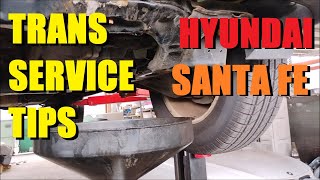
Typical fix: Perform a transmission fluid drain-and-fill or a full fluid exchange. Use only 🎬 See how to perform a 3.5L transmission fluid change Hyundai-specified automatic transmission fluid (ATF). Per TSB 22-AT-010H, 2007-2009 models with the 5-speed use SP-III, while 2010-2012 models with the 6-speed use SP4-M.
Est. part cost: $50-$150 - Faulty Shift Solenoid 🟡 Medium Probability → Shop Transmission Valve Body Solenoids control the flow of fluid to engage gears. A solenoid can stick mechanically or fail electrically, preventing the 5th gear clutch from engaging properly. This is a common failure point in the A6MF transmission family.
How to confirm: A professional scan tool can command the solenoid on and off to test its function. Resistance can also be checked with a multimeter. This requires accessing the valve body inside the transmission.
Typical fix: Replace the faulty shift solenoid. This is done by removing the transmission oil pan and valve body. Hyundai TSBs instruct technicians to replace solenoids before condemning the entire transmission.
Est. part cost: $100-$250 - Internal Transmission Failure 🟡 Medium Probability → Shop Transmission Assembly Hyundai TSB 24-AT-002H acknowledges that incorrect ratio codes can be caused by internal clutch slip, which may require transmission replacement. For the A6-series transmissions, specific known failures include worn clutch packs, loose underdrive support bolts that cause clutch drag, or cracked underdrive pistons.
How to confirm: This is diagnosed after ruling out fluid, sensor, and solenoid issues. A mechanic may check line pressures and inspect the fluid for excessive metal shavings, which indicate severe internal wear. The A6 transmission family has pressure taps for each clutch assembly, allowing for detailed hydraulic diagnosis.
Typical fix: The transmission must be rebuilt or replaced.
Est. part cost: $2500-$5000+ - Faulty Input or Output Speed Sensor ⚪ Low Probability While less common to fail than solenoids, a faulty speed sensor can send incorrect data to the TCM, causing a miscalculation of the gear ratio. Hyundai issued TSB 14-AT-013 for speed sensor codes, indicating they are a known, though less frequent, issue.
How to confirm: Use a scan tool to monitor live data from both sensors while driving. If one sensor reads erratically or drops out, it is likely faulty. This often triggers other codes, such as P0720 for the output speed sensor.
Typical fix: Replace the faulty sensor. On this vehicle, the sensors are often located inside the transmission, requiring removal of the valve body for access. TSB 14-AT-013 provides diagnostic guidance for these sensors.
Est. part cost: $60-$120
Rare But Worth Checking
- Clogged Transmission Filter: → Shop Transmission Assembly A clogged filter restricts fluid flow and can cause symptoms identical to low fluid. It should be replaced during any transmission service.
- Faulty Valve Body: → Shop Transmission Valve Body The valve body is the hydraulic brain of the transmission. A sticking valve or, notably on the A6-series, significant wear in the solenoid valve bores can prevent fluid from being routed correctly to engage 5th gear.
- Wiring Issue: A damaged wire or corroded connector for a speed sensor or solenoid can cause intermittent signal loss, leading to the code. The internal valve body harness is also a potential point of failure.
Diagnosis Steps
- Check the transmission fluid level and condition. If low, top it off and check for leaks. If dirty or burnt, perform a fluid and filter change using the correct Hyundai-specified fluid (SP-III or SP4-M).
- Use an OBD-II scanner to check for any other pending or active trouble codes. Prioritize diagnosing any solenoid (P0750-P0773) or sensor-specific codes first.
- With a professional scan tool, monitor the live data for the input speed sensor (ISS) and output speed sensor (OSS) while driving. Verify both are providing a smooth and plausible signal.
- If fluid and sensors are good, the next step is to inspect the shift solenoids. This involves removing the transmission pan to access the valve body.
- Test the resistance of the 5th gear shift solenoid and check for any visible damage to the wiring harness inside the transmission.
- If solenoids and wiring are confirmed to be good, the problem is likely a deeper mechanical issue within the valve body (bore wear) or with the 5th gear clutch pack itself, such as a cracked underdrive piston.
- At this stage, consult Hyundai TSB 24-AT-002H or 19-AT-012H, as a transmission rebuild or replacement is the likely next step according to the official procedure.
Parts You'll Likely Need
- Automatic Transmission Fluid
(OEM #SP-III: 00232-19012 (quart), SP4-M: 00232-19057 (quart))— The most common cause is low or degraded fluid. Per TSB 22-AT-010H, use SP-III for 5-speed transmissions (2007-09) and SP4-M for 6-speed transmissions (2010-12).
Trusted brands: Hyundai Genuine, Idemitsu SP-III / Type-HK, AISIN ATF-SP3 / SP4
OEM price range: $15-$25 per quart
Aftermarket price range: $10-$20 per quart - Automatic Transmission Control Solenoid
(OEM #463133B665)— A sticking or failed shift solenoid is a frequent cause of gear-specific shifting problems. TSBs recommend replacing faulty solenoids before the entire transmission.
Trusted brands: Hyundai Genuine, Standard Motor Products, Rostra
OEM price range: $150-$250
Aftermarket price range: $80-$150 - Automatic Transmission Assembly — If the cause is internal clutch wear or other mechanical failure, a complete transmission replacement is often the recommended repair, per Hyundai's TSB for this issue.
Trusted brands: Hyundai Genuine (New or Remanufactured)
OEM price range: $3000-$5000+
Aftermarket price range: $2000-$4000 (Remanufactured)
Related Codes That Often Appear With This One
- P0731, P0732, P0733, P0734 — These are incorrect ratio codes for gears 1, 2, 3, and 4. If multiple gear ratio codes are present, it strongly points to a systemic issue like low fluid, a clogged filter, or a failing transmission oil pump, rather than a single gear-specific component.
- P0720 — This code indicates a fault with the Output Speed Sensor (OSS) circuit. If P0735 appears with P0720, the OSS is the primary suspect, as the TCM cannot calculate the gear ratio correctly without a reliable signal from it.
Technical Service Bulletins (TSBs) & Recalls
- TSB 24-AT-002H / 19-AT-012H: Titled 'AUTOMATIC TRANSMISSION INCORRECT RATIO DTC...'. These bulletins provide the official diagnostic procedure for a range of incorrect ratio codes, including P0735. The guidance is to first check for and repair any solenoid-specific DTCs. If none are present, the procedure points towards further diagnosis that may result in transmission replacement.
- TSB 22-AT-010H: Titled 'AUTOMATIC TRANSMISSION ATF AND DCT/IVT GEAR OIL'. This TSB specifies the approved fluids for Hyundai transmissions. It confirms that 2007-2009 Santa Fe models with the 5-speed use SP-III, while 2010-2012 models with the 6-speed use SP4-M.
- TSB 14-AT-013: Titled 'AUTOMATIC TRANSAXLE INPUT/OUTPUT SPEED SENSOR DTC P0717, P0721 & P0722'. This bulletin advises against replacing the entire transmission for speed sensor codes, instead instructing technicians to replace the specific sensor or wiring harness.
Mechanic-Grade Diagnostic Values
- Shift Solenoid Resistance (A6MF2 6-Speed) — expected: Variable Force Solenoids (VFS): ~5.1-5.3 Ohms. On/Off Shift Solenoids (SSA/SSB): ~10-11 Ohms.. Failure: A reading outside of these ranges (open circuit or short) indicates a failed solenoid coil.
- Shift Solenoid Resistance (A5HF1 5-Speed) — expected: All clutch and TCC solenoids are identical and should have a resistance of 2.6 - 2.9 Ohms.. Failure: Readings significantly higher or lower than the specified range point to a faulty solenoid.
- Speed Sensor Signal (ISS/OSS) — expected: A smooth, consistent AC voltage signal that increases with speed when monitored on a scan tool or oscilloscope. Some sensors are Hall-effect and require checking for a 5V or 12V reference voltage at the connector with the key on.. Failure: An erratic, dropping, or non-existent signal indicates a faulty sensor or wiring issue.
Scan Tool Commands That Help
- Hyundai GDS (Global Diagnostic System): Resetting Auto T/A Values — This function should be performed after replacing the transmission, valve body, solenoids, or TCM to clear the old learned shift adaptations. Failing to do so can result in poor shift quality even with new parts. The procedure is found under 'Option Treatment' in the A/T menu.
- Hyundai GDS (Global Diagnostic System): Relearn Adaptive Values — After resetting the adaptive values, a specific drive cycle must be performed to allow the TCM to relearn shift points and pressures. This involves accelerating moderately through all gears multiple times while monitoring the throttle position sensor value on the GDS.
OEM Part Supersession History
46313-3B060, 46313-3B660, 46313-3B661→46313-3B665— This is the part number progression for a common control solenoid used in the A6MF2 6-speed transmission. The updates likely reflect improvements in materials or design to increase reliability.
Model Year Variations Within This Range
- 2007-2009: These models primarily used the 5-speed A5HF1 automatic transmission, which has different internal components, solenoids (7 total), and fluid requirements (SP-III) compared to later models.
- 2010-2012: These models used the new 6-speed A6MF2 automatic transmission, which features different solenoids (8 total), internal architecture, and fluid (SP4-M). There may also be a parts difference for transmissions built before and after June 11, 2010, which could affect wiring or computer compatibility.
Diagnostic Flowchart
Other Known Issues on This Vehicle
Issues unrelated to this code that are worth knowing about as an owner of this generation:
- Faulty Fuel Level Sensor 🟠 Medium — Very common across the 2007-2009 model years. Causes erratic fuel gauge readings (e.g., showing empty when full) and can trigger a Check Engine Light. (Ref: No recall, but a widely known issue discussed in owner forums and repair guides.)
- Valve Cover Gasket Oil Leak Causing Alternator Failure (V6 Engines) 🔴 High — A well-documented and frequent problem on 3.3L V6 models where the front valve cover gasket leaks oil directly onto the alternator below, causing premature alternator failure and potential vehicle stalling. (Ref: Hyundai issued a service campaign (Campaign TXX) for 2007-2009 models to inspect and replace the gasket and, if necessary, the oil-damaged alternator.)
- Premature Alternator Failure 🔴 High — Commonly occurs as a direct result of the V6 valve cover oil leak, but can also fail independently. Symptoms include dimming/flickering lights, a battery warning light, stalling, and strange grinding or whining noises.
- Clogged EGR Valve (2.7L V6 / 2.4L I4) 🟡 Low — Carbon buildup in the EGR valve is common on the 2.7L V6 and 2.4L I4 engines, leading to an erratic or rough idle, especially when the vehicle is stopped.
Used vs. New Parts: Buying Guide for This Vehicle
When a used part is the smart pick: A complete used transmission assembly can be a cost-effective choice if the vehicle has high mileage (over 150k miles) and the owner wants to avoid the high cost of a new or remanufactured unit. It is a gamble, but can extend the vehicle's life for a lower initial cost.
Donor-vehicle mileage cap: roughly under 80000 miles for the part to have meaningful remaining life.
What to inspect on the donor part:
- Verify the donor vehicle's mileage and obtain a vehicle history report if possible to check for accidents or maintenance records.
- Inspect the transmission fluid from the donor unit. It should be bright red and not smell burnt. Dark, brown, or burnt-smelling fluid is a major red flag.
- Check for any visible damage to the transmission case, connectors, and sensors.
- If buying from a dismantler, ask about their testing process and warranty policy. A 30-90 day warranty is standard.
OEM-only on this vehicle (don't cheap out):
- Transmission Control Module (TCM): Aftermarket or used TCMs can have compatibility and programming issues. It's safest to use a new, genuine Hyundai part if the TCM is condemned.
- Internal Wiring Harness: Given the harsh environment inside a transmission, a new OEM harness is recommended to prevent future electrical issues.
Aftermarket brands forum-validated for this vehicle:
- Solenoids: Rostra and Standard Motor Products (SMP) are generally considered reliable aftermarket solenoid manufacturers.
- Rebuild Kits: Precision International and other reputable transmission parts suppliers offer comprehensive rebuild kits.
Brands owners have reported issues with on this vehicle:
- Unbranded 'no-name' solenoids or valve bodies from online marketplaces can be poorly manufactured and often fail prematurely, leading to repeat repairs.
Related OBD-II Codes
Frequently Asked Questions
What is the correct transmission fluid for my 2007-2012 Santa Fe?
My mechanic wants to replace the whole transmission for a P0735 code. Is this always the first step?
Could a bad speed sensor cause the P0735 code on my Santa Fe?
I only have a P0735 code with no other solenoid codes. What does Hyundai recommend?
My Santa Fe is stuck in 'limp mode' and won't shift high. Is this related to P0735?
Is the P0735 issue common on other vehicles besides the Santa Fe?
Helpful Videos

We Have This Part in Stock

The information in this article is provided for general reference and educational purposes only. Vehicle specifications, procedures, and part compatibility can vary by production date, trim level, and region. Always consult your vehicle's factory service manual and verify part numbers before purchasing or performing repairs. Safety-critical components such as airbags, seat belts, and braking systems should be installed by a qualified professional.
- Hyundai Santa Fe:
- 🧭 Diagnostic Flowchart
- 🎬 Helpful Videos
- 🛍️ Shop This Part
- What's Unique About the 2007-2012 Hyundai Santa Fe
- Symptoms You May Notice
- Most Likely Causes
- Rare But Worth Checking
- Diagnosis Steps
- Parts You'll Likely Need
- Related Codes That Often Appear With This One
- Technical Service Bulletins (TSBs) & Recalls
- Mechanic-Grade Diagnostic Values
- Scan Tool Commands That Help
- OEM Part Supersession History
- Model Year Variations Within This Range
- Other Known Issues on This Vehicle
- Used vs. New Parts: Buying Guide for This Vehicle
- Related OBD-II Codes
- Frequently Asked Questions
- 🎟️ Get 5% Off